Die Reihe bietet ein Publikationsforum für innovative Arbeiten zu allen Themengebieten der analytischen Philosophie. Der Schwerpunkt liegt auf den Disziplinen der theoretischen Philosophie: Metaphysik, Ontologie, Erkenntnistheorie, Sprachphilosophie, Logik. Willkommen sind auch Beiträge zur Geschichte der Philosophie, wenn die systematische Durchdringung der gewählten Themen im Vordergrund steht. In Philosophical Analysis werden Monographien und Sammelbände mit hohem wissenschaftlichem Anspruch publiziert.
- 318 pages
- English
- ePUB (mobile friendly)
- Available on iOS & Android
eBook - ePub
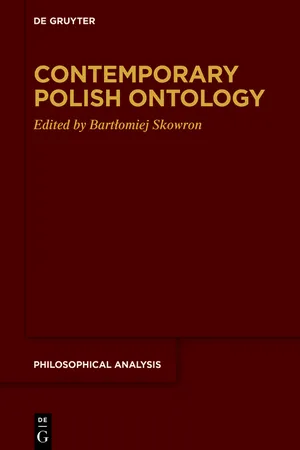
Contemporary Polish Ontology
About this book
Information
Topic
FilosofiaSubtopic
Filosofia analiticaMarek Magdziak
The Ontologic of Actions
Marek Magdziak, Faculty of Social Sciences, Wrocław University, Poland.
Abstract: The term ontologic was suggested by the Polish logician Jerzy Perzanowski, as a name for the theoretical or formal parts of ontology. The expression ontologic of actions refers to the formal logical study of ontological concepts that pertain to the domain of actions. Action is the intentional causing of change in the world. Such changes occur when certain states of affairs appear or disappear. The ontologic of actions should therefore be based on the ontologic of states of affairs. This paper provides a tentative formal logical study of ontological concepts pertaining to action, as these relate to the concept of a state of affairs and of the production or destruction of states of affairs through acting. It provides an axiomatic characterization of these concepts within the framework of a multi-modal propositional logic, and then presents a semantic analysis of them. The resulting deductive system also takes into account the concepts of the performance and the omission of an action. It thus aims to furnish a basic logical framework for addressing foundational ethical issues. The semantics amounts to a slight modification of the standard relational semantics for normal modal propositional logic.
Keywords: ontologic, action, state of affairs, performance, omission.
Introduction
From an ethical point of view, actions can be treated as the contents of evaluative concepts, the point being that we all sometimes describe certain actions as good or bad or right or wrong. However, states of affairs can also be regarded as good or bad. So not just actions, but also states of affairs, can make up the contents of evaluative concepts. This leads us to ask: how are evaluations of states of affairs related to evaluations of actions? This question concerns the relation between the rightness (or wrongness) of an action and the goodness or badness of the state of affairs produced or destroyed by that action. Moreover, an action can be evaluated in two different ways: on the one hand, it can be regarded as a good or bad action per se, but on the other, any particular performance or omission of that action can also as such be regarded as good or bad. The problem connects up with such matters as the relation between prima facie duties or obligations and the actual...
Table of contents
- Cover
- Title Page
- Copyright
- Contents
- Some Introductory Thoughts on Contemporary Polish Ontology
- On Essential Structures and Symmetries
- Prospects for an Animalistically Oriented Simple View
- How Long Does the Present Last? The Problem of Fissuration in Roman Ingarden’s Ontology
- The Subject’s Forms of Knowledge and the Question of Being
- The World as an Object of Formal Philosophy
- Logic and the Ontology of Language
- Benedict Bornstein’s Ontological Elements of Reality
- On the Topological Modelling of Ontological Objects: Substance in the Monadology
- Does Mathematical Possibility Imply Existence?
- Neologicism for Real(s) – Are We There Yet?
- Possible Worlds and Situations: How Can They Meet Up?
- The Ontologic of Actions
- “Physical Intentionality” and the Thomistic Theory of Formal Objects
- An Assessment of Contemporary Polish Ontology
- Author Index
Trusted by 375,005 students
Access to over 1.5 million titles for a fair monthly price.
Study more efficiently using our study tools.
Frequently asked questions
Yes, you can cancel anytime from the Subscription tab in your account settings on the Perlego website. Your subscription will stay active until the end of your current billing period. Learn how to cancel your subscription
No, books cannot be downloaded as external files, such as PDFs, for use outside of Perlego. However, you can download books within the Perlego app for offline reading on mobile or tablet. Learn how to download books offline
Perlego offers two plans: Essential and Complete
- Essential is ideal for learners and professionals who enjoy exploring a wide range of subjects. Access the Essential Library with 800,000+ trusted titles and best-sellers across business, personal growth, and the humanities. Includes unlimited reading time and Standard Read Aloud voice.
- Complete: Perfect for advanced learners and researchers needing full, unrestricted access. Unlock 1.5M+ books across hundreds of subjects, including academic and specialized titles. The Complete Plan also includes advanced features like Premium Read Aloud and Research Assistant.
We are an online textbook subscription service, where you can get access to an entire online library for less than the price of a single book per month. With over 1.5 million books across 990+ topics, we’ve got you covered! Learn about our mission
Look out for the read-aloud symbol on your next book to see if you can listen to it. The read-aloud tool reads text aloud for you, highlighting the text as it is being read. You can pause it, speed it up and slow it down. Learn more about Read Aloud
Yes! You can use the Perlego app on both iOS and Android devices to read anytime, anywhere — even offline. Perfect for commutes or when you’re on the go.
Please note we cannot support devices running on iOS 13 and Android 7 or earlier. Learn more about using the app
Please note we cannot support devices running on iOS 13 and Android 7 or earlier. Learn more about using the app
Yes, you can access Contemporary Polish Ontology by Bartłomiej Skowron in PDF and/or ePUB format, as well as other popular books in Filosofia & Filosofia analitica. We have over 1.5 million books available in our catalogue for you to explore.