- 100 pages
- English
- ePUB (mobile friendly)
- Available on iOS & Android
eBook - ePub
Information
Topic
Theology & ReligionSubtopic
Christian Theology
Copyright © 2008 J. Philip Newell
First published 2008
First published 2008
Wild Goose Publications
4th Floor, Savoy House, 140 Sauchiehall Street, Glasgow G2 3DH, UK
www.ionabooks.com
Wild Goose Publications is the publishing division of the Iona Community.
Scottish Charity No. SCO03794. Limited Company Reg. No. SCO96243.
4th Floor, Savoy House, 140 Sauchiehall Street, Glasgow G2 3DH, UK
www.ionabooks.com
Wild Goose Publications is the publishing division of the Iona Community.
Scottish Charity No. SCO03794. Limited Company Reg. No. SCO96243.
ePub:ISBN 978-1-84952-018-8
Mobipocket:ISBN 978-1-84952-019-5
PDF:ISBN 978-1-84952-069-0
Mobipocket:ISBN 978-1-84952-019-5
PDF:ISBN 978-1-84952-069-0
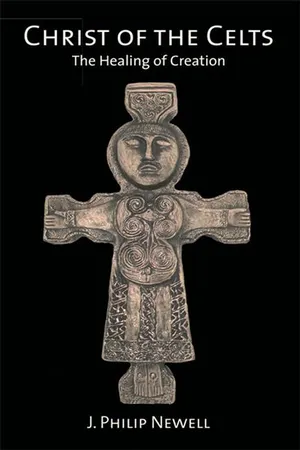
Front cover illustration: The Celtic Cross of Athlone
Image © The Wildgoose Studio, Kinsale, Co. Cork, Ireland.
www.wildgoosestudio.com
Image © The Wildgoose Studio, Kinsale, Co. Cork, Ireland.
www.wildgoosestudio.com
Celtic knot on back cover and interior pages: traditional design, redrawn by Sasha Kopf: www.tapirtype.com
All rights reserved. No part of this publication may be reproduced in any form or by any means, including photocopying or any information storage or retrieval system, without written permission from the publisher.
For any commercial use of the contents of this book, permission must be obtained in writing from the publisher in advance.
John Philip Newell has asserted his right in accordance with the Copyright, Designs and Patents Act, 1988, to be identified as the author of this work.
A catalogue record for this book is available from the British Library.
All biblical quotations are from the New Revised Standard Version Bible
(New York: Oxford University Press, 1989).
(New York: Oxford University Press, 1989).
To the Community of Casa del Sol
Blessed are those who know their need
for theirs is the grace of heaven.
Blessed are the humble
for they are close to the sacred earth.
Blessed are those who weep
for their tears will be wiped away.
Blessed are the forgiving
for they are free.
Blessed are those who hunger for earth’s oneness
for they will be satisfied.
Blessed are the clear in heart
for they see the Living Presence.
Blessed are those who suffer for what is right
for theirs is the strength of heaven.
Blessed are the peacemakers
for they are born of God.
(The Casa del Sol Blessings of Jesus)
Contents
Prelude
Chapter 1: The Memory of the Song
Chapter 2: A Forgotten Tune
Chapter 3: The Rhythm of the Earth
Chapter 4: Empty Notes
Chapter 5: The Sound of Love
Chapter 6: Paying the Piper
Chapter 7: The Hymn of the Universe
Chapter 8: Broken Cadences
Postlude
Notes
Prelude
There is a longing for peace deep within the human soul today. It is a yearning within us and between us in the most important relationships of our lives. It is a yearning among us as nations and as an entire earth community. Yet ranged against this longing for peace are some of the most threatening forces that history has seen. These are forces of fear and fragmentation. And they are wedded to the mightiest political powers and religious fundamentalisms of the world today. Yet deeper still I believe is the longing for peace.
A few months ago, I gathered with over a hundred people in the high desert of New Mexico at the retreat centre of Casa del Sol to pray for peace. During the chants and prayers, which ranged from longings for reconciliation in our families to cries for what we are doing to the body of the earth, there was opportunity to place a twig in the fire at the heart of the courtyard as a symbol of prayer. An eleven-year-old boy was the first to step forward, and he said clearly for us all to hear, ‘People often feel that children don’t think about peace. But I want to be part of making peace in the world.’ He then cast his twig into the flame.
I do not believe that this boy’s words are an exception. I believe that they come from a place deep in the human soul. It may be a place that we have become distant from. And it may be a place that has become hardened over by the pain and bitterness of life’s experiences and divisions. But it is deep in the heart of our being. It does not belong exclusively to the Christian soul or the Muslim soul or the Jewish soul. It belongs to the human soul. And it is cause for great hope. But how do we serve it? How do we set it free for the healing of our lives and world?
There is widespread disillusionment within the Christian household today. And by Christian household I am not referring solely to those who attend church. I am including the much vaster number of us who have grown up in Christian families or Christian cultures and who choose to have little to do with the church. There is despair about much of what Christianity has to offer. So many of its teachings and practices seem either irrelevant to the deepest yearnings of the human soul or flatly opposed to them. Why? Is it not in part because we have been taught to distrust our deepest yearnings rather than to see them as sacred? And is it not also because we have been given the impression that Christ comes to subdue or deny our deepest desires rather than to nurture and heal them?
At key moments of transition in the history of Christianity inspired Christian teachers have asked, ‘Who is Christ for us today?’ That is the question that the great German pastor Dietrich Bonhoeffer asked in the midst of the terrible wrongs that were being done in Nazi Germany. The question, he believed, was not, ‘Who has Christ always been?’ but ‘Who is Christ now?’ "02_prelims.html#e too live at a time of transition as well as a time of deep wrong. And we are in the midst of a change of age. Never before has humanity been more aware of the oneness of the earth, even though that awareness is being opposed by some of the world’s mightiest political and religious forces. The growing consciousness is that life is interwoven, that reality is a web of interrelated influences, and that what we do to a part we do to the whole. So who is Christ for us now? What is it we are to bring from the great treasure-trove of our Christian household to the awarenesses and longings that are stirring within the human soul today? Can we be part of leading this new consciousness instead of opposing it or being unrelated to it?
When Christianity became the religion of the Roman Empire in the fourth century, the church moved from having a plethora of writings about Christ to a tightly defined canon of scripture that came to be known as the New Testament. The empire exerted pressure on the church to limit religious orthodoxy to what was acceptable to the state. The tragedy is that many writings were destroyed or lost. Fragments have survived, and hidden manuscripts such as The Gospel of Thomas have come to light to disclose to the modern world other ways of seeing Christ. Among these is The Acts of John, a second-century document that provides us with an image that is relevant to the new consciousness of life’s unity and the longings for peace.
The Acts of John includes a description of the Last Supper. At the end of the meal, Jesus invites his disciples to form a circle, and they begin a simple Hebrew circle dance together. Jesus stands in the middle of the circle and says, ‘I will pipe, dance all of you! … I will mourn, lament all of you!’1 His words point to the dance of life. They point also to the brokenness of the dance and to the sufferings that disharmony brings. ‘The whole universe takes part in the dance,’ he says.2 Jesus is speaking of a harmony at the heart of life. And he is pointing to a way of moving in relation to all things, even though he knows also the price of living in relation to such a unity.
To see Christ as leading us further into the unity of life is a belief that was cherished in the ancient Celtic world. I have spoken of the new longing for peace today and the growing consciousness of the earth’s oneness. But this is an ancient longing and a perennial wisdom. All the great spiritual traditions of humanity have pointed in their distinct ways to the Oneness from which we come and the Oneness that we long for. The Celtic tradition has done this through its love of Christ. He is viewed as leading us not into a separation from the world and the rest of humanity but into a renewed relationship with the Ground of Life, the One from whom all things come.
And so the Celtic tradition has some important contributions to make today. That is not to say that we all need to become Celtic Christians, which would be as absurd as saying that we all need to become Roman Catholics or Jehovah’s Witnesses. These are the definitions of the past that have been used to separate us. What we need today are insights and spiritual practices that remind us of the Unity of our origins and that further nourish the longing for peace that is stirring among us. The Celtic tradition offers these to us, while at the same time being deeply aware of the disharmonies within and between us that shake the very foundations of life. This is not a tradition that is naive regarding the destructive energies of evil.
I will be drawing on material that ranges from the earliest centuries after Christ through to today. Some of these sources historically have been hidden or lost sight of, such as The Acts of John and The Secret Book of John. Others, like the biblical gospel of John, have been available all along although viewed through lenses coloured by the imperial orthodoxy of the fourth century and following. The Celtic tradition cherishes the memory of the one whom Jesus especially loved. John is remembered as leaning against Jesus at the Last Supper. It was said of him that he therefore heard the heartbeat of God. He becomes an image of listening within life for the beat of God’s presence. And so I will draw on the writings associated with John the Beloved and his community in Asia Minor over the first centuries, using both canonical and non-canonical texts and legends.
In addition to these I shall refer to the great teachers of the Celtic world who draw heavily on John and his memory, from as early as Irenaeus in second-century Gaul through Eriugena in ninth-century Ireland to Teilhard de Chardin in twentieth-century France. These teachers have stirred reaction from Western orthodoxy over the centuries, for again and again they point to the essential harmony between Christ and creation.
In Chapter One, ‘The Memory of the Song’, I explore the Celtic image of Christ as the memory of what we have forgotten. He remembers the dance of the universe and the harmony that is deep within all things. He is the memory also of who we are. He shows us not a foreign truth but a truth that is hidden in the depths of the human soul. He comes to wake us up, to call us back to ourselves and to the relationship that is deep within all things. The emphasis is not on becoming something other than ourselves but on becoming truly ourselves. Christ discloses to us the sacred root of our being and of all being. This has enormous implications for how we view ourselves and one another and how we approach the deepest energies within us and within all things. It invites us to change the way we move in the dance of life together as nations, as individuals, and as an entire earth community.
To speak of Christ as the memory of the harmony within all things is to question many of the teachings that have dominated Christian thought and practice over the centuries. We have neglected the truth that we and all life come from the same Source, and that all things therefore carry within them the sound of the Beginning. And so in Chapter Two, ‘A Forgotten Tune’, I explore how the doctrine of original sin, so dominant in Western Christian thought, has fed discord within us and between us rather than enabling the dance. It has given us the impression that what is deepest in the human soul is essentially opposed to God. The traditional answer has therefore been that our essence needs to be changed, which in turn puts us at odds with the rest of humanity and the rest of the created order. In the Celtic tradition Christ comes to remind us of the tune, not a strange tune that comes from afar but a deeply familiar tune that we have forgotten. It is the tune at the heart of our being and all being.
In Chapter Three, ‘The Rhythm of the Earth’, I look at the Celtic belief that the universe comes out of the womb of the Eternal. The Genesis story at the beginning of the Bible is pointing not to an event that occurred in the distant past. It is pointing to the ever-unfolding mystery of life in the cosmos and to the Heart from which all things come now. Matter, therefore, whether the moist matter of the fecund earth or the exploding matter of burning stars, is not a neutral substance put in motion by a distant Creator. The matter of creation is a holy and living energy born from the hidden depths of God. The universe is a single organism that carries within itself one ancient rhythm. It is a body with one Heartbeat. Christ comes to lead us back into the dance. In him we hear the beat that comes from the heart of all things.
‘Empty Notes’, Chapter Four, explores another traditional doctrine that impedes the dance today. It is the doctrine of creation ex nihilo, the belief that God created the world out of nothing. The great Celtic teachers over the centuries have said that creation does not come out of nothing. It comes out of God. The belief that matter is made from nothing is like saying that the basic notes or elements of the universe are empty, that they do not carry within themselves the sound of God’s Being. This is exactly what the imperial religion of the fourth century was content to say. It allowed the Holy Roman Empire, as it has allowed Western empires ever since, to exploit matter and to dominate nations and peoples. It has made room for a subordinating of the physical and of humanity’s birthing energies, including a subordination of the feminine. Instead, in the Celtic tradition, Christ comes to show us that matter matters. Creation will be saved only if we learn to revere matter, whether that be the matter of our human bodies, the matter of the body of the earth, or the matter of the body politic and how we relate to one another as sovereign nations. The elemental notes of the universe are alive with Spirit.
Christ leads us not away from matter but more deeply into the stuff of the universe and the stuff of daily life and relationship. And he discloses to us that the deepest note in the universe is love and the longing for union. So in Chapter Five, ‘The Sound of Love’, I explore the Celtic belief that the Heartbeat of life is Love. That is the first and deepest sound within the unfolding cosmos. It vibrates at the heart of all things. Christ is viewed as disclosing the passion of God to us. The cross is a theophany or showing of Love and the desire for oneness. It reveals God rather than appeases God. So, in the Celtic tradition, the cross reveals also what is deepest in us. By disclosing to us the Heart of all being, Christ discloses to us the heart of our own being. The cross reveals that we approach our true selves as we give ourselves away to one another in love. This is when we...
Table of contents
- Cover
- Begin reading
Trusted by 375,005 students
Access to over 1.5 million titles for a fair monthly price.
Study more efficiently using our study tools.
Frequently asked questions
Yes, you can cancel anytime from the Subscription tab in your account settings on the Perlego website. Your subscription will stay active until the end of your current billing period. Learn how to cancel your subscription
No, books cannot be downloaded as external files, such as PDFs, for use outside of Perlego. However, you can download books within the Perlego app for offline reading on mobile or tablet. Learn how to download books offline
Perlego offers two plans: Essential and Complete
- Essential is ideal for learners and professionals who enjoy exploring a wide range of subjects. Access the Essential Library with 800,000+ trusted titles and best-sellers across business, personal growth, and the humanities. Includes unlimited reading time and Standard Read Aloud voice.
- Complete: Perfect for advanced learners and researchers needing full, unrestricted access. Unlock 1.5M+ books across hundreds of subjects, including academic and specialized titles. The Complete Plan also includes advanced features like Premium Read Aloud and Research Assistant.
We are an online textbook subscription service, where you can get access to an entire online library for less than the price of a single book per month. With over 1.5 million books across 990+ topics, we’ve got you covered! Learn about our mission
Look out for the read-aloud symbol on your next book to see if you can listen to it. The read-aloud tool reads text aloud for you, highlighting the text as it is being read. You can pause it, speed it up and slow it down. Learn more about Read Aloud
Yes! You can use the Perlego app on both iOS and Android devices to read anytime, anywhere — even offline. Perfect for commutes or when you’re on the go.
Please note we cannot support devices running on iOS 13 and Android 7 or earlier. Learn more about using the app
Please note we cannot support devices running on iOS 13 and Android 7 or earlier. Learn more about using the app
Yes, you can access Christ of the Celts by in PDF and/or ePUB format, as well as other popular books in Theology & Religion & Christian Theology. We have over 1.5 million books available in our catalogue for you to explore.