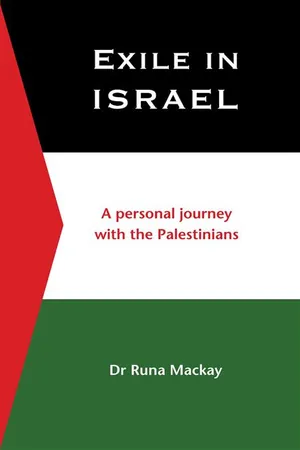
- 132 pages
- English
- ePUB (mobile friendly)
- Available on iOS & Android
eBook - ePub
Information
1
THE BEGINNING
‘Take time to be, to feel,
to listen to the stories, dreams and thoughts
of those who have no voice.
They’re wounded for the want of being listened to:
they cry
and too few hear;
they slowly die
and too few mourn. ’
to listen to the stories, dreams and thoughts
of those who have no voice.
They’re wounded for the want of being listened to:
they cry
and too few hear;
they slowly die
and too few mourn. ’
Kate Compston, ‘Seeds of Hope’1
‘Then they called me a refugee’ — these were Abu Hassan’s bitter words which have been engraved on my heart since 1987 when I heard them in Qasmiyeh, a Palestinian refugee ‘camp’ in south Lebanon. Abu Hassan was a Beduin and he used to ride freely over the hills of Galilee — until the day in 1948, when he and all his tribe had to flee north into Lebanon to escape the advancing Israeli army. In order to explain how I came to be living with Palestinian refugees in a camp in south Lebanon in 1987, I have to go back some seventy years.
My early years were spent in Hull where my father practised as an eye surgeon. At the beginning of the Second World War I went up to Edinburgh to study medicine — following in my father’s footsteps — and I graduated in 1944. When my father had been a medical student, he had worked in the Livingstone Dispensary in Edinburgh’s Cowgate, the poorest area of Edinburgh at that time, and, naturally, when I became a student I too went to work there. The Livingstone Dispensary was run by the Edinburgh Medical Missionary Society (EMMS), which had been founded in 1841 to train doctors to serve overseas as medical missionaries. At first the assistance offered to students was mainly financial but in 1895 a medical mission dispensary was opened in the Grassmarket area by one of the directors of the society. As the years passed the dispensary was adopted by EMMS and was used by the university for the training of its medical students, both those who were planning to be medical missionaries and others, like me, who had no thought of ever working overseas. In my student days, in the 1940s, there was a busy outpatient clinic with a pharmacy and a dental surgery. Short daily services were held, as well as a Sunday School, women’s meetings and Bible classes, all of which activities the students shared. It was a valuable experience for me. I would plod up and down the tenement stairs visiting patients and I still remember one little boy who was very ill with pneumonia. In those days there were no antibiotics, not even penicillin. I told the medical superintendent of the dispensary, Dr Lechler, how worried and helpless I felt about the child. He said to me, ‘You can only do your best, the rest is in God’s hands’, advice which has stood me in good stead throughout my medical career.
The work of the Livingstone Dispensary was eventually made redundant, with the coming of the National Health Service, and closed down. The work of EMMS in helping to finance prospective medical missionaries, however, continued until government grants made such financial help unnecessary. The student hostel remained open until 1989. EMMS also had the responsibility of running two hospitals, one in Nazareth and one in Damascus.
Medical work began in Nazareth in 1861 by Dr Kaloost Vartan. At that time Nazareth was a small town in Palestine in the Vilayat of Beirut in the Ottoman Empire. Dr Vartan was born in Istanbul, capital of the Ottoman Empire, in 1835 to Armenian Episcopalian parents. He could speak Armenian, Turkish and English and was employed as a translator by a British officer in the Russian/Ottoman War of 1853. His work took him among the sick and wounded so he vowed to become a doctor. At the end of the war he was able to study in Edinburgh with the help of EMMS. In 1860, in the wake of the terrible massacres of Christians by Druze in Mount Lebanon, Dr Vartan was sent by The London Society for Sending Aid to the Protestants of Syria, to help the survivors who had fled to Beirut. Later he was invited to go to Nazareth and to open a dispensary there. In 1865 he was adopted as the ‘agent’ of EMMS in Nazareth. He soon saw the need for a hospital and presented plans to the Society and, in 1871, the first EMMS Hospital in Nazareth was opened, with eighteen beds. The site of the present hospital was purchased from the Turkish government in 1906. There were financial problems at first and then when the hospital was nearly completed the First World War broke out. The building was commandeered by the Turkish army and vandalised. By 1924 it had been repaired and was reopened and continues to this day to serve the people of Nazareth and Galilee. The hospital in Damascus was opened in 1884 but was forced to close down in 1957 after the Suez War.
The work of EMMS was thus known to me, but, when I qualified in 1944, I was set on making my career in paediatrics. The state of Israel had been declared in 1948, but that fact and the resultant flight and plight of the Palestinians meant little to me. The horrors of the Holocaust and the death of six million Jews were much more vivid.
I had worked as professorial medical registrar in the Children’s Hospital in Manchester since 1952. By 1954 I knew that this work was coming to an end and I had to decide what my next step should be. Unexpectedly a letter came from Dr John Tester in the EMMS Hospital in Nazareth — since 1948 in the state of Israel — asking if I knew of anyone who could do a locum for him while he went on six-months leave. I was free so I rather tentatively offered to go, pointing out that I was a paediatrician and, although I was a Christian, I had never thought of myself as a missionary — my offer was immediately accepted and in March 1955 I flew out to Israel, to start work at the Nazareth Hospital, originally for six months, but I eventually stayed for thirty years. My six-month contract was extended to one year and then Dr Doris Wilson, who had looked after the women and children for many years, decided to move out to work in a village under the auspices of the Arab Episcopal Church. She asked me if I would consider succeeding her. I had enjoyed all the jobs I had done but had not considered any of them long term, but now I knew that work in Nazareth could become my life’s work, God willing, and so it proved to be.
The medical work was heavy and kept me very busy — at times in the early days there would only be two of US looking after more than a hundred inpatients and many more outpatients in the hospital. However, as ninety-nine per cent of the patients and the local staff were Palestinian Arabs, one absorbed the history, the culture and the ethos of Palestine, day-by-day. We were often invited to weddings in Nazareth and the villages of Galilee and everybody visited everybody else at all the religious feasts, whether Christian or Muslim. My life thus became intricately bound up with that of the Palestinians.
1 Circles of Silence (Darton, Longman & Todd, London, 1994, p. 43)
2
HISTORY OF PALESTINE
‘The Lord says, “The land is Mine and you are
but aliens and My tenants.” ’
but aliens and My tenants.” ’
Leviticus 25.23 (New International Version of the Holy Bible)1
The Palestinians are a people descended from the earliest recorded inhabitants of the area, who intermarried with the Philistines, Jews and Arabs who came from the Arabian peninsula. In the days of the Roman Empire, Palestine was the land to the west of the Jordan River and the east bank was called Urdun. In the time of Christ the Jews had been in the majority but, after the Jewish revolt against the Romans in AD 132, the majority were slaughtered and the rest scattered. With the fall of the Roman Empire in the middle of the fifth century Palestine became part of the Eastern Byzantine Empire, a Greek kingdom with a Roman law code and a Christian faith, until the coming of Islam in the seventh century. The Muslim armies captured Jerusalem in AD 638, the people of Syria and Palestine began to speak Arabic and ninety per cent converted to Islam. The ten per cent who chose to remain Christian and the Jews who still lived there were treated well as ‘People of the Book’ — they only had to pay a ‘head tax’. In 1099 the Crusaders recaptured Jerusalem from the Muslims — and massacred the entire population of the city, Jewish and Muslim. They established a kingdom in Palestine based in Jerusalem but in 1187 they were defeated and expelled from Jerusalem by Saladin. They were eventually expelled from Palestine in 1291 when their last stronghold, the port of Acre, was recaptured by the Muslims. In 1516 the Ottomans took Palestine and Syria from the Mamelukes of Egypt, put Jerusalem under direct rule from Constantinople, made the south of Palestine part of the Sanjuk of Jerusalem and the west of Palestine part of the Vilayat of Beirut. The Ottoman Empire lasted for 400 years until it was overthrown in the First World War.
General Allenby entered Jerusalem in 1917 and then, at the Treaty of Versailles, Britain was given the League of Nations Mandate for Palestine. By the terms of the Mandate, Britain promised to administer the country according to the principle that the wellbeing and development of the inhabitants form a sacred trust of civilisation. However also enshrined in the articles of the Mandate were the Mandatory’s responsibility to ensure the establishment of the ‘Jewish National Home’ and to facilitate Jewish immigration.
Theodore Herzl, the founder of the modern Zionist movement in 1896, had not, at first, been particular about where a Jewish state should be located but, in the end, he chose Palestine because of its emotional appeal to the Jewish masses of Eastern Europe, although it was opposed by the rabbis. In the First World War the Allies needed the support of the Zionists against Germany, so in 1917 the British Foreign Secretary, Lord Balfour, wrote to Lord Rothschild his famous letter which became known as the Balfour Declaration: ‘His Majesty’s Government view with favour the establishment in Palestine of a National Home for the Jewish people, and will use their best endeavours to facilitate the achievement of this object, it being clearly understood that nothing shall be done which may prejudice the civil and religious rights of the existing non-Jewish communities in Palestine, or the rights and political status enjoyed by Jews in any other country.’ But Balfour admitted that, ‘in Palestine we do not propose even to go through the form of consulting the wishes of the present inhabitants of the country. The four Great Powers are committed to Zionism, and Zionism, be it right or wrong, good or bad, is rooted in age-long traditions, in future hopes of far profounder import than the desires and prejudices of the 700,000 Arabs who now inhabit that ancient land.’2
So began the stormy years of British mandatory rule in Palestine. Jewish immigration continued slowly but remorselessly and although, at first, the Palestinians were not unduly worried they gradually came to realise what was happening — that their country was being taken over by the Jews with British connivance. Large tracts of land in Palestine — owned by absentee landlords in Lebanon — were sold, over the heads of the Palestinian peasants, to the Jewish Agency.
There were revolts and massacres, government commissions and White Papers but the outbreak of the Second World War and then the horrors of the Holocaust changed ‘the goal posts’. Many Jews from Eastern Europe had fought with the Allies, six million had died in the Holocaust and the survivors had nowhere to go. Europe, including Britain, was impoverished and relying on US aid and the US had closed its doors, admitting only 4,787 survivors in 1946. It seemed that the only place they could go to was Palestine. Britain was helpless to resolve the conflicting claims and in 1947 decided to turn over the whole question of the future of Palestine to the United Nations. After extensive hearings the UN recommended the partition of Palestine into an Arab state and a Jewish state, with the internationalisation of Jerusalem. The Jewish state would include the coastal plain (except for Arab Jaffa), part of Galilee and most of the Negev.
The Jews accepted the plan, because, as Ben Gurion, Israel’s first Prime Minister, had said in 1938, ‘When we become a strong power after the establishment of the state we will abolish partition and spread throughout the whole of Palestine.’3 The Arabs rejected the plan, much to the relief of the Jews. Menachim Begin said, ‘My greatest worry was that the Arabs might accept the UN plan then we would have been left with a Jewish state so small that it could not absorb all the Jews of the world.’4 The Jews could now set in motion, on the pretext that the Arabs had rejected a UN decision, their carefully laid plans to dislodge the Palestinians by fair means or foul and extend the proposed UN boundaries by military force and thus create a Jewish state.
Fighting started as soon as the details of the Partition Plan were announced. The Jews had a well-organised and well-armed force — the Haganah, plus two terrorist organisations, the Irgun, formed in 1938 and headed by Menachem Begin and the Stern Gang led by Yitzhak Shamir. Their combined membership numbered 30,000, plus 30,000 reservists. A large supply of armaments came in regularly, though clandestinely, from Czechoslovakia. The Jews also had the great advantage of unity of command and interior battle lines so they could switch men around as needed. The disorganised Palestinians could only muster 2,500 men, however they created the Arab Liberation Army consisting of 4,996 volunteers from various countries under the command of the Arab League Military Committee in Damascus. Nevertheless they were poorly armed, Czechoslovakia having reneged on an agreement to supply them with arms. The Arab League states said they would help the Palestinians but they had no intention of sending in their own regular armies and, anyway, between them they had less than 14,000 men. By April 1948 the vital port city of Haifa fell to the Jews setting off a chain reaction of alarm throughout Palestine.
Cedar was nine years old in 1948 and living in Haifa. She recalls how she and her eight-year-old brother were put on a vegetable lorry travelling to Nazareth and told to lie flat until they reached the house of their grandparents in Nazareth. They were absolutely terrified, hearing shooting all around them and not understanding what was happening to them. They arrived safely and, some time later, their father joined them having escaped from Haifa in a British Navy ship which was helping to evacuate Palestinians from Haifa and taking them to Beirut. Cedar’s father managed to jump ship in Acre and so reached Nazareth.
By 13 May Jaffa was also captured and the next day, all British troops having been evacuated, the British Mandate came to an end, and the leaders of the Jewish community proclaimed the birth of the state of Israel. Immediately the Arab states sent in their undersized regular armies. The success of the Zionists and the expulsion of the Palestinians had really alarmed the Arab world and made them fearful that they would be the next for invasion.
The fighting dragged on, but, by the end of the year, Israel had signed armistice agreements with Egypt, Syria, Lebanon and Transjordan. Israel now had control of all the parts of Palestine which had been allotted in the Partition Plan, plus a corridor from Tel Aviv to the western half of Jerusalem.
Soon afterwards King Abdulla of Jordan annexed the rest of Palestine to Transjordan creating thereby the kingdom of Jordan and Palestine was no more. The human cost of the war had left several hundred Palestinians dead, 726,000 had fled and 160,000 were incorporated into the new state of Israel. Thus be...
Table of contents
- Cover
- Title Page
- Copyright Page
- Contents
- Introduction by Dr Swee Chai Ang
- Map
- 1 The Beginning
- 2 History of Palestine
- 3 Refugees
- 4 Nazareth
- 5 The Sixties and the Six-Day War
- 6 The Seventies and the Yom Kippur War
- 7 A Change of Direction
- 8 Life in Lebanon
- 9 Lebanon's Wars
- 10 Baptism of Fire
- 11 The Intifada
- 12 Hebron
- 13 The Gulf War
- 14 Return to Lebanon
- 15 War Again
- 16 Peace At Last
- 17 Voices From ‘The Meadow of Flowers’
- 18 Religion
- 19 Epilogue
Trusted by 375,005 students
Access to over 1.5 million titles for a fair monthly price.
Study more efficiently using our study tools.
Frequently asked questions
Yes, you can cancel anytime from the Subscription tab in your account settings on the Perlego website. Your subscription will stay active until the end of your current billing period. Learn how to cancel your subscription
No, books cannot be downloaded as external files, such as PDFs, for use outside of Perlego. However, you can download books within the Perlego app for offline reading on mobile or tablet. Learn how to download books offline
Perlego offers two plans: Essential and Complete
- Essential is ideal for learners and professionals who enjoy exploring a wide range of subjects. Access the Essential Library with 800,000+ trusted titles and best-sellers across business, personal growth, and the humanities. Includes unlimited reading time and Standard Read Aloud voice.
- Complete: Perfect for advanced learners and researchers needing full, unrestricted access. Unlock 1.5M+ books across hundreds of subjects, including academic and specialized titles. The Complete Plan also includes advanced features like Premium Read Aloud and Research Assistant.
We are an online textbook subscription service, where you can get access to an entire online library for less than the price of a single book per month. With over 1.5 million books across 990+ topics, we’ve got you covered! Learn about our mission
Look out for the read-aloud symbol on your next book to see if you can listen to it. The read-aloud tool reads text aloud for you, highlighting the text as it is being read. You can pause it, speed it up and slow it down. Learn more about Read Aloud
Yes! You can use the Perlego app on both iOS and Android devices to read anytime, anywhere — even offline. Perfect for commutes or when you’re on the go.
Please note we cannot support devices running on iOS 13 and Android 7 or earlier. Learn more about using the app
Please note we cannot support devices running on iOS 13 and Android 7 or earlier. Learn more about using the app
Yes, you can access Exile in Israel by in PDF and/or ePUB format, as well as other popular books in History & Historical Biographies. We have over 1.5 million books available in our catalogue for you to explore.