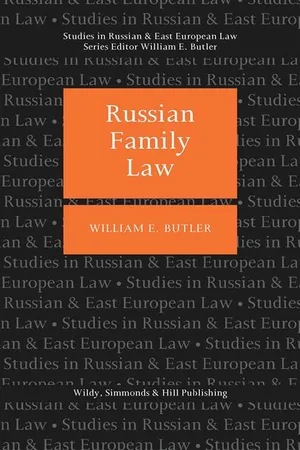
eBook - ePub
Information
FAMILY LAW
2. General Provisions on
Family Relations
Family Relations
Russian legal doctrine, just as Soviet legal doctrine and, prior thereto, Imperial Russian legal doctrine, undertakes to identify the aggregate of social relations that are postulated or deemed to fall within the ambit of regulation of a particular branch of law. This is in and of itself an inherently comparative exercise even though it does not necessarily engage another legal system.
Family relations are those that arise, many Russian jurists believe, from the fact of marriage and affiliation to a family. It is accepted that family relations are subject to regulation from a variety of sources – principles of morality, customs, religious convictions, for example, in addition to legal rules or norms embodied principally in family legislation. In this study we dwell upon the relevant provisions of family legislation.
Concept of Family
The modern family is an historical phenomenon which has evolved over the millennia throughout the planet. It has a sociological existence, as well as a legal one. The sociological understanding of the family is a broader one than the legal.
There is no definition of the “family” in the Family Code of the Russian Federation and never has been in earlier Russian or Soviet legislation. Moreover, the interpretation of “family” differs from one branch of law to another (civil, labor, housing, social security, and so on). Russian doctrinal writings contain a considerable range of definitions. G. F. Shershenevich, for example, wrote in 1907 that the family is:
... a union of persons connected by marriage and persons emanating from them ... A physiological moment underlies the family, the aspiration to satisfy sexual needs. The elementary composition of the family is determined by this, presupposing the joining of a man and woman. Children are the natural consequence of cohabitation ... the legal element is essential and advisable in the domain of property relations of family members”.1
Soviet legal doctrine expanded upon this approach to offer a broader understanding: a family was a combining of persons based on marriage or kinship who were linked by personal and property rights and duties, mutual moral and material community and support, birth and nurturing of descendants, and keeping a common household.2 Others have identified what they regard as the general (sociological) and special (legal) concepts of the family. The sociological concept regards the family as an “alliance of persons based on marriage, kinship, acceptance of children in the family for nurturing, characterized by a community of life, interests, and mutual concern”, whereas in its legal manifestation the family is a “group of persons connected by rights and duties arising from marriage, kinship, adoption, or other form of accepting children for nurturing and called upon to further the strengthening and development of family relations”.3
Post-Soviet legal doctrine has ventured no further in the direction of elaborating a definition of the family. From the standpoint of family law, Nechaeva observed, a family has “distinctive peculiarities” which, as a rule, consist of the community of persons jointly residing unified by rights and duties provided by family legislation.4 Sedugin views the family as a “certain aggregate (or community, group of people who as a general rule are relatives based on marriage, kinship, and affinity” who live together and keep a common household that forms a “natural milieu” for the well-being of its members, nurturing of children, mutual assistance, and continuation of the line.5
Whether the Russian legislator should aspire to elaborate a legal definition of the “family” is controversial. Some Russian jurists believe the matter is one of urgency, for it would contribute to greater conceptual cohesion in the domain of family law. Others suggest that the absence of a legal definition of the family in Russian law is “no accident” and even desirable. In this view the family is essentially a sociological concept and not a legal one. Russian legislation, depending upon which branch of law is involved, has varying understandings of who comprises a family and what rights and duties these individuals have. To provide an exhaustive definition in family law would mean to determine precisely who is within and who is not within the concept of a family exhaustively, which may lead to a violation of the rights of some individuals.6
Notwithstanding differing views with regard to the concept of a family, there is much in common in the sundry views advanced. As Pchelintseva noted, the family is:
... a distinctive collective based, as a rule, on marriage, whose members reside jointly and are linked by kinship, mutual rights and duties, and are, on the other hand, is an essential factor in the development of a civilized society. The family is a social organism not comparable with anything that satisfies a whole complex of essential human requirements (birth and raising of children, spiritual communion, mutual moral and material support of family members, and so on), in connection with which special measures are provided for its patronage and defense on the part of the State in legislation (family, civil, criminal, and so on).7
Family law, therefore, does not attempt or undertake to regulate the family as such, but merely the family relations that exist among family members insofar as these relations need regulation. Key aspects of family life are not, and perhaps cannot be, regulated by the legal system (for example, love, respect, psychological and spiritual ties). Many aspects or features of family life are strongly influenced by moral precepts and values. These should not be the proper concern of the State, although some would argue that legislation should perhaps do what is possible to reinforce these moral dimensions of marriage.
Indeed, Russian family legislation affirms an explicit commitment of the State to defend the family, motherhood, fatherhood, and childhood (Article 1, Family Code). This includes a positive State duty to strengthen the family and to structure family relations on feeling of mutual love and respect, mutual assistance, and responsibility of all family members to the family.
The importance of this statement of principles of family legislation for Russian judicial practice should not be underestimated. They figured strongly in a case decided by the Supreme Court of the Russian Federation in 2012. On 15 February 2012 the Kostroma Region adopted a law which prohibited the propaganda of homosexuality, lesbianism, bisexualism, and transgenderism among minors and established administrative responsibility for such propaganda. These provisions were challenged in the Kostroma Regional Court on several grounds: as violating Articles 8, 10, 11, and 14 of the European Convention on the Protection of Human Rights and Fundamental Freedoms; Articles 13 and 29, Convention on the Rights of a Child; recommendations of the Committee of Ministers of the Council of Europe, and other rights of the applicant guaranteed by federal legislation. It was further contended that the terms “propaganda”, “bisexualism”, and “transgenderness” were not defined in federal or regional normative legal acts, which violated the principle of legal certainty and the principle of equality before the law consolidated in Article 1.4 of the Code on Administrative Violations of the Russian Federation.
In affirming the dismissal of the case by the Kostroma Regional Court, the Supreme Court of the Russian Federation noted that motherhood and childhood were under the defense of the State and in the joint jurisdiction of the Russian Federation and subjects of the Federation, of which Kostroma Region was one. The federal legislator, the Supreme Court pointed out, had already adopted legislation providing administrative responsibility for a violation of Russian Federation legislation concerning the defense of children against information causing harm to their health and/or development, which meant that the exercise of joint jurisdiction was not inappropriate. The legislation concerned only prohibited “public actions” directed towards propagandizing homosexuality and the like among minors. In the Court’s view, such a limited prohibition was not contrary to federal legislation or international norms because:
... children, by virtue of their physical and intellectual immaturity, need special protection and concern, including proper legal defense. The factors and life circumstances from which one should exercise such defense of a child are determined by the priority purposes of the protection of the legal interests of a child and are formed in national law by taking into account international norms and generally-recognized principles of international law.8
The Supreme Court observed that the family, motherhood, fatherhood, and childhood are recognized as family values in the Russian Federation in Article 7(2) of the 1993 Russian Constitution and Article 1 of the Family Code of the Russian Federation and are under the protection of the State. Taking this in account, and also national traditions of the attitude towards the family “as a biological union based on the marriage of a man and a woman”, the Family Code provides that family relations are regulated in accordance with the principles of the voluntariness of the marriage union of a man and a woman, the priority of the family nurturing of children, and concern for their well-being and development. The Supreme Court found that these propositions were in full conformity with the Universal Declaration of Human Rights (Article 16), International Covenant on Economic, Social, and Cultural Rights (Article 10), and the Preamble to the United Nations Convention on the Rights of the Child. The legislative provisions of the Kostroma Region were, in the Supreme Court’s view, fully consistent with relevant federal legislation, including the principles of the Family Code of the Russian Federation.
The subject-matter of family legislation, that is, the relations regulated by family legislation, is determined by the Family Code of the Russian Federation (Article 2) to include the following:
| (1) | the conditions of entering into, terminating, or deeming invalid a marriage; |
| (2) | personal nonproperty and property relations between family members: spouses, parents and children, whether natural, adopted, or adoptive, and other relatives and persons; |
| (3) | the forms and procedure for placing children left without parental care in another family. |
This subject-matter is regulated pursuant to basic principles of family legislation contained in Article 1 of the Family Code:
| (1) | strengthening the family; |
| (2) | structuring family relations on feelings of mutual love and respect, mutual assistance, and responsibility of all family members to the family; |
| (3) | inadmissibility of arbitrary interference of anyone into family affairs; |
| (4) | ensuring the unobstructed exercise by family members of their rights; |
| (5) | the possibility of judicial defense of these rights; |
| (6) | the voluntary nature of marriage between a man and a woman; |
| (7) | the exclusive right of the State to conclude and register a valid marriage; |
| (8) | the equality of the rights of spouses in a marriage; |
| (9) | the priority of family nurturing of children and concern for their well-being and development; |
| (10) | ensuring the priority defense of the rights and interests of minors and family members who do not have the capacity to work. |
These principles underlie all legal rules in family legislation and are reflected in other provisions of the Family Code as well as in Article 1. But they are not an exhaustive statement of the relations regulated by family legislation and, indeed, an exhaustive enumeration would be quite impossible. Some family relations are “mixed”, that is, they cross over into other branches of law, especially civil law, but also administrative, criminal, land, and private and public international law. For the most part, however, family legislation regulations personal nonproperty and property relations arising in connection with the conclusion, validity, and termination of marriage, the formation of the family, care for children without parents, in foster families, or in children’s institutions. Property relations proper in family law are primarily concerned with alimony, common property of spouses, and the property of parents, individuals replacing them, and children.
The Supreme Court of the Russian Federation has invoked Article 2 of the Family Code to remind judges that “family legislation does not regulate relations arising between participants of civil turnover not relegated to members of a family”; in this case the dispute was over a contract of purchase-sale concluded between former spouses nearly two years after their marriage had been dissolved.9
Family Rights and Duties
The rights and duties of family members originate in the basis provided in the Family Code of the Russian Federation, relevant legislation of the subjects of the Federation, and, in some cases, civil or other legislation, and international treaties of the Russian Federation.
Exercise of family rights. The exercise of family rights is linked directly in Russian legal doctrine with the constitutional provision (Article 17) that “the basic rights and freedoms of man shall be inalienable and shall belong to each from birth”.10 This is understood to mean that each individual may freely dispose of his or her rights (the principle of free disposition), duly consolidated in the Family Code of the Russian Federation (Article 7), which provides that citizens “at their discretion” dispose of rights belonging to them arising from family relations, including the right to defend these rights, unless provided otherwise by a law. Taken together, these provisions imply a balance among the right to exercise and/or dispose of rights and duties, limitations imposed by the legal system on the exercise or disposition of rights and duties, and the volitional desire to exercise rights and duties (which includes the choice not to exercise a particular right). The legal limitations on the exercise of family rights are commonly jus...
Table of contents
- Cover
- Title Page
- Copyright
- Contents
- Preface
- Abbreviations
- Historical Background
- Family Law
- Annex: Family Code of the Russian Federation
- Bibliography
- Index of Names
Trusted by 375,005 students
Access to over 1.5 million titles for a fair monthly price.
Study more efficiently using our study tools.
Frequently asked questions
Yes, you can cancel anytime from the Subscription tab in your account settings on the Perlego website. Your subscription will stay active until the end of your current billing period. Learn how to cancel your subscription
No, books cannot be downloaded as external files, such as PDFs, for use outside of Perlego. However, you can download books within the Perlego app for offline reading on mobile or tablet. Learn how to download books offline
We are an online textbook subscription service, where you can get access to an entire online library for less than the price of a single book per month. With over 1.5 million books across 990+ topics, we’ve got you covered! Learn about our mission
Look out for the read-aloud symbol on your next book to see if you can listen to it. The read-aloud tool reads text aloud for you, highlighting the text as it is being read. You can pause it, speed it up and slow it down. Learn more about Read Aloud
Yes! You can use the Perlego app on both iOS and Android devices to read anytime, anywhere — even offline. Perfect for commutes or when you’re on the go.
Please note we cannot support devices running on iOS 13 and Android 7 or earlier. Learn more about using the app
Please note we cannot support devices running on iOS 13 and Android 7 or earlier. Learn more about using the app
Yes, you can access Russian Family Law by in PDF and/or ePUB format, as well as other popular books in Law & Family Law. We have over 1.5 million books available in our catalogue for you to explore.