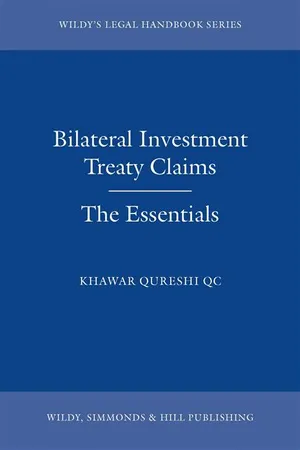
- 206 pages
- English
- ePUB (mobile friendly)
- Available on iOS & Android
eBook - ePub
Information
ANNEX 1: Sample Bilateral Investment Treaty
Agreement Between the Government of Canada and the Government of the People’s Republic of China for the Promotion and Reciprocal Protection of Investments
(in force from 1 October 2014)
The Government of Canada and the Government of the People’s Republic of China (the “Contracting Parties”),
Recognizing the need to promote investment based on the principles of sustainable development;
Desiring to intensify the economic cooperation of both States, based on equality and mutual benefit;
Have agreed as follows:
Part A
Article 1
Definitions
For the purpose of this Agreement,
1. “investment” means:
(a) an enterprise;
(b) shares, stocks and other forms of equity participation in an enterprise;
(c) bonds, debentures, and other debt instruments of an enterprise;
(d) a loan to an enterprise
(i) where the enterprise is an affiliate of the investor, or
(ii) where the original maturity of the loan is at least three years;
(e) notwithstanding sub-paragraphs (c) and (d) above, a loan to or debt security issued by a financial institution is an investment only where the loan or debt security is treated as regulatory capital by the Contracting Party in whose territory the financial institution is located;
(f) an interest in an enterprise that entitles the owner to share in the income or profits of the enterprise;
(g) an interest in an enterprise that entitles the owner to share in the assets of that enterprise on dissolution;
(h) interests arising from the commitment of capital or other resources in the territory of a Contracting Party to economic activity in such territory, such as under
(i) contracts involving the presence of an investor’s property in the territory of the Contracting Party, including turnkey or construction contracts, or concessions to search for and extract oil and other natural resources, or
(ii) contracts where remuneration depends substantially on the production, revenue or profits of an enterprise;
(i) intellectual property rights; and
(j) any other tangible or intangible, moveable or immovable, property and related property rights acquired or used for business purposes;
but “investment” does not mean:
(k) claims to money that arise solely from
(i) commercial contracts for the sale of goods or services, or
(ii) the extension of credit in connection with a commercial transaction, such as trade financing, other than a loan covered by sub-paragraph (d); or
(l) any other claims to money,
that do not involve the kinds of interests set out in sub-paragraphs (a) to (j);
2. “investor” means with regard to either Contracting Party:
(a) any natural person who has the citizenship or status of permanent resident of that Contracting Party in accordance with its laws and who does not possess the citizenship of the other Contracting Party;
(b) any enterprise as defined in paragraph 10(a) of this Article;
that seeks to make, is making or has made a covered investment;
3. “investment of an investor of a Contracting Party” means an investment owned or controlled directly or indirectly by an investor of such Contracting Party;
4. “covered investment” means, with respect to a Contracting Party, an investment in its territory of an investor of the other Contracting Party existing on the date of entry into force of this Agreement or an investment of an investor admitted in accordance with its laws and regulations thereafter, and which involves the commitment of capital or other resources, the expectation of gain or profit, or the assumption of risk;
5. “returns” means the amounts yielded by investments, and in particular, though not limited to, profits, capital gains, dividends, interest, royalties, returns-in-kind or other income;
6. “measure” includes any law, regulation, rule, procedure, decision, requirement, administrative action, or practice;
7. “existing measure” means a measure existing at the time this Agreement enters into force;
8. “financial service” has the same meaning as in sub-paragraph 5(a) of the Annex on Financial Services of the GATS;
9. “financial institution” means any financial intermediary or other enterprise that is authorized to do business and is regulated or supervised as a financial institution under the law of the Contracting Party in whose territory it is located;
10. “enterprise” means:
(a) any entity constituted or organized in accordance with the laws of a Contracting Party, such as public institutions, corporations, foundations, agencies, cooperatives, trust, societies, associations and similar entities and private companies, firms, partnerships, establishments, joint ventures and organizations, whether or not for profit, and irrespective of whether their liabilities are limited or otherwise; and
(b) a branch of any such entity
11. “intellectual property rights” means copyright and related rights, trademark rights, patent rights, rights in layout designs of semiconductor integrated circuits, trade secret rights, plant breeders’ rights, rights in geographical indications and industrial design rights;
12. “confidential information” means business confidential information and information that is privileged or otherwise protected from disclosure;
13. “disputing investor” means an investor that makes a claim under Article 20;
14. “disputing Contracting Party” means a Contracting Party against which a claim is made under Article 20;
15. “disputing party” means the disputing investor or the disputing Contracting Party;
16. “ICSID” means the International Centre for Settlement of Investment Disputes;
17. “ICSID Convention” means the Convention on the Settlement of Investment Disputes between States and Nationals of other States, done at Washington on 18 March 1965;
18. “Additional Facility Rules of ICSID” means the Rules Governing the Additional Facility for the Administration of Proceedings by the Secretariat of the International Centre for Settlement of Investment Disputes and Schedule C (Arbitration) thereto, approved by the Administrative Council on 29 September 2002, as amended from time to time;
19. “Tribunal” means an arbitration tribunal established under Part C;
20. “UNCITRAL Arbitration Rules” means the Arbitration Rules of the United Nations Commission on International Trade Law, approved by the United Nations General Assembly on 15 December 1976, as amended from time to time;
21. “WTO Agreement” means the Agreement Establishing the World Trade Organization done at Marrakesh on 15 April 1994;
22. “territory” means:
In respect of Canada:
(a) the land territory, air space, internal waters and territorial sea over which Canada exercises sovereignty;
(b) the exclusive economic zone of Canada, as determined by its domestic law pursuant to Part V of the United Nations Convention on the Law of the Sea (UNCLOS); and
(c) the continental shelf of Canada as determined by its domestic law pursuant to Part VI UNCLOS.
In respect of China:
the territory of China, including land territory, internal waters, territorial sea, territorial air space, and any maritime areas beyond the territorial sea over which, in accordance with international law and its domestic law, China exercises sovereign rights or jurisdiction with respect to the waters, seabed and subsoil and natural resources thereof.
Part B
Article 2
Scope and Application
1. This Agreement shall apply to measures adopted or maintained by a Contracting Party relating to investors of the other Contracting Party and covered investments.
2. A Contracting Party’s obligations under this Agreement shall apply to any entity whenever that entity exercises any regulatory, administrative or other governmental authority delegated to it by that Contracting Party, such as the power to expropriate, grant licenses, approve commercial transactions or impose quotas, fees or other charges.
3. Each Contracting Party shall take all necessary measures in order to ensure observance of the provisions of this Agreement by provincial governments.2
Article 3
Promotion and Admission of Investment
Each Contracting Party shall encourage investors of the other Contracting Party to make investments in its territory and admit such investments in accordance with its laws, regulations and rules.
Article 4
Minimum Standard of Treatment
1. Each Contracting Party shall accord to covered investments fair and equitable treatment and full protection and security, in accordance with international law.
2. The concepts of “fair and equitable treatment” and “full protection and security” in paragraph 1 do not require treatment in addition to or beyond that which is required by the international law minimum standard of treatment of aliens as evidenced by general State practice accepted as law.
3. A determination that there has been a breach of another provision of this Agreement, or of a separate international agreement, does not establish that there has been a breach of this Article.
Article 5
Most-Favoured-Nation Treatment
1. Each Contracting Party shall accord to investors of the other Contracting Party treatment no less favourable than that it accords, in like circumstances, to investors of a non-Contracting Party with respect to the establishment, acquisition, expansion, management, conduct, operation and sale or other disposition of investments in its territory.
2. Each Contracting Party shall accord to covered investments treatment no less favourable than that it accords, in like circumstances, to investments of investors of a non-Contracting Party with respect to the establishment, acquisition, expansion, management, conduct, operation and sale or other disposition of investments in its territory.
3. For greater certainty, the “treatment” referred to in paragraphs 1 and 2 of this Article does not encompass the dispute resolution mechanisms, such as those in Part C, in other international investment treaties and other trade agreements.
Article 6
National Treatment
1. Each Contracting Party shall accord to investors of the other Contracting Party treatment no less favourable than that it accords, in like circumstances, to its own investors with respect to the expansion, management, conduct, operation and sale or other disposition of investments in its territory.
2. Each Contracting Party shall accord to covered investments treatment no less favourable than that it accords, in like circumstances, to investments of its own investors with respect to the expansion, management, conduct, operation and sale or other disposition of investments in its territory.
3. The concept of “expansion” in this Article applies only with respect to sectors not subject to a prior approval process under the relevant sectoral guidelines and applicable laws, regulations and rules in force at the time of expansion. The expansion may be subject to prescribed formalities and other information requirements.
Article 7
Senior Management, Boards of Directors and Entry of Personnel
1. A Contracting Party may not require that an enterprise of that Party, that is a covered investment, appoint individuals of any particular nationality to senior management positions.
2. A Contracting Party may require that a majority of the board of directors, or ...
Table of contents
- Cover
- Title Page
- Copyright
- Contents
- Foreword
- Introduction
- Background
- Key Issues
- Bit Claim Checklist
- Additional Considerations
- Role of National Courts
- Annex 1: Sample Bilateral Investment Treaty
- Annex 2: Relevant Legislation, Rules and Guidelines
- Annex 3: Recent Bit Arbitration Decisions Which Impact Upon Key Concepts
Trusted by 375,005 students
Access to over 1.5 million titles for a fair monthly price.
Study more efficiently using our study tools.
Frequently asked questions
Yes, you can cancel anytime from the Subscription tab in your account settings on the Perlego website. Your subscription will stay active until the end of your current billing period. Learn how to cancel your subscription
No, books cannot be downloaded as external files, such as PDFs, for use outside of Perlego. However, you can download books within the Perlego app for offline reading on mobile or tablet. Learn how to download books offline
Perlego offers two plans: Essential and Complete
- Essential is ideal for learners and professionals who enjoy exploring a wide range of subjects. Access the Essential Library with 800,000+ trusted titles and best-sellers across business, personal growth, and the humanities. Includes unlimited reading time and Standard Read Aloud voice.
- Complete: Perfect for advanced learners and researchers needing full, unrestricted access. Unlock 1.5M+ books across hundreds of subjects, including academic and specialized titles. The Complete Plan also includes advanced features like Premium Read Aloud and Research Assistant.
We are an online textbook subscription service, where you can get access to an entire online library for less than the price of a single book per month. With over 1.5 million books across 990+ topics, we’ve got you covered! Learn about our mission
Look out for the read-aloud symbol on your next book to see if you can listen to it. The read-aloud tool reads text aloud for you, highlighting the text as it is being read. You can pause it, speed it up and slow it down. Learn more about Read Aloud
Yes! You can use the Perlego app on both iOS and Android devices to read anytime, anywhere — even offline. Perfect for commutes or when you’re on the go.
Please note we cannot support devices running on iOS 13 and Android 7 or earlier. Learn more about using the app
Please note we cannot support devices running on iOS 13 and Android 7 or earlier. Learn more about using the app
Yes, you can access Bilateral Investment Treaty Claims by in PDF and/or ePUB format, as well as other popular books in Law & International Trade Law. We have over 1.5 million books available in our catalogue for you to explore.