eBook - ePub
Information
PART I
OBSCURITY
CHAPTER 1
‘The last moment’
On 18 December 1907 a young artist called Robert Wood, charged with murder, stood waiting in the dock of court number one at the Old Bailey. After six days of evidence and only seventeen minutes of deliberations, the jury had reached its verdict. It was just before eight o’clock in the evening and the panelled court was shadowy in the inadequate newly installed electric lighting. About ten minutes were to elapse before the verdict was pronounced. Acquittal meant immediate release into the freedom of the cold Christmas crowds of London; conviction was an unimaginable alternative. Executions followed three clear Sundays after sentence with no hangings on a Monday. It needed a lawyer to work out when it was going to happen. The last walk from the condemned cell to the execution shed in Pentonville prison yard was seventy-five feet. You had to walk it in all weathers in those days. Not that the weather mattered much. Before you began the walk your arms were tied behind your back and your collar was undone to bare your neck. That was to minimise the time you stood on the drop. By then it would be exactly 8am. They always came for you at 8am. The chaplain walked with you, chanting the prayers for the dead. After all, he was only a few minutes premature. Then feet on the drop on the designated chalk marks. Legs pinioned. Bag over the head. The rope. You wouldn’t see it, but you’d be able to feel it.
Even to Wood, a man of quite remarkable self-possession, it must have seemed a very long ten minutes. He spent it doing the thing he loved most, drawing. Under a technically accomplished little sketch of the judge in full regalia he wrote in a steady hand, ‘The last moment; Old Bailey Dec. 18 ’07.’ For others, the minutes were filled with ritual. The foreman of the jury told the jury bailiff that the jury had reached its decision. The jury bailiff told the gaoler. The judge, waiting in his chambers, reminded himself from a transcript of the solemn words of the pronouncement of death. The chaplain stood by, his job to add the ‘amen’ that put God’s consoling seal of approval on the sentence of the court. The judge’s clerk waited, black cap in hand, ready to usher his master back into court. Counsel for the prosecution and for the defence, lounging in the friendly litter of the cramped robing room, stubbed out their half-smoked cigars, abandoned their half-told reminiscences, slapped their wigs back on their heads and took their places in a court vibrating with tension. The public, amongst them many novelists, dramatists and leaders of society, scrambled into the public gallery if they were famous enough or lucky enough to have had seats reserved for them, or pressed closer to the doors of the court, the better to hear as soon as possible. The press, in a hungry, unruly pack, indifferent as to the result, since either way it would be next morning’s sensation, took their places in the seats allocated to them.
When all were settled, the jury, a stolid, respectable-looking bunch of men, filed back in. The simultaneous beating of the hearts of those with a role to play in the state-imposed killing of a healthy human being was palpable in the hush. Into that breathless silence, silence was nonetheless called for. The clerk requested the jury foreman to stand and asked for the verdict. There is always a little pause; it seems as deliberate as that of the modern television presenter announcing the winner of a competition.
‘Not guilty.’
The court erupted into a great wave of sound, so loud that it was heard by the people waiting outside in the darkness, an incredible 10,000 in number, and taken up by them. It continued during Mr Justice Grantham’s release of Wood from the dock and his thanks to a jury who had, as he told them, ‘been engaged in one of the most remarkable trials that is to be found in the annals of the criminal courts of England for many years’ and whom he now, in recognition of their dedication to their duty, exempted from further jury service for ten years. The crowd outside, however, cared nothing for the formalities ending the trial. Carried along on a massive wave of hysteria they were cheering for Robert Wood, the first man ever to be acquitted after giving evidence in his own defence in a capital case, and for the jury, whose collective courage had resulted in that acquittal. But most of all they were yelling for defence counsel Edward Marshall Hall KC, the handsome, magnetic crowd puller who had achieved the astonishing victory. Vans, cabs and lamp-posts were appropriated as people fought for a good vantage point. An Italian chestnut seller was pushed aside, his roaster with its coals still burning flung to the ground and the barrow on which it had rested used as a grandstand. Hats and handkerchiefs were thrown into the air. Sticks were brandished. Fireworks were let off. Women screamed. A hopelessly inadequate fifty mounted policemen tried to hold back the crowd.1
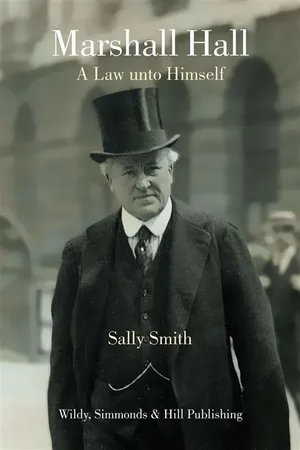
Marshall Hall was nothing if not a showman; he appeared like a king at a window above the roaring crowd, his dazed client by his side. Minutes later, Wood was spirited away invisible in the phalanx of policemen surrounding him, whilst Marshall Hall, who always ensured he was very visible, descended the steps of the court to meet his public. He was forty-nine years old, six feet three inches tall at a time when the average height for a man was five feet eight inches, immaculately turned out, with strikingly dark eyes and patrician features, his dark hair streaked with silver. ‘No-one’, said the rather less physically impressive F E Smith wistfully, ‘could have been as wonderful as Marshall Hall then looked.’2 But the public thought he was just as wonderful. They saw what he intended them to see, the glamorous embodiment of a glamorous profession and not the turmoil that lay beneath. The sickening pre-trial stage fright, the naked ambition, the breathless gamble with his client’s life, the ruthless triumph of winning combined with manic elation and extreme exhaustion were all carefully hidden beneath that immaculate façade.
Nor did the crowds know what Marshall Hall knew: that this was his last chance. It was not his first taste of fame, but previously it had been dashed away time and again. Domestic scandal and tragedy, flaming rows with judges, vendettas by the press and the envy of colleagues had all led in the end to what he regarded as the bitterest disgrace there could be, that of professional obscurity. This time, though, the pedestal upon which press and public had put him really did feel stable. And this time he was determined to cherish his fame with all the tenderness he lavished on his renowned collection of eighteenth-century snuff boxes: to gloat over it, burnish it, augment it at every opportunity. All those years of quixotic optimism in the face of disaster and sheer bloody-minded egotism were going to pay off.
The Wood trial was over. The victim lay, her throat cut from ear to ear so savagely that her head was only just attached to her body, in a quiet grave in Finchley. Robert Wood was to live the rest of his life in the forgotten shadows inhabited by the controversially acquitted. But for Marshall Hall the trial had to be not an end, but a beginning.
Back in his chambers in the Temple the congratulations were piling up from colleagues at the Bar and his many friends, actors and journalists, politicians and peers, and there were the invitations from the newly attentive society hostesses. They all had to be answered. He prided himself on his little personal notes, charming, self-deprecatory; he had always believed in the importance of making people feel special. Then there were the Wood trial press cuttings to add to his neatly catalogued albums. That, if he was honest, was what made him feel special.
His love affair with publicity had begun at the outset of his career, back in 1884. Every time his name was so much as mentioned in a newspaper, however obscure, he had lovingly stuck the cutting into the ever-increasing volumes. By now, in 1907, there were eight of them, a relentless whirl of thefts and assaults, perjury and blackmail, carnal knowledge and horse stealing, bigamy and breaches of promise, attempted suicide and selling beer without a licence, the occasional terrible murder: all the trivial and tragic transgressions that comprise a barrister’s experience.
Now they invoked all those dawn trains from London stations, lugging wig and gown, books and briefs all over England. They conjured up for him those first trials in dim stuffy local courts and then the solemn rituals of the bigger trials in the great assize courts, the horrible accuracy of prosecuting counsel, his own frequent naked insolence to obscure judges, some long dead, and the competition and camaraderie of his contemporaries. Feuds and friendships made for a lifetime. All that early promise and then all those failures. The pages smelled to him of thwarted ambition and of nostalgia.
To his regret there were very few reports amongst them of the massively lucrative briefs that had eventually come the way of many of those contemporaries. Little or no commercial work, or disputes involving wills or land, or even murders committed by those with money to pay and society reputations to defend. Not until now. Robert Wood had been employed by a highly fashionable company producing etched glass in the new Art Nouveau style. The company, anxious to avoid the publicity of one of its top designers on the gallows, had written a handsome cheque for Wood’s defence, one of the largest Marshall Hall had ever received.3
His life so far, like that of all barristers, had been characterised by the waiting: waiting for trains, waiting for cases to be called into court, waiting for verdicts, waiting for cheques. Now there was the wait for the next big opportunity. Somewhere soon some other fractured lives would lead to another sensational trial and now this one remarkable success would mean that his name would be foremost in the mind of every solicitor in England looking to brief defence counsel. No one could ever say of him that he had not fought passionately, all his working life, for the underdog, quite irrespective of personal gain. He had represented the bad, the mad, the innocent, the guilty in accordance with the ethics of his profession but also with a passionate conviction and an utter disregard for personal cost. Few of those colleagues carefully forging their careers with an eye on pocket and advancement could say as much. That did not mean he was indifferent to money, though. On the contrary, he wanted a lot of it.
Ever since his call to the Bar, twenty-five years earlier, money had been a constant worry. Until recently, there had been no public defence funding and even now it was pitifully inadequate. The lifestyle so important to his carefully nurtured image was increasingly expensive and the Inland Revenue was constantly on his back.4 He was not sure how long he could maintain his little family in the stuccoed staffed grandeur of Cambridge Terrace, Bayswater,5 what with the ever-growing art and antique collections, Hetty’s entertaining and dresses, the governess for Elna, now ten, and the carriage horses eating their heads off in the mews behind the house, not to mention Elna’s beloved donkey. Despite the income from his sideline dealing in jewellery and antiques, he had begun to think something would have to go.
It was probably time for the horses to go anyway. The new motor car had certainly attracted a few headlines and now he knew he could afford not only to run it, but to employ his own chauffeur as well. It really did seem as though, at last, a career of crime might be going to pay. Crime in the professional sense, that is, of course. He had only ever actually committed one himself and that had been forty years earlier. He must have been eight or nine at the time; a good-looking little boy, chunkily built with the coordinated agility of the brilliant sportsman he was to become, the thick dark hair partly concealing a picturesque scar on his forehead inflicted when he was a toddler by the challenge of a table far too high to climb onto. He was bright eyed with intelligence; self-confident with the security born of the devoted love, prosperity and social standing of his parents; outgoing; and bursting with a contempt for authority that because of his charm, grown-ups indulgently labelled as mischief.
Only on this occasion, he had been guilty of rather more than mischief, although it was never of course the attempted murder his victim had alleged. It had truly been an accident, the first of many occasions on which he was to run that particular defence to a gun crime.
The scene of the crime had been the Old Chain Pier6 in Brighton, a stone’s throw from his home in Old Steine, and the weapon had been his newly acquired pistol.7 He had loved that pistol with a passion and never really got over its loss.
The Chain Pier was an irresistible lure to the young Edward. Racing along the promenade he spurned the entertainments laid on there for children; not even the rides in little wooden carts pulled by goats had the appeal of the pier with its grown-up attractions and potential for danger. Sneaking unnoticed past the toll booth at the entrance was easy enough when you knew how. And then you were on the pier itself, which spanned the beach below with its beguiling mix of ragged fishing boats and bathing cabins (ladies to the east of the pier, gentlemen to the west) and stretched out into the sea, allowing glimpses of heaving waves to sparkle in the gaps of the decking floor.
Along its length, in the bases of the iron towers from which the suspension rods and chains were hung, were irresistible delights: a camera obscura and a silhouette artist, souvenir shops and a sweet kiosk manned by Mrs Terry, who doted on him, bestower of sticky ecstasy in the form of treacle fudge, marzipan and brandy balls. Not all those working on the pier were as benevolent as Mrs Terry; the pier master had reason to love him rather less. There had been some unfortunate incidents involving Edward’s perilous fishing activities and, worse, his deliberate losing of a pail full of crabs onto the decking, causing the promenading ladies to scream and lift up their skirts, exhibiting forbidden glimpses of ankles to the hidden Edward. But on this occasion, the pier master was elsewhere. Pistol in hand and already on the way to becoming a consummate shot, Edward had looked around for something to aim at. Glistening with gold paint the ‘o’ of the word ‘Royal’ emblazoned on a wooden advertising sign on the beach below was irresistible. How satisfying a neat black hole would look in the centre of that ‘o’ and how sure he was he could get it right in the middle. He aimed and fired. It was a good shot.
How on earth could he have known that the sign was painted on the back of a bathing machine? Or that the bathing machine at that moment concealed a fat man with few clothes on?
Fright had a strong effect on them both. Even the intrepid Edward was alarmed out of his usual defiance as the fat man, beside himself with rage, dragged him off down the pier, destined for the police station. It was fortunate that Mrs Terry witnessed the scene from her sweet kiosk. No trained advocate had ever mastered a brief more quickly and effectively than did Mrs Terry. She hurled herself between the two and into passionate oratory on Edward’s behalf. A lightning assessment of the evidence (small boy holding a literally smoking gun) and of the characteristics of the victim (outrage oozing from every naked pore but in fact unhurt) made Mrs Terry realise that salvation for Edward lay in mitigation. This little boy was a dear little boy; this was not a little boy to be dragged to the police station like any ragamuffin off the streets of Brighton. This was a little boy whose distinguished father could be relied upon to deal with him. And so on, until at last the fat man was defeated by consummate advocacy and, the beloved pistol confiscated, Edward was allowed to go home.
That night as he went to bed after the loving discipline of father and mother, so infinitely preferable to the terrors of the Brighton Constabulary, he had learned a great truth. When in trouble, there is no comfort in the world greater than the passionate support of a really good advocate. He never forgot it.
Father was Dr Alfred Hall MD FRCP, descended from a family of landowners in Derbyshire. The Cressy Halls of Alfreton were an old and proud dynasty. Business and law ran in the family. The family money derived from business interests in one of the nearby collieries and Alfred’s father, John Cressy Hall, had his own trading wharf, Hall’s Wharf, on the Cromford Canal at Langley Mill. John had trained as a lawyer, been called to the Bar in Gray’s Inn and subsequently practised as a local attorney, the equivalent of a modern-day solicitor. Active in local Conservative politics, he brought up his family in a house described at the time as a neat modern mansion in its own park, Swan...
Table of contents
- Cover
- Half-title Page
- Title Page
- Copyright
- Contents
- List of Illustrations
- Foreword
- Preface
- Part I: Obscurity
- Part II: Notoriety
- Part III: Ascendancy
- Part IV: Fame
- Appendix
- Acknowledgements
- Select Bibliography
- Sources and Notes
- Index
- Illustrations
Trusted by 375,005 students
Access to over 1.5 million titles for a fair monthly price.
Study more efficiently using our study tools.
Frequently asked questions
Yes, you can cancel anytime from the Subscription tab in your account settings on the Perlego website. Your subscription will stay active until the end of your current billing period. Learn how to cancel your subscription
No, books cannot be downloaded as external files, such as PDFs, for use outside of Perlego. However, you can download books within the Perlego app for offline reading on mobile or tablet. Learn how to download books offline
Perlego offers two plans: Essential and Complete
- Essential is ideal for learners and professionals who enjoy exploring a wide range of subjects. Access the Essential Library with 800,000+ trusted titles and best-sellers across business, personal growth, and the humanities. Includes unlimited reading time and Standard Read Aloud voice.
- Complete: Perfect for advanced learners and researchers needing full, unrestricted access. Unlock 1.5M+ books across hundreds of subjects, including academic and specialized titles. The Complete Plan also includes advanced features like Premium Read Aloud and Research Assistant.
We are an online textbook subscription service, where you can get access to an entire online library for less than the price of a single book per month. With over 1.5 million books across 990+ topics, we’ve got you covered! Learn about our mission
Look out for the read-aloud symbol on your next book to see if you can listen to it. The read-aloud tool reads text aloud for you, highlighting the text as it is being read. You can pause it, speed it up and slow it down. Learn more about Read Aloud
Yes! You can use the Perlego app on both iOS and Android devices to read anytime, anywhere — even offline. Perfect for commutes or when you’re on the go.
Please note we cannot support devices running on iOS 13 and Android 7 or earlier. Learn more about using the app
Please note we cannot support devices running on iOS 13 and Android 7 or earlier. Learn more about using the app
Yes, you can access Marshall Hall by in PDF and/or ePUB format, as well as other popular books in History & Historical Biographies. We have over 1.5 million books available in our catalogue for you to explore.