Electronics For Dummies
eBook - ePub

Electronics For Dummies

  1. English
  2. ePUB (mobile friendly)
  3. Available on iOS & Android
eBook - ePub

Electronics For Dummies

About this book

Build your electronics workbench—and begin creating fun electronics projects right away

Packed with hundreds of diagrams and photographs, this book provides step-by-step instructions for experiments that show you how electronic components work, advice on choosing and using essential tools, and exciting projects you can build in 30 minutes or less. You'll get charged up as you transform theory into action in chapter after chapter!

  • Circuit basics — learn what voltage is, where current flows (and doesn't flow), and how power is used in a circuit
  • Critical components — discover how resistors, capacitors, inductors, diodes, and transistors control and shape electric current
  • Versatile chips — find out how to use analog and digital integrated circuits to build complex projects with just a few parts
  • Analyze circuits — understand the rules that govern current and voltage and learn how to apply them
  • Safety tips — get a thorough grounding in how to protect yourself—and your electronics—from harm

P.S. If you think this book seems familiar, you're probably right. The Dummies team updated the cover and design to give the book a fresh feel, but the content is the same as the previous release of Electronics For Dummies (9781119117971). The book you see here shouldn't be considered a new or updated product. But if you're in the mood to learn something new, check out some of our other books. We're always writing about new topics!

Frequently asked questions

Yes, you can cancel anytime from the Subscription tab in your account settings on the Perlego website. Your subscription will stay active until the end of your current billing period. Learn how to cancel your subscription.
At the moment all of our mobile-responsive ePub books are available to download via the app. Most of our PDFs are also available to download and we're working on making the final remaining ones downloadable now. Learn more here.
Perlego offers two plans: Essential and Complete
  • Essential is ideal for learners and professionals who enjoy exploring a wide range of subjects. Access the Essential Library with 800,000+ trusted titles and best-sellers across business, personal growth, and the humanities. Includes unlimited reading time and Standard Read Aloud voice.
  • Complete: Perfect for advanced learners and researchers needing full, unrestricted access. Unlock 1.4M+ books across hundreds of subjects, including academic and specialized titles. The Complete Plan also includes advanced features like Premium Read Aloud and Research Assistant.
Both plans are available with monthly, semester, or annual billing cycles.
We are an online textbook subscription service, where you can get access to an entire online library for less than the price of a single book per month. With over 1 million books across 1000+ topics, we’ve got you covered! Learn more here.
Look out for the read-aloud symbol on your next book to see if you can listen to it. The read-aloud tool reads text aloud for you, highlighting the text as it is being read. You can pause it, speed it up and slow it down. Learn more here.
Yes! You can use the Perlego app on both iOS or Android devices to read anytime, anywhere — even offline. Perfect for commutes or when you’re on the go.
Please note we cannot support devices running on iOS 13 and Android 7 or earlier. Learn more about using the app.
Yes, you can access Electronics For Dummies by Cathleen Shamieh in PDF and/or ePUB format, as well as other popular books in Technology & Engineering & Electrical Engineering & Telecommunications. We have over one million books available in our catalogue for you to explore.
Part 1

Fathoming the Fundamentals of Electronics

IN THIS PART …
Discovering what makes electronics so fascinating
Shopping for circuit components and tools
Experimenting with series and parallel circuits
Chapter 1

Introducing You to Electronics

IN THIS CHAPTER
Bullet
Seeing electric current for what it really is
Bullet
Recognizing the power of electrons
Bullet
Using conductors to go with the flow (of electrons)
Bullet
Pushing electrons around with voltage
Bullet
Making the right connections with a circuit
Bullet
Controlling the destiny of electrons with electronic components
Bullet
Applying electrical energy to loads of things
If you’re like most people, you probably have some idea about the topic of electronics. You’ve been up close and personal with lots of consumer electronics devices, such as smartphones, tablets, iPods, stereo equipment, personal computers, digital cameras, and televisions, but to you, they may seem like mysteriously magical boxes with buttons that respond to your every desire.
You know that underneath each sleek exterior lies an amazing assortment of tiny electronic parts connected in just the right way to make something happen. And now you want to understand how.
In this chapter, you find out that electrons moving in harmony through a conductor constitute electric current — and that controlling electric current is the basis of electronics. You discover what electric current really is and find out that you need voltage to keep the juice flowing. You also get an overview of some of the incredible things you can do with electronics.

Just What Is Electronics?

When you turn on a light in your home, you’re connecting a source of electrical energy (usually supplied by your power company) to a light bulb in a complete path, known as an electrical circuit. If you add a dimmer or a timer to the light bulb circuit, you can control the operation of the light bulb in a more interesting way than just manually switching it on and off.
Remember
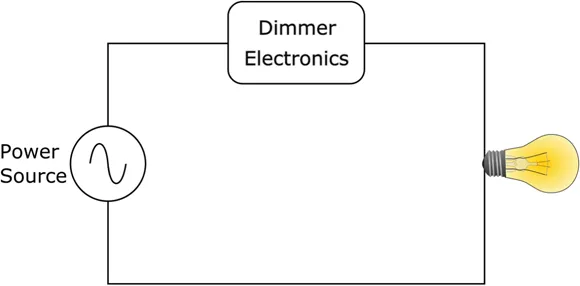
Electrical systems use electric current to power things such as light bulbs and kitchen appliances. Electronic systems take this a step further: They control the current, switching it on and off, changing its fluctuations, direction, and timing in various ways to accomplish a variety of functions, from dimming a light bulb (see Figure 1-1), to flashing your holiday light display in sync with your favorite holiday tune, to communicating via satellites — and lots of other things. This control distinguishes electronic systems from electrical systems.
The dimmer electronics in this circuit control the flow of electric current to the light bulb.
FIGURE 1-1: The dimmer electronics in this circuit control the flow of electric current to the light bulb.
The word electronics describes both the field of study that focuses on the control of electrical energy and the physical systems (including circuits, components, and interconnections) that implement this control of electrical energy.
To understand what it means to control electric current, first you need a good working sense of what electric current really is and how it powers things such as light bulbs, speakers, and motors.

Checking Out Electric Current

Electric current, sometimes known as electricity (see the sidebar “What is electricity?”), is the movement in the same direction of microscopically small, electrically charged particles called electrons. So where exactly do you find electrons, and how do they move around? You’ll find the answers by taking a peek inside the atom.

Exploring an atom

Atoms are the basic building blocks of everything in the universe, whether natural or manmade. They’re so tiny that you’d find millions of them in a single speck of dust. Every atom contains the following types of subatomic particles:
  • Protons carry a positive electric charge and exist inside the nucleus, or center, of the atom.
  • Neutrons have no electric charge, and exist along with protons inside the nucleus.
  • Electrons carry a negative electric charge and are located outside the nucleus in an electron cloud. Don't worry about exactly where the electrons of a particular atom are located. Just know that electrons whiz around outside the nucleus, and that some are closer to the nucleus than others.
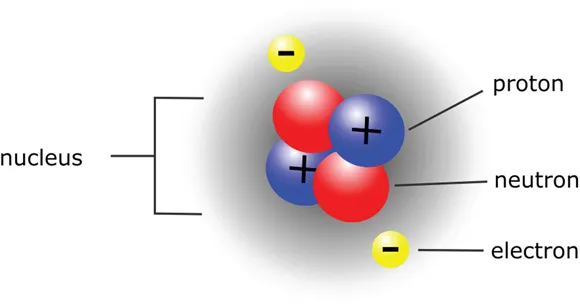
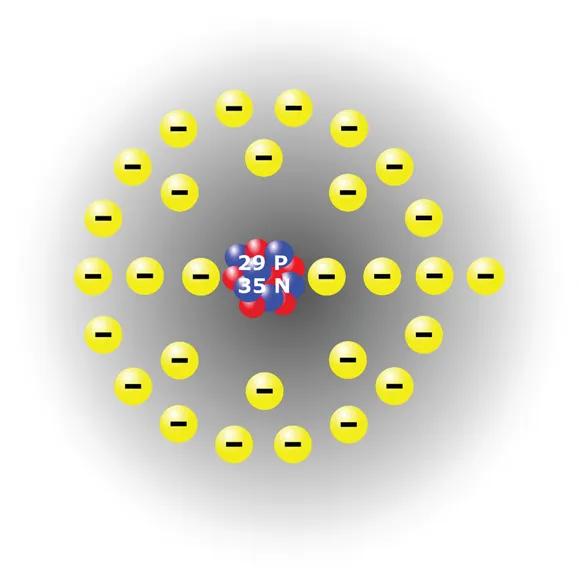
The specific combination of protons, electrons, and neutrons in an atom defines the type of atom, and substances made up of just one type of atom are known as elements. (You may remember wrestling with the Periodic Table of the Elements way back in Chemistry class.) I show a simplistic representation of a helium atom in Figure 1-2 and one of a copper atom in Figure 1-3.
This helium atom consists of 2 protons and 2 neutrons in the nucleus with 2 electrons surrounding the nucleus.
FIGURE 1-2: This helium atom consists of 2 protons and 2 neutrons in the nucleus with 2 electrons surrounding the nucleus.
A copper atom consists of 29 protons, 35 neutrons, and 29 electrons.
FIGURE 1-3: A copper atom consists of 29 protons, 35 neutrons, and 29 electrons.

Getting a charge out of protons and electrons

Technical stuff
Electric charge is a property of certain particles, such as electrons, protons, and quarks (yes, quarks) that describes how they interact with each other. There are two different types of electric charge, somewhat arbitrarily named positive and negative (much like the four cardinal directions are named north, south, east, and west). In general, particles carrying the same type of charge repel each other, whereas particles carrying opposite charges attract each other. Within each atom, the protons inside the nucleus attract the electrons that are outside the ...

Table of contents

  1. Cover
  2. Table of Contents
  3. Introduction
  4. Part 1: Fathoming the Fundamentals of Electronics
  5. Part 2: Controlling Current with Components
  6. Part 3: Getting Serious about Electronics
  7. Part 4: The Part of Tens
  8. Glossary
  9. Index
  10. About the Author
  11. Advertisement Page
  12. Connect with Dummies
  13. End User License Agreement