![]()
chapter 1 Science
Provocations
![]()
Science provocations can be introduced to children in many ways. You can use the provocation to prompt their curiosity and explore their prior knowledge about a topic before you begin formal curricular study. You can encourage science provocations using related content ideas and materials children are experiencing simultaneously during more formal lessons. Or you can use a science provocation at the end of a unit of formal study so that your students have an opportunity to apply their new understandings and experiences. There is no one right way or time to use a particular provocation, but it is important to connect their student-led work during provocations to other experiences in your classroom.
In particular to science provocations, students are often working with a variety of materials, so you will want to take time to explain the materials that are available for them to use and also explain any restrictions for materials use that you’d like the students to follow. A brief introduction is typically all that is needed; remember to keep the experience as open ended and child led as possible, given the nature of
the experience.
Provocation 1: Physical-Change Collage
Physical changes are an important part of understanding the three common states of matter: solid, liquid, and gas. Physical changes can include changes in the shape or appearance of an object, such as tearing a piece of paper, dissolving sugar in water, or bending chenille stems into shapes. Physical changes do not make new substances. Because objects do not become new or different substances during a physical change, often the change can be reversed. For instance, a bent chenille pipe cleaner can be straightened.
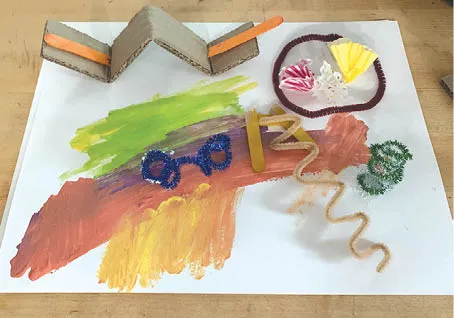
In this provocation, children are invited to conduct physical changes with everyday objects and to create collages using the materials they have manipulated.
Materials
Provocation Prompt
How can you change these materials to make them different than they are?
Differentiation by Grade Level
- Pre-K and kindergarten students will enjoy creating changes to the materials. Provide them with containers to put the materials in as they rip, tear, crumple, and cut. The children can create an ephemeral, or temporary, collage by just laying out their pieces in a design on their table while working individually or in a group. A temporary collage can encourage them to spend more time exploring the physical changes in the materials without the need to create a take-away product. This way, they can lay down, pick up, alter, and move objects countless times.
For first-, second-, and third-graders, try encouraging them to create permanent collages using their altered materials and to add other arts media, such as mixed-color paints. Providing trays for children to work in will help to contain the materials and make cleanup easier.
A second-grader’s physical-change collage
Provocation 2: Build a Bug, Build an Insect, Build an Arthropod
“It’s a bug!” is a common phrase heard across all playgrounds as young children explore all those small creatures that walk, fly, and crawl. This provocation draws children’s attention to the differences among bugs, insects, and arthropods as a means to build both life-science understandings and classification skills.
- A bug has a mouth shaped like a straw (called a stylet), no teeth, and tough forewings. Common bugs include beetles, aphids, stink bugs, and water bugs.
- An insect has a hard outer shell (called an exoskeleton), three main body parts (head, thorax, and abdomen), and usually two pairs of wings and three pairs of legs. Common insects include ants, bees, mosquitos, butterflies, and beetles.
- Arthropods make up about 85 percent of all known animals on Earth. They have segmented bodies, multiple jointed legs or limbs, and exoskeletons and are cold-blooded. Common arthropods are spiders, ticks, centi...