Speechless
eBook - ePub

Speechless

  1. 288 pages
  2. English
  3. ePUB (mobile friendly)
  4. Available on iOS & Android
eBook - ePub

Speechless

About this book

As the world has rapidly changed, how do we best prepare young people for the future?
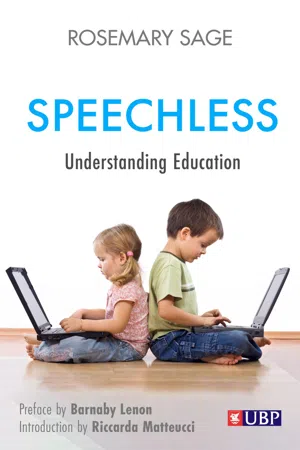
How do we adapt to the fact that children may now spend more time looking at a screen than engaging in actual conversation?

Speechless unpicks the political, economic and social issues surrounding education that pose challenges in schools, colleges and universities, as well as workplaces. These suggest that a different approach to learning, assessing, teaching and training is needed to develop relevant experiences that allow all students to achieve their potential.

Learners show a huge range of abilities and interests that they must share, with only a broad, varied, flexible curriculum satisfying their needs.

Heeding student voices and expecting them to pay attention to their teachers and each other is important in building respect for everyone, whatever their background. Sharing knowledge brings awareness of what you know and need to acquire. Speechless, with both facts and humour, makes a passionate case as to why teachers must talk with their students and not just to them.

Frequently asked questions

Yes, you can cancel anytime from the Subscription tab in your account settings on the Perlego website. Your subscription will stay active until the end of your current billing period. Learn how to cancel your subscription.
No, books cannot be downloaded as external files, such as PDFs, for use outside of Perlego. However, you can download books within the Perlego app for offline reading on mobile or tablet. Learn more here.
Perlego offers two plans: Essential and Complete
  • Essential is ideal for learners and professionals who enjoy exploring a wide range of subjects. Access the Essential Library with 800,000+ trusted titles and best-sellers across business, personal growth, and the humanities. Includes unlimited reading time and Standard Read Aloud voice.
  • Complete: Perfect for advanced learners and researchers needing full, unrestricted access. Unlock 1.4M+ books across hundreds of subjects, including academic and specialized titles. The Complete Plan also includes advanced features like Premium Read Aloud and Research Assistant.
Both plans are available with monthly, semester, or annual billing cycles.
We are an online textbook subscription service, where you can get access to an entire online library for less than the price of a single book per month. With over 1 million books across 1000+ topics, we’ve got you covered! Learn more here.
Look out for the read-aloud symbol on your next book to see if you can listen to it. The read-aloud tool reads text aloud for you, highlighting the text as it is being read. You can pause it, speed it up and slow it down. Learn more here.
Yes! You can use the Perlego app on both iOS or Android devices to read anytime, anywhere — even offline. Perfect for commutes or when you’re on the go.
Please note we cannot support devices running on iOS 13 and Android 7 or earlier. Learn more about using the app.
Yes, you can access Speechless by Rosemary Sage in PDF and/or ePUB format, as well as other popular books in Education & Education Theory & Practice. We have over one million books available in our catalogue for you to explore.

SPEECHLESS

CHAPTER SUMMARIES

1. THE LEARNER CONTEXT

This chapter focuses on some issues that underpin learning problems. Educators are expected to teach to nationally required standards, with students tested at specific stages within the primary, secondary and tertiary systems. This one-size-fits-all philosophy ensures that transmission instruction reigns, with the teacher talking in long stretches to the class. Many learners do not prosper in a regime where they have to deal with large chunks of spoken and written language, because they have problems in assembling and expressing meaning. This situation is now common in a society relying on text rather than talk communication. Therefore, special needs and special educational needs are a growing problem in Britain, which does not respect the fact that humans develop at different rates and in ways not aligning with a prescriptive philosophy. The job of teachers is complicated further by continuing immigrant influxes. These students often lack the background to cope with the British system as their culture has followed a different child-rearing trajectory. Although the Department for Education dictates must be followed in schools, colleges and universities, being fully aware of the influences on teaching reinforces the importance of participatory approaches which are explored in later chapters of the book.

2. LEARNING IS COMMUNICATION: SIGNS, SIGNALS, SYMBOLS AND CODES

To teach people to communicate effectively for learning from others, one must understand the nature and structure of this complex process. The idea of codes lies at the heart of human communication and instruction, and without the use of signs, signals and symbols, which comprise this system, the exchange of messages would be impossible. The chapter looks at these aspects of communicating in order to raise awareness of their importance in teaching and learning in plural societies where language differences can cause misunderstandings. It helps comprehension of the many different verbal and non-verbal aspects of communicating effectively with one another that take account of various intercultural customs.

3. ENGLISH AS THE INTERNATIONAL LANGUAGE

The English language dominates our planet and will continue to do so as the medium of the World Wide Web. Initially it spread across the globe with the march of the British Empire gaining and retaining prominence because of the economic success of English-speaking nations. English hit the million-word jackpot in 2009, with, appropriately, Web 2.0’, defining future web products and services. Of course, many of its words have origins in other languages, due to cultural mixing. Finalists meeting the 25,000 citations set by the Global Language Monitor, tracking usage trends, included Silicon Valley, India, China and Poland. The Polish word ‘Bangsters (people responsible for predatory practices) combines banker with gangster and was coined for those triggering the trillions asset wipe-out and financial crisis. At its current rate, English generates a new word every 90 minutes, and is spoken by nearly a third of the world’s 7 billion+ folk. Traditional language study and teaching has focused on its components – sounds, words, sentences and their graphical representations – but now broadens to consider the context in which it is used and the other systems involved in making meaning. In Britain, this emphasis from communication research has had limited impact on educational practice, although at the North Wales Language and Business School (Glain Orme) a successful course is based on this extended model. Language is the mode whereby people communicate, but is ironically the main means whereby they fail to do so. The chapter considers international problems posed by human languages and styles of communicating as well as intra-national issues for mutual understanding from the many linguistic varieties used in science, education, medicine, law, religion and mass communication. Solutions are suggested to bring new communicative insights.
The importance of learning other languages is mentioned, as in our plural societies many jobs are dependent on having multilingual competencies and therefore broader perspectives on the world. This allows appreciation of other cultures as well as relativising your own to see it objectively. It is a vital for making people more tolerant and open to the rest of the world. In terms of science, Anglophones are fortunate that the world writes in English, but in the humanities, this is not the case. If you want to be published in an Anglophone paper, you must conform to what they think humanities are about. In many domains, the English nation is not the best in the world. Since the British do not commonly read literature in other languages, their research is regarded generally as having limited application.

4. MULTIPLE LITERACIES IN A GLOBAL SOCIETY

This chapter discusses a broad-based conception of literacy, including all verbal and non-verbal ways of symbolising and representing meanings, so highlighting the importance of communication in personal and academic success. Over the past 100 years the world has moved from spoken to written communication, with a mass education system that regards reading and writing as the hallmark of achievement. Success in written language depends, however, on literate structures achieved in formal speaking, which assemble quantities of information for instructing, informing and explaining. Today, we spend more time looking at visual display screens than talking formally, and there is strong evidence that a lack of speaking opportunity affects verbal comprehension and expression and higher-level thinking. Human development indicates that formal talk structures must be achieved to shift primary language (spoken) into secondary modes (written). The fact that many people show difficulties in spoken and written communication suggests more awareness of these processes in teaching. This encourages us to look at a range of interdisciplinary perspectives to inform us how to facilitate learning, focusing on second language acquisition (SLA) for migrants in order to facilitate social inclusion and employment.

5. EDUCATING THE WHOLE BRAIN

The media joke about people with ‘two brains’ refers to their super intelligence. The joke is also on us as we all have two brains – a verbal and non-verbal one – with two ways of thinking. However, we exist on less than half our brain power and this is unpacked, unravelled and understood to raise performance. On the right side, we have one way of knowing. We ‘seeimaginary things (mind’s eye) or recall real ones. Imagine a favourite food – its colour, shape, taste and smell. We ‘see’ how things exist in space, understand metaphors, dream, fill in information/opinion gaps in talk/text, combine ideas to make new ones and assemble meaning (synthesise). If a thing is too complex to speak about we gesture. Describe a spiral object without hands! Images (‘seeing’ within) are idiosyncratic, non-verbal thinking ways – intuitively, holistically and metaphorically. This is the ‘seeing/feeling brain, communicating with ourselves and understanding whole things/events. The left side works oppositely. It analyses, abstracts, counts, marks time, plans and states logically, with words expressing thoughts. If apples are bigger than plums and plums bigger than cherries, we say that apples are bigger than cherries. This illustrates the left brain – analytic, sequential, symbolic, linear, objective and verbal. It is the ‘saying/hearing’ brain communicating thoughts conventionally. This chapter shows how both brains complement one another suggesting that education favours left brain growth at the expense of the right. It leaves us full of facts but unable to apply them judiciously. Small changes in how we learn can produce big results. Using both brains effectively may shoot us up the evolutionary as well as the educational rankings f...

Table of contents

  1. Cover
  2. Reviews of Speechless
  3. Title Page
  4. Copyright
  5. Speechless
  6. Dedication
  7. Preface
  8. Introduction
  9. Prologue: A New Conversation about Education
  10. Speechless