1
GOING ALL IN: FORTUNE FAVORS THE OBSESSED
Good requires motivation.
Great requires obsession.
—M. Cobanli1
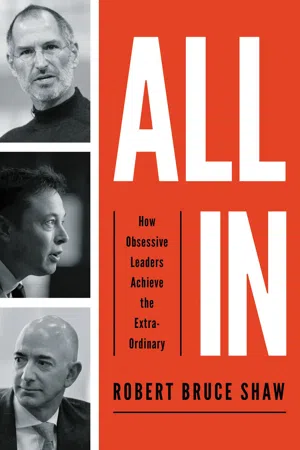
Try this. Go to relentless.com on your phone or computer. Now ask yourself why the homepage for Amazon is filling your screen. It may seem strange that “relentless” takes you to a website that sells everything from tea to televisions—until you delve into the history of the company. Amazon’s founder, Jeff Bezos, is arguably the most influential business leader in America today. His firm has transformed the way we shop and has forced competitors, large and small, to adapt to the digital economy that Amazon helped create. Bezos also disrupted the technology industry through Amazon Web Services and is now pushing into areas such as logistics, advertising, media, and health care. It is a rare person who alters the competitive landscape of just one industry—but it is almost unheard of for someone to do so in several.2
Bezos started his company thinking that the internet, small at the time but growing at a dramatic rate, would enable people to shop in a new way. This seems obvious today when we buy goods with a single click and they appear outside our door in days, if not hours.3 However, what we now take for granted was much less certain when Bezos founded Amazon.
The internet was initially an emergency communication tool for the military. It evolved into a platform for academic and scientific researchers to share information and findings. Bezos saw its commercial potential and analyzed start-up possibilities based on the best-selling mail-order businesses of the day—including books, music, videos, and computers. He decided that books offered the most upside because the web would allow him to offer a vast selection of titles from among the millions of books in print—using technology to allow customers to quickly find, review, and buy titles of interest.
These potential advantages were compelling because they couldn’t be replicated by conventional bookstores, no matter how large. The largest bookstore stocked only 150,000 titles and couldn’t match the search-and-review capabilities of the web. Bezos still thought what he called his “crazy idea” had only a 30 percent chance of success and told friends and family who invested with him that they would most likely lose their money. At the age of thirty, Bezos quit his high-paying job at a financial services firm in New York and took an entrepreneurial leap of faith. Driving across the country with his wife to their new home in Seattle, Bezos outlined his business plan and considered potential names for his new venture.
One that he liked was relentless.com, believing that good things came to those with the ability to focus intensely. This was certainly true in his own life. Bezos applied himself with a rigor that those who knew him viewed as exceptional. A story from his youth gives some insight into his personality. His Montessori teachers told his mother that her young son was unique in being completely engrossed in school activities. At times they had no choice but to pick up Jeff’s chair, with Jeff still in it, to get him away from what he was doing and on to the next classroom activity. Childhood stories, when told by famous individuals and their parents, are prone to exaggeration. However, those who have worked with Bezos over the years describe him as being exceptionally intense and methodical in just about everything he does.4
Bezos registered the relentless.com domain name soon after arriving in Seattle.5 He decided not to use it because friends pointed out that it was not a name that would help sell books. “Relentless” suggests someone or something that is single-minded, tenacious, and harsh. It is a word one might use to describe a wolf pack pursuing its prey. Bezos, after a false start with another company name, settled on Amazon. As the longest river in the world, it expressed his ambition to create the earth’s biggest bookstore. But Bezos retained relentless.com and linked it to his Amazon website—perhaps thinking it would be useful in reminding his future colleagues what was needed for his crazy idea to become a reality.6
Over the next twenty-five years, Bezos built one of the fastest-growing firms in history. More than 200 million people visit its websites each month,7 and it is the most trusted name in e-commerce.8 Amazon’s success, of course, is not simply the result of Bezos’s relentless nature. Many relentless people don’t build a successful firm, let alone one that can compare to Amazon. Bezos is a leader with the strategic ability to “see around corners”—noting patterns, trends, and possibilities that elude most people. He anticipated the potential of e-commerce when others thought the internet was little more than a research tool. He saw, despite resistance from his board of directors, that Amazon’s technology platform would be useful to a wide variety of firms. He pushed the development of the Kindle e-reader and the Echo smart-device when few, if any, customers were asking for them. Amazon is now investing in a range of other innovative initiatives, such as drone technology for deliveries, to provide customers with products even faster and cheaper. Time and again, Bezos spotted opportunities that others missed and made long-term investments to capitalize on his insights.
Bezos is also operationally savvy. He has a deep understanding of the gritty details that are critical to his company’s success. Bezos gets into the specifics of his business, how it is executing, and what is needed to enhance its performance moving forward. He knows, for instance, the intricacies of supply chain management and what is required to achieve ever-decreasing delivery times for customers. Watch him describe how Amazon manages its logical challenges and how the firm’s fulfillment centers operate—including the intricacies of order-processing software and product-picking robots—and you might think he is a mid-level engineer responsible for operations management.
A colleague who worked with Bezos suggested, with only a hint of sarcasm, that others should view him as a super-intelligent alien—one requiring special handling particularly if you find yourself making a recommendation to him.9 At Amazon, this often comes in the form of a short written proposal that is reviewed and then discussed by the firm’s senior leadership team. When presenting, one of Bezos’s former colleague recommends that others
assume he already knows everything about it. Assume he knows more than you do about it. Even if you have groundbreaking original ideas in your material, just pretend it’s old hat for him. Write your prose in the succinct, direct, no-explanations way that you would write for a world-leading expert on the material . . . tearing out whole paragraphs, or even pages, to make it interesting for him. He will fill in the gaps himself without missing a beat. And his brain will have less time to get annoyed with the slow pace of your brain.10
Bezos, however, is more than strategically and operationally smart—he is also lucky.11 He describes this as “the planets aligning” to support his newly launched firm. Bezos at times calls his success and enormous wealth as him “winning the lottery.” This phrase may be an attempt to appear humble in the eyes of the public but, even if so, Bezos seems to truly believe that luck was his partner in propelling Amazon forward.
He was fortunate in starting an e-commerce company when the internet was gaining widespread acceptance. At the time, it wasn’t clear that the public would embrace shopping online, with many reluctant to order goods and provide credit card information to an unseen vendor. Comfort with the internet was on the upswing when Bezos founded Amazon, allowing his company to grow much faster. At the same time, starting Amazon a few years later would have resulted in losing his first-mover advantage over firms such as Barnes & Noble. Bezos was lucky again in some of his first hires, including a gifted technologist named Shel Kaphan who skillfully shaped the firm’s all-important website. He was lucky again when J. K. Rowling published a blockbuster novel, which Bezos used to build his customer base by pricing her book low and shipping it for free. But perhaps he was luckiest in having competitors who were arrogant and, even worse, slow to market. They made the mistake of underestimating the impact the web would have on book retailing—and also doubted that a small start-up in Seattle, whose leader had no retail and little business experience, could challenge their dominant industry position.
At the time, one of Barnes & Noble’s founders said that, “No one is going to beat us at selling books—it just ain’t gonna happen.”12 Barnes & Noble experimented with e-commerce by first partnering with America Online and then taking almost two years to launch an online site, which was poorly designed and even more poorly executed. The largest book retailer in America struggled to provide its e-commerce customers with the most basic services such as reliable order processing. Amazon had a window of opportunity to establish its brand and enhance its online capabilities.13
While recognizing that several factors must converge for a company to be successful, we can assume that Amazon would not have become Amazon if Bezos wasn’t relentless and hadn’t built a company with the same defining attribute. Leaders, particularly founders, imprint their personalities on their firms, which impacts performance—for better and sometimes worse, as we will see in the following chapters.14 Bezos pushed Amazon, from day one, to embody the trait that had served him so well throughout his life. What separates successful entrepreneurs from inventors is the ability to build a team and then a firm that can commercialize their ambitious ideas. We tend to focus on individual leaders in explaining the success or failure of a company—and leaders such as Bezos are key figures in driving their firms forward. But success in business requires many people working together to produce something extraordinary. The relentless leader, then, needs an equally relentless organization to produce something significant. Read Bezos’s annual shareholder letters and you find an innovative leader who thinks deeply about Amazon’s culture and work practices. When asked which leader he most admired, Bezos pointed to Walt Disney, noting that
it seemed to me that he had this incredible capability to create a vision that he could get a large number of people to share. Things that Disney invented, like Disneyland, the theme parks, they were such big visions that no single individual could ever pull them off, unlike a lot of the things that Edison worked on. Walt Disney really was able to get a big team of people working in a concerted direction.15
Brad Stone, author of The Everything Store, a well-regarded book on Amazon’s history, observed that the company is built in Bezos’s image—“an amplification machine meant to disseminate his ingenuity and drive across the greatest possible radius.”16 Amazon, then, is an institutional manifestation of Bezos’s beliefs, values, and personality. Many terms can be used to describe Bezos and the firm he built, but relentless may be the most telling.
The second most visible business leader in America today is arguably Elon Musk. He is approaching cult status because he designs, builds, and markets one revolutionary product after another. The electric car industry was stagnant, at best, until Musk developed the Tesla S. The high-performance version of this vehicle received the highest rating ever awarded by Consumer Reports.17 It also achieved the highest safety rating of any vehicle ever tested by the US regulatory agency NHTSA.18 To date, Tesla has sold over six hundred thousand electric cars, which have traveled more than ten billion miles.19 His vehicles have saved an estimated four million metric tons of CO2 compared to internal combustion equivalents.20 Musk also founded SpaceX, which became the first private company to launch a rocket to dock with the International Space Station. It was also the first to develop a reusable rocket—which has drastically reduced the cost of transporting materials and equipment, such as satellites, into space. What Musk has achieved is all the more remarkable because he is competing with well-established firms, such as BMW in automobiles and Boeing in aerospace. Bill Gates summarized Musk’s achievements best when he said, “There’s no shortage of people with a vision for the future. What makes Elon exceptional is his ability to make his come true.”21
If we think of Jeff Bezos as relentless, it is equally appropriate to think of Elon Musk as obsessive. The word obsessive comes to us from the Middle Ages, when it described the siege of a town or castle by an invading army.22 Over time the word evolved and took on a religious significance, referring to those haunted or possessed by an evil force. Several centuries later, the meaning of obsession changed yet again, this time to being viewed as a psychological disorder. An invading army became an invading spirit that became an invading thought. Most now see obsession as an overwhelming and unwanted fixation on a single idea, person, or thing. An example is an individual who is consumed by an irrational fear of germs—on a restaurant table, restroom door, or the hand of the person he or she just met. Their obsession can go beyond unwanted and recurring thoughts, resulting in compulsive behaviors such as washing one’s hands thirty times a day. This type of obsessive-compulsive disorder, while sometimes viewed as curious or even funny, is a severe and debilitating disease that can torment a person.23
Some obsessions are less extreme but of uncertain value. Marion Strokes was a librarian and civil rights activist who taped news shows nonstop for thirty-five years. At the time of her death, she had an estimated 140,000 videocassettes of TV news shows stockpiled in her apartment and various storage units—resulting in almost one million hours of recorded programming.24 Strokes’s motivation: she didn’t trust the media and wanted to document how broadcasters filtered information and distorted the portrayal of various groups in society. She organized her life, and in many respects that of her family, around her taping. Every six hours she needed to insert new tapes in the numerous video machines throughout her apartment. Her TV archive may be unmatched in its sheer volume and duration. Time will tell if her tapes become a valuable resource to those wanting to research the history and behavior of the media.25
There is a third, very different, type...