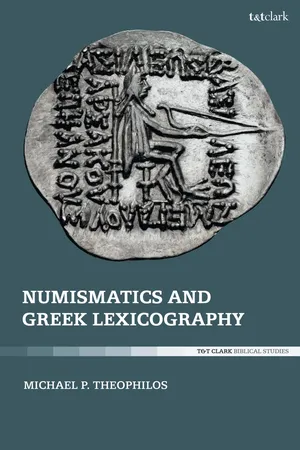
Michael P. Theophilos explores the fascinating variety of numismatic contributions to Greek lexicography, pertaining to lexicographic studies of the Second Temple period in general, and the New Testament in particular.
Theophilos considers previous scholarly attempts to grapple with, and incorporate, critical numismatic material into the emerging discipline of Greek lexicography - including foundational work by F. Preisigke and E. Kiessling - before outlining his own methodological approach. Theophilos' then examines the resources available for engaging with the numismatic material, and presents a series of specific case studies throughout the New Testament material. His carefully annotated images of coins draw readers in to a greater understanding of the material culture of the Greco-Roman world, and how this impacted upon the Greek language and the New Testament.
- 296 pages
- English
- ePUB (mobile friendly)
- Available on iOS & Android
eBook - ePub
Numismatics and Greek Lexicography
About this book
Information
1
Introduction
The Russian novelist Ivan Turgenev wrote in 1862, ‘Рисунок наглядно представит мне то, что в книге изложено на целых десяти страницах’ (trans. ‘the drawing shows me at one glance what might be spread over ten pages in a book’),1 and this is particularly relevant for numismatics where physical space on the surface of the coin is extremely limited, and thus generally reserved for iconographic depictions with short epigraphic inscriptions. The goal of this volume is to bring two distinct areas of historical enquiry, namely numismatics and post-classical Greek lexicography, into a more fruitful dialogue. In so doing, the volume aims to cover new methodological ground as well as application of the theory to New Testament (NT) studies.2 As a corollary, it is hoped that our present discussion will directly expand the material culture that is considered by NT specialists in general and Greek lexicographers in particular, beyond normative recourse to papyrological, epigraphic and related literary traditions.3
Numismatic material has, at times, been drawn upon for contributing to clues which illuminate the iconographic and symbolic world of the NT period.4 A strong case has been put forward by R. Oster who advocates for the inclusion of numismatic material by NT academicians at the conceptual symbolic level (rather than, per se, the lexicographic level as proposed in the current volume). Oster’s ‘Numismatic Windows into the Social World of Early Christianity’,5 among other achievements, admirably explores the apotheosis of the Roman emperor, the appearance of the comet at the commemorative games and the relationship of these images to the so-called ‘nativity comet’ of Matthew’s Gospel, specifically in light of the coinage subsequently produced by Octavian in the late first century BCE.6 The narrative of Oster’s article more broadly is the general neglect of numismatic evidence for ancient history in general and NT studies in particular.7 In Oster’s analysis, coins are to be seen as a valid ‘source for ancient economics, art, political science, history of religions, and general history’,8 yet he fails to make any mention of the serious and substantial contribution of numismatics to Greek lexicography, which strikes at the very heart of the discipline. Nonetheless, Oster is accurate when he states, ‘historians of earliest Christianity have repeatedly failed to give appropriate and significant attention to the analysis and application of data preserved on ancient coins’.9
Since 1982, when Oster penned this critique, little has changed. The use of coins in the secondary literature of NT studies has typically been haphazard and generally employed for non-related aesthetic purposes of only tenuous connection or mere decorative value. There are, of course, several valuable exceptions to this rather pessimistic assessment but I note the phenomenon here as a genuine cause for concern more broadly on how the material has been applied. Nonetheless, the studies noted above, and indeed several others noted below provide ample evidence that the iconographic dimension of incorporating numismatic material into NT studies has significant exegetical implications.
For example, as I have argued elsewhere,10 Roman imperial coins were minted under state contracts and paid, first and foremost to the soldiers, whose loyalty the emperors were constantly seeking to secure, the coins of the emperors are themselves valuable documents. By way of further illustration, one of the primary indications that the reality which Matthew 24 describes is that of 70 CE and not a cataclysmic end to the space–time continuum is the proverbial-like saying of verse 28, ‘Wherever the corpse is, there the eagles will gather’. Nonetheless, commentators (Luz, Davies and Allison, Mühlethaler11) have often taken this phrase in reference to the ‘second coming’ of Jesus, and related it to his visibility and obvious heavenly descent. However, a strong connection between ‘eagles’ and ‘(Roman) military troops’ is able to be established on the basis of the numismatic record. Representations of eagles (and their association with Jupiter, the chief god of the Roman state) were common on coins which functioned as tangible propaganda, demonstrably so in the case of Nero, Galba, Otho, Vespasian and Domitian. In confirmation of this Josephus regularly refers to the events surrounding Herod’s erection of an eagle on the temple in Jerusalem as a sign of political dominion (War. 1.648-655; 2.5; Ant. 17.151-152, 155, 206). The focus of this volume, however, is not the iconographic exegetical dimension but the lexicographic contribution to NT studies, that is, where inscriptions on coins can help to refine the relevant semantic domains of key or debated terminology.12
One of the early modern scholarly endeavours to grapple with, and incorporate, critical numismatic material into the emerging discipline of Greek lexicography was that of F. Passow’s Wörterbuch der griechischen Sprache (1825–1831).13 A century later, the pioneering linguistic work by F. Preisigke and E. Kiessling, Wörterbuch der griechischen Papyrusurkunden mit Einschluss der griechischen Inschriften, Ausschriften, Ostraka, Mumienschilder usw. aus Ägypten also drew on numismatic material, as did the work’s revisions and supplements.14 Although later studies have occasionally drawn on the material evidence of the numismatic record, characteristically this material is neglected in technical discussions of Greek lexicography.
The trajectory of this project explores the implications of the numismatic material for contributions to lexicography, particularly as it pertains to linguistic features of post-classical Greek. The working aim and methodology adopted can be summarized as follows: To employ dated and geographically legitimate comparative numismatic data to refine, illuminate and clarify the relevant semantic domains of NT vocabulary, with a particular interest in NT cruces interpretationis.
There are, of course, many other dimensions and possibilities for the contribution of numismatics to NT studies, including economics,15 social customs,16 archaeology17 and semiotics, but as noted I am concerned in this study exclusively with the linguistic. This is the distinctive approach of the current volume, and where it seeks to make its most original and significant contribution. The simple supposition is that the linguistic material on coins should be included as one part of the primary source materials for NT Greek lexicography. The hope is that when the current array of ancient Greek dictionaries proceed through the next iteration of revision, our current discussion might provide some impetus for further considering the inclusion of coins as primary sources of documented Greek linguistic use in the Mediterranean world. As noted above, the current monograph is by no means a definitive discussion on the contribution, but it is hoped that the response in this volume goes some way to bridge the deficit and open up many possibilities for further examination. Similar to many branches of knowledge that flourished in the nineteenth and twentieth centuries, numismatics is as guilty as any other for operating within an academic silo. ...
Table of contents
- Cover
- Halftitle Page
- Title Page
- Contents
- List of Figures
- List of Tables
- Acknowledgements
- List of Abbreviations
- Part One
- Part Two
- Bibliography
- Index of Modern Authors
- Index of Scripture References and Other Ancient Sources
- Imprint
Trusted by 375,005 students
Access to over 1.5 million titles for a fair monthly price.
Study more efficiently using our study tools.
Frequently asked questions
Yes, you can cancel anytime from the Subscription tab in your account settings on the Perlego website. Your subscription will stay active until the end of your current billing period. Learn how to cancel your subscription
No, books cannot be downloaded as external files, such as PDFs, for use outside of Perlego. However, you can download books within the Perlego app for offline reading on mobile or tablet. Learn how to download books offline
Perlego offers two plans: Essential and Complete
- Essential is ideal for learners and professionals who enjoy exploring a wide range of subjects. Access the Essential Library with 800,000+ trusted titles and best-sellers across business, personal growth, and the humanities. Includes unlimited reading time and Standard Read Aloud voice.
- Complete: Perfect for advanced learners and researchers needing full, unrestricted access. Unlock 1.5M+ books across hundreds of subjects, including academic and specialized titles. The Complete Plan also includes advanced features like Premium Read Aloud and Research Assistant.
We are an online textbook subscription service, where you can get access to an entire online library for less than the price of a single book per month. With over 1.5 million books across 990+ topics, we’ve got you covered! Learn about our mission
Look out for the read-aloud symbol on your next book to see if you can listen to it. The read-aloud tool reads text aloud for you, highlighting the text as it is being read. You can pause it, speed it up and slow it down. Learn more about Read Aloud
Yes! You can use the Perlego app on both iOS and Android devices to read anytime, anywhere — even offline. Perfect for commutes or when you’re on the go.
Please note we cannot support devices running on iOS 13 and Android 7 or earlier. Learn more about using the app
Please note we cannot support devices running on iOS 13 and Android 7 or earlier. Learn more about using the app
Yes, you can access Numismatics and Greek Lexicography by Michael P. Theophilos in PDF and/or ePUB format, as well as other popular books in Theology & Religion & Biblical Studies. We have over 1.5 million books available in our catalogue for you to explore.