Shortlisted for the 2020 Business Book Awards
Why do some businesses thrive, while many more struggle and fail? A key reason – and the focus of this book – is strategic alignment. This is the careful arrangement of the various elements of an enterprise – from its business strategy to its organisation – to best support the fulfillment of its long-term purpose. The best-aligned enterprises are the best performing.
Most executives recognise that their enterprises should be managed in this aligned way, but lack a robust system of thought to allow them to execute strategic alignment effectively and realise its full benefits. There are thousands of organisations globally that are operating below their potential simply because they are not aligned. This book aims to change that.
In Align, Jonathan Trevor provides a blueprint for how strategic alignment can be effectively developed, implemented and sustained. Drawing upon active research at the University of Oxford's Saïd Business School (with contributions from the joint works of Dr Jonathan Trevor and Dr Barry Varcoe), Jonathan also provides practical case studies and evidence-based insights – culminating in a thoughtful and compelling message to help leaders everywhere to improve their alignment and enterprise performance.
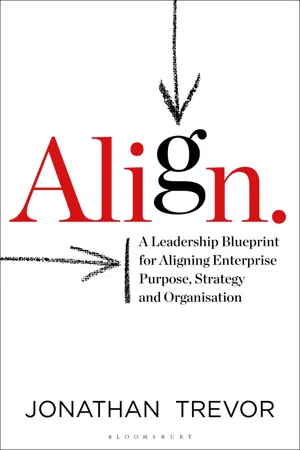
eBook - ePub
Align
A Leadership Blueprint for Aligning Enterprise Purpose, Strategy and Organisation
- 256 pages
- English
- ePUB (mobile friendly)
- Available on iOS & Android
eBook - ePub
Align
A Leadership Blueprint for Aligning Enterprise Purpose, Strategy and Organisation
About this book
Information
1
Introduction to Strategic Alignment
Section 1.1 A familiar story?
I had spent two days shivering in an overly air-conditioned and nondescript conference room with members of the Middle Eastern bank’s executive board. We were discussing some fundamental questions around the bank’s corporate purpose, strategy and organisational design. As a business school professor supporting the bank’s leadership, it was not an easy executive workshop, especially to begin with. Nobody wanted to be there. For many of the senior managers, it must have felt like just another talking shop and a distraction from the day job. Having spoken with him, I knew the bank’s CEO, who was the workshop sponsor, was becoming increasingly frustrated with his top team, and with good reason. The future of the bank looked uncertain.
While it had never been easy, the bank had grown significantly over 25 years to become a major player in its region and the second largest bank in its home country. The fact that the bank had achieved such growth purely on its own merits and without state support was rightly a source of great pride. But even here, at the cash-rich frontier of the Middle East, they were not immune to the effects of the still-raging global financial crisis. Making money was becoming harder, but investors were not at all sympathetic. There were more competitors, both global and local, than ever before. The bank had been the first to introduce automatic telling machines in the country, back in the day, but like other simple technologies, it was no longer a differentiator 20 years later.
Most importantly, there was a sense that their increasingly sophisticated customer base wanted different things from the bank and was willing and able to take their custom elsewhere. Customers wanted greater choice and a highly personalised service to match their individual lifestyles. Something off the shelf was simply not good enough. They also wanted a user-friendly one-stop shop for their total banking needs, and not a number of separate banking arrangements. Interestingly, competitors were still thought of in terms of the usual suspects – other established banks. However, there was a sense that, elsewhere in the world, there were new and disruptive entrants to the financial services marketplace. ‘Fintech’ was a word much bandied around, but little understood, especially in terms of how the bank might respond to it as either an opportunity or a threat.
The CEO was used to having all the answers to the bank’s challenges – he had built a highly successful career on it. He was hugely popular among staff and enjoyed a reputation as a canny operator and a generous and charismatic boss. His ‘walkabouts’ of the bank’s various offices and branches were celebrated by staff – the sharing of selfies with the ‘big boss’ on Facebook was not uncommon. However, it was a different story for those working very closely with him. A self-made man, he cut an imposing and intimidating figure, and I heard tell of his direct reports, all big personalities, leaving board meetings pale and reeling from unanticipated verbal lashings.
In the current climate, it was obvious the CEO could not have all the answers to the multitude of complex challenges facing the bank. He looked to his top team for help to create a vision for the future, while also continuing to deliver short-term results demanded by investors. His executives were woefully unprepared for this dual role. They came together for strategic discussions not as a team, but as a committee of direct reports and, it seemed to me, were only interested in the elements of the business that came under their direct control.
They struggled to put aside the affairs of their own divisions and functions and to think of the bank and its direction as one enterprise. A competitive atmosphere prevailed at executive board meetings – others doing poorly only served to deflect scrutiny by the CEO and make everyone else seem better by implication. It was certainly not a team in any conventional sense. There didn’t seem to be any consensus about the role of the executive board. They had a shared interest in the balance sheet, but no unified sense of purpose or corporate vision.
Nobody seemed to understand in any detail what was happening outside of the bank. This was especially concerning because the bank operated in one of the most competitive markets in the world (if measured by the number of banking services per head of population). Essential questions such as ‘What are current customer trends?’, ‘What’s competitor X really good at?’ or ‘How could we differentiate ourselves in the market?’ all drew a blank. The information that was shared in meetings was the result of hearsay or gossip gleaned from personal connections or experience. It was hardly a robust evidence base from which to make sound corporate decisions.
To compound matters, day-to-day front-line firefighting was taking up the lion’s share of executive bandwidth. There was neither the time nor the appetite to have speculative conversations about the future; there were simply too many immediate problems to fix first. For these reasons and more, the bank lacked a coherent and well-understood purpose, strategy and organisational design for the future, or even one for the very near future. There may have been furious activity all around, but there was very little progress.
In lieu of a long-term strategy, the bank’s response to the strategic challenges it faced was to exploit its existing business model even more aggressively. This meant pushing harder for performance in each of its business verticals, minimising costs and attempting to squeeze every ounce of ‘juice’ out of its assets, including its people. The strategic focus was not on innovation, but on execution – doing the same as it always had, just better. Practically, attempts were made to be more efficient at allocating resources, controlling performance and beefing up operational governance. The ‘bureaucratic intensification’ process was accompanied, separately, by the introduction of buzzwordy statements in corporate communications about the need to become more innovative, more joined-up and, in particular, more agile. Words and deeds were inconsistent and confusing.
It was hard to say what differentiated the bank from its competitors. It wasn’t more innovative than any other firm. Nor, if truth be told, was it any more efficient. It was running in the same race as its competitors and doing so in the same way. It was not even considered a fair race. Its main rival was state-supported – it couldn’t fail. Despite the burning need for competitive differentiation, ideas about how the bank might do its business differently – which is to say, better aligned to changing customer preferences and beyond the capability of competitors – remained elusive. As one executive board member candidly said to me in a workshop break over coffee and an abundance of wasted pastries and snacks, ‘the last innovation in the retail banking business model was three hundred years ago’.
Even if the executive board had wanted to pursue a radically different business strategy, there would have been significant barriers to implementing it. Organisationally, the bank resembled a ‘hub-and-spoke’ type structure. The structure was not the result of an intentional design, but rather had naturally emerged that way over time. As it had grown, it had diversified into new product areas and markets, and set up teams to mine their local seam in the emerging market as best they could. Inevitably, multiple specialist teams had branched off in several separate business lines, which, over time, had come to form the bulk of the bank’s easy-to-forget organisational chart. The hub-and-spoke structure had worked well when the bank was small and straightforward, permitting each business line a good deal of freedom to respond to customer and competitor pressures in its area. The engagement had been high, especially at the coalface – staff were highly invested in making their bit of the business work.
The downside was that each business line had evolved to be a stand-alone unit. Sure, there was a common corporate logo and strapline (although no one could easily remember it), but that is where it ended. There was little in the way of day-to-day collaboration between staff in different business lines and therefore few obvious synergies that were exploited. Staff were incentivised in every respect, including financially, to maximise the performance of their own area, but no more than that.
In the past, this hadn’t mattered so much. The bank had grown fast precisely because its various parts were performing well and maturing into serious market players. Equally, in the early days, when the bank employed fewer people and was much simpler compared to the present day, the CEO (the same person) had been able to be everywhere all the time. There was little consistency of management style across the bank, but it didn’t matter, so long as there was the opportunity for direct intervention from the top if necessary. The CEO’s job had been to corral his best performers to go out and beat rivals to the punch and stake the bank’s claim; as a result, the bank had been operating as a leader in a frontier market for decades.
Today, however, the market had matured. The bank’s growth had abated, and the same structure that had once supercharged its growth was now holding it back. As it had grown, it had become much more complicated: its hundreds of employees had become thousands; a handful of business activities had become a diverse portfolio; one or two locations now extended to a major regional presence with multiple offices; and limited business relationships with local institutions now formed a complex web of international partnerships.
Throughout its rapid growth, delegation had been necessary, and the CEO’s management-by-walking-around had become inevitably less frequent, despite his best efforts. Growth had necessitated not merely operational delegation, but also the introduction of corporate functions to manage the infrastructure of what was now a large and complex firm with many moving and interconnected parts. The tension between ‘front office’ (the bankers) and those considered ‘back office’ (the functions) was palpable. The human resources department, for example, was simultaneously perceived as a welfare function, for staff to complain to about their line manager, but also by line managers as an instrument of the corporation’s interference in their day-to-day work. It all added up to the bank being incapable of meaningful organisational change to transform how it performed its business.
I spent about three months at the bank, on and off, asking ‘dumb’ questions and trying to encourage people to develop robust answers as a team. I must have sounded like a broken record. I certainly felt as if I was being bothersome. My engagement came to its natural conclusion, and I moved on to new things and a new academic role. In the six months following my departure, I learned that the bank had failed to meet its targets and investors were not happy – profits had taken a double-digit dip. Within nine months, the CEO had been summarily removed from his group position, despite more than 25 years of service, and replaced by the bank’s chairman as an interim measure until a new successor could be found. Several of the executive board recruited originally by the CEO had also left, although some had survived. The chairman was still holding the reins, the last I heard, even after two years.
Section 1.2 Introduction to strategic alignment
Does any of this real-world vignette sound familiar? The bank is far from unusual in my experience. Through my research and consultancy, most executives I’ve worked with know their enterprises should be aligned – their business strategies, organisational capabilities, organisational architecture (their structure, culture, processes and people) and management systems should all be arranged to support their enterprise’s purpose. The challenge is that executives tend to focus on one of these areas to the exclusion of the others, when what really matters for performance is how they all fit together.
The concept of alignment – or ‘fit’ as it is also known – is not new.1 However, many of the opportunities and challenges of the emerging information-age operating environment are. All other things being equal, highly aligned enterprises stand the best chance of succeeding in the intensely competitive, complex and changeable 21st-century marketplace. The best-aligned enterprises are the best performing because their leaders approach alignment as a strategic concern. This means that they arrange all elements of their enterprise – including its business strategy and the way it is organised – in such a way as to best support the fulfilment of its long-term purpose.
This is the essence of the approach I refer to as strategic alignment – strategic because it is a purposeful and systematic decision-making process to improve enterprise performance and competitiveness over time.
What is strategic alignment?
Consider McDonald’s. What does it take to be able to serve 1 per cent of the world’s population, 70 million customers, every day and in virt...
Table of contents
- Cover
- Series
- Dedication
- Title
- Contents
- List of Figures
- Introduction
- 1 Introduction to Strategic Alignment
- 2 Enterprise Purpose
- 3 Business Strategy
- 4 Organisational Capability
- 5 Organisational Architecture
- 6 Management Systems
- Conclusion
- Acknowledgements
- References
- Index
- Copyright
Trusted by 375,005 students
Access to over 1.5 million titles for a fair monthly price.
Study more efficiently using our study tools.
Frequently asked questions
Yes, you can cancel anytime from the Subscription tab in your account settings on the Perlego website. Your subscription will stay active until the end of your current billing period. Learn how to cancel your subscription
No, books cannot be downloaded as external files, such as PDFs, for use outside of Perlego. However, you can download books within the Perlego app for offline reading on mobile or tablet. Learn how to download books offline
We are an online textbook subscription service, where you can get access to an entire online library for less than the price of a single book per month. With over 1.5 million books across 990+ topics, we’ve got you covered! Learn about our mission
Look out for the read-aloud symbol on your next book to see if you can listen to it. The read-aloud tool reads text aloud for you, highlighting the text as it is being read. You can pause it, speed it up and slow it down. Learn more about Read Aloud
Yes! You can use the Perlego app on both iOS and Android devices to read anytime, anywhere — even offline. Perfect for commutes or when you’re on the go.
Please note we cannot support devices running on iOS 13 and Android 7 or earlier. Learn more about using the app
Please note we cannot support devices running on iOS 13 and Android 7 or earlier. Learn more about using the app
Yes, you can access Align by Jonathan Trevor in PDF and/or ePUB format, as well as other popular books in Business & Business Strategy. We have over 1.5 million books available in our catalogue for you to explore.