- 304 pages
- English
- ePUB (mobile friendly)
- Available on iOS & Android
eBook - ePub
A Short History of the American Civil War
About this book
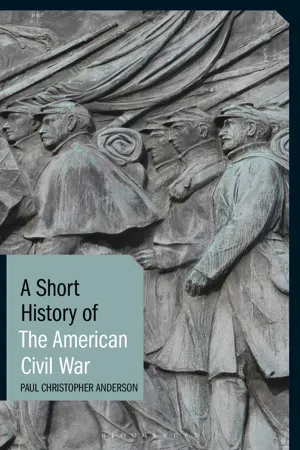
The American Civil War (1861-65) remains a searing event in the collective consciousness of the United States. It was one of the bloodiest conflicts in modern history, claiming the lives of at least 600,000 soldiers and an unknown number of civilians and slaves. The Civil War was also one of the world's first truly industrial conflicts, involving railroads, the telegraph, steamships and mass-manufactured weaponry. The eventual victory of the Union over the Confederacy rang the death-knell for American slavery, and set the USA on the path to becoming a truly world power. Paul Christopher Anderson shows how and why the conflict remains the nation's defining moment, arguing that it was above all a struggle for power and political supremacy but was also a struggle for the idea of America. Melding social, cultural and military history, the author explores iconic battles like Shiloh, Chickamauga, Antietam and Gettysburg, as well as the bitterly contesting forces underlying them and the myth-making that came to define them in aftermath. He shows that while both sides began the war in order to preserve - the integrity of the American state in the case of the Union, the integrity of a culture, a value system, and as slave society in the case of the Confederacy - it allowed the American South to define a regional identity that has survived into modern times.
Trusted by 375,005 students
Access to over 1.5 million titles for a fair monthly price.
Study more efficiently using our study tools.
Information
1
UNION: 1860
On November 26, 1859, readers of the English weekly magazine All the Year Round were at last brought to the astonishing climax of what would become Charles Dickens’s most popular novel. In those pages the hopelessly dissipated Sydney Carton gives up his life at the guillotine to satiate the Vengeance – a mob of revolutionary Parisians that has mistaken him for Charles Darnay, the selfless aristocrat whom Carton resembles only in appearance and the man wedded to Carton’s ideal wife. So it was, in A Tale of Two Cities, unrequited but purposed, at the end, to make something lastingly meaningful of himself, the meekest of humanity laid down his life for love and redeemed the worst of times for the betterment of time.
Not quite a week later, in the languid noonhour of December 2, John Brown stepped upon a makeshift gibbet in Charles Town, Virginia, offered his head to an executioner who adjusted hood and noose, and with a grim resolution that impressed even those who feared him, fell through the platform to hang in the stillness, as it seemed to one observer, “between heaven and earth.” We have come to understand the meaning of the American Civil War’s violence in what we say to redeem a vengeful carnage. Yet it began with a prophecy. On the way from his jail cell to the execution field Brown had handed one of his captors a note. “I John Brown am now quite certain,” it read, “that the crimes of this guilty land will never be purged away, but with Blood. I had, as I now think vainly, flattered myself that without very much bloodshed, it might be done.”1
The prophecy was as remarkable for what it did not pronounce. Brown had hoped to shed some of that blood and perhaps even flattered himself as the avenger who would shed it in just the right tincture. Both hopes were vanities. On the night of October 16, he had led a small band of abolitionist revolutionaries into Harpers Ferry, Virginia, intent on capturing arms from the town’s long-established federal arsenal and rifle works. Their number was twenty-two and would have been serendipitously Dickensian had not the great black leader Frederick Douglass, who told Brown his band “would never get out alive,” positively refused to join them.2 As Brown envisioned the dream marching on, word of his deed would spread to slaves near and slaves far off. They would rush to his banner, Brown’s insurrectional band growing into a liberation legion as it moved southward down the spine of the Appalachian mountains, into North Carolina, into South Carolina, into Georgia, the legion multiplying again and again as it strode into the phalanx of a general slave rebellion that would destabilize the institution in America and destroy it once and for all. Far-fetched it might have been, but such operations always had a far-out quality to them. The swashbuckling American filibusters with Narciso Lopez invaded Cuba in 1851 with a provisional army of a few hundred. William Walker invaded Honduras in 1855 with a similar crowd. Filibustering – and Brown’sattempt was a kind of attempt to annex native country for free soil – always had in it the element of the fantastic.
Brown captured the arsenal fairly easily (it was guarded by one watchman) and even took among his hostages the great-grandnephew of George Washington, who lived nearby, and was wanted, Brown said, “for the moral effect it would give our cause.”3 Then, for reasons no one has ever come to know fully, Brown simply sat there, in Harpers Ferry, and waited. He even allowed free passage of the night-train to Baltimore, whose conductor soon spread the alarm via telegraph. Maybe such chivalry seems less inexplicably antic in light of Brown’s first decision the next morning, which was to order breakfast for his hostages from the local hotel. By that time Harpers Ferry was alive with armed residents and oncoming local militia, its cobblestoned streets sparking with the spent bullets of a nasty affray in which the town’s mayor was picked off and several of Brown’s raiders killed and their corpses humiliated. Among these was the “very fair mulatto” Dangerfield Newby, whose hope to liberate his wife from slavery died with him. He lay “stretched along the pavement” with a “most hideous wound” in his throat “gaping open quite large enough to admit the fore part of an ordinary-sized foot.” Presumably, other details were too grotesque to admit to either a public telling or a public confession of atrocity, for Newby’s corpse was dragged into a gutter where a trophy-hunting townsman sliced off his ears. The rest of him was left there to be rooted by village hogs.4
Meanwhile, Brown had been driven into a small building housing the arsenal’s fire engine. There did he, four of his men, and eleven hostages hole up during the night of the seventeenth. By the next morning a detachment of US Marines under the command of Colonel Robert E. Lee had arrived from Washington, DC. With Lee observing from a nearby hillside and at least two thousand local spectators on hand for the denouement, the Marines summarily stormed the engine house and ended the insurrection thirty-six hours after it began. Brown’s “provisional army,” as he styled it, included three of his sons. Five others were black, the now-mutilated Newby being one, the fugitive slave Shields Green another. The raid was less a plan than a vision, less an insurgency than a sacrifice. Ten raiders were killed, including Brown’s sons Oliver and Watson, while seven were captured – two in Pennsylvania after they had managed to flee the immediate scene – and later executed. The last of Brown’s raider-sons, Owen, and the others managed to escape entirely.
Brown probably would have been run-through and killed had the marine who attacked him been wielding a weapon other than his dress-sword. The old man was severely wounded as it was. Sometime in the long hours before the final attack, if not much, much sooner – again, no one has been able to embrace his mind – he had known failure the likely outcome but had also resolved that martyrdom, if acted heroically, was the best of all outcomes. This clarity he had achieved in the engine house during the frantic night before the final assault, where he stoically awaited the morning and urged his men “to sell their lives as dearly as they could,” even as his son Oliver died of his wounds in the darkness; this determination he had made during his incarceration, in which he corresponded with friends and dignitaries and manfully impressed the governor of Virginia in a personal interview; this duty he had taken up during his trial, speedily convened a few weeks after the raid, in which the outcome was not to be doubted but in which he managed to make himself both an Old Testament Maccabee and a New Testament baptizer exhorting among a brood of vipers. It was almost as if he had been brought before Pilate. He remarked during his trial,
I see a book kissed, which I suppose to be the Bible, which teaches me that all things whatsoever I would do that men should do to me, I should do to them. I say I am yet too young to understand that God is any respecter of persons. I believe [that] to have interfered as I have done in behalf of His despised poor, is no wrong, but right. Now, if it is deemed necessary that I should forfeit my life for the furtherance of the ends of justice, and mingle my blood with the blood of millions in the slave country whose rights are disregarded by wicked, cruel, and unjust enactments, I say let it be done.5
And this resolve he had taken to the gallows. “I am worth inconceivably more to hang,” he wrote one of his correspondents, “than for any other purpose.”6 For all of the religious overtones of his manner and speech, critically vital as they were to perceptions of him in a pious age, there was also something of a narrative awareness in Brown’s words, as in his actions, a way of patterning himself on the heroic and romantic literary conventions of the Victorian era. That sensibility should not be dismissed as a conceit. More than one historian has surmised that Brown could see the story after him – he understood what his death might do, how the tale was supposed to be written after his doom, if he could but write himself into it as the tale demanded. He acted a martyr’s part, and acted symbolically, in essence, so as to make the story come true.
As it was no conceit, neither was the sensibility restricted to Brown. For much longer than many might imagine possible in a war that scraped romanticism off to its nubs, a considerable array of the era’s most distinguished figures acted as dramatists in what they had already conceived as the fateful American epic. For many of them, it was as if destiny unfolded in vibrant possibility before them – only the substance and the tone of their part in it remained to be found, beginning with the peerless hostage Colonel Lewis Washington, whose self-authored tale soon appeared in the newspapers in marvelous Thackerayian visuality. He was waylaid at home in his nightshirt by men carrying “lighted flambeaux, made of pine whittlings,” and after inquiring about the weather (“rather chilly,” he was advised; wear an overcoat) was allowed to dress for the occasion, then driven to his imprisonment in his own carriage and by his own servant.7 The heroic ideal was a motive force indeed in a sentimental age.
Brown’s fortitude in death, his utter acceptance, was all the more compelling because it redounded to his mystique then and later in stoic contrast to the reactions of his white countrymen. An atmosphere of spine-tingling fear and scramble gripped both North and South in the weeks and months after the raid. A search of the nearby farmhouse where Brown and his men lived as they prepared for their mission had turned up the old man’s correspondence – which implicated six abolitionists as his major financial supporters, called then and afterward the Secret Six. Three panicked and fled to Canada to avoid arrest, another was conveniently ill and convalescing in Europe, and a fifth, Gerrit Smith, the wealthiest of them, checked himself into a lunatic asylum. Only Thomas Wentworth Higginson, previously renowned in Boston and elsewhere for his militant dissidence and famous during the War as an officer of an all-black Union regiment, publicly and stridently defended the raid and his own role in it.8 None claimed to know exactly what Brown planned when they contributed to the cause, although it is hard to imagine they did not conjecture a stunning errand into the wilderness. Whether they fully comprehended its violence is also – odd as it sounds given Brown’s reputation – a matter of some conjecture. Brown’s presence, like his oratory, was mesmerizing, captivating, was charismatically persuasive beyond rationality. He would die insisting that he intended to incite no insurrectionary violence at all. If blood were shed, it would be on the hands of slaveholders who attacked Brown’s innocent fugitives as they fled, equally innocently because freedom was God-given but man-taken. The lowly could not be blamed for killing in the self-defense that followed from self-emancipation. Something of the same logical magic had captured the imaginations of the Secret Six.
A far more nimble scramble was required of Northerners whose antislavery opinions and rhetoric had, according to white Southerners unwilling to make fine distinctions in it, nurtured abolitionists and incendiaries and conspirators. Distancing themselves from that charge became yet more difficult after December 2. Church bells peeled in some Northern towns at the hour of Brown’s death; memorial services were conducted; silence was kept. Those who sympathized with Brown’s beliefs but condemned his act struggled to express their continuing support for antislavery tenets on the one hand and their rejection of insurrectionary violence on the other. This tack was particularly treacherous for leaders of the Republican Party, which had formed in the middle of the decade on an antislavery platform. Already, long before the raid, white Southerners and many Northern political opponents had perverted it into a coalition of radical levelers and Jacobins. Under circumstances that threatened to legitimate this caricature, the best many Republicans could do was to call Brown insane and attempt to prove it by the bewildering, botched monomania of his plan. They could also point up a family history of mental illness, long the gossip of old neighbors and acquaintances at home, an effective tactic perhaps as a mitigating defense in the court of public opinion, yet less so in the court of execution, where Brown himself utterly and eloquently rejected it. It would not have mattered: He was a dead man.
Frenzy in other forms shook Southerners, in Virginia and elsewhere. Insurrection was the blackest fear of any slaveholder. Although it is an exaggeration to say that white Southerners lived in daily hysteria, they were all too aware, and aware all too often, of the potential horror of slave rebellion. Memories were long, and nightmares leapt from one dream to the next. No one need remind any white Southerner of the Haitian revolution of the 1790s, in which masters had been overthrown, cut in half, and buried alive, especially not in South Carolina or Mississippi where the slave population outnumbered the white one. No jarring recall was necessary of the most recently sensational American example, Nat Turner’s rebellion in Virginia in 1831, which was put down brutally and its leader executed but not before several of Turner’s white victims had been thrown into fireplaces.
These were known, rote, but the slave system did not generally publicize its disturbances. Only those insurrections whose scale of terror made them impossible to ignore – Haiti, Turner, now Brown – tended to become matters of discussion. Best to be silent. White awareness could not, after all, be hidden from black slaves, who very well might choose to accept slave rebels as role models and their rebellions as templates. Local outbreaks might take the form of loose collusions, such as an uprising thwarted in Camden, South Carolina, in 1816, or cabalist acts of violence, such as the poisoning of a master here or there. These were far more numerous than organized rebellion and tended to be hushed up. The actuality of any plot did not really matter. A suspected conspiracy was enough to set a considerable machinery of repression into service, as at Natchez, Mississippi, in 1861, where at least twenty-seven slaves were tortured and executed when whites began to fear vague talk among their slaves about something possibly happening sometime. What might happen was far more unpredictable – Independence Day in July or Christmastime could be edgy – and the anguish of not knowing more pervasive. Fear was glutted with a dread generated by the justification slave owners had created for their own domination. Very few rumors of rebellion did not contain a fantasy: the reputed uprising must include, not just as an inseparable act of insurrection but as the objective of insurrection, the rape of white women. Mastery contained within itself the loathing of its apocalypse.9
The military spectacle that accompanied Brown’s captivity, trial, and execution was in many ways both a compensation for fear and a projection of it. The governor of Virginia, who had accused Harpers Ferry residents of acting like sheep in the face of Brown’s attack and boasted that he could have captured Brown with a penknife, nevertheless summoned the state militia into service and spent $250,000 (a lot of penknives, then or now) to underwrite an arresting martial display of horses, guns, and chivalry. Vigilance justified such spectacular stage-drama, it was said, to prevent Brown’s escape or his deliverance at the hands of spies or rescue parties rumored to be on the move from Pennsylvania and Ohio. Nor was drama or hysteria confined to Virginia. It radiated southward. Slaveholding communities everywhere redoubled vigilance, shined their boots and bolstered patrols, perked their ears to the murmurings of their human chattel in just the way their slaves had always perked their ears around them, and cast beady eyes on strangers white and black, road travelers, and Yankees known and unknown.10

Figure 2: John Brown, by John Bowles, c. 1856, Public Domain.
Such reactions might seem grotesquely out of proportion when measured against the broken plan of one man, whom many thought insane, and an army of twenty-two that its captain had rather optimistically called “provisional.” More than one contemporary was overheard wondering whether it was the pathological reaction, rather than the act, which befitted lunacy. Yet Brown’s raid was a critical matter: it proved powerfully destabilizing as well as transitionally unifying. Its incendiary cataclysm not only closed a pivotal, rancorous decade in which arguments over slavery constantly, continuously usurped all attempts to settle or suppress them. It gave Americans north and south a narrative of themselves, and of each other, they could live into, and that more dramatically and less messily than their politics had allowed. By fate or connivance it came on the eve of a presidential election in which the political system, formerly friendly to slavery and built to contain such shocks, was instead already fraying and reorganizing under them. When that election itself came to be understood as a hostile act – an act of conspiracy and civil insurrection, if not a terror itself in which legions of Northern voters were transformed into the ballot-box proxies of Brown’s raiders – the Union was not to endure it. Some thought it was already doomed. Brown was guilty of a fiendish plot “to murder our wives, our children, and ourselves,” one Virginian wrote to his son on the day of the old abolitionist’s execution. “Methinks I can see you … engaged on a Sunday evening molding balls and preparing for the conflict.”11
****
By 1840, the American political party system was the most tangible manifestation of the nation’s virtuous democracy. Modern elements of the national state were generally nonexistent or weak by design, and even the...
Table of contents
- Cover
- Halftitle Page
- Title Page
- Dedication Page
- Contents
- List of Illustrations
- Preface
- Prologue: Battleground
- Chapter 1: Union: 1860
- Chapter 2: Revolution: 1861
- Chapter 3: Liberty: 1862
- Chapter 4: Emancipation: 1862
- Chapter 5: Bloodfield: 1863
- Chapter 6: On Home Ground: 1864
- Epilogue: United, or Untied? 1865 …
- Notes
- Index
Frequently asked questions
Yes, you can cancel anytime from the Subscription tab in your account settings on the Perlego website. Your subscription will stay active until the end of your current billing period. Learn how to cancel your subscription
No, books cannot be downloaded as external files, such as PDFs, for use outside of Perlego. However, you can download books within the Perlego app for offline reading on mobile or tablet. Learn how to download books offline
Perlego offers two plans: Essential and Complete
- Essential is ideal for learners and professionals who enjoy exploring a wide range of subjects. Access the Essential Library with 800,000+ trusted titles and best-sellers across business, personal growth, and the humanities. Includes unlimited reading time and Standard Read Aloud voice.
- Complete: Perfect for advanced learners and researchers needing full, unrestricted access. Unlock 1.5M+ books across hundreds of subjects, including academic and specialized titles. The Complete Plan also includes advanced features like Premium Read Aloud and Research Assistant.
We are an online textbook subscription service, where you can get access to an entire online library for less than the price of a single book per month. With over 1.5 million books across 990+ topics, we’ve got you covered! Learn about our mission
Look out for the read-aloud symbol on your next book to see if you can listen to it. The read-aloud tool reads text aloud for you, highlighting the text as it is being read. You can pause it, speed it up and slow it down. Learn more about Read Aloud
Yes! You can use the Perlego app on both iOS and Android devices to read anytime, anywhere — even offline. Perfect for commutes or when you’re on the go.
Please note we cannot support devices running on iOS 13 and Android 7 or earlier. Learn more about using the app
Please note we cannot support devices running on iOS 13 and Android 7 or earlier. Learn more about using the app
Yes, you can access A Short History of the American Civil War by Paul Christopher Anderson in PDF and/or ePUB format, as well as other popular books in History & American Civil War History. We have over 1.5 million books available in our catalogue for you to explore.