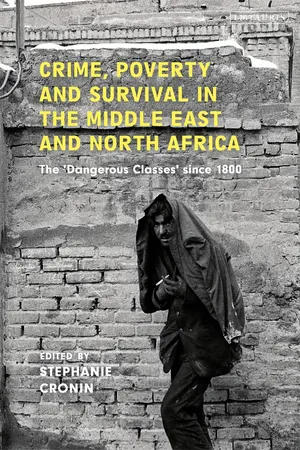
The concept of the 'dangerous classes' was born in a rapidly urbanizing and industrializing nineteenth century Europe. It described all those who had fallen out of the working classes into the lower depths of the new societies, surviving by their wits or various amoral, disreputable or criminal strategies. This included beggars and vagrants, swindlers, pickpockets and burglars, prostitutes and pimps, ex-soldiers, ex-prisoners, tricksters, drug-dealers, the unemployed or unemployable, indeed every type of the criminal and marginal.
This book examines the 'dangerous classes' in the Middle East and North Africa, their lives and the strategies they used to avoid, evade, cheat, placate or, occasionally, resist, the authorities. Chapters cover the narratives of their lives; their relationship with 'respectable' society; their political inclinations and their role in shaping systems and institutions of
discipline and control and their representation in literature and in popular culture. The book demonstrates the liminality of the 'dangerous classes' and their capacity for re-invention. It also indicates the sharpening relevance of the concept to a Middle East and North Africa now in the grip of an almost permanent sense of crisis, its younger generations crippled by a pervasive sense of hopelessness, prone to petty crime and vulnerable to induction as foot soldiers into drug and people smuggling, petty gangsterism and jihadism.
eBook - ePub
Crime, Poverty and Survival in the Middle East and North Africa
The 'Dangerous Classes' Since 1800
- 328 pages
- English
- ePUB (mobile friendly)
- Available on iOS & Android
eBook - ePub
Crime, Poverty and Survival in the Middle East and North Africa
The 'Dangerous Classes' Since 1800
About this book
Information
Part One
Dangerous Women
1
Disciplining Sex Work in Colonial Cairo
In the last quarter of the nineteenth century, as Egypt’s capital Cairo became an increasingly cosmopolitan city marked by the contradictions of globalization and colonialism, urban sex work changed dramatically. Anxieties about the influx of rural migrants, manumitted slaves and unattached foreign women engaging more or less overtly in the selling of sexual services haunted modern urban life in cosmopolitan Cairo. Mass free movement, the intermingling of socially disparate people and unsupervised physical contact between the sexes raised serious suspicions among the authorities: crowds and individual bodies were seen by the ruling elites as dangerous sites of moral degeneration and physical pollution that had to be actively monitored. The Egyptian authorities – and after 1882 the British colonial administrators – tried to implement a whole array of disciplinary techniques to ensure public order and health. After decades of loose administrative intervention by the Egyptian authorities, the British introduced a local version of French-inspired regulationism after they took power. Based on governmental sources, colonial archives, local and imperial narratives, and sexologist literature, this chapter presents a detailed analysis of sex work regulation as a specific type of colonial and biopolitical project. The term ‘colonial’ here carries two interrelated but distinct meanings. First, and primarily, it refers to the expanding capacity of state institutions to intervene and establish order and uniformity over societal processes. This was a self-strengthening policy Egyptian and colonial ruling elites alike adopted to discipline a marginal segment of the population: unruly women selling sex. Second, the adjective ‘colonial’ qualifies the historical case of imperial intervention in Egypt with its specific governmentality. Clearly, Egypt was not formally a colony during the period considered here, yet Egyptian politics were largely shaped by a set of hierarchical and extractive power relations imposed by an external power. The limited nature of Egyptian sovereignty, even after the declaration of independence and the formal end of the British protectorate in 1922, meant the country was in a situation of de facto colonial subordination.
In this context, the regulation of prostitution is seen as a distinct dimension of the modern ‘power to colonize’, to use Timothy Mitchell’s famous expression.1 It is a type of epistemology of power centred on the imperative of controlling individual embodied practices in such a way as to maximize their positive effects and minimize their potential dangers to collective well-being and productivity. Disciplinary logics and techniques came to ‘colonize’ human interactions, by defining normative and heteronormative racialized, classed and gendered subjectivities whose orderly production and reproduction were integral to modern biopolitical forms of governmentality.2 In Egypt the antecedents of biopolitical concerns can be traced back to Muhammad Ali’s modernizing efforts. They morphed into a self-conscious disciplinary project at the intersection between imperial and nationalist politics in and after 1882, when sex work regulation was introduced. This imperial policy was aimed at both protecting colonial troops from venereal diseases and preserving public order. The fascinating process by which sex workers were turned into a specific ‘dangerous class’ by the state3 can be investigated at different levels. This chapter focuses on the process with a view of pushing the boundaries of Foucaldian governmentality and biopolitical theory beyond its Eurocentric focus.4 The colony was a laboratory where imperial disciplinary strategies were tested and contested, interiorized, then manipulated and rearticulated by local hegemonic groups and ordinary people during the formulation of their own types of vernacular modernity. Egypt was the site of a subtle and complex interplay between a colonial power and a formally sovereign, yet de facto externally controlled, local form of rule, an emerging modernist and nationalist movement, and the problems arising from the existence of large numbers of non-local subjects protected by capitulary legislation. It therefore offers an interesting example of the provincialization of sex work regulation as a facet of typically Western imperial governmentality and its imagined order. In this chapter, I focus mainly on the prescriptive aspects of regulation, namely the techniques through which individual supervision extended to quite a comprehensive, if flawed, system of surveillance in Cairo in the last quarter of the nineteenth century. This regime consisted of a number of interrelated practices: labelling, zoning, medicalization, detention and racialization. The subjectification of sex workers as prostitutes constituted both the outcome and the necessary prerequisite of regulationism.
Labelling
As shown by Khaled Fahmy,5 in Egypt the emergence of state interest in sex workers’ activities can be traced back to Muhammad Ali’s defensive modernization reforms6: in 1834 a ban on sex work expelled Cairo’s prostitutes and performers – albeit temporarily – to Upper Egypt.7 This was a decisive break from the previous Mamluk and Ottoman practices of de facto toleration, whereby sex work was treated as a profession and, despite being excluded from the guild system, taxed. Taxation was carried out by tax farmers and community leaders, who had free reign in adding or erasing women’s names from their registers, often in return for a bribe.
The advent of regulationism in 1882 resulted in a dramatic qualitative change in the way sex work was managed in modern Cairo and signalled a momentous transformation in the relationship between the state and the people. By starting to regulate sex work directly, the state expanded its reach over society in an unprecedented way. The institutionalization of prostitution through the establishment of state-licensed brothels in designated urban areas where registered sex workers offered their services entailed the creation of a system of legal oversight. This was carried out by the brothel owners, who were responsible for making sure their employees underwent weekly medical checks, and by the so-called lock hospital, used for quarantining sex workers suffering from venereal diseases. This system was accompanied by a broad medical discourse on social hygiene, reflecting the emerging political priority of creating a normative knowledge corpus about the biological and the social.
The British introduced systematic regulationist policies – a local variant of the French-style state-licensed brothel system – immediately after their occupation of Egypt in September 1882.8 At that time, the modular logic of individual confinement and regulation of abnormal social practices were turned into an expansive regulatory apparatus for reasons of sheer imperial governmentality. Based on a double standard for male and female sexualities, and on the Augustinian conception of prostitution as a ‘necessary evil’, this system of regulated prostitution understood prostitutes as a clear-cut, separate category of marginal social actors. Removed from the working class they originally belonged to, they were increasingly stigmatized as agents of moral corruption and physical contamination. The Malthusian logic of social productivity came to bear on this subaltern group in such a way that regulation was seen as the key method to transform these ‘indolent’, disorderly elements into disciplined workers, thus making their activity both socially and morally acceptable. Unlike France, Great Britain was not a regulationist country: the Contagious Diseases Act of 1864 was the closest it came to sex work regulation. The Act was repealed in 1883 due to vocal opposition from a variegated abolitionist front. Yet, regulationism was invariably put into place in the British colonies, where racist notions about the cultural inferiority and sexual primitivism of the native people were coupled with the paramount importance of colonial security. Utilitarian concerns about public order and the spread of venereal diseases among imperial troops made regulation mandatory, all the while ‘offering a counterargument to the notion that British liberalism was largely responsible for the limited engagement with regulationist pratices’.9
The first law disciplining sex work was drafted in Egypt on 31 October 1882, i.e. only a month and a half after the British victory against the nationalist uprising led by Colonel Ahmad ‘Urabi at Tell al-Kabir, which brought about the occupation of Egypt by 13,000 colonial troops. According to the Egyptian social historian ‘Imad Hilal,10 the British authorities forced the Egyptian government to adopt overtly racist discrimination against sex workers. Since the ‘Orient’ was commonly associated with images of sensuality, lust and unrestrained vice, the colonial imagination constructed local women as subhuman. As one Lieutenant Olliver, on duty on the HMS Calypso of the Mediterranean Fleet during the First World War, put it:
Perhaps people in England do not realize the effect that the immense inferiority of foreign women – compared to our own – has on men; more or less according to the meridian of longitude of the place so is the woman either a beast of burden, a chattel of her man, or more or less his equal. Tho’ one may respect ones’ equal, one has not the same feeling for the chattel of a man who is decidedly inferior to oneself and who does not respect herself. And the whisky or vodka inside one tends to take away the objection to her dago nationality or her yellow skins.11
Given the enthusiasm with which rank-and-file soldiers on leave tended to patronize brothels and taverns throughout the empire, the authorities felt the need to take measures to help prevent the physical degeneration of the occupying forces, in later times steering towards abolitionism. Security reasons were combined with public order and health considerations. According to N. W. Willis, an Australian author of pamphlets on moral reform in the interwar years, Cairo had been reeking with violence and disease before the arrival of the British:
The Wazza [the Wass‘ah, the Cairene area for licensed native prostitution, mine] bazaar was to be found a fearful death-trap of iniquity […] and the Egyptian police was afraid to enter [it] in response to the cries of the unfortunate who were being done to death. It was then – in the dark days of Egypt – quite a common thing to discover the mangled body of one of the poor unhappy women in the roadway at Wazza bazaar as the beneficent sun cast its morning rays on this plague-spot. Then, no man or woman was safe in such dens. Many went into the dark, dirty lanes and came out no more … this state of things has been abolished, until today the place is safe for a European to walk through as Piccadilly Circus or Leicester Square.12
In other words, according to Willis, the introduction of regulationism in Cairo was tantamount to a philanthropic act, which not only benefitted the city’s ordinary residents but, most crucially, the sex workers themselves, as they could now ply their trade in a safe environment. According to this narrative, sex work regulation in Egypt was part and parcel of the British civilizing mission, and it was justified by the locals’ cultural backwardness.
The manshur ‘amm, or ‘general decree’, of 1882 profoundly changed the practice of sex work in Egypt.13 It formally established sex work as a profession by creating a juridical difference between women who were legally authorized to exchange sex for money in state-licensed brothels, and unauthorized clandestine prostitutes and streetwalkers. Regulationism introduced a system of supervision consisting of the brothel, where prostitutes worked under the control of the brothel owner (badrona), and the inspection room (maktab al-taftish). Two inspection rooms managed by the central Health Administration were opened in both Cairo and Alexandria. The prostitutes’ names had to be listed in special registers, together with the results of their medical check-ups. If diagnosed with a disease, prostitutes would be hospitalized and could resume work only after they were discharged from the lock hospital and issued with a medical certificate. Prostitutes had to obtain licences as a proof of their professional status; more importantly, third parties were granted the right to run brothels legally by applying for a regular licence. According to Article 3 of the decree, every prostitute (imra’ah ‘ahirah) working in a locale known for prostitution was obliged to register her name with the local police in the Bureau of Medical Inspection. She was given an identification card that clearly showed her name, age, address, personal characteristics and the name of the brothel owner she was working for. She had to undergo weekly sanitary inspections, and the results were reported on her card. The inspections took place on a daily basis, from 8.00 am to 1.00 pm in summer and from 10.00 am to 2.00 pm in winter. Doctors were prohibited from carrying out sanitary check-ups at the woman’s domicile. The prostitutes who were unable to attend the weekly sanitary inspection due to illness had to send a doctor’s certificate proving that their condition prevented them from being present at the medical inspection. The same provisions applied to female brothel owners, with the exception of women over fifty years of age. The effort to make the marginal status of prostitutes clear is evident in Article 13: every prostitute who wished to leave the trade as a result of marriage or repentance (tawbah)14 had to produce two witnesses and apply to the Public Health Administration in order to have her name removed from the registration list. Pecuniary fines were applied to enforce the law: all women who failed to attend medical examinations or produce a doctor’s certificate were subjected to a 50 piastres fine in the first instance, 100 piastres in the second and imprisonment from two to eight days thereafter.15 The 1882 decree was followed by a number of legal texts elaborating upon its main provisions. In July 1885, for example, an ordinance on the medical inspection of prostitutes was promulgated by the Minister of Interior, ‘Abd al-Qadir Hilmi Pasha.16 It stipulated that the inspection bureaus of Cairo and Alexandria were to be staffed by one or two doctors, one nurse, a secretary with knowledge of Arabic and French, a police officer and a suitable number of guards. A comprehensive Law on Brothels (La’ihah Buyut-al-‘ahirat) was finally issued on 15 July 1896.17 This law marked the real beginning of licensed prostitution (bigha’ rasmi, literally ‘official prostitution’) in Egypt, and it constituted the basis for the 1905 Arête. The latter was the ultimate legal ...
Table of contents
- Cover
- Halftitle Page
- Title Page
- Contents
- Notes on contributors
- Acknowledgements
- Note on transliteration
- The Dangerous Classes in the Middle East and North Africa Stephanie Cronin
- Part One Dangerous Women
- Part Two Banditry and Crime
- Part Three Dangerous Streets
- Notes
- Bibliography
- Index
- Imprint
Trusted by 375,005 students
Access to over 1.5 million titles for a fair monthly price.
Study more efficiently using our study tools.
Frequently asked questions
Yes, you can cancel anytime from the Subscription tab in your account settings on the Perlego website. Your subscription will stay active until the end of your current billing period. Learn how to cancel your subscription
No, books cannot be downloaded as external files, such as PDFs, for use outside of Perlego. However, you can download books within the Perlego app for offline reading on mobile or tablet. Learn how to download books offline
Perlego offers two plans: Essential and Complete
- Essential is ideal for learners and professionals who enjoy exploring a wide range of subjects. Access the Essential Library with 800,000+ trusted titles and best-sellers across business, personal growth, and the humanities. Includes unlimited reading time and Standard Read Aloud voice.
- Complete: Perfect for advanced learners and researchers needing full, unrestricted access. Unlock 1.5M+ books across hundreds of subjects, including academic and specialized titles. The Complete Plan also includes advanced features like Premium Read Aloud and Research Assistant.
We are an online textbook subscription service, where you can get access to an entire online library for less than the price of a single book per month. With over 1.5 million books across 990+ topics, we’ve got you covered! Learn about our mission
Look out for the read-aloud symbol on your next book to see if you can listen to it. The read-aloud tool reads text aloud for you, highlighting the text as it is being read. You can pause it, speed it up and slow it down. Learn more about Read Aloud
Yes! You can use the Perlego app on both iOS and Android devices to read anytime, anywhere — even offline. Perfect for commutes or when you’re on the go.
Please note we cannot support devices running on iOS 13 and Android 7 or earlier. Learn more about using the app
Please note we cannot support devices running on iOS 13 and Android 7 or earlier. Learn more about using the app
Yes, you can access Crime, Poverty and Survival in the Middle East and North Africa by Stephanie Cronin in PDF and/or ePUB format, as well as other popular books in History & Middle Eastern History. We have over 1.5 million books available in our catalogue for you to explore.