During the half century after 1650 that saw the gradual imposition of a slave society in England’s North American colonies, poor white settlers in the Chesapeake sought a republic of equals. Demanding a say in their own destinies, rebels moved around the region looking for a place to build a democratic political system. This book crosses colonial boundaries to show how Ingle’s Rebellion, Fendall’s Rebellion, Bacon’s Rebellion, Culpeper’s Rebellion, Parson Waugh’s Tumult, and the colonial Glorious Revolution were episodes in a single struggle because they were organized by one connected group of people.
Adding land records and genealogical research to traditional sources, Noeleen McIlvenna challenges standard narratives that disdain poor whites or leave them out of the history of the colonial South. She makes the case that the women of these families played significant roles in every attempt to establish a more representative political system before 1700. McIlvenna integrates landless immigrants and small farmers into the history of the Chesapeake region and argues that these rebellious anti-authoritarians should be included in the pantheon of the nation’s Founders.
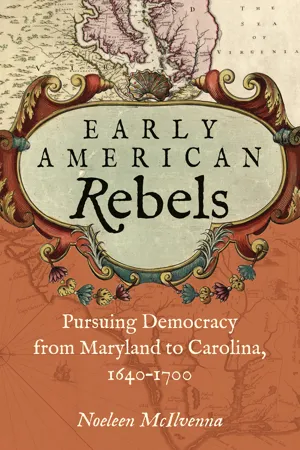
eBook - ePub
Early American Rebels
Pursuing Democracy from Maryland to Carolina, 1640–1700
- 192 pages
- English
- ePUB (mobile friendly)
- Available on iOS & Android
eBook - ePub
About this book
Information
CHAPTER ONE
Ingle’s Rebellion, 1638–1650
The Hierarchy is out of dateOur Monarchy was sick of lateBut now ’tis growne to an excellent stateOh God a mercy Parliament
The settlement of Lord Baltimore’s colony occurred in a revolutionary era. Historians often explain the early decades of Maryland’s colonial past in the context of religious tensions, but serious political tensions also simmered, carried over from England. Religion and politics were so entangled in the seventeenth-century Atlantic world that one might say that the churches, rather than court factions, anticipated political parties. As the Roundheads and Cavaliers clashed on the fields of England, important philosophical differences emerged about who should govern. Was “the Hierarchy … out of date?” How much power should Parliament have, and how widespread should the franchise be for that Parliament? These arguments played out around the Chesapeake Bay as well as in London.1
The Ark and the Dove sailed across the Atlantic in the winter months of 1633–34 to settle the coastal region north of Virginia. The passengers had left an England full of the disgruntled. Puritans seeking more local control from the Church of England were flooding into Massachusetts, and now Lord Baltimore looked to find a place that would allow Catholics to practice their faith free of harassment. In the eyes of the Puritans, Charles I’s direct rule from the throne, aided by his henchman Archbishop Laud, had made England’s state church more Catholic-friendly, with altars and prayer book, but the changes did not include bringing Catholics back in from the cold. So for dissenters of all stripes, the brand-new colonies along the water’s edge of North America beckoned with toleration. Many dissented as much from an unchecked monarchy as they dissented from the Anglican Church, although this particular monarch’s religious policies helped that political questioning along.2 That the Americas offered a chance to remake the political landscape was rarely articulated in any of the tracts and other promotional literature. To write such was treason. And the promoters, successful men on the whole, tended to favor an English political system in which they had succeeded, anyhow. This was certainly true of anyone with the title “Lord.”
The first Lord Baltimore (actually named George Calvert) had traveled to Newfoundland and Virginia in the 1620s, looking for lands that might serve both his religious and entrepreneurial bents. He was granted a charter for Maryland months after his death in 1632, and his son Cecilius inherited both the Baltimore title and the almost seven million acres in the Americas. A proprietorship guaranteed him as “the source, within the province, of office and honor, the fountain of justice, the commander of the military, the recipient of the provincial revenue.… They were in kind the power of the English monarch.” This new Lord Baltimore occupied a moderate wing of Catholicism, seeking only toleration, rather than fostering any plot to retake England for the pope. When it came to politics or any other decisions, he consistently voted for his wallet rather than adhering fundamentally to any core principles. So his new colony happily welcomed Protestants and Catholics. As long as they paid their rents and everyone could practice their faith in peace, he had no further ambition for Maryland’s settlers.3
Baltimore carefully planned his colony to resemble a little England with lords of the manor and plenty of servants and a few of the middling sort in between. Unlike today’s sprawling “middle” class, in the seventeenth-century Chesapeake region, at least 70 percent and perhaps as many as 85 percent of the population were servants.4 Maryland’s elaborate shoreline made for a scattered colony of riverine plantations, but a small town also developed in St. Mary’s City. The manorial lands—averaging 2,000 acres—were granted to gentlemen who should employ servants to raise tobacco and corn. This country squirearchy would run local courts, but defer in more important matters to the governor, Baltimore’s younger brother, Leonard Calvert. Although they were the elite of these early days in Maryland, this group should not be confused with the great aristocrats depicted in Downton Abbey or Brideshead Revisited, nor even with eighteenth-century Virginia planters, who might scoff at 2,000 acres.
However, Baltimore’s charter also contained a clause detailing the need for the “Advice, Assent, and Approbation of the Free-Men … or of their Delegates” in any legislation. Thus from the beginning, Maryland had a General Assembly, and the people had a venue for their voice. At first, the population was small enough that all freemen (even the landless) were called to the Assembly, gaining valuable experience in the administration of local affairs. Gradually some men, such as James Baldridge, carpenter Francis Gray, cooper Thomas Sturman, and Nathaniel Pope, who came to Maryland as free but poor men, went as delegates for others to St. Mary’s, and although they perhaps did not carry much weight in decision making at first, they learned by observation the work of the legislature. After Lord Baltimore vetoed early Assembly statutes, discussions about the jurisdiction of English law and the limits of Baltimore’s authority demystified, little by little, the machinations of power. As the historian of Maryland’s government describes, “Gentlemen and recent freedmen, the well-educated and the illiterate voted side by side and sat together in the assembly.” Thomas and James Baldridge served as sergeant and sheriff, respectively. These freemen, occupying a middling place in the social hierarchy, often aligned with servants rather than gentlemen. Francis Gray intervened on behalf of some servants who felt that their Catholic master was preventing their religious practice, because the servants “had no knowledge what to doe in it, nor could so well goe to the Governor for redresse as the freemen could.”5
Arriving in 1638, Thomas Gerard was considered gentleman enough that soon Baltimore awarded him one of the manors, St. Clement’s Hundred. As one of the younger sons of a gentry family in Lancashire, Gerard could not inherit land in England, but his relatives helped him get started in life with a lump sum to invest. While many men in his position joined the military or the Church, Gerard took another popular route—seeking his fortune in the colonies. In return for the generous land grant, Baltimore demanded he protect the game from poachers and prevent any of his tenants or servants from trading with the Indians, “Specially Such as Shall give or Sell to any Indian any arms or ammunition.” Gerard was also obligated to provide arms for the defense of the English on his property. He would serve as the local justice for St. Clement’s and eventually as councilor to the governor.6
Governor Calvert chose only Catholics for his inner circle, a fact that drew the suspicions of the majority-Protestant residents of the colony. But Gerard stood out. His wife, Susannah, née Snow, the sister of Justinian and Marmaduke Snow, wealthy merchants in 1630s Maryland and well connected to the Calverts, was a Protestant. She raised their ten children in that faith without any apparent conflict with her husband. Susannah Gerard, very sadly, left no voice, for her influence over events in Maryland can only be described as profound, given her husband’s and daughters’ roles over the next few decades. All evidence suggests that she was a mediatrix, as Julie Crawford defines the term for seventeenth-century women: “politically and culturally powerful, but with an edge of oppositionism; at once a patron to be honored and a force to be reckoned with.” Crawford describes the lives of several women like Gerard in England, women whose papers have been saved and archived, as Gerard’s were not. They were not “mere support staff … [but rather] the leaders and spokespeople.” These were upper-class women, of course, as was Susannah Gerard. That no one recorded any of Susannah’s words means that she never earned a reputation as a “brabbling” woman, one who faced court proceedings for unruly and inappropriate public speech. On the contrary; in the seventeenth century, the gendered restrictions on political discourse had not fully developed as they would later.7
This family situation helps explain Thomas Gerard’s actions throughout his life in the colonies. A man of toleration in an intolerant era, his philosophy could not easily be predicted from his external group identities, such as class or religion. In addition to the influence of his wife, he perhaps took his relative Gilbert Gerard as his role model. Gilbert played a prominent role in the administration of Elizabeth I and managed to protect his Catholic relatives from persecution, despite their long history of conspiracies to reinstate a Catholic monarch. Another relative of Thomas, Father John Gerard, had to escape to France after the Gunpowder Plot, because of his close association with many of the main players in that attempt to blow up the king and the House of Lords. Like Gilbert, described as “a Protestant in London, a papist in Lancashire,” Thomas Gerard in Maryland was a pragmatist devoted more to family and to having a say in government than to any theology.
Younger sons of elite families, fed by stories of Hernando Cortés and of the sugar barons of the West Indies, often dreamed of accumulating great riches in the colonies. But these dreams did not materialize in Maryland as quickly as many hoped. About half of the gentlemen returned to England. Plus, the terrible death rate of the early decades paid little respect to social rank. Most died before their mid-forties.8 Those who survived and stayed would form factions and quarrel among themselves in their quest for power. Gerard stayed out of this internecine squabbling, forming friendships and alliances with his neighbors in St. Clement’s instead.
The initial settlers in St. Clement’s, as with the rest of Maryland’s manors, were primarily young men, some free, but mostly indentured servants. Although they mostly volunteered, some had been outright kidnapped, or “spirited,” as contemporaries referred to the practice. Few had any input into their destination once they left England. Over the seventeenth century, the Chesapeake’s reputation as a torture chamber or deathtrap would grow, for the protections of an indentured servant were minimal. A ballad described the dehumanizing practices at the dockside up on arrival: “Some view’d our Limbs, tur[n]ing us round, Examining, like Horses.… Some felt our Hands, others our Legs and Feet.… Some view’d our Teeth.” The trade in servants made them feel like commodities. In 1644, Gerard gave up on a runaway servant considered valuable for his brickmaking skills and would “Sell Bargaine and make over … [his] Right, Interest and Title in the Said Servant for the full Terme of years belonging unto [him] by Indenture” to a Virginian. The brickmaker had been promised 200 acres with a furnished house and some livestock in return for three years’ labor, but three months working for Gerard was apparently enough. Other court cases reflect the commodification: Sarah Hall pleaded to be released from a cruel master. She got her wish, but the court ordered that appraisers decide her value for another “buyer.”9
From the beginning the servants mixed primarily with others in their local area. St. Clement’s lies twenty-five miles to the northeast of St. Mary’s City, on the banks of the Wicomico tributary of the Potomac. The outer coastal plain sees tidal salt water come up the river, creating wide creeks like the Wicomico and much marsh and wetland. Unfamiliarity with the region and presumably a lack of boats restricted travel around the colony. Lorena Walsh, the expert on Maryland’s colonial social history, studied the interactions of residents of St. Clement’s Manor closely, explaining that “all the repeated and ordinary contacts of male residents involved other households lying within an approximate five-mile radius of the home.” Within this geographically limited world, neighborly social engagements included fun activities like drinking and gambling, but also political debate. Far from the tight censorship of England’s Star Chamber courts, the only policing could come from Gerard himself. Walsh’s research disclosed that St. Clement’s men showed no signs of the social deference enforced in the home country, freely “expressing resentment about the social pretensions of the emerging ruling class. Talk about the sexual irregularities or incapacities of county officials or of the alleged promiscuity of their wives served to bring those in power down to the level of the politically powerless.”10
The material culture supported this refusal to acknowledge social rank. Carving out small homes in the wilderness, the elite of seventeenth-century Maryland rarely went to the trouble and expense of transporting across the Atlantic the fancy trappings used to distinguish social class in England.11 In addition to the lack of status symbols, the opportunity for many of humble background to own land blurred the lines of class distinction always at the forefront back home. Population density in England made the ownership of land the predominant marker between the haves and the have-nots. In the British colonies in the Americas, as disease decimated the native population, land seemed plentiful. So elites had to find workers to produce tobacco through the backbreaking labor of clearing forests and then cultivation. In the seventeenth and eighteenth centuries, control of the labor of others gradually emerged as the definition of status. By the turn of the eighteenth century, the racialized nature of labor made race itself the carrier of status in the southern colonies.
But in the early 1640s, before the African slave trade made much impact on Maryland’s economy or society, transplanted Englishmen fought among themselves for the chance at profit from land and trade. Serious tension between an individual based in Virginia named William Claiborne and the Calvert family over ownership of Kent Island had already come to blows. Claiborne, having built a close and lucrative partnership with the Susquehannocks, constructed an elaborate trading post on Kent before the Maryland Charter granted the island to the Calverts. Claiborne and his trading partners and employees fought off attempts by the new Maryland regime to claim the island and the business in the mid-1630s. They believed that the fur trade would be threatened by settlers, whose desire for land would damage the peaceful and profitable relationships between the Susquehannocks and Claiborne. But by 1638, as Thomas Gerard arrived, Calvert had finally taken the island, and Claiborne had been charged with sedition.12 He had not surrendered, however, and would continue to plead his case.
Both Claiborne and the Calverts had high connections in London, where the final word on jurisdictional issues sat. Until 1640, the most powerful of all these connections was of course the Calverts’ friend, the king. But as the tensions between Crown and Parliament came to a boil, Claiborne’s allies John Pym and John Hampden, leaders in Parliament’s opposition to Charles I, emerged at the forefront of the struggle to limit monarchical absolutism. The colonies thousands of miles away were not so removed from the enormous upheaval of the next two decades as we might expect. Roger Williams, founder of Rhode Island, while attending his patron Edward Coke, witnessed the king’s arrest of Pym and Hampden and met Oliver Cromwell before setting off for the colonies. Hugh Peters of Massachusetts headed back to join his Puritan friends in their fight and became a leader of the regicides, those who would bring about the execution of the king and the establishment of a short-lived r...
Table of contents
- Cover
- Title Page
- Copyright
- Dedication
- Contents
- Figure and Maps
- Acknowledgments
- Introduction
- Chapter One: Ingle’s Rebellion, 1638–1650
- Chapter Two: Fendall’s Rebellion, 1650s
- Chapter Three: Albemarle and Other Fringes, 1661–1674
- Chapter Four: Revolution in the Chesapeake, 1675–1679
- Chapter Five: Papists in Trouble, 1681–1688
- Chapter Six: Religion Is but Policy, 1689–1699
- Conclusion
- Notes
- Bibliography
- Index
Trusted by 375,005 students
Access to over 1.5 million titles for a fair monthly price.
Study more efficiently using our study tools.
Frequently asked questions
Yes, you can cancel anytime from the Subscription tab in your account settings on the Perlego website. Your subscription will stay active until the end of your current billing period. Learn how to cancel your subscription
No, books cannot be downloaded as external files, such as PDFs, for use outside of Perlego. However, you can download books within the Perlego app for offline reading on mobile or tablet. Learn how to download books offline
Perlego offers two plans: Essential and Complete
- Essential is ideal for learners and professionals who enjoy exploring a wide range of subjects. Access the Essential Library with 800,000+ trusted titles and best-sellers across business, personal growth, and the humanities. Includes unlimited reading time and Standard Read Aloud voice.
- Complete: Perfect for advanced learners and researchers needing full, unrestricted access. Unlock 1.5M+ books across hundreds of subjects, including academic and specialized titles. The Complete Plan also includes advanced features like Premium Read Aloud and Research Assistant.
We are an online textbook subscription service, where you can get access to an entire online library for less than the price of a single book per month. With over 1.5 million books across 990+ topics, we’ve got you covered! Learn about our mission
Look out for the read-aloud symbol on your next book to see if you can listen to it. The read-aloud tool reads text aloud for you, highlighting the text as it is being read. You can pause it, speed it up and slow it down. Learn more about Read Aloud
Yes! You can use the Perlego app on both iOS and Android devices to read anytime, anywhere — even offline. Perfect for commutes or when you’re on the go.
Please note we cannot support devices running on iOS 13 and Android 7 or earlier. Learn more about using the app
Please note we cannot support devices running on iOS 13 and Android 7 or earlier. Learn more about using the app
Yes, you can access Early American Rebels by Noeleen McIlvenna in PDF and/or ePUB format, as well as other popular books in History & Early American History. We have over 1.5 million books available in our catalogue for you to explore.