An important investigation of the sociocultural fallout of America's work on the atomic bomb
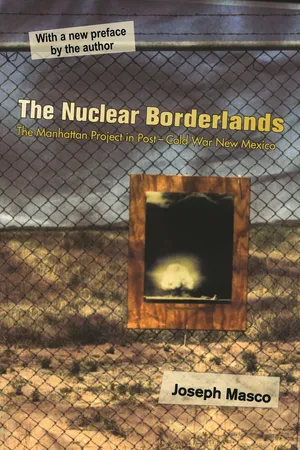
In The Nuclear Borderlands, Joseph Masco offers an in-depth look at the long-term consequences of the Manhattan Project. Masco examines how diverse groups in and around Los Alamos, New Mexico understood and responded to the U.S. nuclear weapons project in the post–Cold War period. He shows that the American focus on potential nuclear apocalypse during the Cold War obscured the broader effects of the nuclear complex on society, and that the atomic bomb produced a new cognitive orientation toward daily life, reconfiguring concepts of time, nature, race, and citizenship. This updated edition includes a brand-new preface by the author discussing current developments in nuclear politics and the scientific impact of the nuclear age on the present epoch of a human-altered climate.
eBook - ePub
The Nuclear Borderlands
The Manhattan Project in Post–Cold War New Mexico | New Edition
- English
- ePUB (mobile friendly)
- Available on iOS & Android
eBook - ePub
About this book
Information
1 The Enlightened Earth
The Enlightenment has always aimed at liberating men from fear and establishing their sovereignty. Yet the fully enlightened earth radiates disaster triumphant.—Horkheimer and Adorno, The Dialectic of Enlightenment
The nuclear age began in earnest in New Mexico.1 Los Alamos scientists created much more than simply a new technology with the invention of a military atomic device in 1945; they engendered new forms of consciousness, new means of being in the world distinct from those that came before. For over a half century now, the psychosocial spaces of American modernity have been shaped by the most prominent legacies of Los Alamos: a utopian belief in the possibility of an unending technological progress, and an everyday life structured around the technological infrastructures of human extinction. The Manhattan Project not only marks the beginning of American big science and a new kind of international order; the invention of the atomic bomb transformed everyday life, catching individuals within a new articulation of the global and the local, and producing social imaginaries drawn taut by the contradictory impulses of the technologically celebratory and the nationally insurgent, as well as the communally marginalized and the individually abject.
Looking back across the temporal surface of the Cold War, the purple fireball and glassified green earth created in the deserts of New Mexico at exactly 5:29:45 a.m. on July 16, 1945, can only be narrated as a moment of historical rupture and transformation (see Figure 1.1).2 For the detonation of the first atomic bomb marked the end of one kind of time, and the apotheosis of another, an uncanny modernity that continually exceeds the language of “national security,” “mutual assured destruction,” the “Cold War,” or even “terror.” For this reason alone, we might profitably return to the northern Rio Grande to assess the legacy and implications of one of the twentieth century’s most enigmatic, yet lasting, achievements. For with the flash of the explosion known as Trinity, certain contradictions in modern life—involving the linkages between secrecy, security, technoscience, and national identity—become increasingly extreme in the United States, and much of this book is an exploration of the anxieties and ambivalences in American power made visible by the end of the Cold War in New Mexico.

1.1. The Trinity Test, July 16, 1945, 5:29:45 a.m. (U.S. Department of Energy photograph)
Attention to the local effects of the nuclear age, however, also promises a different vantage point on the phantasmagoria of nuclear conflict promulgated during the Cold War, both disturbing its familiarity and challenging its social purpose. Since Hiroshima and Nagasaki, nuclear war has repeatedly been marked in American culture as “the unthinkable,” an official declaration that no government would willingly engage in actions that could potentially end life on earth.3 But today, in the absence of the Soviet-U.S. global polarism and during an expanding “war on terror,” we might interrogate the “unthinkability” of the nuclear age anew, and ask: What kind of cultural work is performed in the act of making something “unthinkable”? How has the social regulation of the imagination—in this case, of nuclear war—been instrumental in American life since World War II? What are the legacies of this social project after the Cold War, in a world once again negotiating “nuclear terror”? For to make something “unthinkable” is to place it outside of language, to deny its comprehensibility and elevate it into the realm of the sublime. The incomprehensibility of the bomb is therefore an enormous national-cultural project, one whose effects constantly exceed the modernist logics required to build the nuclear complex in the first place. But what then encompasses the cultural spaces left behind when a national project of the size and scope of the nuclear complex is excised from political discourse? What happens when the submerged cultural legacies of nuclear nationalism come flooding back into the public sphere, as they did for communities in and around Los Alamos upon the end of the Cold War in 1991 or for a broader American public after the terrorist attacks on New York and Washington on September 11, 2001?
In a post–Cold War world, then, we might usefully interrogate the cultural work performed by a nation-state in managing so explicit an image of its own end, of controlling the terms whereby citizens are confronted with their own, impossibly sudden, nonexistence. For if it is reasonable, as Benedict Anderson has argued, to “begin a consideration of the cultural roots of nationalism with death” (1991: 10), then the nuclear complex remains a particularly potent national project, informing one way in which citizens imagine both their collective lives and deaths. The unthinkability of the nuclear age has from this vantage point been perhaps the American nation-building project since World War II. The cultural logic of ensuring the “immortality” of the nation, which Anderson has shown is characteristic of the modern nation-state, is also, however, immediately compromised by the reality of nuclear weapons. The contradiction nuclear arsenals evoke is that as more national-cultural energy is put into generating “security” through improved weapons systems, the vulnerability of the nation to new military technology is ever further revealed; indeed, as the U.S.-Soviet arms race demonstrated, it is worked out in ever-exacting detail. The pursuit of “security” through ever-greater technological means of destruction thus troubles the nation’s internal coherence by constantly forwarding the everyday possibility of the ultimate national absence. Indeed, what Paul Edwards (1996) has called the “closed world” system of American Cold War technology—the ideological commitment to encompassing the globe with perfect technologies of command, control, surveillance, and military nuclear power—ultimately offered nuclear superpowers a perverse new form of immortality, one drawn from the recognition that a nuclear war might well be the last significant national act on earth.
The “unthinkability” of the nuclear age has right from the beginning, then, produced its rhetorical opposite; namely, a proliferation of discourses about vulnerability and insecurity.4 This is easiest to see in the periods of heightened international tensions of the early 1950s, 1960s, 1980s, and 2000s, when the unthinkability of nuclear war, in fact, made it impossible for many in the United States to think about anything else. But even in periods of relative international calm, Cold War nuclear discourse retained a specific trajectory in the United States, one that inevitably focused attention on the imagined end of the nation, and thus of life itself. Given that a nuclear war has not yet occurred, this apocalypticism remains at the level of a national imaginary. Nevertheless, an imagined end to the nation, or the human species, energized the argumentative core of (post) Cold War nuclear discourse and continues to this day to enable social movements both for and against the construction of the U.S. nuclear complex.5 In other words, the nuclear politics of the Cold War, the steady discourse and counterdiscourse of nuclear/antinuclear commitments, has promoted a specific apocalyptic vision in the United States, one that has made it difficult to see how the nuclear age has already impacted everyday lives.
With the end of that multigenerational project known as the Cold War, we might now interrogate the repressed spaces within nuclear modernism; that is, the social logics, technoscientific practices, and institutional effects that were rendered invisible by this national fixation on extinction. We can now examine how more than a half century of international work to construct a global nuclear economy has affected everyday lives on a local level, paying attention to the regional and cultural complexities and specificities of life in the nuclear age. For while we all still live in a world quite capable of nuclear war, the cumulative effects of the nuclear complex are already both more subtle and more ever-present than (post) Cold War culture has allowed, affecting some lives more than others, and impacting local ecologies and cultural cosmologies in ways that we have yet to recognize fully. To approach nuclear technologies from the quotidian perspectives of tactile experience, focusing on how people experience an orientation in time and space, and an individual relationship with a national-cultural infrastructure, is to fundamentally rewrite the history of the nuclear age. Indeed, attention to the local effects of the nuclear complex makes strange the invisibility of the U.S. arsenal in everyday American life, and allows us to interrogate the national-cultural work performed in the act of making so enormous a national project reside in the “unthinkable.” Consequently, it may be more useful to approach nuclear war as a phantasmagoria, a spectral fascination that distracts attention from the ongoing daily machinations of the U.S. nuclear complex. Indeed, the constant end game articulation of nuclear discourse has, I think, enabled two of the most profound cultural achievements of the nuclear age: the near erasure of the nuclear economy from public view, and the banalization of the U.S. nuclear weapons in everyday American life. The consequence of this historical structure is that the U.S. nuclear complex is primarily visible today only in moments of crisis, when the stakes of nuclear policy are framed by heightened anxiety, and thus, subject, not to reassessment and investigation, but to increased fortification. The material and cultural effects of U.S. nuclear weapons—involving local, national, and global structures—are more deeply embedded in everyday life than is visible in moments of national crisis, making a contemporary analysis of the regional effects of the Manhattan Project simultaneously an ethnographic study of a specific technoscientific project, a sociocultural investigation into American Cold War culture, and an anthropology of American power in the twenty-first century.
THE NUCLEAR STATE OF EMERGENCY
From the invention of the cross-bow in the 12th century, to gunpowder in the Middle Ages, to Alfred Nobel’s invention of high explosives, man has had but few restraints on having learned how to kill more effectively. Our ability to destroy each other reached new heights early this century with the invention of mustard and nerve gases, and airplanes and submarines deployed in war. By World War II, mankind had escalated its ability to kill 55 million people in one war. The atomic bomb changed all of this … Over 80 million of the 100 million war related deaths so far this century occurred in its first half. I believe the devastation and the psychological impact of Hiroshima and Nagasaki combined with the realization of even greater destructive power of modern nuclear arsenals, drove deterrence diplomacy and bought us time. It appears that for the first time in human history mankind has paused and not used the latest technological innovation in warfare … However, the resulting “peace” was an uneasy one at best as the Soviet Union and the United States built nuclear arsenals totaling the destructive power of millions of Hiroshimas.—Sig Hecker (director, Los Alamos National Laboratory), Reflections on Hiroshima and NagasakiThe tradition of the oppressed teaches us that the “state of emergency” in which we live is not the exception but the rule. We must attain to a conception of history that is in keeping with this insight. Then we shall clearly realize that it is our task to bring about a real state of emergency, and this will improve our position in the struggle against Fascism. One reason why Fascism has a chance is that in the name of progress its opponents treat it as a historical norm. The current amazement that the things we are experiencing are “still” possible in the twentieth century is not philosophical. This amazement is not the beginning of knowledge—unless it is the knowledge that the view of history which gives rise to it is untenable.—Walter Benjamin, Theses on the Philosophy of History
Sig Hecker’s statement offers a compelling modernist history of the nuclear age, a Cold War narrative of nuclear technology “buying time” for humanity even as the stakes of national conflict grow ever higher. As director of Los Alamos National Laboratory (LANL) (1985–97), Hecker’s primary job was to certify the viability of the nuclear arsenal, to ensure that the United States maintain the ability to inflict “overwhelming power” against any would-be aggressor. His genealogy of the bomb—moving from the crossbow to the thermonuclear warhead—forwards weapons science as an inseparable component of historical progress. Published in LANL’s Newsbulletin on the occasion of the fiftieth anniversary of the atomic bombing of Hiroshima and Nagasaki in 1995, Hecker’s essay reiterates the necessity of nuclear weapons as a means of deterring both nuclear and conventional war. He ends with a call for Los Alamos employees to “keep the horrid images of Hiroshima and Nagasaki in front of us as a stark reminder of what we must avoid” and to focus attention “on dealing with the current nuclear dangers to the benefit of mankind so that at the 100th anniversary people can look back and say the Manhattan Project turned out all right.”
What is remarkable in this statement is not simply the brute calculation of life attributed to the U.S. nuclear arsenal—80 million killed in twentieth-century wars before the bomb, 20 million after—or the taken-for-granted assumption that the existence of nuclear weapons prevented a third World War in this century; it is that Hecker seems to suggest that the bomb’s primary power is cultural not technological: nuclear weapons affect how people think. But while the cultural work of the bomb may have postponed a nuclear war with the Soviet Union, it did not slow the commitment to developing technologies of mass destruction. Between August 6, 1945, and August 6, 1995, the power of nuclear weapons, as Hecker notes, increased many thousandfold, and technologies were invented to deliver U.S. nuclear weapons to any part of the world in less than thirty minutes. Hecker’s notion of the cultural work of the bomb is, then, quite specific, one based on separating the social effects of the bomb from the reality of the bomb itself. For implicit within the cosmology of weapons scientists is an understanding that nuclear technologies are now forever part of the world system, and consequently, the need for a state-of-the-art nuclear arsenal, as a deterrent, is a near-permanent feature of modern life. Thus, the Manhattan Project can never really end. It can, however, “turn out all right” in Hecker’s view, if a national commitment to new technologies enables renewed investment in nuclear power, a global system for tracking plutonium, environmental cleanup of contaminated sites, safe storage of nuclear waste, and ongoing investments to maintain a state-of-the-art nuclear arsenal. Within this philosophy of history, the end of the Cold War offers merely a moment of pause, a chance to readjust the trajectory of the Manhattan Project, but it does not significantly reduce (indeed, in some ways it reenergizes) the technostrategic worldview that enabled the U.S. nuclear complex to become ubiquitous in the first place.
Walter Benjamin’s, like Hecker’s, theory of progress is grounded in the terrifying reality of World War. But whereas Hecker looks to technology to provide solutions to nationalist violence, Benjamin looks for answers in the vulnerability of the human body to modern technology. Benjamin wrote the “Theses on the Philosophy of History” while trying to escape an advancing Nazi army in 1940. It has often been evoked by contemporary Euro-American scholars as a prescient critique of the anesthesia-effect of modern life, the increasing sense of isolation and insulation from experience brought about by the combined effect of the swift pace of new industrial technologies and a flood of new urban forms (see Buck-Morss 1991). Benjamin believed this overstimulation of the body after World War I forced individuals to retreat inward, to take psychological refuge from the new dangers of an increasingly industrialized world by cutting themselves off from sensory experience, by anesthetizing themselves in everyday life.6 By drawing together contemporary social forms and their recently outmoded predecessors to create a “dialectical image,” Benjamin sought to produce a “shock” effect, one that revealed the constantly reconstructed sameness of modern life, enabling people to break through the trancelike state produced by a sea of changing commodities and technologies, and envision an emancipatory social movement. In this way, he sought to create “a real state of emergency” that would disrupt the historical possibility of fascism by changing the terms of “progress” to emphasize not the machine, but the quality of everyday life and the fragility of the human body.
Though Benjamin did not live to enter the nuclear age, his critique of modernity in the 1930s remains relevant to any investigation into how nuclear technologies have affected everyday life since the bombing of Hiroshima and Nagasaki. For Benjamin saw not only the liberatory potential of technology but also how the aestheticizing effects of technology could enable new kinds of mass control, making industrial warfare even seem beautiful, and therefore, seductive (1969b: 241).7 In his most celebrated essay, “The Work of Art in the Age of Mechanical Reproduction,” largely remembered for its embrace of technology as a form of social revolution, Benjamin also warned that “all efforts to render politics aesthetic culminate in one thing: war” (1969b: 240–41; see also Buck-Morss 1992). The aestheticizing of nuclear technology by nation-states during the Cold War would elevate Benjamin’s question about the social consequences of industrial technology into the realm of planetary survival. Indeed, America’s initial response to fascism was profoundly modernist: it consisted of a radical break with history achieved through a new industrial technology, the atomic bomb. The Manhattan Project, quite subversively, produced the kind of “shock” effect Benjamin had hoped to achieve—a new experience of everyday life grounded in the vulnerability of the human body. In the brief window between the bombings of Hiroshima and Nagasaki and the start of the Cold War, many in the United States, including some of the primary figures at Los Alamos, believed that the achievement of the atomic bomb made war obsolete as a means of solving conflict and initiated a global movement for the control of nuclear technologies.8 America’s explosive entry into the nuclear age, thus, produced a flash of insight enabling some in the United States to imagine a fundamental restructuring of (inter)national order. This detonation in political consciousness was on the order of what Benjamin hoped to achieve through his critical work, as national violence was now irrevocably tied to the possibility of human extinction, a reality that se...
Table of contents
- Cover Page
- Title Page
- Copyright Page
- Table of Contents
- Preface to the 2020 Edition
- List of Illustrations
- Acknowledgments
- 1. The Enlightened Earth
- Part I Everyday Life in the Plutonium Economy
- Part II National Insecurities
- Notes
- References
- Index
Trusted by 375,005 students
Access to over 1.5 million titles for a fair monthly price.
Study more efficiently using our study tools.
Frequently asked questions
Yes, you can cancel anytime from the Subscription tab in your account settings on the Perlego website. Your subscription will stay active until the end of your current billing period. Learn how to cancel your subscription
No, books cannot be downloaded as external files, such as PDFs, for use outside of Perlego. However, you can download books within the Perlego app for offline reading on mobile or tablet. Learn how to download books offline
Perlego offers two plans: Essential and Complete
- Essential is ideal for learners and professionals who enjoy exploring a wide range of subjects. Access the Essential Library with 800,000+ trusted titles and best-sellers across business, personal growth, and the humanities. Includes unlimited reading time and Standard Read Aloud voice.
- Complete: Perfect for advanced learners and researchers needing full, unrestricted access. Unlock 1.5M+ books across hundreds of subjects, including academic and specialized titles. The Complete Plan also includes advanced features like Premium Read Aloud and Research Assistant.
We are an online textbook subscription service, where you can get access to an entire online library for less than the price of a single book per month. With over 1.5 million books across 990+ topics, we’ve got you covered! Learn about our mission
Look out for the read-aloud symbol on your next book to see if you can listen to it. The read-aloud tool reads text aloud for you, highlighting the text as it is being read. You can pause it, speed it up and slow it down. Learn more about Read Aloud
Yes! You can use the Perlego app on both iOS and Android devices to read anytime, anywhere — even offline. Perfect for commutes or when you’re on the go.
Please note we cannot support devices running on iOS 13 and Android 7 or earlier. Learn more about using the app
Please note we cannot support devices running on iOS 13 and Android 7 or earlier. Learn more about using the app
Yes, you can access The Nuclear Borderlands by Joseph Masco in PDF and/or ePUB format, as well as other popular books in History & North American History. We have over 1.5 million books available in our catalogue for you to explore.