The literature describing social conditions during the post–World War II Allied occupation of Germany has been divided between seemingly irreconcilable assertions of prolonged criminal chaos and narratives of strict martial rule that precluded crime. In The Art of Occupation, Thomas J. Kehoe takes a different view on this history, addressing this divergence through an extensive, interdisciplinary analysis of the interaction between military government and social order.
Focusing on the American Zone and using previously unexamined American and German military reports, court records, and case files, Kehoe assesses crime rates and the psychology surrounding criminality. He thereby offers the first comprehensive exploration of criminality, policing, and both German and American fears around the realities of conquest and potential resistance, social and societal integrity, national futures, and a looming threat from communism in an emergent Cold War. The Art of Occupation is the fullest study of crime and governance during the five years from the first Allied incursions into Germany from the West in September 1944 through the end of the military occupation in 1949. It is an important contribution to American and German social, military, and police histories, as well as historical criminology.
eBook - ePub
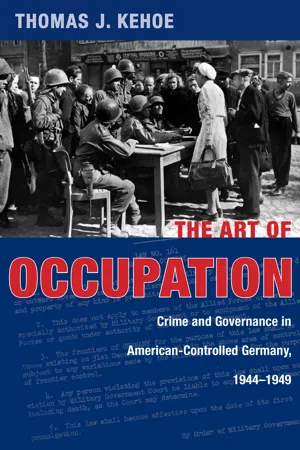
The Art of Occupation
Crime and Governance in American-Controlled Germany, 1944–1949
- 382 pages
- English
- ePUB (mobile friendly)
- Available on iOS & Android
eBook - ePub
About this book
Information
Subtopic
20th Century HistoryIndex
HistoryPART I
Tradition and an Unprecedented Enemy: Planning and First Steps
1 Crime and Control in American Military Thought
Mother and daughter, Friedel and Marianne Souvigier appeared before an American military tribunal on 27 September 1944, charged with disobeying a military government (MG) order, an unspecified but likely minor breach of the peace. They were residents of rural district Aachen (Landkreis Aachen), which surrounded the city, and they may have been the first Germans formally prosecuted by American occupiers on German territory. American forces had crossed the German-Belgian border just one week earlier, and the city of Aachen remained under German control. Despite its proximity to the front, the trial was a proper affair. Personal details for each woman including their residences and ages (Friedel was fifty and Marianne seventeen) were recorded in the military court register along with the names of the other participants. The officer acting as judge was Captain Kurt L. Walitschek and the women’s defense counsel was Dr. Philip Bohne.1
Attendance of a defense lawyer was a privilege not mandated by the MG Legal Code for frontline trials, and it was rarely employed thereafter. His presence complemented the trappings of formality around the court proceedings and highlighted the importance the Americans placed on martial law. By contrast, Walitschek’s decisions illuminate the tension between appearance and pragmatism in American military occupation. Bohne represented the six defendants prosecuted that day and lost every case. Friedel and Marianne were convicted and received harsh sentences, six months in prison for Friedel and a fine of 2,000 reichsmarks (RM) or two hundred days in prison for Marianne. These sentences were later reduced to thirty days’ and fifty days’ imprisonment. Like every American officer overseeing occupation, Walitschek grappled with whether martial law was about justice or about control for the sake of military expediency. It was traditionally determined to be the latter.2
Actions, Orders, and Guidelines
Nuremberg and Augsburg fell in quick succession to the US Seventh Army in the second half of April 1945. The Americans encountered stiff resistance at Nuremberg, finding that the Germans, despite being heavily outnumbered, were “fanatical” defenders who forced the Americans to fight “room to room” through the city for five days.3 The Americans turned toward Augsburg following Nuremberg’s capture, expecting another ferocious fight for the bridges over the River Lech en route to Munich. Instead, a hastily formed “Freedom Party” comprising many of Augsburg’s leaders organized its surrender, and Americans entering early on 28 April were astounded to see that “white flags were hanging from the windows.”4
Military government officers (MGOs) arrived in each city shortly after its capture. They faced vastly different conditions. Nuremberg remained a combat zone filled with thousands of Germans and non-German displaced persons (DPs) when Major Clarence E. Hamilton established MG headquarters on 20 April. Sustained bombing and fighting had reduced the city to its bones, and the “occasional sniper” still stalked the streets.5 Augsburg, by contrast, was bombed once during the war. Its people were surely traumatized, but their surrender meant that Colonel Joseph C. Joublanc could better count on their compliance.6 Despite the different circumstances, Hamilton and Joublanc followed standing orders for establishing military rule. Martial law replaced German law and was supplemented by the special MG legal code enunciated in Section 2M of the Military Government Handbook, Germany. Curfews and travel restrictions were imposed, and weaponry, wireless transmitters, and carrier pigeons were confiscated. Criminal offenders of all types from petty thieves to partisans who attacked the Allied forces would be tried before military tribunals. But asserting control was the most pressing issue in these earliest hours of the occupation, and restoring order was the first step.7
According to Hamilton, crime was initially his “most difficult problem.”8 The Americans tended to immediately free the Nazis’ foreign forced laborers, giving them the freedom to celebrate but also to drink, riot, and seek revenge against Germans.9 In Nuremberg, thousands of these newly created “DPs” were “on the loose … looting,” and reports of disorder flooded in from around the city.10 Hamilton turned to the German police to calm the situation. On 21 April, he placed a captured police captain in charge of 150 officers. Though stripped of their uniforms, they retained many of their powers, and Hamilton charged them with distributing MG proclamations and assisting in crowd control. He noted in his diary that the Counter Intelligence Corps (CIC) would eventually screen these police for Nazi affiliations, but until then, preventing “general disorganization” was more pressing than denazification.11 He then reopened a local prison to house arrested persons. When rioting continued, he ordered the detention of all non-German DPs. A military tribunal was established three days later to begin trying the hundreds of people arrested.12
Joublanc in Augsburg also prioritized control, despite the city’s surrender. He also turned to German bureaucrats and police to effect the new regime. Most bureaucrats and administrators in the city were part of the Freedom Party that had surrendered before the mayor and Nazi Gauleiter committed suicide rather than be captured by the Americans.13 The Germans were still surprised by the power Joublanc granted to a new city leadership after a perfunctory selection process. The colonel questioned candidates for mere minutes before appointing them to key positions.14 Josef Mayr, the new regional magistrate (Oberbürgermeister) he appointed, later expressed astonishment that only ten American officers were left to supervise a mostly German government.15
Hamilton’s and Joublanc’s actions reflected the US military’s guiding principles that were articulated in handbooks and training. Both pursued social order, which was the fundamental objective for military government. But there were also differences in their approaches. Hamilton established MG courts almost immediately.16 For reasons that are unclear, courts were not established in Augsburg until 11 June, though its surrender may have mitigated the rioting and looting that necessitated immediate trials.17 These variations reflected a pattern of small, compounding differences between MG regions that was often most apparent in policing and criminal justice. For instance, MGOs recruited and uniformed German police at different rates. Sentences for the same offense also varied wildly. Across different regions (city and rural), the average punishment for violating curfews ranged between nineteen and seventy-one days’ imprisonment.18
These variations came from the wide-ranging discretion afforded to MGOs in the districts. It was exemplified in the MG Legal Code by two catchalls—Sections 21 and 43—that allowed officers to prosecute as a criminal offense virtually any behavior deemed “disobedience” or an “act to the prejudice of the good order.” Throughout the occupation, MGOs applied them to everything from public drunkenness and offensive language to murder. The ceding of such latitude and power to frontline officers at the rank of lieutenant, captain, and occasionally major was contentious and drew criticism from within and outside the military. Members of the military’s legal division objected most vociferously. In September 1945 for instance, legal officer for MG in Bruchsal, Baden-Württemberg, First Lieutenant William G. East wrote a memorandum to the detachment commander complaining about other MGOs’ regular deviations from what he saw as proper legal procedures. These included ignoring sentencing guidelines and voiding arrests without proper hearings or record.19 He was not alone. In 1947, chief of MG courts in Bavaria Eli E. Nobleman recommended that all defendants convicted of illegally possessing a firearm be imprisoned for approximately five years.20 Even at the beginning of the occupation, such recommendations had rarely been followed. In 1945, the average sentence handed down by MG courts in Bremen was 234 days’ imprisonment; it was a mere 41 days in Augsburg.21 Such variations led Nobleman to lament that across the board, MG’s approach to criminal justice was at best “haphazard.”22
These criticisms had little impact on MGOs’ consequentialist approach to military rule. But such flexible attitudes to law enforcement, sentencing, and the use of Germans in government were seemingly at odds with the Allies’ long-held aim to destroy Nazism. American and British command expected tenacious Nazi resistance during the occupation. As late as April 1945, the chief of staff for the Supreme Headquarters Allied Expeditionary Forces (SHAEF)—the overarching command structure on the western front—British Lieutenant-General Frederick E. Morgan was sufficiently confident that Germans would continue fighting after defeat of their regular army. He reminded commanders that draconian anti-reprisal measures were permitted,23 including “forced evacuation” and “destruction” of resistant areas “by bombing, artillery fire, or burning.”24 The need for such violence seemed to necessitate a repressive occupation. It was a vision of MG that SHAEF supreme commander, American general Dwight Eisenhower, appeared to suggest when characterizing MG as the answer to Nazi insurgency.25 Strict martial law would allow “resistance to … be ruthlessly stamped out,” he announced on the eve of the Western Allies’ invasion of Germany in September 1944.26
But as powerful as fears of German resistance were within Allied command, most MGOs on the ground approached occupation like Hamilton and Joublanc did, relying on cooperative Germans.27 The structure of MG meant that it could not be about domination. Small MG detachments (labeled so because they were groups of officers “detached” from a larger unit) comprising between five and twenty officers and an equal number of enlisted men were responsible for each city and rural district captured by the Allies.28 Consequently, Germans were expected to offer more than deference to martial law; they were to provide material assistance to MG.29 Thus at its very heart, there was a conflict in the American military’s approach to occupation during World War II between fear of Nazism and the expectation that MGOs could rely on helpful Germans.
The Long History of American Military Government
The conflict was not so apparent in late 1941 when, following the United States’ entrance into the war, the military began training officers for foreign occupation. The US Army’s Provost Marshal’s Office (PMO) established the first Military Government Training School in May 1942 at the Charlottesville campus of the University of Virginia. The academic setting was chosen to impart the challenging and august nature of this endeavor.30 The army felt that such training could not be formulaic learning by rote; MGOs had to understand the complex military science of occupation and acquire the critical skills necessary to adapt to unforeseen conditions. Academics from Yale and Johns Hopkins Universities developed the six-month curriculum and imbued it with the intellectual rigor they believed military governance required.31 On completion, each man graduated with a diploma from the University of Virginia.32 In turn, students were carefully selected for their academic abilities, most coming from civilian white-collar professions.33
The instructors were career officers, uniformed professionals, and academics. Among them were Major General David P. Barrows, an anthropologist and former president of the University of California; Joseph P. Harris, later of the University of California at Berkeley’s Institute of Governmental Studies; and career officer Major General Thomas H. Green, who became judge advocate general in 1945.34 Many of the teachers had served in previous foreign interventions. Prior experience shaped their thinking, and they brought a range of views on issues from the phases of MG operations to salient historical precedents and the viability of American colonialism.35 Some even plumbed antiquity and reached to ancient Greece and Rome for examples their students should follow.36
These differing viewpoints reflected a consensus within the military that the conduct of military occupation and foreign governance was complex. There was no set formula for a perfect operation. Instead, it required deftness and creativity in officers’ thinking, which was reflected in the differing views of the school’s faculty. Barrows, for instance, questioned the prevailing view that military government was apolitical, existing purely during open warfare. He thought that the attempt to separate the strategic aims guiding a particular military occupation from a nation’s political intentions created an acontextual approach that denied the obvious: war was an instrument of international politics. The military, in his view, should acknowledge the political implications of its actions, though he noted that such thinking was outside the mainstream, writing, “At any rate, and however this question of definition may be decided, in this country we know very well what military government is, not so much from attempts at its legal definition as from its actual exercise.”37 Such debate about even the fundamental philosophy of MG highlighted for students the importance of critically thinking through all aspects of military occupation. And to that end, the curriculum at Charlottesville was wide-ranging in its coverage of governance, from security, criminal justice, and repression of insurgency to economic management and cultivation of morale.38
Un...
Table of contents
- Cover
- Title Page
- Copyright
- Dedication
- Contents
- Acknowledgments
- Introduction
- Part I: Tradition and an Unprecedented Enemy: Planning and First Steps
- Part II: Destruction, Disorder, Fear, and Fantasy: The Direct Military Occupation of Germany, 1945–1946
- Part III: Enduring Legacies, 1947–1949: Threat, Policing, and a Culture of Anxiety
- Conclusion
- Appendix: The Military Government Legal Code: Proclamations, Ordinances and Laws Issued by Allied Military Government in Germany
- Glossary of Terms
- Notes
- Bibliography
- Index
Trusted by 375,005 students
Access to over 1.5 million titles for a fair monthly price.
Study more efficiently using our study tools.
Frequently asked questions
Yes, you can cancel anytime from the Subscription tab in your account settings on the Perlego website. Your subscription will stay active until the end of your current billing period. Learn how to cancel your subscription
No, books cannot be downloaded as external files, such as PDFs, for use outside of Perlego. However, you can download books within the Perlego app for offline reading on mobile or tablet. Learn how to download books offline
Perlego offers two plans: Essential and Complete
- Essential is ideal for learners and professionals who enjoy exploring a wide range of subjects. Access the Essential Library with 800,000+ trusted titles and best-sellers across business, personal growth, and the humanities. Includes unlimited reading time and Standard Read Aloud voice.
- Complete: Perfect for advanced learners and researchers needing full, unrestricted access. Unlock 1.5M+ books across hundreds of subjects, including academic and specialized titles. The Complete Plan also includes advanced features like Premium Read Aloud and Research Assistant.
We are an online textbook subscription service, where you can get access to an entire online library for less than the price of a single book per month. With over 1.5 million books across 990+ topics, we’ve got you covered! Learn about our mission
Look out for the read-aloud symbol on your next book to see if you can listen to it. The read-aloud tool reads text aloud for you, highlighting the text as it is being read. You can pause it, speed it up and slow it down. Learn more about Read Aloud
Yes! You can use the Perlego app on both iOS and Android devices to read anytime, anywhere — even offline. Perfect for commutes or when you’re on the go.
Please note we cannot support devices running on iOS 13 and Android 7 or earlier. Learn more about using the app
Please note we cannot support devices running on iOS 13 and Android 7 or earlier. Learn more about using the app
Yes, you can access The Art of Occupation by Thomas J. Kehoe in PDF and/or ePUB format, as well as other popular books in History & 20th Century History. We have over 1.5 million books available in our catalogue for you to explore.