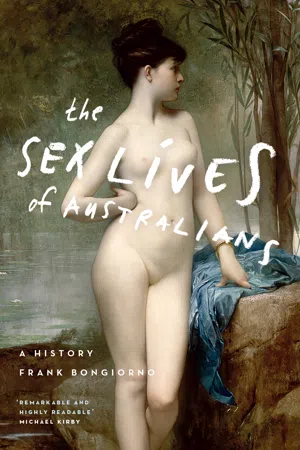
Cross-dressing convicts, effeminate bushrangers and women-shortage woes – here is the first ever history of sex in Australia, from Botany Bay to the present-day.In this fascinating social history, Frank Bongiorno uses striking examples to chart the changing sex lives of Australians. Tracing the story up to the present, Bongiorno shows how the quest for respectability always has another side to it.Along the way he deals with some intriguing questions – What did it mean to be a 'mate'? How did modern warfare affect soldiers' attitudes to sex? Why did the law ignore lesbianism for so long? – and introduces some remarkable characters both reformers and radicals. This is a thought-provoking and enlightening journey through the history of sex in Australia.With a foreword by Michael Kirby, AC CMG. Winner of the 2013 ACT Book of the Year AwardShortlisted in the 2013 Prime Minister's Literary Awards and the 2013 NSW Premier's History Awards. 'Entertaining, enlightening, infuriating and frequently hilarious. Highly recommended.' — MX Sydney 'This is highly readable, serious history about our most intimate yet most culturally sensitive selves.' — Canberra Times 'A fascinating tale.' — Sydney Morning Herald 'An invaluable reference for anyone with an interest in Australian history and sex.' —David Hunt, author of Girt ' The Sex Lives of Australians is such a treasure trove that it is hard to do it justice … a work of real significance that makes a fresh contribution to understanding our culture.' — The Australian 'A great book, a compound of wit and tragedy, as you'd expect from the subject matter, plus wide learning and common sense.' —Alan Atkinson, author of The Europeans in Australia 'Engaging, open-minded and humorous.' — Bookseller+Publisher Magazine 'An engaging book … both educational and entertaining' — Daily Telegraph
- 368 pages
- English
- ePUB (mobile friendly)
- Available on iOS & Android
eBook - ePub
About this book
Information
Chapter 1
Founding Sexualities
‘Such a Crime Could Not Be Passed with Impunity’
At 8 o’clock in the morning on St Patrick’s Day in 1795, Mary Hartley, a sixteen-year-old Irish convict, arrived at the house of Thomas Cotterill, a former marine farming at the Field of Mars, in what is now the Sydney suburb of East Ryde. The ‘house’ was a grog shop, its supplies recently replenished by the arrival of some brandy from the Cape of Good Hope. Two men were with Hartley; the group had come to buy liquor, as had others, and the place was quickly occupied by a rowdy company of men.
Cotterill allowed Hartley, who was affected by alcohol but not insensible, to rest on his bed. While he was distracted, however, some other men in the house made for the bedroom. Cotterill later testified that he had caught one man, and then another, between Hartley’s legs, but that he managed to ward them off. When he left the house to get more liquor from a nearby barn, some guests overpowered the man Cotterill had charged with looking after Hartley, and they dragged her from the house.
There were contradictions in the evidence later offered in court, but it is clear that Hartley was viciously gang-raped. She had early warning of her fate when she heard one man, John Anderson, ‘say that he would have a grinding mill, to grind the fine corn. That having heard that expression before in Sydney, she understood by it, that a number would lay with one woman and use her as they liked’. Once they had reached the field, the men then laid her on her back and while two of them, Morgan Brian and Joseph Dunstill, opened her legs, two others held her hands and another covered her mouth. She claimed to have then been raped by sixteen men, twice each, although only six – a mixed cohort of convicts and ex-convicts – would come to trial. (Another witness later testified that Mary said she had been raped by forty men twice over.) Brian, she recalled, had said, ‘kill the whore at once and there will be no more to do with her’ while another man ‘came and calling her bitch, bade her get up, not to lay there, they ought to have killed her’. Even after she left Cotterill’s with two men – perhaps her original companions – she was followed by Brian and another man, John Hyams, and raped again. Her face covered in scratches, she later encountered the surgeon Thomas Arndell, to whom she told her story. He arranged for her admission to hospital, where she was unable to leave her bed without help for a fortnight.1
In the early years of our own century, media commentators deemed contrary to Australian values some ‘pack-rapes’ carried out by ‘Muslim’ youths just a few miles from the cornfield where Mary was assaulted that morning.2 It took an historian, Graham Willett, to point out that even the term ‘pack-rape’ itself was of Australian coinage. ‘Suddenly,’ he said in a letter to a newspaper, ‘we are forced to think about this kind of behaviour not as some recent and alien intrusion into our way of life, but as an integral part of Australian history, dating back to the unloading of the first convict ships’.3 Willett was right that pack-rape had occurred from the earliest years of British settlement in Australia. All the same, the disgust that Mary’s experience induced in some colonial men suggests that it was probably not a common offence. The authorities were certainly determined that the rapists should pay a price, that ‘such a crime could not be passed with impunity’, as Judge-Advocate David Collins remarked.4 So, although the men were initially found not guilty, and despite the legal principle of jeopardy which is supposed to prevent anyone being tried twice for the same crime, they were retried on a lesser charge of assault, convicted and sentenced to several hundred lashes each.
Some historians have been all too eager to present rape as a foundational sexual experience of both white and black women in colonial Australia. Popular histories by Robert Hughes and Thomas Keneally have suggested, without evidence, that the initial landing of the female convicts in Sydney on 6 February 1788 was marked by their rape or attempted rape. These happenings are presented as part of an ‘orgy’ or ‘great Sydney bacchanal’.5 The reality was certainly more prosaic. Encouraged by the Governor himself, convict settlers married from the earliest days of the colony. Others formed households and de facto relationships that had customary standing as a marriage-like bond. Officials, marines and sailors took mistresses from among the convicts but children born out of wedlock were often acknowledged and provided for. Women were vulnerable to rape – including gang-rape – not least because they formed a minority in a colony where single men were preponderant. But despite the resilient stereotype of the convict woman as a ‘whore’, men valued such women for their skills, companionship and sexuality. As in other times and places, powerful men sometimes became infatuated, and they were occasionally willing to risk careers and reputations in pursuit of convict women. Within the constraints of a patriarchal society, women too made their choices, and they used their sexuality as a source of power in their dealings with men.6
A Colonial Sexual Economy
Australia was first settled as a penal colony in 1788, at a time when some long-standing ideas about sex, gender and the body were being radically transformed.7 In some ways, this means Australian sex was born ‘modern’. By the late eighteenth century, scientific opinion was coming to accept a view of men’s and women’s bodies and minds as fundamentally different from each other. Medical opinion increasingly rejected the ancient idea that men and women had the same genitals, only that the greater heat of the male body caused men’s to protrude. Women’s possession of ovaries now came to define their sex, where once these had been treated as the female equivalent of the testes.8
These changes were accompanied by a decline in Britain in the average age of marriage over the course of the eighteenth century – from the late to the mid-twenties – a transition that some historians have attributed to economic factors such as rising wages and others to changes in sentiment and culture. There was also an increasing frequency of penetrative sex among young unmarried people. Where courting had once been dominated by various forms of petting short of full intercourse, sex was by the end of the eighteenth century coming to mean the penetration by the penis of the vagina. A true man was someone who desired and penetrated women. A respectable man would eventually settle with one woman, confine his penetration to her, and use his healthy semen to father vigorous children. Meanwhile, the sexual double standard ensured that while a true woman allowed herself to be penetrated, if she was virtuous she would only do so within marriage and with a natural feminine restraint, rather than the greater passion associated with women’s sexual behaviour in the early modern period. Sex was also to be for the fulfilment of her essential purpose in life, motherhood. Where in the early modern period moderate female sexual pleasure was understood as a prerequisite for procreation, this idea was in decline by the late eighteenth century. Varieties of sexual behaviour that did not conform to these basic norms – masturbation, sex between men, sex between women, sex between humans and animals, even female aggression towards men – were not only sinful, but unnatural. As divisions between the bodies, minds and souls of the sexes became more sharply defined in western thought, so too did the boundaries between acceptable and unacceptable sexual behaviour.9
The development of this basic sexual economy was well advanced by the time the First Fleet sailed into Sydney Cove. Yet if we examine the very early colonial period – the half-century or so before Victoria came to the throne – there are few indications that the erotic behaviour of either free or unfree settlers was understood as a strong indication of the character of an individual or society. The early colonial state did not set the control of the ‘sexual’ impulse apart from other appetites. When Samuel Marsden, the clergyman, magistrate and landowner, condemned the immorality and wickedness of the colonists – as he often did – he certainly had in mind what we would now call sexual immorality. But he did not place it either above or outside a larger cluster of undesirable behaviours – drunkenness, blasphemy, idleness, theft, Sabbath desecration and radical politics – that he regarded as un-Christian and dangerous.10 In any case, the authorities were in practice able to exercise only a limited influence on the sexual conduct of either convicts or free settlers in the early years. For one, they made only a desultory effort to replace popular acceptance of stable de facto relations as a kind of ‘marriage’ with a sterner state-imposed order.11
As in other parts of the Pacific in the age of enlightenment and discovery, Indigenous women aroused the curiosity and desire of European men far from home. Many early descriptions were blatantly erotic. Aboriginal men, meanwhile, seemed to want to protect the women from the presence of Europeans; yet they also, at times, appeared to be offering up their women as a kindness. Governor Arthur Phillip worried about conflict with the locals over sexual matters, and was especially concerned at the effects of liaisons between convicts and Aboriginal women. Some early racial conflict was a result of sexual relations of this kind; convicts incurred obligations and debts by accepting the sexual favours of Aboriginal women which they subsequently failed to meet. The appearance of light-skinned babies soon pointed to sex between colonisers and Indigenous women.12 Mixed-race children were sometimes killed and one Aboriginal woman was spotted rubbing her too-white baby in some ashes, in a fruitless attempt to darken its skin.13
Many early authors of journals and diaries in the colonies were repulsed by Aboriginal sexual customs but they made no systematic effort to reform them. Commentators believed rape common in Aboriginal societies, and they seemed shocked at the regular resort of Aboriginal men to beating their wives.14 Yet officials also remarked on the extent to which violence occurred between convict and emancipist settlers, frequently over sex. There was an uncomfortable affinity between the behaviour of the lower-class white and the Aborigine, one that contributed to the image of the convict as not fully civilised. David Collins commented of the gang-rape case with which this chapter began: ‘They appeared to have cast off all the feelings of civilised humanity, adopting as closely as they could follow them the manners of the savage inhabitants of the country.’15 But Collins’s own adulterous behaviour – that ‘Polygamist Governor’ as one settler would indelicately remember him – raised awkward questions about the boundaries between the savage and the civilised.16 After all, Aboriginal men’s own polygamy was seen as a mark of their ‘barbarism’. Similarly, the accusation that convict men were living off the immoral earnings of their ‘wives’ placed little daylight between native and convict forms of ‘savagery’, because Aboriginal men were known to dispose ‘of the favours of their wives to the convict-servants for a slice of bread or a pipe of tobacco’.17 A practice that for Aboriginal society was a form of hospitality and even a means of drawing the coloniser into relations of kinship, diplomacy and trade was, for the newcomers, indistinguishable from prostitution.18 Among the settlers themselves, the much larger number of men than women from the outset meant that male opportunities for sex with a woman were limited. The total number of male convicts would eventually outnumber the women by more than six to one while the marines and, later, the soldiers of the NSW Corps were also mainly unaccompanied. Officials recognised the potential for disorder in these arrangements even before the First Fleet sailed, and they famously considered importing women from the Pacific Islands as mates for the marines in Australia’s earliest scheme of sexual engineering.19
Officials, seamen and marines enjoyed an advantage over most convicts in forming stable relationships, having a higher status and more material goods to offer. From Norfolk Island in 1794, Lieutenant-Governor King reported regular complaints from convict and emancipist settlers ‘of the ill-treatment they had received from the soldiers in seducing their wives’.20 The colony’s gentlemen, King among them, also often had convict mistresses, liaisons that sometimes began on the voyage out.21 This kind of arrangement was in line with a contemporary acceptance in polite British society that married gentlemen would keep one or more mistresses, the latter often drawn from the lower orders.22 David Collins, who had left a wife behind in England, fathered two children by a convict mistress in Sydney but his behaviour as Lieutenant-Governor of Van Diemen’s Land was especially brazen. In Hobart, he had an open liaison with a woman married to a convict under his charge. Collins built a house for Hannah Power and her convict husband, Matthew – ‘the contented cuckold’, as John Pascoe Fawkner later called him – conveniently close to his own.23 But Hannah lived in Collins’s home. Eventually, he sent her away, her place being taken by a fifteen-year-old girl recently arrived from Norfolk Island, Margaret Eddington. She was less than one-third of Collins’s age.24
Collins’s behaviour, being both wildly indiscreet and openly hypocritical, was a source of turbulence. Yet scrutiny of his behaviour was informal, carried on through the intimacies of everyday personal contact. Judgments were delivered through the snub, the insult and the spread of gossip.25 While these measures had their effects on local reputation, they could not as yet destroy the colonial career of a powerful ruler. Meanwhile, convicts and emancipists also enjoyed considerable freedom in their everyday lives. If a male convict’s home was not quite his castle, so long as he (and his family, if he had one) did not behave in a blatantly disorderly manner, he was unlikely to experience much official interference in his domestic life.26 Men in authority passed adverse judgment on the morals of convicts, especially women, but they did not closely scrutinise their sexual behaviour. For instance, neither sodomy nor bestiality charges came before the courts as a result of official sur...
Table of contents
- Cover
- Copyright
- THE SEX LIVES OF AUSTRALIANS
- Contents
- Dedication
- Foreword
- Introduction
- Chapter 1: Founding Sexualities
- Chapter 2: The Victorian Scene
- Chapter 3: A Pleasant Amusement?
- Chapter 4: The Foe within Ourselves
- Chapter 5: Tabbies, Amateurs and the Cream of Australian Manhood
- Chapter 6: Fast Times
- Chapter 7: War and Peace
- Chapter 8: Sexual Revolution
- Chapter 9: Toleration, Liberation, Backlash
- Picture section
- Acknowledgements
- Abbreviations
- Endnotes
Trusted by 375,005 students
Access to over 1.5 million titles for a fair monthly price.
Study more efficiently using our study tools.
Frequently asked questions
Yes, you can cancel anytime from the Subscription tab in your account settings on the Perlego website. Your subscription will stay active until the end of your current billing period. Learn how to cancel your subscription
No, books cannot be downloaded as external files, such as PDFs, for use outside of Perlego. However, you can download books within the Perlego app for offline reading on mobile or tablet. Learn how to download books offline
We are an online textbook subscription service, where you can get access to an entire online library for less than the price of a single book per month. With over 1.5 million books across 990+ topics, we’ve got you covered! Learn about our mission
Look out for the read-aloud symbol on your next book to see if you can listen to it. The read-aloud tool reads text aloud for you, highlighting the text as it is being read. You can pause it, speed it up and slow it down. Learn more about Read Aloud
Yes! You can use the Perlego app on both iOS and Android devices to read anytime, anywhere — even offline. Perfect for commutes or when you’re on the go.
Please note we cannot support devices running on iOS 13 and Android 7 or earlier. Learn more about using the app
Please note we cannot support devices running on iOS 13 and Android 7 or earlier. Learn more about using the app
Yes, you can access The Sex Lives of Australians by Frank Bongiorno in PDF and/or ePUB format, as well as other popular books in History & Australian & Oceanian History. We have over 1.5 million books available in our catalogue for you to explore.