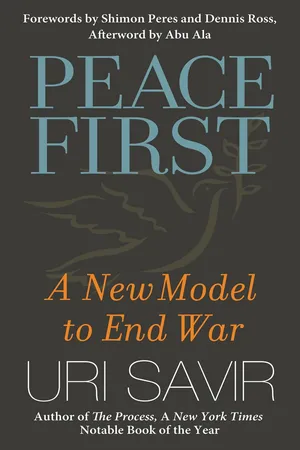
Uri Savir has an ambitious, indispensable goal: to bring peacemaking into the 21st century. 'ÄúLittle in today'Äôs world,'Äù writes Savir, 'Äúis more progressive than modern warfare. Yet little is more archaic than peacemaking.'Äù We remain trapped in a centuries-old mindset, with leaders bargaining warily for concessions and signing treaties that collapse because no one on the ground has any real stake in them.
Drawing on his experiences negotiating the Oslo Peace Accords as well as on trenchant examples from Ethiopia, Eritrea, Rwanda, Sierra Leone, Afghanistan, India, Pakistan, Northern Ireland, and the former Yugoslavia, Savir argues that an enduring peace is built from the bottom up, not from the top down. He describes a new model based on establishing and nurturing mutually beneficial forms of cooperation beginning on the local level, city-to-city and organization-to-organization.
This process of 'Äúglocalization'Äù'Äîinvolving local actors in global issues'Äîis the first step toward constructing a peace ecology: a comprehensive transnational culture dedicated to breaking down the psychological and social barriers between former enemies. These efforts are furthered through the establishment of joint ventures that give each side a tangible stake in maintaining peace. Diplomacy still has a role, but it must reject maneuvering for gain and instead emphasize the advantages both sides will gain with the cultivation of lasting peace.
Throughout, Savir provides concrete examples of how these concepts have been put into practice. And he ends with a detailed vision of how this model could bring an enduring peace in one of the world'Äôs most war-torn areas: the Mediterranean Basin. Peace First offers a pragmatic yet revolutionary new approach that promises to end our most intractable conflicts.
HISTORY IS BEING WRITTEN IN THE RED INK OF BLOOD AND not in the black ink of peace treaties.
For thousands of years, war has enabled countries and societies to conquer land, procure assets, and acquire power. As a result, any peace that follows from war has mostly focused on tangible achievements or failures, assets and power secured and squandered. The wise Chinese Communist leader Chou En-lai, paraphrasing Clausewitz, said, “All diplomacy is the continuation of war by other means.”
The same can be said about peace. Peace treaties have traditionally declared an end to fighting; established formal, legally oriented relations; and included an inventory of assets, such as land, industrial resources, and prisoners of war, to be distributed upon the cessation of war—but not much more. Although such tangible acquisitions and losses have become less relevant in modern war, a model focused on security and assets is crystallized in the histories of most countries, whose peaceful reconciliation developed only after persistent struggles for influence, control, and colonies.
Peace represents a fundamental human freedom—the right to live. But peace, freedom, and democracy have been almost mutually exclusive throughout history. Even after democracy has permeated the international system, peace has continued to be a method to consolidate and distribute assets, territory, natural resources, and influence. When war was waged in the name of independence from colonial powers, such as the American Revolutionary War (1775-1783), some liberties and democratic elements resulted. However, even the US pursuit of peace by way of war discounted 16 the interests and human rights of the defeated side. Furthermore, the spoils of war were mostly guaranteed to the state, the government, and the elite.
Paradoxically, war has become a more participatory process than peace. This contradiction stems from our historical understanding of peace as a strategic concept rather than a human right. Western peacemaking and peace treaties, both domestic and international, have evolved only minimally from “real estate” treaties into broader documents pursuing peace.
In this chapter, I will first dissect a handful of case studies from modern Western history to illustrate the evolution of peacemaking. I will then extract the core failures of Western peacemaking and explain them in light of recent peace treaties. We begin with the world’s current great superpower, the United States.
As early as the nineteenth century, treaties such as those between the US government and the Indian tribes (for example, the 1805 Chickasaw Treaty) were essentially real estate treaties based on the ceding of territory, the relinquishment and acquisition of property, and financial recompense.1 The Barbary Treaties (1786-1816) between the US authorities and the king of Algiers were similarly formatted as commercial agreements pertaining to the distribution of chattels, outlining conservative security arrangements alluding to the expectation of future wars, and establishing formal diplomatic relations, including the free expression of religion.2
Such modes of “peaceful settlement” also were reflected in European peace treaties during the “age of nation-states” (from the mid-eighteenth century through the Crimean War of 1854-1856), the Second Industrial Revolution (1870-1914), the unifications of Germany and Italy (1871), the Danish-Prussian War (1864), the Austro-Prussian War (1866), and the Franco-Prussian War (1870-1871). The aims of these wars defined the nature of the peace that followed: the conquering and consolidation of territory in the Crimean War, in which Russia endeavored to extend its control over various Ottoman provinces; and the maintaining of monarchies and the unification of territory, which was Otto von Bismarck’s 17 raison d’être. Although he was a master of diplomacy, Bismarck perceived peace as the amplification of German power and the acquisition of assets to strengthen coalitions.
Similarly, the Spanish-American War (1898) resulted in US control over former Spanish colonies in the Caribbean and Pacific. In a war of independence, Cuban rebels fought the Spanish while the US Congress passed joint resolutions proclaiming Cuba “free and independent.” Spain broke off diplomatic relations with the United States, resulting in a declaration of war between the United States and Spain. The Treaty of Paris (1898) formally ended hostilities. The treaty gave the United States almost all of Spain’s colonies and dealt with the relinquishment of Spanish property and associated rights—more like a property settlement following a divorce than a peace treaty. The First Amendment credo of equality and respect was not at all evident in this or in ensuing treaties between the United States and its former enemies.
Twentieth-century diplomacy begins prior to World War I (1914) and ends in 1990. Historian Eric Hobsbawm calls it a “century of extremism,”3 which ran the gamut from fascism to communism, with commonalities characterizing both extremes. Additionally, a Eurocentric view was prevalent throughout this period; Europeans saw themselves as the center of the earth, not just physically but also culturally, believing that people on the periphery needed to be “acculturated” through imperialism.
Such arrogance was manifest in the Treaty of Versailles (1919),4 which essentially served to guarantee assets, territories, and compensation—fundamental elements of imperial culture—and created a hegemonic narrative in which Germany was defeated and blamed. This defeat resulted in a sense of isolation and humiliation on the part of most Germans, whose sense of grievance was later exploited by Hitler in his quest for power.
Indeed, such a diktat can only survive temporarily. If a peace agreement is not reciprocal, providing both sides with an incentive for peace, it will not stand the test of time. The challenge of Versailles was to win the war and create a new international system 18 so that all sides could live together; instead, the human instinct for total victory dominated. This was the ultimate mistake of the architects of Versailles, and it became the impetus for totalitarianism in Germany.
In retrospect, the lessons of Versailles—including the contrast between the New World, symbolized by a vigorous America emerging as a global power, and the old colonial European world weighed down by tradition and resistance to change—penetrated the global peace agenda only after World War II. Perhaps the most significant consequence of this war over the long term was the rebalancing of world power and the establishment of two spheres of influence. Britain, France, Germany, and Japan ceased to be great powers in the traditional military sense, leaving only the United States and the Soviet Union. The failures of Versailles prompted the United States to work with Europe against the Soviet Union; the United States recruited Germany and Japan into cooperation instead of threatening a reprisal.
This movement toward cooperation is reflected in the North Atlantic Treaty (1949),5 which emphasizes freedom of the individual, democracy, rule of law, and the protection of the heritage of the West. The agreement, which formed the North Atlantic Treaty Organization (NATO), highlights a liberal, legal view with respect to stability and prosperity in the North Atlantic, not a totalitarian view of an inclusive peace. The NATO agreement was supported by the Marshall Plan (1947), an initiative of US Secretary of State George Marshall, which offered Europe up to $20 billion for relief if the European nations cooperated to create a reasonable aid plan.6 The nations were obliged to work together and to act as a single economic unit, paving the way for European resource and infrastructure integration. But the example of regional cooperation in Europe has proven the exception to the rule. For most of history, the goal of nations has been to conquer land; peace has simply been the time between wars, during which groups prepared for the next conflict. 19
Modern history has since seen the rise of non-state-centric issues. Socioeconomic gaps between the haves and the have-nots are increasing. This phenomenon is connected to demographics, particularly in Europe—home to approximately fifty million Muslims7—and in the United States, where the Hispanic constituency is now an electoral power.8 Furthermore, ecological issues such as water pollution and greenhouse gases have penetrated international borders, as have issues of human rights—not to speak of the globalized economy.
However, modern history has also seen the number of intense national conflicts and wars grow exponentially. As mentioned in the introduction, the Heidelberg Institute’s Conflict Barometer has charted the rise of high- and medium-intensity conflicts, from fewer than twenty in 1945 to one hundred thirty in 2007.9 An increase in conflicts has resulted in an increase of peace treaties—most of which have floundered.
Reflecting on historical treaties of the past several centuries, it’s clear that their purpose has been to consolidate the acquisitions of war and to further traditional aims rather than to aspire to new directions of peaceful relations that emphasize a culture of peace and democratization. These treaties serve to sustain the status quo through the balance of power that results from war, achieving stability via narrow security doctrines based on deterrence. The militant nature of the traditional peace treaty reflects the nature of the peacemaker: most peacemakers are former warmakers who do not rule out the use of force as a possible solution to the conflict. This is true both in the realm of political leadership and in the recruitment of military personnel for peacemaking procedures.
Similarly, peace agreements aimed at consolidating assets, territories, and spheres of influence are not designed to equitably distribute peace dividends. Peace and its dividends have traditionally been claimed by states and their elites and have not been linked to greater social justice or the reduction of socioeconomic gaps. Economics has been represented in traditional peace treaties in terms 20 of spoils emanating from victory, with little mention of economic cooperation between former enemies. The notion of regional development, as well as the role of the international community in strengthening the peace economy, has been largely ignored.
Surprisingly, these gaps are present in peace processes even during this age of globalization. One might have expected globalization to change the nature of peacemaking, to include cooperation within a societal, regional, and global context, emphasizing the values of reconciliation, cooperation, and democratization. On the contrary; although globalization and technology have transformed the world into a global village on one level, particularly in those regions where territory and resources are dominant, peacemaking has not adopted new forms of intercultural exchange and economy.
Simply put, old-fashioned principles of peacemaking are as ineffective in modern times as they were historically, even in places where liberal values of democracy have penetrated legal systems and societies. Peace has not been recognized as a discernible, independent social value. In post-conflict regions, little effort has been made to create a participatory process, to cultivate an environment of peaceful coexistence between former enemies, or to discipline those who are violently opposed to peace.
Modern peace treaties—those of the past fifteen years—continue to fail because they fall into traps of old-fashioned peacemaking. Just like historical peacemaking efforts before them, these modern treaties
further traditional aims and dwell on the past;
reflect a narrow security doctrine;
fail to promote a culture of peace;
fail to establish a mechanism against increased socioeconomic gaps;
fail to emphasize economic cooperation; 21
lack planning for regional development and international assistance;
fail to promote peace socially and politically and lack implied sanctions against domestic opposition; and
involve past warmakers acting as peacemakers.
Not every modern peace agreement exhibits all of these flaws —some treaties include progressive peacemaking strategies alongside traditional approaches. Unfortunately, most attempts at modernizing peace have either been buried beneath outdated arrangements or have remained abstract concepts, forgotten by the time implementation rolls around. Here, I explore these core failures of modern peace treaties, using examples of peace agreements from the past decades.
Furthering traditional aims and dwelling on the past. The Dayton Accords (1995),10 which were supposed to create peace in the former Yugoslavia, have left much of the region reduced to poverty, with massive economic disruption and persistent instability across the territories where the worst fighting occurred. The accords dealt mostly with the traditional aims of territorial integrity, military aspects of regional stabilization, and boundary demarcation. The wars were the bloodiest conflicts on European soil since the end of World War II, resulting in an estimated 125,000 dead and millions more driven from their homes.11 Many of the key individual participants were subsequently charged with war crimes. The accords lack clauses relating to reconciliation or strategic peacebuilding efforts.
Reflecting a narrow security doctrine. The Peace Treaty and Principles of Interrelation between Russian Federation and Chechen Republic Ichkeria (1997) is a perfect example of a narrow security doctrine. The first two clauses of the treaty deal with the rejection of the “use of force” and the development of relationships according to the “norms of international law.”12 Its remaining three clauses have no bearing on peace at all—indeed, hostilities were being 22 sustained. Similarly, the Khasavyourt Joint Declaration and Principles for Mutual Relations (1996) signed by the Chechen and Russian parties takes into account only the “cessation of military activities” and the “inadmissibility of the use of armed force or threatening its usage.”13
Failure to promote a culture of peace. A peace culture was not promoted by the Guatemalan Agreement on a Firm and Lasting Peace (1996).14 During this civil war, guerilla groups orchestrated coups against the military regimes, an estimated 200,000 people were killed, and many human rights were violated.15 The agreement outlined a cessation of violence and a redistribution of resources and compensation, but it did not address peacebuilding measures to create a culture of peace. Peace still is not present in Guatemala, more than a decade later.
Failure to establish a mechanism against increased socioeconomic gaps. More than two million people were displaced and an estimated thirty thousand people were killed during nine years of civil war in which the Sierra Leone government and a rebel group fought over the distribution of that country’s resources.16 The Peace Agreement between the Government of Sierra Leone and the Revolutionary United Front of Sierra Leone (1999)17 was supposed to end this horrendous civil war; however, the agreement failed to outline methods of decreasing socioeconomic gaps, and to this day the country continues to be wracked with poverty and instability.
Failure to emphasize economic cooperation. This failure is particularly evident in the peace agreement signed in Khartoum by the government of Sudan and the South Sudan United Democratic Salvation Front (1997).18 General Omar al-Bashir, head of the Khartoum government, came to power in an Islamist-backed coup in 1989 and had introduced elements of Sharia law, which was opposed by the mainly Christian and animist rebels in the south. The war between northern and southern Sudan has generally been interpreted as a typical ethno-religious conflict between Muslims 23 and Christians or between Arabs and Africans. Although this characterization was true of the earlier manifestation of the conflict, in the 1950s, and still has some bearing on the recent war, the nature of the conflict has changed. The fighting now is primarily over resources, with the economic and resource crisis in the north emerging as a driving force behind the civil war. The fourth section of the 1997 treaty mentioned a “comprehensive economic and social plan” and the establishment of “development projects,” but these were not sufficiently emphasized or developed in this treaty, nor did ensuing agreements and declarations ensure their implementation. Fighting in south Sudan continues to this day.
Lack of planning for regional development and international assistance. The Belfast Agreement (also known as the Good Friday Agreement) (1998),19 signed by the British and Irish governments, gained the support of most Northern Ireland political parties, including Sinn Fein (the political wing of the Irish Republican Army), and many of the positive characteristics outlined here are present in that agreement. However, many of the cooperative economic and social projects and other peacebuilding efforts outlined in the agreement have to a large degree not been implemented. Perhaps the addition of a clause relating to international assistance on facilitation and finance would have resulted in more cooperati...
Table of contents
COVER PAGE
TITLE PAGE
COPYRIGHT PAGE
FOREWORD by Shimon Peres
FOREWORD by Dennis Ross
INTRODUCTION Making Peace in a World at War
PART I The Challenge Archaic Peace
PART II A New Model The Four Pillars of Modern Peace
PART III The Modern Process Steps to Lasting Peace
PART IV On the Ground Pax Mediterraneo
CONCLUSION A New Vision for 2020
AFTERWORD by Abu Ala (Ahmed Qurei)
NOTES
ACKNOWLEDGMENTS
INDEX
ABOUT THE AUTHOR
ABOUT BERRETT-KOEHLER PUBLISHERS
BE CONNECTED
Trusted by 375,005 students
Access to over 1.5 million titles for a fair monthly price.
Study more efficiently using our study tools.
Frequently asked questions
Yes, you can cancel anytime from the Subscription tab in your account settings on the Perlego website. Your subscription will stay active until the end of your current billing period. Learn how to cancel your subscription
No, books cannot be downloaded as external files, such as PDFs, for use outside of Perlego. However, you can download books within the Perlego app for offline reading on mobile or tablet. Learn how to download books offline
Perlego offers two plans: Essential and Complete
Essential is ideal for learners and professionals who enjoy exploring a wide range of subjects. Access the Essential Library with 800,000+ trusted titles and best-sellers across business, personal growth, and the humanities. Includes unlimited reading time and Standard Read Aloud voice.
Complete: Perfect for advanced learners and researchers needing full, unrestricted access. Unlock 1.5M+ books across hundreds of subjects, including academic and specialized titles. The Complete Plan also includes advanced features like Premium Read Aloud and Research Assistant.
Both plans are available with monthly, semester, or annual billing cycles.
We are an online textbook subscription service, where you can get access to an entire online library for less than the price of a single book per month. With over 1.5 million books across 990+ topics, we’ve got you covered! Learn about our mission
Look out for the read-aloud symbol on your next book to see if you can listen to it. The read-aloud tool reads text aloud for you, highlighting the text as it is being read. You can pause it, speed it up and slow it down. Learn more about Read Aloud
Yes! You can use the Perlego app on both iOS and Android devices to read anytime, anywhere — even offline. Perfect for commutes or when you’re on the go. Please note we cannot support devices running on iOS 13 and Android 7 or earlier. Learn more about using the app
Yes, you can access Peace First by Uri Savir in PDF and/or ePUB format, as well as other popular books in Politics & International Relations & American Government. We have over 1.5 million books available in our catalogue for you to explore.