- 166 pages
- English
- ePUB (mobile friendly)
- Available on iOS & Android
eBook - ePub
About this book
THE WAYS WE GO about changing organizations usually don't work, asserts Geoff Bellman. Our underlying assumptions predetermine the results and preclude the broad success we so desperately seek. Change efforts often end up off-track because of small expectations. What is needed are grand expectations, so big that they cannot be realized in many lifetimes. It is only when people awaken to and work toward these immense purposes that they have the chance of finding fulfillment. Organizations are the perfect place to do this-these "beasts" which we create and curse, love and hate, that are so essential to our lives. In The Beauty of the Beast, Bellman shows how we can explore our huge potential and shift our daily organizational focus to one of long life and fulfillment-and in the process redesign our organizations for tomorrow.
Bellman examines why we keep creating these creatures that fall so far short of our dreams for them. He reveals how to recognize the beast in ourselves, showing how organizational control and hierarchy multiply our natural and less constructive inclinations many times over. He points out that the problem is not the existence of organizations but in the ways we imagine them.
Bellman asks us to consider what we want to pass on to future generations, helps us imagine the organizations we would be proud to create, and challenges us to take action from where we are today. He offers twenty renewal assertions to help us in redesigning organizations for tomorrow. These solid guides (with related questions for work groups) open the organization to new possibilities, helping us to embrace the organizational world as it really is while working hard to change it. In the process we will also change ourselves, as we ultimately feel less distant from-and more responsible for-creating those troubling structures we love to vent about.
The Beauty of the Beast. will help people see their daily work in a new and larger perspective. It will help them embrace the real organizational world while they work at renewing it. And it will help people to recognize the choices available to them-and to exercise those choices for positive results.
Information
1
Part One
Part One
Facing the Beast
Most organizations are beastly creatures to live with and guide; they have developed power, energy, and intelligence beyond what most of us ever imagined. Many of us pull away from these beasts, automatically assigning them less humanity and heart. We see their primitive power and we stand back from their threat and unpredictability. Our fears often turn to prejudice; we “know” what an organization is before we experience it. Part One is about facing these beasts, facing the truth of their ugliness, and eventually coming to terms with them. It’s about taking the early risks that allow us to learn more about organizations and appreciate them for what they are—rather than what we imagine. We are like Belle in the fairy tale, our lives are at risk and we must choose how we are going to see the Beast before us. And we will make her choice: We will proceed with the belief that there is something deeper here, something to be appreciated, if we open ourselves to it. This is a courageous step full of faith, and we may not be rewarded as Belle was. We may not live happily ever after. After all, what we are living is not a fairy tale.
Organizations are with us and will be with us as long as we humans exist. Face it; face them. Imagine throwing your arms around this huge, powerful, hairy creature you call the organization.… Imagine looking it in the eye, knowing it deeply, finding what there is to appreciate. Read this part of the book with the intent of looking deeply. And, while looking at the organization, take a good look at yourself, notice the eyes through which you see organizations. We each use our view of organizations to define and judge them. What is the view you hold?2
My view is that the beginning of the beauty we aspire to is here; we just have to see it. The path to the organization we dream about runs through the door of the organization we live in; we must walk it. There is no transporting ourselves to a new and more perfect organizational world. This is it. This is as perfect as worlds come. So we begin here, holding our dreams and living with the reality. Whatever we will do to move ourselves or this organization in the direction of our aspirations will begin right here. This is a hard truth to swallow when we are deep in our disdain for, or hatred of, or revulsion for, an organization. This is not a truth we want to hear. But it is the truth: Face the Beast.
Chapter 1
Hating and Loving Organizations
As with many relationships, ours with organizations varies from problematic to traumatic to romantic to ecstatic… but they are seldom static. Pursuing our individual purpose within a larger community can be troublesome, whether we are deciding about working on a team, or going to a family reunion, or choosing our telephone service provider. An array of thoughts, emotions, and questions comes to the fore, provoked by what we might gain or lose through making this commitment. Today’s huge organizations incite larger emotions as we become one among millions in their databases. We have more choices than ever before, but we must choose from among the options they offer. “Press the number one on your keypad if you want.… “ We have less direct influence on forming those options: one hundred television channels and nothing is on. We know the feelings that arise as we try to get what we want from a large organization. We are locked in a close tight dance in which we don’t name the tune, don’t get to look our partner in the eye, don’t get to lead—and it’s a rather hairy partner at that! At least it can feel that way.3
Or it can be wonderful. Websites that show and tell all you need to know for a purchase without ever leaving home… clothing made to fit you… information at your fingertips through search engines… the handiness of credit cards… the cell phone.… These are just a few examples of services and products meeting your needs better than before. Large organizations serve us best when they can offer us what we want quickly and conveniently and routinely. The dance can be smooth and satisfying when we name the right tune.4
This chapter extends the dance, helping you explore your relationships with organizations, what you get and give in the process. This chart shows what you will be working with:
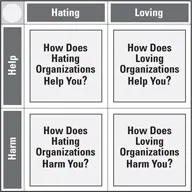
This two-by-two matrix shows dynamics among hate and love, harm and help; its questions ask you to look into your own experience with organizations. The questions could have been, “How does loving/hating this organization help/harm you?” In fact, you may find it useful to read this chapter with a particular organization in mind—one with which you have a long term, or at least interesting, relationship. It could be a company, a school, an agency, a church, a marriage, a scout troop, a political party. The matrix pushes you toward polarities—love<>hate and help<>harm—and encourages you to exaggerate your responses along the way.5
Imagine forty people in four teams recreating this matrix, each team moving to a separate quarter of the room to deal with one quadrant with its question. Imagine the teams answering the questions and shouting their answers across the room to each other. That’s what happened on an early outing with this matrix, provoking thought, passionate expression, feelings, and hilarity as people reflected on themselves. I want to provoke this kind of expression and energy in you. See, hear, notice what questions you care most about; call out your confluence and contradiction; define your relationship with organizations as you fill the boxes with your answers. Take time to answer the questions now. My bet is you will be intrigued with your answers—and the feelings that accompany them.
After completing the four quadrants:
- Which is the most compelling quadrant for you?
- Where (if at all) are you most clearly aligned?
- Where (if at all) do you see dilemmas?
- What can you say about yourself now that you might not have said before?
- Who would be interested in discussing this with you?
This matrix is a simple way of teasing out the sources of our discontent, and pleasure, with the organizational beasts around us, allowing us to search out the source of our energy for organization work. To aid your exploration, I will make my own trip around the four quadrants. I will share my experience with loving and hating organizations to stimulate your thoughts and feelings.
Love and Help

Large organizations are more fascinating to me today than when I began working with them years ago. I am intrigued by their personalities, their behaviors, their unpredictability. I see them as individuals with many of the same characteristics as people. I love to watch them, participate in them, help build their success, and continue to figure out what “makes them tick.” Though I’m convinced they are unfathomable, I continue trying to fathom them.6
My fascination with organizations was fed as I left full employment in one to begin consulting to many. From the inside, I had a deeper appreciation of the workings of the organization I was then serving. I also turned its peculiarities into generalizations: What I found wrong with my employer I “knew” was wrong with organizations in general. From the outside, after years of working with hundreds of companies, I see how much they have in common and how much my learning about one is applicable to others. Much of my work has been spreading learning across organizations, assuring each that their problems are not as unique as they might imagine in their more anxious moments.
I still love the anthems and rhythms created when crowds of people, sharing some common purpose and acknowledging roughly the same boundaries, try to do something together. I’m intrigued by how much the donut makers, god worshippers, insurance sellers, ball players, star seekers, steel makers, and salmon savers have in common. They are much more similar than different when I watch them work. Just as people are similar in their outward makeup (arms, legs, language, habits) so organizations seem to work in similar ways regardless of purpose, and I have been privileged to watch all of that—and get paid for watching!
My love for organizations has helped me in numerous ways. First of all, it has fed me for over thirty years. Organizations have fed my mind, heart, and family. Organizations have made me a part of their large purposes; they have put their resources at my disposal. They have given me other people who are also on “my side”; my power in the world has been multiplied through working with them. Working with organizations has allowed me to be influential, and I have made a number of good friends along the way.7
Love and Harm

My love for organizations causes me to believe in them, to dismiss critics and doubters too early. In the process, I lose the benefit of other perspectives that would help me make better choices. My allegiance to organizations comes with blinders. Other more independent people have drawn back from my willingness to appreciate or ascribe good intentions to these monoliths. In the heat of discussion or resolution of conflicts, I often forget that I am making assumptions about organizations that are different from and no more valid than others’ assumptions.
In my life as an organizational observer and player, organizations have given power to me and I have given them a power over me. I have supported their definitions of success in the work we did together. I certainly influenced them, but they decided whether I would be there to influence them. As I gained intimate knowledge of them—especially corporations—I became more like them. They defined their game and I played it. I continually reminded myself of the larger, personal life game I was living, but returning to their halls and meetings year after year affected my independent thinking and choice. I’ve prided myself on my independence, but I have also fooled myself. My ego, loving the strokes that come with successful organization work, often equates and mistakes that success with human progress.
My work with organizations has usually involved money. I want to assign high motives to organizations that pay me well and often; I have distorted my reality to fit theirs. In addition to keeping me from addressing the needs of worthwhile organizations with no money, my actions say that organizations with money are the most important in the world. How much have I lost in this bargain?8
Hate and Harm

I often hate what organizations do, what they do to people, what they do to the world. Years of working with corporations have refined my disgust for what they are capable of doing in the service of control, speed, and greed. Recent times have created companies hugely distorted toward profit. Often stakeholders like the community or suppliers are neglected in favor of immediate returns for the stockholders and management. The profit motive becomes an organizational cancer growing faster and out of proportion to the rest of the corporate body; profit crowds out all other purpose and consumes energy needed for wider corporate health. Traditionally, the church or the state or the military perverted power. Now in our market-driven society it is corporations that abuse the power derived from their amassed wealth.
My fixation on the faults of organizations reduces, or eliminates, any sense of personal responsibility for what they are doing. I separate them from me, make them objects to despise, worthy of my hatred. They are wonderful villains! I diminish and lift myself at their expense. They become smaller, I become larger. I inflate my goodness and their badness. Hating them distorts my views of myself.
Large organizations have the potential to bind human energy in the service of greater good for all of us. They present the possibility of human communities that unite our spirit. They can hold out the promise of widespread fulfillment and happiness. Sometimes I hate them because they fall so far short of this potential—the same reasons I occasionally hate associates, friends, and myself. My expectations of them come from my expectations of myself. Since I hate it when I fall short, I hate it when they fall short. I project onto them what I expect of myself and they don’t make it. I am disappointed in them because I am disappointed in myself.… And my diatribe against organizations turns on me!9
That’s how it is for many of us. The words vary, but the melody is the same: We often expect of others what we expect of ourselves. To the extent we are punishing ourselves, we will punish others for similarly perceived shortcomings. To the extent we are accepting of ourselves, we will be more accepting of others. That punishment or acceptance often extends more easily to faceless organizations that are safer to blame than to an individual who might retaliate.
Hate and Help

The organizational failings of my clients are a dependable source of inner turmoil: Can I continue to support organizations that damage the world and its people? To what extent am I selling out? My hatred of their abuses is one source of energy to change them and the world in some small ways. The gap between what they do and could do calls out for action. Organizations are powerful in the world; I have skills useful in changing them. If I want to make a difference, what better place is there for me to act? It makes sense… and, I can imagine myself as just what they need—a missionary to the heathens, a breath of fresh air, a light in the darkness. All those fantasies feed my sense of importance to them, to the world, and to myself. Even without the fantasy, the reality of organizational shortcomings and potential helps me act.
Here is some surprising, shadowy help coming out of my difficulties with organizations: With time, my pattern of concerns about organizations have boomeranged. I have considered: Why do I hate these abuses so much? Why am I disturbed again and again over what I see? No one is asking me to hold that concern or emotion. Gradually I am realizing that what I hate in organizations is often what I hate in myself—that part of myself I have yet to come to terms with. With this perspective, I find my intense response to what is going on out there in a particular organization hints at something unresolved within myself. Yes, there truly are problems out there, but the problems inside myself are the more compelling; they affect and distort my views on everything. This unintended, backhanded gift coming from organizations has helped me look into and learn about myself.10
Summary
Expectations of myself have been a vital source of energy for the organizational change work I’ve done over the years. My self-imposed expectations allow me to pursue t...
Table of contents
- Cover Page
- Title Page
- Copyright Page
- Preface
- Part One Facing the Beast
- Chapter 1 Hating and Loving Organizations
- Chapter 2 Accepting Organizations for What They Are
- Chapter 3 Creating a Bureaucracy to Curse
- Part Two Searching for the Beauty
- Chapter 4 Essential Questions for Organizations
- Chapter 5 Aspiring to Life
- Chapter 6 Signs of Life in Your Organization
- Part Three Finding Beauty Within the Beast
- Chapter 7 The Reach for Renewal
- Chapter 8 The Roots of Renewal
- Chapter 9 The Response to Renewal
- Chapter 10 The Realities of Renewal
- Part Four Renewing Organizations, Groups, and Individuals
- Chapter 11 Renewing a Large Organization
- Chapter 12 Bringing Work Groups to Life
- Chapter 13 Practicing Renewal Daily
- Conclusion: The Choices We Make
- Related Resources
- Index
- About the Author
Trusted by 375,005 students
Access to over 1.5 million titles for a fair monthly price.
Study more efficiently using our study tools.
Frequently asked questions
Yes, you can cancel anytime from the Subscription tab in your account settings on the Perlego website. Your subscription will stay active until the end of your current billing period. Learn how to cancel your subscription
No, books cannot be downloaded as external files, such as PDFs, for use outside of Perlego. However, you can download books within the Perlego app for offline reading on mobile or tablet. Learn how to download books offline
Perlego offers two plans: Essential and Complete
- Essential is ideal for learners and professionals who enjoy exploring a wide range of subjects. Access the Essential Library with 800,000+ trusted titles and best-sellers across business, personal growth, and the humanities. Includes unlimited reading time and Standard Read Aloud voice.
- Complete: Perfect for advanced learners and researchers needing full, unrestricted access. Unlock 1.5M+ books across hundreds of subjects, including academic and specialized titles. The Complete Plan also includes advanced features like Premium Read Aloud and Research Assistant.
We are an online textbook subscription service, where you can get access to an entire online library for less than the price of a single book per month. With over 1.5 million books across 990+ topics, we’ve got you covered! Learn about our mission
Look out for the read-aloud symbol on your next book to see if you can listen to it. The read-aloud tool reads text aloud for you, highlighting the text as it is being read. You can pause it, speed it up and slow it down. Learn more about Read Aloud
Yes! You can use the Perlego app on both iOS and Android devices to read anytime, anywhere — even offline. Perfect for commutes or when you’re on the go.
Please note we cannot support devices running on iOS 13 and Android 7 or earlier. Learn more about using the app
Please note we cannot support devices running on iOS 13 and Android 7 or earlier. Learn more about using the app
Yes, you can access The Beauty of the Beast by Geoffrey M Bellman in PDF and/or ePUB format, as well as other popular books in Business & Business General. We have over 1.5 million books available in our catalogue for you to explore.