Leading with Character and Competence
Moving beyond Title, Position, and Authority "Leadership is an applied discipline, not a foamy concept to muse about, " says three-time CEO, Oxford-trained scholar, and consultant Timothy R. Clark. "In fact, it's the most important applied discipline in the world." The success of any organization can be traced directly to leadership. And leadership can be learned. But too many books and development programs focus exclusively on skills. In reality, performance and ultimate credibility are based on a combination of character and competence. As Clark puts it, character is the core and competence the crust. He shows how greatness emerges from a powerful combination of the two, although in the end character is more important. A leader with character but no competence will be ineffective, while a leader with competence but no character is dangerous.Clark spotlights the four most important components of character and competence and offers a series of eloquent, inspiring, and actionable reflections on what's needed to build each one. Fundamentally, he sees leadership as influence—leaders influence people "to climb, stretch, and become." You need character to influence positively and competence to influence effectively. This is a book for anyone, no matter where he or she is on the organization chart. Because today employees at all levels are being asked to step up, not only can everyone be a leader, everyone has to be. Clark's insights are profound, and his passion is infectious. "Leadership" he writes, "is the most engaging, inspiring, and deeply satisfying activity known to humankind. Through leadership we have the opportunity to progress, overcome adversity, change lives, and bless the race."
eBook - ePub
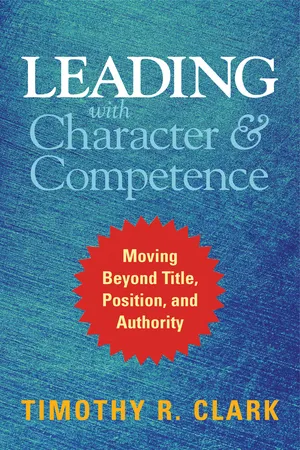
Leading with Character and Competence
Moving Beyond Title, Position, and Authority
- 216 pages
- English
- ePUB (mobile friendly)
- Available on iOS & Android
eBook - ePub
About this book
Information
PART ONE
The Four Cornerstones of Character
LEADERSHIP BEGINS WITH CHARACTER. IF YOU START building competence without the footings and foundation of character in place, you will implode when there’s pressure, stress, or the temptation to accept an unearned reward.
Integrity
The first cornerstone of character is integrity. Integrity is about basic honesty and squaring up to who you are and what you believe. Integrity accelerates your personal development as you avoid feigned attempts to be amoral. When you avoid ethical misconduct and self-justification, your modeling behavior becomes astonishingly powerful. You deal justly with others because you deal justly with yourself. You put forth your best personal effort. You are careful to take credit and generous in giving it.
Humility
The second cornerstone of character is humility. Humility is a companion to integrity and is the unresented acknowledgment of your own dependency and ignorance. It’s the capacity to avoid hubris and the reality distortion field it creates.The more humility you have, the clearer your thoughts and the cleaner your actions. Humility does three amazing things: First, it keeps you safe from the perils of your own ego. Second, it brings you more satisfaction as you rejoice in the success of others. Third, it makes you more willing and able to change.
Accountability
The third cornerstone of character is accountability. Great leaders are not only willing but eager to be answerable for their results. Isn’t it interesting that poor leaders hate to be measured and great leaders can’t wait? When you model the principle of accountability, you do not deflect personal responsibility, you understand that hiding is a false concept, and you always assume that private choices leak into public consequences. Finally, accountability means finishing what you start and resisting all forms of entitlement along the way.
Courage
The fourth and final cornerstone of character is courage. To have courage is to resist and challenge the forces of the status quo when necessary. You are the one who has to upend the state of affairs and rebel against the popular culture. You are the creator, not the caretaker. You have a heavier social, emotional, intellectual, spiritual, and physical burden to bear. You avoid the soft quit—where you deliberately lessen your effort and eliminate any chance of success—and maintain the discipline to make something happen. Finally, you have the courage to set stretch goals that fire the imagination.
CHAPTER 1
The First Cornerstone of Character: Integrity
I prefer to be true to myself, even at the hazard of incurring the ridicule of others, rather than to be false, and incur my own abhorrence.
Frederick Douglass (1818–1895)
African-American social reformer, abolitionist, orator, writer, and statesman
The Narrative of the Life of Frederick Douglass (1845)
African-American social reformer, abolitionist, orator, writer, and statesman
The Narrative of the Life of Frederick Douglass (1845)
Our Integrity Problem
The first cornerstone of character is integrity—but let’s not get philosophical about what that means. We are talking about basic, straight-up honesty. Unfortunately, corruption is the pandemic of our time.1 Most nations on planet Earth are deeply and almost irretrievably corrupt. They have become undrainable swamps. Greek philosopher Aristotle said, “The mass of citizens is less corruptible than the few.”2 For the sake of civil society, we need that to be true. Yet according to the Edelman Trust Barometer, three out of four institutions globally are losing the public’s trust.3
Consider that in this country we are chasing after dreamy egalitarianism with fiscal recklessness. We like rights and dislike responsibility. With our no-fault philosophy, we suffer from the tyranny of tolerance. We have adopted a spray-on-tan culture of YOLO narcissism. Indeed, if we can clear the decks of right and wrong—disavow, repudiate, and savage the concepts—we can give ourselves permission to do anything we want.4 And if we want to sound erudite about it, we call morality “cultural relativism.”5 As one observer said, “As truth has been relativized—absolutely relativized, so to speak—so has morality.”6
We have a hard time being honest about the problem. We would rather extend our adolescent play of the mind. The truth is that our compass-free society is immoral in its feigned attempts to be amoral. As political thinker and historian Alexis de Tocqueville said of the Old World, we can say of the new: We are “untroubled by those muddled and incoherent concepts of good and evil.”7
The Broken Triangle
We all come with a preinstalled moral sense, yet we still need to be taught integrity because it requires skill and vigilance to maintain it. We learn integrity by seeing it in action. Our children have to learn it the same way. Regrettably, as a society we are not teaching and modeling integrity to the next generation as we should. Religiosity has waned, and most schools are mandated by law to play neutral. If we yield to this “wintry piece of fact,”8we have to admit that the three institutions of home, church, and school—these agents that represented the triangle of socialization and have for centuries carried the burden of imbuing the next generation with integrity—are broken. This largely explains our demoralization, which is a predictable consequence of our willingness to embrace the delusion of amorality, or permissiveness thinly disguised.9
With the triangle of socialization broken, we have, as political scientist James Q. Wilson asserts, amputated our public discourse on morality at the knees.10 And the predatory media is happy to step in as a surrogate to teach secular humanism and its popular corruptions—namely, the norms of gain and glory, indulgence, self-aggrandizement, and a hundred forms of venality. Not surprisingly, many of society’s young think that integrity is unrealistic and perhaps even quaint. They may discount it as Disney idealism because they have been taught that a serious person plays to win.11 Indeed, ours has become a cowardly culture in which everyone forbids everyone to make value judgments.12
You Will Be Tested
On one occasion I was training leaders at a Fortune 500 corporation. I brought a large for sale sign into the room, the kind you would plant in your front yard. I gave it to one of the leaders and asked, “Are you for sale?” Then I paused and said, “If you don’t have an ethical creed that goes to your marrow and says, ‘some things are not for sale at any price,’ you are for sale. You will go to the highest bidder.”
Through the course of your personal and professional life, you will run an ethical gauntlet. Your integrity will be tested. You will be propositioned to lie, steal, cheat, extort, bribe, indulge, silence, swindle, defraud, scam, evade, and exploit. Even if you don’t go looking, the opportunities for ethical misconduct will find you. At the very least, you will be asked to remain purse-lipped and silent as you witness soft forms of crooked behavior around you.
Anticipate the obstacles. Prepare for their arrival. When an ethical dilemma presents itself in the moment, the situation suddenly becomes pressurized. Negotiators call it “deal heat.” Be ready for that dialed-up intensity. And be alert because ethical issues do not announce themselves. Howard Winkler, manager of ethics and compliance at Southern Company, said, “When an ethical issue arises, it does not come gift-wrapped with a note that says, ‘This is an ethical issue. Prepare to make an ethical decision.’ It just comes across as another business problem that needs to be solved.”13
Know too that at least once in your life you will face a monumental obstacle, a severe trial, a crucible affliction that will try your integrity to the breaking point. You may well experience, as writer Victor Hugo said of his character Jean Valjean in Les Miserables, “the pressure of disproportionate misfortune.”14That day comes for all of us when our integrity goes on trial. It came for Sir Walter Scott, the beloved Scottish writer, when his publishing house failed and he found himself buried under crushing debt. In his personal journal, he described it this way: “Yet God knows, I am at sea in the dark, and the vessel leaky.”15
Do You Have a Personal Magna Carta?
Albert Schweitzer, the great humanitarian and Nobel Peace Prize winner, studied ethics and said the experience “left me dangling in midair.”16Ethics, which is a branch of philosophy, likes to ruminate about what is right and wrong, but it steadfastly refuses to tell you what to do. Don’t worry, you can’t read your way to integrity, anyway.
Yes, we face some very complex ethical issues in our day. But most of the time, acting with integrity is not about knowing what to do; it’s simply about doing it. The ability to perform moral reasoning does not make you moral; it’s doing what is moral that makes you moral. For example, in a recent survey in the United Kingdom, students were asked, “Would you cheat in an exam if you knew you wouldn’t get caught?” Fifty-nine percent of those surveyed said, “Yeah, sure,” while only 41 percent said, “No way.”17Do these students lack moral-reasoning skills?
As a human being, you confront moral choices that test your integrity. Leaders with integrity govern themselves. They regulate their own behavior and impose their own limits. They do not lie, steal, or cheat because they know it’s inherently wrong. They have a personal Magna Carta to stand on principle.18 People flock to their high standards and taproot convictions.
But if you are unsworn to principles, integrity vanishes. As professor Harvey Mansfield wrote, “When choice is without any principle to guide it, those who must make a choice look around for something to replace principle.”19 That search will often come back to the pursuit of selfish interest. If you don’t stand for principle, there is simply nothing left to stand on. You will accept the unprincipled gain and reject the principled loss.
Leaders without integrity must be regulated from the outside by rules, laws, compliance systems, organs of restraint, and the larger control environment around them. They also know innately that lying, stealing, and cheating are wrong. They know the principle but refuse to be governed by it. Surely you have seen how people behave in riots. As the risk/reward ratio shifts, as the deterrence and the threat of punishment disappear, people burn cars and loot the neighborhood store. There’s no internal check on behavior. It’s a base and primal response.
The Four Moral Navigators diagram shows how people make moral decisions, using four devices that have an impact on their behavior (see figure 1.1).

Figure 1.1 The Four Moral Navigators

Each device is important and has a role to play, but to maintain integrity, principles and moral values must have the last word. The person or organization without integrity suspends principles and moral values while applying the other navigational devices. For example, why did Volkswagen executives decide to ma...
Table of contents
- Cover Page
- Title Page
- Copyright Page
- Dedication
- Contents
- Preface
- Introduction
- Part One The Four Cornerstones of Character
- Part Two The Four Cornerstones of Competence
- Conclusion
- Notes
- Leading with Character and Competence Self-Assessment
- Acknowledgments
- Index
- About the Author
Trusted by 375,005 students
Access to over 1.5 million titles for a fair monthly price.
Study more efficiently using our study tools.
Frequently asked questions
Yes, you can cancel anytime from the Subscription tab in your account settings on the Perlego website. Your subscription will stay active until the end of your current billing period. Learn how to cancel your subscription
No, books cannot be downloaded as external files, such as PDFs, for use outside of Perlego. However, you can download books within the Perlego app for offline reading on mobile or tablet. Learn how to download books offline
Perlego offers two plans: Essential and Complete
- Essential is ideal for learners and professionals who enjoy exploring a wide range of subjects. Access the Essential Library with 800,000+ trusted titles and best-sellers across business, personal growth, and the humanities. Includes unlimited reading time and Standard Read Aloud voice.
- Complete: Perfect for advanced learners and researchers needing full, unrestricted access. Unlock 1.5M+ books across hundreds of subjects, including academic and specialized titles. The Complete Plan also includes advanced features like Premium Read Aloud and Research Assistant.
We are an online textbook subscription service, where you can get access to an entire online library for less than the price of a single book per month. With over 1.5 million books across 990+ topics, we’ve got you covered! Learn about our mission
Look out for the read-aloud symbol on your next book to see if you can listen to it. The read-aloud tool reads text aloud for you, highlighting the text as it is being read. You can pause it, speed it up and slow it down. Learn more about Read Aloud
Yes! You can use the Perlego app on both iOS and Android devices to read anytime, anywhere — even offline. Perfect for commutes or when you’re on the go.
Please note we cannot support devices running on iOS 13 and Android 7 or earlier. Learn more about using the app
Please note we cannot support devices running on iOS 13 and Android 7 or earlier. Learn more about using the app
Yes, you can access Leading with Character and Competence by Timothy R. Clark in PDF and/or ePUB format, as well as other popular books in Business & Mentoring & Coaching. We have over 1.5 million books available in our catalogue for you to explore.