eBook - ePub
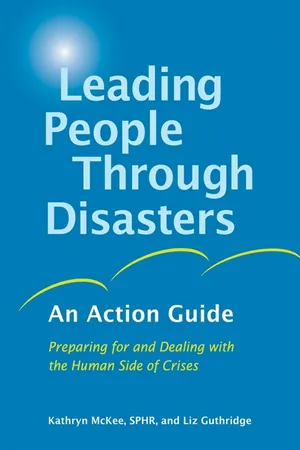
Leading People Through Disasters
An Action Guide: Preparing for and Dealing with the Human Side of Crises
- 180 pages
- English
- ePUB (mobile friendly)
- Available on iOS & Android
eBook - ePub
Leading People Through Disasters
An Action Guide: Preparing for and Dealing with the Human Side of Crises
About this book
Sooner or later, most organizations will face some kind of disaster--flood, fire, hurricane, earthquake, workplace violence, bombings, even the arrest or sudden death of the CEO. Existing books on crisis management deal almost exclusively with physical breakdowns, logistics issues, data losses and environmental and economic impacts. But it is people who actually make a business run, and Leading People Through Disasters is the first book to deal with the all-important human side of recovery.
Kathryn McKee and Liz Guthridge show how to ensure that your business continuity plan addresses human as well as business issues and they offer detailed advice on what to do when disaster actually strikes--how to keep people safe, calm, and informed; help managers care for employees; and deal with employees' immediate and ongoing emotional and psychological needs while getting the organization back on its feet. This comprehensive guide features a wealth of examples, checklists, forms, and other practical tools that will help you take action when you need it most.
Information
15
Part I
Part I
Planning for Disasters
This section discusses the following topics:
- The roles and responsibilities of Human Resources managers, line managers, communications staff members, and others in the planning effort and when faced with a disaster; the leadership capabilities one needs in order to lead a business continuity planning effort, and those needed when one is facing a disaster.
- How to prepare for and lead the business continuity planning effort; where to go for basic information; what should be included, and what pieces of the plan small companies should concentrate on in their planning efforts; and how to protect the plan against failure.
- What policies the planning team should consider when developing the business continuity plan. By having policies in place before a disaster, those responding to a disaster will save an enormous amount of time and will be free to make critical decisions on the fly.
17 Chapter 1
Chapter 1
Preparing to Lead in the Face of Fear
This chapter covers four topics:
When planning for a disaster:
- Identifying the players as well as their roles and responsibilities for planning
- Recognizing the competencies (such as skills, knowledge, and attributes) that can help you be an effective leader
When dealing with a disaster:
- Reviewing the roles and responsibilities of the various players
- Understanding what leadership competencies are necessary in the face of fear, especially in a disaster situation
Overview
On a scale of 1 to 10, how prepared are you to deal with a disaster befalling your organization? Are you ready to lead your employees through it? Are you geared up to deal with a hurricane, fire, flood, tornado, murder, chemical spill, act of corporate malfeasance, flu pandemic, terrorist attack, or some other type of disaster?
On second thought, maybe you’d prefer to close this book and take a pleasure trip. How about a cruise down the Mississippi River, where you’ll end up in New Orleans? You’ll find yourself in the state of Louisiana, which in August 2005 was actually “the state of denial,” according to Charles Pizzo and Gerard Braud, two crisis communications experts and Hurricane Katrina victims. 18“And if you’re not thinking about or planning what you might do in a crisis situation now, you’re in a state of denial too. There are just too many risks out there,” Pizzo warns.
One good sign that you’re not in the state of denial is that you have this book open. We hope you’re ready for the challenge. Our goal is to excite you to action so you will take a leadership role within your organization and prepare for the worst, with the hope that nothing bad actually happens. However, the odds are that you will face some kind of minor or major crisis in the course of your work life.
Preparing for a Disaster
Identifying the Players and Their Roles and Responsibilities
In business continuity planning, one of the critical leadership tasks is defining the roles and responsibilities of the key members of management who will be involved in planning for and managing a disaster. This section details the processes to be carried out by individuals in the roles of CEO, CFO, Human Resources Director, Communications Officer, and other selected members of the management team. The job titles and organizational structure of your company may differ from the generic positions described here, but this summary will give you an idea of the division of responsibilities.
Most senior executive: Chief Executive Officer/ General Manager/other title
- Mandates the development and implementation of a business continuity plan
- Appoints the core team, announcing and expressing confidence in its members and emphasizing their delegation to a high level of independent thinking
- Meets with the core team from time to time for updates and to offer advice and counsel
Incident Commander
- Reports to the CEO
- Develops the Incident Command System, which specifies who will do what tasks in the case of an incident (emergency, crisis, disaster, catastrophe, etc.)
- 19Takes charge in case of a disaster and is the sole contact with emergency responders, such as firefighters, police, and hazmat (hazardous materials) team
- Addresses the media on-site covering the disaster, as he or she is on the line and has the most up-to-date information on the situation, unless another individual is designated to be the spokesperson
Chief Financial Officer/Controller/other title for financial executive
- Works with the core team to develop the business case for planning, including the return on investment. Consider the costs of planning, such as:
- Possible use of an outside expert on emergency preparedness or business continuity planning
- Downtime (i.e., time away from job duties, spent in meetings, information gathering, etc.; or due to dislocation of work or loss of property) and its impact on the profitability or viability of the business
- Materials, equipment, and supplies, including food and water, cots, blankets, radiophones, walkie-talkies, satellite phones, extra cell phones, 800 number for an employee “cool line,” and special website
- Possible off-site space for an emergency operations center (see Chapter 2)
- Backup information technology and telecommunications systems
- Trauma counseling or Employee Assistance Program
(EAP) (see Prologue and Chapter 8 ) and returning employees to reasonable levels of productivity
Core team
The core team will develop the strategies and policies that will be used to develop contingency plans for a short business interruption (e.g., a few hours); a disaster, where business is interrupted for a few days; and a major catastrophe, where 20business is interrupted for the foreseeable future, with no identifiable end date. Core team members and their responsibilities are:
Human Resources
- Working with the core team to identify the Incident Commander and others who will take charge in case of a disaster
- Defining roles and responsibilities for the various individuals who will staff the Emergency Operations Center (see Chapter 2 )
- Developing contingency plans for the relocation of employees under a variety of scenarios
- Instructing the core team about Human Resources philosophy and how the organization can care for its workforce through contingent HR policies, as well as developing contingency HR policies (explained in Chapter 3 )
- Developing the executive emergency contact list, which specifies who gets alerted and when
- Arranging for the contingent use of external behavioral health consultants or an Employee Assistance Program (EAP) (see Chapter 8 )
- Developing a telephone tree or other electronic notification system along with collateral materials so that employees at all levels of the organization know whom to call, where to go, when to stay home, and what other actions to take
- Ascertaining the need to deploy staff in other parts of the United States or the world to keep the business running
Safety Officer or security (if applicable)
- Developing a variety of scenarios that could result in business interruption and coordinating these scenarios with communications facilities
- Developing evacuation procedures as well as specific procedures for such disasters as a fire, flood, hurricane, tornado, chemical spill, or explosion, and setting up a “shelter in place” (i.e., a place in the facility where employees can go for shelter rather than leaving the facility and risking exposure)
Operations/production (if applicable)
- Developing contingency plans for inventory, manufacturing, distribution, and other functions in case of evacuation
- Identifying a location to borrow or rent space
- Determining the feasibility of moving the warehouse, production, and distribution functions
- Analyzing the consequences of a short- or medium-term inability to deliver products/services to customers
Communications
- Creating a crisis communications plan that dovetails with the business continuity plan and includes key messages for each scenario in the business continuity plan
- Developing a media strategy for minor and major crises
- Working closely with the Incident Commander to determine who will serve as the company spokesperson, depending on the situation, and clarify who speaks, when, and to whom, internally and externally; also, providing advance media training for these individuals, if needed
- Maintaining ongoing good relations with the press, especially the radio and TV newscasters in the local markets, and preparing press releases and organizing press conferences as necessary
- Developing employee communication templates and determining the best distribution system for the communications under different disaster scenarios
- Working with the Safety Officer to develop response plans for a variety of disaster scenarios (e.g., short- or long-term power outage, explosion, chemical spill, or other foreseeable event, given the type of business) and coordinating closely with other core team members as well as with the entire planning team
- Coordinating closely with HR and Safety officers when a disaster strikes
Business continuity planning team
This team develops detailed business continuity plans and tactics for each major function in the organization. For an outline of the 22 topics to be considered, refer to the Resources section on page 141. Depending on the management structure, functions also may include:
Information technology
- Developing system backup plans and arranging for backup sites for data storage
- Developing backup plans for all telecommunications devices, including instructions on how phone lines are to be redirected to other sites and the establishment of toll-free numbers
- Developing IT network backup plans and testing protocols
Engineering, marketing, sales, and customer relations
- Developing specific business continuity plans
- Agreeing to take direction from the Incident Commander initially, when disaster strikes, and until the Incident Commander returns control to the management hierarchy
- Confirming that functional managers have made appropriate plans and have the necessary supplies to take care of employees
Legal
- Ensuring that the plan complies with federal and state safety and security regulations
- Verifying that workplace laws and regulations have been addressed (provisions for disabled employees, confidentiali...
Table of contents
- Cover Page
- Title Page
- Copyright Page
- Praise for Leading People Through Disasters
- Foreword
- Preface
- Prologue
- Part I: Planning for Disasters
- Chapter 1: Preparing to Lead in the Face of Fear
- Chapter 2: Developing a Business Continuity Plan That Addresses Human Issues
- Chapter 3: Creating Contingent HR Policies
- Part II: Dealing with Disasters
- Chapter 4: Taking Care of Employees
- Appendix
- Chapter 5: Guiding Managers and HR Staff
- Chapter 6: Balancing the Needs of Employees with the Need to Return to Work
- Chapter 7: Restabilizing Yourself and the Organization
- Chapter 8: Building Resiliency While Helping Hearts and Minds to Heal
- Chapter 9: Starting to Prepare Now—Five-Minute Planning Steps
- Resources
- Literature and Websites
- An Outline for Business Continuity Planning
- A Sample Telephone Tree
- A Sample Wallet Card
- Employee Emergency Response Procedures
- Suggested Actions to Take at Home
- Notes
- Acknowledgments
- Index
- About the Authors
Trusted by 375,005 students
Access to over 1.5 million titles for a fair monthly price.
Study more efficiently using our study tools.
Frequently asked questions
Yes, you can cancel anytime from the Subscription tab in your account settings on the Perlego website. Your subscription will stay active until the end of your current billing period. Learn how to cancel your subscription
No, books cannot be downloaded as external files, such as PDFs, for use outside of Perlego. However, you can download books within the Perlego app for offline reading on mobile or tablet. Learn how to download books offline
Perlego offers two plans: Essential and Complete
- Essential is ideal for learners and professionals who enjoy exploring a wide range of subjects. Access the Essential Library with 800,000+ trusted titles and best-sellers across business, personal growth, and the humanities. Includes unlimited reading time and Standard Read Aloud voice.
- Complete: Perfect for advanced learners and researchers needing full, unrestricted access. Unlock 1.5M+ books across hundreds of subjects, including academic and specialized titles. The Complete Plan also includes advanced features like Premium Read Aloud and Research Assistant.
We are an online textbook subscription service, where you can get access to an entire online library for less than the price of a single book per month. With over 1.5 million books across 990+ topics, we’ve got you covered! Learn about our mission
Look out for the read-aloud symbol on your next book to see if you can listen to it. The read-aloud tool reads text aloud for you, highlighting the text as it is being read. You can pause it, speed it up and slow it down. Learn more about Read Aloud
Yes! You can use the Perlego app on both iOS and Android devices to read anytime, anywhere — even offline. Perfect for commutes or when you’re on the go.
Please note we cannot support devices running on iOS 13 and Android 7 or earlier. Learn more about using the app
Please note we cannot support devices running on iOS 13 and Android 7 or earlier. Learn more about using the app
Yes, you can access Leading People Through Disasters by Kathryn McKee, SPHR,Liz Guthridge in PDF and/or ePUB format, as well as other popular books in Business & Human Resource Management. We have over 1.5 million books available in our catalogue for you to explore.