For organizations to thrive, indeed to survive, in today's global economy, we must find ways to dramatically improve the performance of large-scale projects. Applying the concepts of complexity theory can complement conventional project management approaches and enable us to adapt to the unrelenting change that we ignore at our own peril.
Managing Complex Projects: A New Model offers an innovative way of looking at projects and treating them as complex adaptive systems. Applying the principles of complexity thinking will enable project managers and leadership teams to manage large-scale initiatives successfully.
• Explore how complexity thinking can be used to find new, creative ways to think about and manage projects
• Diagnose complexity on a wide range of projects — from small, independent, short projects to highly complex, longer projects
• Understand and manage the complexity of the business problem, opportunity, solution, and other dimensions that come into play when managing large-scale efforts
Use the Project Complexity Model to determine the most effective approach to managing all aspects of a project based on the level of complexity involved.
- 330 pages
- English
- ePUB (mobile friendly)
- Available on iOS & Android
eBook - ePub
About this book
Information
PART I
Complexity Thinking in the world of Business
In this part, we introduce complexity theory, the nature of complex adaptive systems, and their relevance to the world of business. We then present the case for applying complexity thinking to managing complex projects, building high-performing project teams, and selecting the appropriate management approach.
In Chapter 1 we briefly define complexity theory and consider the nature of complex adaptive systems. We then explore the notion of businesses and project teams as examples of complex adaptive systems.
In Chapter 2 we examine conventional project management approaches and consider whether they are sufficient for dealing with complex projects. We then present an adaptive approach to managing complex projects.
In Chapter 3 we introduce our Project Complexity Model. We explore when and how to use the model, focusing on the steps involved in applying complexity thinking to projects.
CHAPTER 1
Complexity Thinking
“I am convinced that the nations and people who master the new sciences of complexity will become the economic, cultural, and political superpowers of the next century.”
—HEINZ PAGELS, PHYSICIST
Dr. Gerry Gingrich, instructor at the Information Resources Management College, National Defense University, states: “Military thinkers, politicians, scientists, and corporate executives are all looking for ways to understand the dynamics of global change and to prepare for the 21st century. Many are looking to the new science of complexity for answers. The science of complexity, however, does not yield answers, at least not in the sense that we have typically sought to describe our world and predict its events since the beginning of the Scientific Revolution. What it does yield is a new way of thinking about the world.”1
Complexity is one of those words that is difficult to define. Some say complexity is the opposite of simplicity; others say complicated is the opposite of simple while complex is the opposite of independent. A complex structure is said to use interwoven components that introduce mutual dependencies and produce more than the sum of their parts. In today’s business systems, this is the difference between myriad connecting “stovepipes” and an effective set of “integrated” solutions.2
A complex system can also be described as one in which many different components interact in multiple ways.3 In the context of a design that is difficult to understand or implement, complexity is the quality of being intricate and compounded.4 When project managers characterize a project as complex, they usually mean the project is “… challenging to manage because of size, complicated interactions, or uncertainties. Often, anxiety goes hand in hand with complexity.”5
Complex systems and complexity theory have captured the attention of scientists in the fields of anthropology, physics, biology, ecology, economics, political science, psychology, native studies, sociology, finance, and management. Since business organizations as well as project teams are complex systems, the science of complexity theory offers a way to understand and work with the complex nature of organizations and projects. Because complex systems are largely unpredictable, thinking about business systems as complex requires a paradigm shift from long-established business models based on control theory, which is essentially an attempt to manipulate the inputs to a system to obtain a desired effect on the output of the system.6
Complexity scientists are careful to differentiate between complicated and complex. Complicated is considered to have input and output flows and straightforward cause and effect (as in machines), where the pieces can be well understood in isolation and the whole can be reassembled from the parts; one problem can bring the system down, since complicated systems do not adapt.7 Complex, in contrast, is adaptive (as in ecosystems), with cycles, interrelationships, interdependencies, nested systems within systems, and multiple feedback loops. Examples of complex systems include weather systems, the Internet, the U.S. power grid, highways, supply chains, information transfer within organizations, business systems, and business organizations themselves. According to Julio Ottino, professor at the R.R. McCormick School of Engineering and Applied Sciences at Northwestern University, “The hallmarks of these complex systems are adaptation, self-organization and emergence—no one designed the web or metabolic processes within a cell.”8
COMPLEX SYSTEMS AND COMPLEXITY THEORY
Scientists originally thought the world to be linear, explained by simple cause-and-effect relationships. They theorized that if we could break down natural systems into their component parts, we could not only understand them but also learn how to predict and control them. Gradually, however, complexity theory emerged.
Complexity theory had its beginning in the 1980s at a think tank known as the Santa Fe Institute. Researchers ranging from graduate students to Nobel laureates formulated the theory that the application of ideas like complexity, adaptation, and turmoil at the edge of chaos can begin to explain “… the spontaneous, self-organizing dynamics of the world in a way that no one ever has before—with potential for immense impact on the conduct of economics, business, and even politics. They believe they are forging the first rigorous alternative to the kind of linear, reductionist thinking that has dominated science since the time of Newton—and that has now gone about as far as it can go in addressing the problems of the modern world.”9
Complexity theory is based on relationships, emergence, patterns, and iterations. It maintains that the universe is full of systems (e.g., weather systems, immune systems, social systems) that are complex and are constantly adapting to their environment; hence the term complex adaptive systems10 Creativity manifests itself in spontaneous emergence, which is at the center of complexity thinking. Emergence is the result of the intricate interplay of dynamics, forces, and energies. Creativity emerges in systems that are constantly evolving, reorganizing, or dissolving into chaos. The genius of complexity thinking is that it nourishes and masters creativity, never trying to lock it into systems, subsystems, or parts.11
Complexity theory states that systems exist on a spectrum ranging from equilibrium to chaos. Equilibrium results in paralysis and death; chaos results in an inability to function. The most productive state to be in is at the edge of chaos, where maximum diversity and creativity lead to new possibilities12 (Figure 1-1).
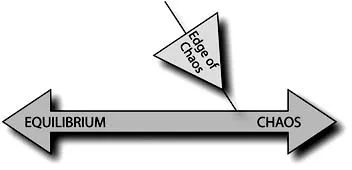
FIGURE 1-1. The Edge of Chaos, the Most Productive State
COMPLEX ADAPTIVE SYSTEMS
Complex adaptive systems are a specific type of complex system. These systems are complex in that they are diverse and comprise multiple interconnected elements; they are adaptive in that they have the capacity to change and learn from experience. The term “complex adaptive system” was coined at the Santa Fe Institute. In his essay, A Brief Descriptio...
Table of contents
- Cover
- Title Page
- Copyright
- About the Author
- Dedication
- Contents
- Foreword
- Preface
- Acknowledgments
- Introduction: Unprecedented Change in the Business Environment
- Part I: Complexity Thinking in the world of Business
- Part II: Applying Complexity Thinking to Assign Key Project Team Members
- Part III: Applying Complexity Thinking to Select the Project Cycle
- Part IV: Managing the Dimensions of Project Complexity
- Epilogue
- Bibliography
- Index
Trusted by 375,005 students
Access to over 1.5 million titles for a fair monthly price.
Study more efficiently using our study tools.
Frequently asked questions
Yes, you can cancel anytime from the Subscription tab in your account settings on the Perlego website. Your subscription will stay active until the end of your current billing period. Learn how to cancel your subscription
No, books cannot be downloaded as external files, such as PDFs, for use outside of Perlego. However, you can download books within the Perlego app for offline reading on mobile or tablet. Learn how to download books offline
Perlego offers two plans: Essential and Complete
- Essential is ideal for learners and professionals who enjoy exploring a wide range of subjects. Access the Essential Library with 800,000+ trusted titles and best-sellers across business, personal growth, and the humanities. Includes unlimited reading time and Standard Read Aloud voice.
- Complete: Perfect for advanced learners and researchers needing full, unrestricted access. Unlock 1.5M+ books across hundreds of subjects, including academic and specialized titles. The Complete Plan also includes advanced features like Premium Read Aloud and Research Assistant.
We are an online textbook subscription service, where you can get access to an entire online library for less than the price of a single book per month. With over 1.5 million books across 990+ topics, we’ve got you covered! Learn about our mission
Look out for the read-aloud symbol on your next book to see if you can listen to it. The read-aloud tool reads text aloud for you, highlighting the text as it is being read. You can pause it, speed it up and slow it down. Learn more about Read Aloud
Yes! You can use the Perlego app on both iOS and Android devices to read anytime, anywhere — even offline. Perfect for commutes or when you’re on the go.
Please note we cannot support devices running on iOS 13 and Android 7 or earlier. Learn more about using the app
Please note we cannot support devices running on iOS 13 and Android 7 or earlier. Learn more about using the app
Yes, you can access Managing Complex Projects by Kathleen B. Hass PMP in PDF and/or ePUB format, as well as other popular books in Business & Business Strategy. We have over 1.5 million books available in our catalogue for you to explore.