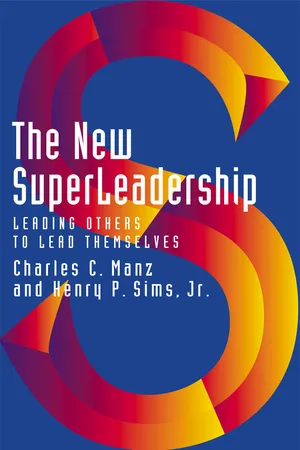
The truly effective leader today must be one who leads others to lead themselves. The rapid pace of change demands fast and flexible responses throughout the organization-there's no time to wait for directives from the top. And the highly-skilled workers so vital to organizational success also demand a high degree of independence. Old-fashioned command-and-control leadership is just too slow and stifling.Charles Manz and Henry Sims, Jr. pioneered the concept self-leadership in their bestselling book SuperLeadership. In The New SuperLeadership, the authors present new content and examples designed to help leaders develop the kind of autonomous, quick-reacting workforce necessary to thrive in these turbulent times. This enriched and expanded edition takes the concepts in the first edition to another level by emphasizing a pragmatic, how-to approach for developing leaders at every level of the organization.Drawing on contemporary examples and profiles, many from the high-tech and information sectors, Manz and Sims shatter the myth of the traditional, aggrandized versions of "heroic" leadership. They show that a leader truly becomes successful by turning followers into extraordinary self-leaders-pillars of strength that will support the organization at every level. They detail a series of action-oriented steps through which the SuperLeader provides an opportunity for followers to express and develop their own leadership skills-and in the process become highly motivated, dynamic contributors.The New SuperLeadership critically reviews traditional leadership styles, vividly illustrating the drawbacks of each: the "Strong Man" whose reliance on fear-based compliance smothers initiative; the "Transactor" who promotes a narrow "what's in it for me?" mentality; and the "Visionary Hero" whose powerful personality inspires commitment but inadvertently discourages independent thinking. By bringing out the leader in every employee, SuperLeadership enables leaders to avoid these pitfalls and develop an enthusiastic, innovative and energized workforce.The New SuperLeadership is a radically new way of looking at leadership, offering a leadership paradigm ideally suited to the realities of the modern workplace. It reveals that the only way to succeed today is to tap into the innate leadership potential that lies within every employee.
Part I The Ghosts of Leadership: Past, Present, and Future
11
1 Leadership in the 21st Century
A leader is best When people barely know he exists, Not so good when people obey and acclaim him, Worse when they despise him. But of a good leader, who talks little, When his work is done, his aim fulfilled, They will say: We did it ourselves. —Lao Tzu
HOW DOES THIS PERSPECTIVE FIT with your own ideas about leadership? Do you feel comfortable with the idea that a leader should not be obeyed or acclaimed, and in fact should barely be recognized? When you are called upon to lead do you prefer to take charge or to help others find their own way? These timeless words of Lao Tzu were written well over 2,000 years ago, yet they send an important message worth considering as we enter a new age. The recent end of the millennium seems particularly symbolic. We are living on the cusp of one of those rare technological turning points in history. Over the past two decades the information revolution emphasized computers and software. But this was only prologue to the main event—the Internet. Mankind is becoming truly “connected” and life will never be the same.
Of course, this revolution in information has substantial ramifications for our social systems. As one example, the way many of us go about our daily work has changed radically because of one communication capability: e-mail. Our patterns of daily work are just very different than they were ten years ago. And it will change further—e-mail is going wireless. The initial technology is already here; by 2010 most of us will have the capability to be connected wherever we are, wherever we go, whenever we want.12
But this is a book about leadership—how one person influences others. How will the technological revolution change the nature of leadership? We believe the effect will be extensive and profound. We are in the midst of a vastly changing social fabric where technology is transforming business, family structures, schools, governments, and even religious institutions. Indeed, all of us face a very challenging arena for exercising leadership in the 21st century.
As only one example, how does one person lead another when that person is located at a remote place?
In this book, we propose a different form of leadership, one that emphasizes the empowerment of others. We call this form of leadership SuperLeadership—that is, leading others to lead themselves.
The industrial age with its hierarchical command-and-control form of organizing is past. The information revolution is causing the deconstruction of organizations. That is, hierarchy is no longer needed to filter and facilitate the movement of information required for task integration. Instead, agents of the organization can now communicate directly and with greater speed, flexibility, and effectiveness.
The key to organizational success … will be to have the right person solving the most important business problems, no matter where they are located in the company hierarchically, organizationally, or geographically.
—James Citrina and Thomas Neff1
Of course, this requires that people possess the skills and knowledge to conduct their information-rich transactions in a speedy manner. The true assets of organizations will no longer be bricks and mortar, but the knowledge invested in their human capital.13
And how do we lead these knowledge workers? We believe first that the ultimate control comes from within—that the essence of leadership in today’s information age is to develop the capacity of people to lead themselves. The real challenge is to maximize the potential of human capital by unleashing this inner self-leadership. The most effective leader of the 21st century will be a SuperLeader, one who leads others to lead themselves in the information age.
As a quick preview, consider the following sample of distinctive strategies of a SuperLeader that will be presented throughout this book:
Listen more and talk less.
Ask more questions and give fewer answers.
Foster learning from mistakes, not fear of consequences.
Encourage problem solving by others rather than solving problems for others.
Share information rather than hoard it.
Encourage creativity, not conformity.
Encourage teamwork and collaboration, not destructive competition.
Foster independence and interdependence, not dependence.
Develop committed self-leaders, not compliant followers.
Lead others to lead themselves, not to be under the control of others.
Establish organizational structures that support self-leadership, such as self-managing teams, virtual teams, distance working.14
Establish information systems through the Intranet and Internet that will support self-leadership.
Establish a holistic self-leading culture throughout the organization.
THE TECHNOLOGICAL REVOLUTION
Think about the typical organizational employee of the 21st century. More specifically, Consider the situation of Alica, a 30-year-old consultant who is indeed “connected.”
Alica has a desktop at home and also works with a 2.5 lb. lightweight laptop with a full size keyboard and screen, although she finds herself using the voice recognition routine more than the keyboard.
But the real jewel in her array of devices is her communication platform—an all-in-one lightweight device about the size of today’s palm computers, but one that has 100 times the computing power of today’s Pentium III desktop. This device is a computer, PDA, cell phone, and even has a mini-videoconferencing capacity.
The device is made by Nokia and is an advanced version of the so-called “3G” family of all-purpose communication devices, sometimes known as the Universal Mobile Telephone System, or UMTS.Voice conversation is just one of its many capabilities. Of course, the Nokia has Internet capabilities, voice recognition, and also wireless synchronization with Alica’s desktop and laptop computers. The screen is a color display that provides entry to her personal calendar, news, Internet, Intranet, address book, personal files, etc. She uses a small wireless “ear bud” to receive transmissions, but so far she has refused to have the “implant” behind her ear that would make reception and transmission instantaneous.
At home and in the office she is connected by broadband, a communication protocol that seems like instantaneous transfer to her. She is easily able to transfer information from one device to any other.15
As a consultant, Alica is mainly engaged in “information work” and some would call her a “knowledge worker.” (Michael Dertouzos defines information work as “the transformation of information by human brains or computer programs.”2 In 1997, Dertouzos estimated that 50 to 60 percent of an industrialized country’s GNP consists of information work. Clearly, this will continue to increase significantly.)
Alica has one place that she prefers to do “alone” type work.This place is her home, and this is where she still uses some old-fashioned books and paper materials. But most of her personal reference data is stored on her personal file system and is accessible wherever she is. And of course she has the powerful research tool represented by her company’s Intranet and the larger, more public Internet.
Alica does not have a real office outside her home. Since she is a consultant, her office typically is a transitory place located at her client’s venue, a broadband-wired hotel room or a “drop in” office. She is a walking, talking, data-receiving-and-sending communication entity.
Alica is a member of several teams or task forces, although she seldom meets with a team as a whole. On a day-to-day basis they typically communicate through their various systems. But most of her teams try to meet on occasion to do some personal bonding.
Despite all this technical augmentation, she values face-to-face opportunities and worries about becoming captured and consumed by the technology. She is concerned about privacy because she knows that with her communication platform, her actual physical location is available to others. Most of all she wants a high degree of control and discretion about where, when, and how she goes about doing her job. She wants to come and go when and where she desires, and uses the communication technology to help her do this. She also has a keen sense of dressing the way she wants versus knowing when and where to “wear the costume.”16
She frequently asks “why” and expects an answer. She wants to be evaluated and rewarded on the basis of end results rather than how she got there. She still has a high degree of anxiety about the seemingly endless conflicts between her work life and her personal life. She wishes she could find more balance, meaning, purpose, and even spirituality through her work. She has become very advanced in ...
Table of contents
Cover Page
Title Page
Copyright Page
Acknowledgments
Introduction: A Call for SuperLeadership
Part I The Ghosts of Leadership: Past, Present, and Future
Part II Self-Leadership Strategies: Leading the One in the Mirror
Part III SuperLeadership— It’s in the Details
Part IV SuperLeadership in the 21st Century
Notes
Index
About the Authors
Trusted by 375,005 students
Access to over 1.5 million titles for a fair monthly price.
Study more efficiently using our study tools.
Frequently asked questions
Yes, you can cancel anytime from the Subscription tab in your account settings on the Perlego website. Your subscription will stay active until the end of your current billing period. Learn how to cancel your subscription
No, books cannot be downloaded as external files, such as PDFs, for use outside of Perlego. However, you can download books within the Perlego app for offline reading on mobile or tablet. Learn how to download books offline
Perlego offers two plans: Essential and Complete
Essential is ideal for learners and professionals who enjoy exploring a wide range of subjects. Access the Essential Library with 800,000+ trusted titles and best-sellers across business, personal growth, and the humanities. Includes unlimited reading time and Standard Read Aloud voice.
Complete: Perfect for advanced learners and researchers needing full, unrestricted access. Unlock 1.5M+ books across hundreds of subjects, including academic and specialized titles. The Complete Plan also includes advanced features like Premium Read Aloud and Research Assistant.
Both plans are available with monthly, semester, or annual billing cycles.
We are an online textbook subscription service, where you can get access to an entire online library for less than the price of a single book per month. With over 1.5 million books across 990+ topics, we’ve got you covered! Learn about our mission
Look out for the read-aloud symbol on your next book to see if you can listen to it. The read-aloud tool reads text aloud for you, highlighting the text as it is being read. You can pause it, speed it up and slow it down. Learn more about Read Aloud
Yes! You can use the Perlego app on both iOS and Android devices to read anytime, anywhere — even offline. Perfect for commutes or when you’re on the go. Please note we cannot support devices running on iOS 13 and Android 7 or earlier. Learn more about using the app
Yes, you can access The New SuperLeadership by Charles C. Manz,Henry P. Sims in PDF and/or ePUB format, as well as other popular books in Business & Leadership. We have over 1.5 million books available in our catalogue for you to explore.