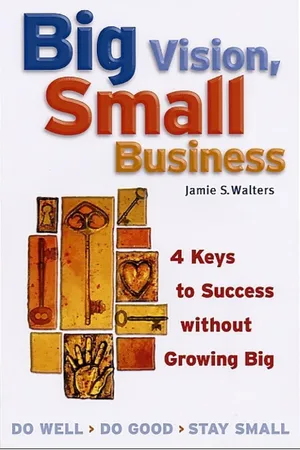
While most of the business world worships size and constant growth, Big Vision, Small Business celebrates the art—and power—of small. Based on interviews with more than seventy small-business owners and on her own experiences as a successful small-business entrepreneur, Jamie Walters shows how a business can stay small and remain vital, healthy, and rewarding. If you long to run a successful, socially conscious enterprise as one element of a fulfilling personal life, Big Vision, Small Business shows you how. Covering growth options and small-enterprise advantages, inspired visioning, communication, and right-relationship, mindset issues and expectation management, and wisdom and mastery practices, Big Vision, Small Business is a must-read for every entrepreneur and futurist. Walters defines for keys essential to creating a small business with a big vision: • Creating alternatives to the dominant definition of "growth• Learning the art of visioning big• Creating "right relationships" with employees, customers, and others• Overcoming the common stumbling blocks, such as money, risk, competition, and success.
- 264 pages
- English
- ePUB (mobile friendly)
- Available on iOS & Android
eBook - ePub
About this book
Information

SECTION ONE
KEY Nọ 1:
THERE’S MORE
THAN ONE WAY TO
DEFINE GROWTH
“DECIDE WHAT YOU WANT,
DECIDE WHAT YOU ARE
WILLING TO EXCHANGE FOR IT.
ESTABLISH YOUR PRIORITIES
AND GO TO WORK.”
H. L. Hunt
“THERE ARE MANY WAYS OF
GOING FORWARD, BUT ONLY
ONE WAY OF STANDING STILL.”
Franklin D. Roosevelt

OUR OBSESSION WITH SIZE creates a number of challenges for the owner of a small business: perceptual challenges regarding the relationship between size and success, for example, as well as the assumption that a business must grow quantitatively or die, a business commandment Inc. Magazine featured as a New Economy Myth.1 For the steward of a big-vision small business, the conflict between an internally motivated desire to build a distinguished organization and the externally motivated desire to create a company that is successful according to cultural norms can be significant, even paralyzing; it is the golden carrot that can lure us down the wrong path, where we may well find that the sparkling gold was merely a thin, colored-foil wrapper.
So how might we know the difference between the real golden carrot and the foil-covered one? This awareness—between the genuine and the superficial, the qualitative and the quantitative—is one factor that sets the big-vision small-business owner apart from her or his small-business peers. This section will begin to explore the distinctions between small and large enterprises and between qualitative and quantitative growth, and how all of these issues play out in the day-to-day lives of big-vision, small-business owners.
Chapter 1
FINDING QUALITY IN THE LAND OF QUANTITY
FINDING EVIDENCE of quantity worship isn’t difficult, even in the midst of so-called small-business advocates. Take, for example, Small Business Week, an event sponsored in May 2000 by the U.S. Small Business Administration (SBA). After referencing some of the contributions made by small businesses to our economy, the organization’s Web site went on to list the selection criteria for Small Business Person of the Year, emphasizing growth in the number of employees and increase in sales or unit volume as indicators of success. The SBA also has defined as “small” those businesses with up to 500 employees, a size most owners of truly small businesses consider very comfortably midsized, or even large.2
In a smaller but no less insidious example, one of the business owners interviewed for this book was named employer of the year by a statewide professional association in recognition of his employee relations practices. In the press release announcing the honor, the association representative referred to the award-winning business as “a small but growing firm,” as if the small group that warranted such recognition in the first place wasn’t quite enough. Seemingly trivial, perhaps, but language matters because it reflects deeply held assumptions and perpetuates an inappropriately narrow view of small business. These examples are just two indications of our culture’s unhealthy and often thoughtless bias toward big.
Surely increased sales or employee count provides one definition of growth but not the only one, and not one that guarantees profitability or success, much less a positive impact on the community or good quality of life for its founders. After all, one has to look no further than the recently worshipped, fast-growth dot-com companies to know that rapid expansion, in terms of employees and capital commitment, doesn’t guarantee a solid business concept, sustainability, profitability, nor economic (not to mention qualitative) contribution.
But just as expanded size doesn’t equate with profitability, satisfaction, or success, neither does an advocacy for refined smaller enterprises eschew the need for profitability and good business judgment. Personally, my advocacy for what author and economist David Korten has called the human-scale, locally accountable enterprise is inseparable from my preference for a good standard of living, which includes a self-defined degree of financial freedom. A preference for small business is not, for me, synonymous with a vow of poverty. It is, however, inseparable from knowing what is enough and what is—at the end of the day or of one’s life—truly important.
So if we’re willing to step away from our torrid cultural affair with size and linear progressions even for a moment, we might allow that growth can also mean an evolution or transformation, with an emphasis on qualitative aspects of business ownership, personal development, and contribution to the community. Unlike the more traditional, numerically focused entrepreneurs, big-vision small-business owners define growth in just this way—more a matter of polishing a gem and perfecting its facets, if you will, than of acquiring an ever expanding number of gems regardless of quality or of the fact that they might be permanently depleting the mine. Ultimately, the choice regarding what’s most appropriate must be left to the business owner, whose business, family, and life are most affected by this very personal decision.
The problem is that the decision to grow quantitatively is rarely driven by a reflection on one’s personal preferences or an assessment of other ways the organization might continue to live and thrive. Too often, the decision to expand is a result of an unquestioning acceptance of the “grow or die” myth, when in fact the end product of this approach might well be “grow and die.”
What are you the small-business owner to do in the face of such questions? Consider that there might be more than one way to grow, reflect on your options, decide what path is most consistent with your vision for your quality of life and desired contribution to the world, and then determine how business size or evolution can provide the best vehicle.
Chapter 2
APPRECIATING THE POWER OF SMALL ENTERPRISE
WE LIVE IN A CULTURE that engages in what E. F. Schumacher, in his book Small Is Beautiful, referred to as the “idolatry of large size.” Despite this, many enterprise owners still opt to keep their organizations small in size and big in vision and craftsmanship. Others, however, succumb to the myth that adding locations, employees, and revenues is the only route to growth and success, even if such a course conflicts with other lifestyle goals or the founding vision of the enterprise. Many even pursue quantitative growth, though it ultimately results not just in the erosion of their vision but in the failure of their company as well. Why? And what choices exist to help make growth-related decisions more deliberate and thoughtful?
One problem is rooted, again, in our assumptions. We assume that, because politicians talk about “helping small business” and large corporations create advertisements extolling the virtues of small business, we have a culture in which people actually demonstrate appreciation for the challenges and contributions of individual small enterprises. We too easily mistake the talk about small business being the engine of the economy, or the buzz about how the smallest businesses consistently create more jobs than their colossal brethren, or that woman-owned companies alone employ more people than the Fortune 500, or the enormous richness of the small-business market, for actual appreciation of small business.
The reality is that small businesses—and I’m not talking about the proliferation (and even more recent demise) of many dot-com Internet startup companies—make an enormous contribution to our neighborhoods, our cities, and our nations. Collectively, the smallest businesses form a force to be recognized and reckoned with. Individually, small businesses offer ideas, innovations, practices, and lifestyle options that larger companies increasingly and unsuccessfully attempt to imitate. But small businesses are what they are and contribute what they contribute because of their size. Similarly, many little, low-budget independent movies that have generated a big grassroots following in the past decade have taken the film industry by storm because they are not products of the large corporate studios. The larger studios can more easily create blockbuster epics and marketing juggernauts, while the greater degree of originality and creativity—both in the art of film and grassroots marketing—more often comes from the budget-challenged independents.
“Growth for the sake of growth is the ideology of the cancer cell.”
EDWARD ABBEY
The issue is not so much that large corporations are overappreciated but rather that the smallest enterprises are underestimated and underappreciated. Given that small organizations make such a significant contribution to the economy and the communities in which they’re located and provide a wonderful vehicle for creating a good quality of life and being of service, the problem is that so few people fully understand and appreciate these very real contributions. To a degree, rhetoric is mistaken for action. The bottom line is that we have work to do in raising the awareness of the true merits of small-size big-impact enterprises. Big-vision small-business owners—whether by example or overt advocacy—promote the virtues and possibilities of a vision- and integrity-driven small enterprise.
A true appreciation will mean that the organizations that lobby on behalf of small enterprise must focus on the vast majority of their constituency—the smallest enterprises, not the larger-scale operations. Heightened awareness will mean that their lobbying should result in policies that better support the small office/home office (SOHO) demographic of enterprises that have fewer than 20 people. It will also mean that local officials won’t blindly welcome big-box retailers into the community without simultaneously creating plans to ensure a robust small-business community and that small-business owners won’t let their assumptions regarding growth dictate their decisions and the quality of both business and life.
What Is a Small Business?
Before looking at some of the contributions small enterprises make, you may be asking, “What exactly constitutes a small business?” It’s a good question and a necessary one if we’re to discern the general contributions of small business or discuss the unique merits of big-vision small business. Unfortunately, relying on current data or definitions yields more than one answer.
We’ve seen that U.S. agencies such as the Small Business Administration often categorize a small business as any enterprise with 500 or fewer employees, though in other cases they define a small business as having fewer than 100 employees and a microenterprise as having 19 or fewer people. Chambers of Commerce report that the majority of their members—70 to 90 percent—are enterprises with 20 or fewer, which is the range used by Working Solo, Inc., a SOHO-market consulting firm, to define a SOHO enterprise.3 In the United Kingdom, most small-business advocates use a standard of up to nine people for a microenterprise, 49 or fewer for small business, 50 to 249 employees for a medium-size firm, and 250-plus for a large company. The European Union defines microenterprises as having fewer than 10 employees, small businesses as those with up to 50.4 Other organizations use a variety of measures, recognizing that industry plays some role in defining what a small business is, since “small” in manufacturing might be 50 while that number might constitute a large enterprise if applied to a florist, printer, or typical consultancy.
While the lack of common, contemporary definitions for small business is troublesome, perhaps worse still is the fact that, according to the U.S. Census Bureau, the single-person enterprises that make up close to 75 percent of all U.S. businesses aren’t even included in many statistical surveys.5 Why? Because most have lower overhead and no one but the owner on payroll and thus comprise only 3 percent of business tax receipts. So despite their sheer number and despite their overall economic and cultural importance, this group of SOHOs is invisible to the government, at least for the purposes of having access to business-supportive policies and resources that stem from statistical prominence.
The multitude of definitions of small business and the exclusion of most self-employed or single-person enterprises from many statistical surveys and reports create problems in discussing and meeting the needs of the majority of small-business owners. The U.S. government hasn’t yet caught up to the reality of solo or SOHO entrepreneurship. According to the SBA Office of Advocacy’s 1998 State of Small Business report to the president, “static data cannot be used to measure dynamic change.”6 While SOHOs are increasingly recognized for their economic and cultural importance in other countries, SOHO-supportive policy making consistently lags in all countries, particularly the United States. Yet even while imperfect, the existing data can be pieced together and mined for clues as to why small business—and particularly big-vision small business—is so vitally important from both economic and cultural perspectives.
I’ve elected to rely upon the SBA microenterprise or SOHO definition of 20 or fewer people, since many of the big-vision business tenets can be more deeply explored and adopted in groups of this size or smaller, for reasons I share throughout this book. Since most statisticians rely on a variety of numerical definitions for small business or are altogether vague about what measure they’re using, it’s not always possible to include breakdowns of statistics as they relate specifically to SOHOs.
The Contributions of Small Business to Society
The good news is that the value and increasing visibility of microenterprises and SOHOs is resulting in additional research to quantify the contributions made by this particular group of enterprises. Even people who readily quip, “Small businesses are the engine of the economy,” are often very surprised when presented with the specific reasons that underscore the truth of this statement, including the fact that the majority of those small businesses are, indeed, very small in size. Do you have doubts about the clout of the smallest companies, particularly those that are both aware of and intent upon leveraging these potential strengths? Consider the following:7
THE SMALLEST BUSINESSES ARE NUMEROUS
Nearly three-quarters of all U.S. businesses are self-employed individuals with no one else on payroll and are responsible for $580 billion in sales. SOHOs, those small enterprises with 20 or fewer employees, comprise one of the fastest-growing market segments, with more than 31 million SOHO enterprises in the United States as of 2001, spending an average of $103 billion each year. According to the Entrepreneurial Research Consortium, another 7 million people are considering business ownership or self-employment. All of these sectors—self-employed persons, home-based offices, small offices—are expected to grow in number and strength in the coming years. These statistics make clear that the vast majority of businesses are not just small businesses but very small businesses, and they’re an increasingly relevant group economically and culturally.
THE SMALLEST BUSINESSES CREATE JOBS
In fact, small enterprises don’t just create a few jobs, they create the majority of jobs, representing 99.7 percent of all employers in the United States. Between 1992 and 1998, small U.S. firms created nearly all of the 12 million net new jobs. The smallest of those, businesses with fewer than 20 employees, generated more than two-thirds of the new jobs. Firms with fewer than five employees generated just over half of those new jobs. The Office of Advocacy also reports that small enterprises are more likely to employ inexperienced and older workers; offer greater opportunities for women, minorities, and immigrants; and provide welfare-to-work or other opportunities for financial self-sufficiency. Since home-based and small-office businesses are both numerous and resilient, they create jobs directly through their own hiring, and also their spending. After all, SOHOs purchase office furniture, supplies, telephones, computers, bank services, and all of the other products and services necessary to run a business—products that often come from larger companies and whose purchase stimulates the creation of jobs to support manufacturing, shipping, and sales.
THE SMALLEST...
Table of contents
- Cover Page
- Title Page
- Copyright Page
- Dedication
- Contents
- Preface: The Great Power of Small Enterprise
- Acknowledgments
- Section One: Key No. 1: There’s More Than One Way to Define Growth
- Section Two: Key No. 2: To Live Large, You Have to Vision Big
- Section Three: Key No. 3: Right Relationship is a Big-Vision Craft
- Section Four: Key No. 4: To Live from the Source, Replenish the Well
- Parting Thoughts
- Notes
- Bibliography and Reading Guide
- Index
- About the Author
Trusted by 375,005 students
Access to over 1.5 million titles for a fair monthly price.
Study more efficiently using our study tools.
Frequently asked questions
Yes, you can cancel anytime from the Subscription tab in your account settings on the Perlego website. Your subscription will stay active until the end of your current billing period. Learn how to cancel your subscription
No, books cannot be downloaded as external files, such as PDFs, for use outside of Perlego. However, you can download books within the Perlego app for offline reading on mobile or tablet. Learn how to download books offline
Perlego offers two plans: Essential and Complete
- Essential is ideal for learners and professionals who enjoy exploring a wide range of subjects. Access the Essential Library with 800,000+ trusted titles and best-sellers across business, personal growth, and the humanities. Includes unlimited reading time and Standard Read Aloud voice.
- Complete: Perfect for advanced learners and researchers needing full, unrestricted access. Unlock 1.5M+ books across hundreds of subjects, including academic and specialized titles. The Complete Plan also includes advanced features like Premium Read Aloud and Research Assistant.
We are an online textbook subscription service, where you can get access to an entire online library for less than the price of a single book per month. With over 1.5 million books across 990+ topics, we’ve got you covered! Learn about our mission
Look out for the read-aloud symbol on your next book to see if you can listen to it. The read-aloud tool reads text aloud for you, highlighting the text as it is being read. You can pause it, speed it up and slow it down. Learn more about Read Aloud
Yes! You can use the Perlego app on both iOS and Android devices to read anytime, anywhere — even offline. Perfect for commutes or when you’re on the go.
Please note we cannot support devices running on iOS 13 and Android 7 or earlier. Learn more about using the app
Please note we cannot support devices running on iOS 13 and Android 7 or earlier. Learn more about using the app
Yes, you can access Big Vision, Small Business by Jamie S. Walters in PDF and/or ePUB format, as well as other popular books in Business & Management. We have over 1.5 million books available in our catalogue for you to explore.