With a clear focus on how business objectives determine project value, this book explains how to use an "investment-based" perspective to integrate finance, risk management and strategic planning. You'll develop workflows that overcome constraints of time, cost and scheduling as you benefit from new tools that relate processes directly to business goals: the project balance sheet and the time-centric earned value system. In addition, a new goal decomposition methodology gives you the best chance of getting projects started - and getting them accomplished successfully.
Whether stated or implied, every organization has some purpose or mission that drives achievement. Likewise, each possesses some vision for the future that inspires, motivates, and attracts stakeholders. From vision and mission, opportunity can be revealed. To exploit opportunities, goals are developed.
CONCEPTS IN MANAGING PROJECTS FOR VALUE
Five key concepts guide the management of projects for value.
Concept 1: Projects Derive Their Value from Goal Achievement
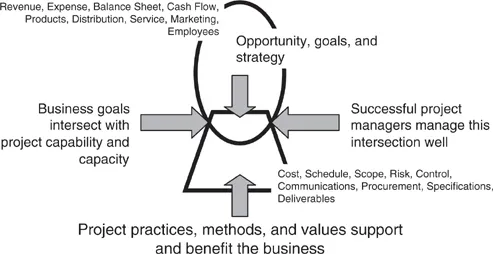
Goals represent that portion of the opportunity value that can be transferred into the business. Goals are the state or condition to which organizations aspire; thus, value is attached to their achievement. Insofar as proposed projects are deemed necessary to achieve goals, projects are valuable to the organization (see Figure 1-1).
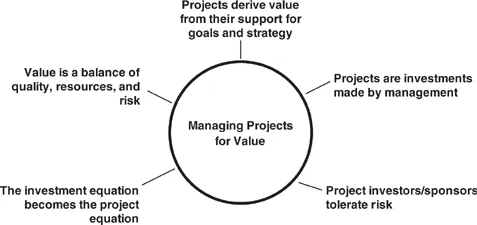
Said another way, projects are not valuable in and of themselves; they only acquire value from the role they play in exploiting opportunity. This idea forms the first of five concepts in managing projects for value: A project’s value is derived from the value obtained by reaching goals (Figure 1-2).
Concept 2: Projects Are Investments Made by Management
By definition, projects begin and projects end,1 but business goes on. For projects to exist, a deliberate assignment of resources must occur. In return for these resources, there is an expectation of a deliverable with benefits attached. Thus, projects can be seen as investments: principal applied, time expended, and return expected. For purposes of this book, the project sponsor is the project investor with authority to commit resources and charter the project. The charter becomes the investment agreement, specifying the value expected, the risk allowed, the resources committed, and the project manager’s authority to apply organizational resources.
FIGURE 1-1 Business goals are the source of value for projects
FIGURE 1-2 Concepts in managing projects for value
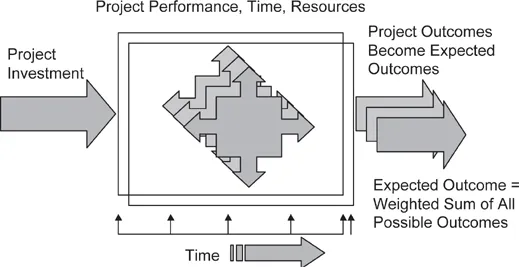
The concept of investment is that a commitment is made in the present time with an expectation of a future reward. The displacement of the future from the present introduces the possibility that unfavorable outcomes could occur (see Figure 1-3). Risk is the word used to capture the concept of potentially unfavorable outcomes. Project sponsors, acting as investors, embrace and understand risk as an unavoidable aspect of pursuing reward. Although project investors/sponsors “tolerate” risk, they do not manage it. Instead, the project manager manages the risk of achieving successful deliverables. Once the project itself is complete, a “benefits manager” manages the risk of achieving the operational value of the project.
As individuals, project investors/sponsors have different attitudes regarding risk. For instance, “objective” investors/sponsors are indifferent to the specific nature of risk, judging only the risk-adjusted value. In effect, different risks of the same value or impact are judged equally.
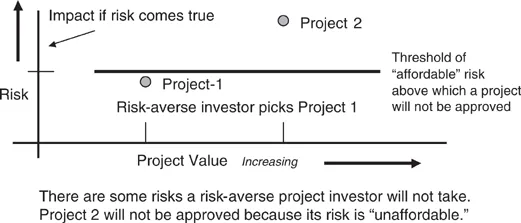
Risk-averse project investors/sponsors seek a balance of risk and reward. Risk-averse investors/sponsors are not necessarily risk avoiders, but they do avoid risks that cannot be afforded if the risk comes true, or cost more if the risk comes true, than the value of the “try.”
FIGURE 1-3 Time adds uncertainty to outcomes
The following example illustrates this concept. In a coin toss, the bet is that heads gets $200 and tails gets $0. The expected value is $100 since half the time $200 will come up and half the time $0 will come up. The “value of the try” is negligible; nothing but a little time is lost if tails comes up. Suppose the bet is changed so that heads gets $400 and tails pays $200 for the same average outcome of $100. The risk-averse investor may not play the second bet even though it has the same positive expected value as the first because of the investor’s aversion to even a 50 percent chance of losing $200 and a judgment that the entertainment “value of the try” is not worth $200.2
Figure 1-4 illustrates the concept of risk aversion applied to projects. Even though Project 2 has a higher expected return, its risk is beyond a threshold of affordable risk compared with Project 1. The risk-averse manager will approve Project 1 and disapprove Project 2.
Concept 4: The Investment Equation Becomes the Project Equation
The traditional investment equation of “total return equals principal plus gain” is transformed into the project equation of “project value is delivered from resources committed and risks taken.” This equation is the project manager’s “math.” Many persons use the terms “benefits,” “return,” and “value” somewhat interchangeably even though they have different meanings.
FIGURE 1-4 To be risk-averse means there are risks that will not be taken
This book employs the following definitions:
Benefits are the mechanism for recovering project investment. For example, a project might be chartered to reduce production costs. Reduced production costs are the benefits that pay for the project investment.
Return is the rate of change of a financial metric; for example, percentage incremental profit per period generated after the project is completed.
Value is the need being satisfied by the project and the source of improved wealth in the business. In this project example, the business need may be to retain the production capability for customer satisfaction.
Concept 5: Value Is a Balance of Quality, Resources, and Risk
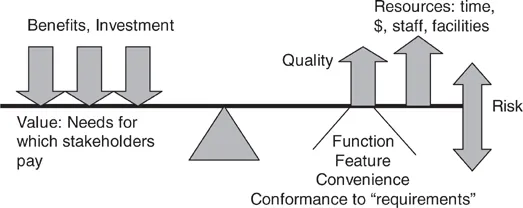
“Balance” is another term for equation. It is the state achieved when one side equals the other. In this context, quality demands are balanced or “provided” by resources and risk. Quality is used here in the sense of satisfying all dimensions of customer and stakeholder needs and expectations. Achievement of quality is accompanied by risk. How much risk? The answer is: only as much as is required to balance quality with resources (see Figure 1-5).
FIGURE 1-5 Value is a balance of quality, resources, and risk
...
Table of contents
Cover
Title Page
Copyright
About the Author
Dedication
Table of Contents
Preface
Acknowledgments
CHAPTER 1 Understanding Project Value
CHAPTER 2 The Sources of Value for Projects
CHAPTER 3 Balancing investment, Returns, and Risk
CHAPTER 4 Estimating the Future
CHAPTER 5 Delivering Value
CHAPTER 6 Schedule Risk and Value Attainment
Bibliography
Index
Trusted by 375,005 students
Access to over 1.5 million titles for a fair monthly price.
Study more efficiently using our study tools.
Frequently asked questions
Yes, you can cancel anytime from the Subscription tab in your account settings on the Perlego website. Your subscription will stay active until the end of your current billing period. Learn how to cancel your subscription
No, books cannot be downloaded as external files, such as PDFs, for use outside of Perlego. However, you can download books within the Perlego app for offline reading on mobile or tablet. Learn how to download books offline
Perlego offers two plans: Essential and Complete
Essential is ideal for learners and professionals who enjoy exploring a wide range of subjects. Access the Essential Library with 800,000+ trusted titles and best-sellers across business, personal growth, and the humanities. Includes unlimited reading time and Standard Read Aloud voice.
Complete: Perfect for advanced learners and researchers needing full, unrestricted access. Unlock 1.5M+ books across hundreds of subjects, including academic and specialized titles. The Complete Plan also includes advanced features like Premium Read Aloud and Research Assistant.
Both plans are available with monthly, semester, or annual billing cycles.
We are an online textbook subscription service, where you can get access to an entire online library for less than the price of a single book per month. With over 1.5 million books across 990+ topics, we’ve got you covered! Learn about our mission
Look out for the read-aloud symbol on your next book to see if you can listen to it. The read-aloud tool reads text aloud for you, highlighting the text as it is being read. You can pause it, speed it up and slow it down. Learn more about Read Aloud
Yes! You can use the Perlego app on both iOS and Android devices to read anytime, anywhere — even offline. Perfect for commutes or when you’re on the go. Please note we cannot support devices running on iOS 13 and Android 7 or earlier. Learn more about using the app
Yes, you can access Managing Projects for Value by John C. Goodpasture PMP in PDF and/or ePUB format, as well as other popular books in Business & Business Strategy. We have over 1.5 million books available in our catalogue for you to explore.