You are not in charge and you want to make a difference: that is the dilemma. You may not know who is in charge in today's changing, temporary, and virtual organizations, but you know you are not! You are searching for ways to contribute through the work you do and gain some personal satisfaction in the process. This book can help you do just that.
In this new edition of his classic book, Geoff Bellman shows readers how to make things happen in any organization regardless of their formal position. The new edition has been written for a wider audience, including people in both the for-profit and not-for-profit sectors, paid and volunteer workers, managers and individual contributors, contract and freelance workers. More than seventy percent of the material is brand new, including new examples, new chapters, new exercises, and much more.
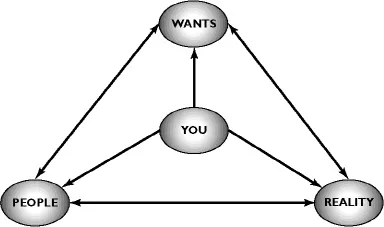
Often, what we need is a simple way to dig through the messiness of task forces, councils, or committees to which we belong. That’s what this model is about. It gives us a way of sorting all the information that inundates us; it helps us decide what is important, and to sort it from what is not. Our hope of influencing our organizations increases when we have a way of understanding them. The Getting Things Done (GTD) model has been useful to many people over the years. You will see this GTD model repeatedly; it is the hook upon which the content of this book hangs. The model’s usefulness is directly related to its simplicity. You can remember it in the middle of a meeting; you can use it to ask questions or to seek or sort the information you need. Or, you can use it to sort out issues within your own life. Or, an entire organization can pause to consider this model.
Consider the four elements of the GTD model:
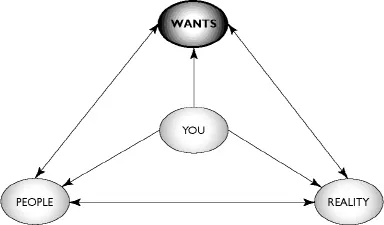
WANTS: This is the way you would like the world to be, the possible, the desirable, the potential world—and it is usually different from REALITY. The difference between WANTS and REALITY creates a tension.
6
REALITY: This is how things are right now, the day-to-day world in which you and others live, with all its comforts and discomforts, joys and sorrows, satisfactions and dissatisfactions.
PEOPLE: These are the individuals and groups that care about the world as it is (REALITY) and/or as it could be (WANT). They are a potential source of talent, energy, money, expertise, and other resources. They may be for or against what you want to do, and they are vital to it.
YOU: You are in the middle of all of this with potential connections to the PEOPLE, WANTS, and REALITY. You are not in charge but you definitely want to get something done. Connecting the dots will create movement and help PEOPLE change REALITY to what they WANT.
This model puts you in the pivotal role. You are potentially powerful; you can connect the dots, making a solid change triangle. You are key to the change. But for this to happen, you have to step out of the PEOPLE corner and define yourself as someone who is willing to take action. Like the person in this example: A worker in a manufacturing plant noticed that disagreements between her shift and the next shift were increasing, reaching the point where they were blaming each other for everything and hardly talking. She decided to do something about it. She gathered a few key PEOPLE over coffee to begin to discuss the REALITY of what was going on and what they WANTED. They agreed that they all wanted work to be a more positive experience. They identified and agreed to work on two problems. None of this would have happened if that one worker had not separated herself from all of the PEOPLE and taken individual action. She brought the issue; she gathered the right people; they identified what they wanted and what they had; they took constructive action.
This example shows the GTD model in action, and it shows how the investment of one person can make a difference. That’s what the model is about, making a positive difference in your work world, stepping out to help people move the present reality toward what you all want. This could be called a “change” model or a “leadership” model. Whether or not you think in terms of being a change agent or a leader, I do, and I will frequently talk in those terms in the coming chapters. The movement from REALITY toward WANTS is change, and YOU at the center of this model are a leader when you start hooking the three corners together.
7
Explore the four elements of the GTD model through these questions:
WANTS
Why is that important?
What do key people in this organization want?
What do their wants have in common?
How do their wants differ?
How committed are they to acting on their wants?
REALITY
What is really happening?
How do key people describe what exists right now?
What do their descriptions have in common?
How do their descriptions differ?
How responsible do they feel for the current state of affairs?
PEOPLE
Who makes a difference?
Who could be affected by the changes anticipated?
Who are the key people?
What are their special talents, resources, or powers?
How willing are they to work with each other?
YOU
How might you help?
What special talents, resources, or powers do you have?
Why do you want to change things?
How does your description of wants fit with others?
How does your description of reality fit with others?
How well do you work with the people involved?
The GTD model, along with the above questions, can help us to think before acting. There are more questions that could be asked; these are merely a sample. Ask these questions of the people you work with and your questions will move them. Things will be different just because you asked. Your questions stir the four key elements. Through questions and answers, the four elements are connected and the change dynamic begins.
8
This book revolves around the GTD model, with chapters highlighting one of the four key elements or the dynamics among them. The table of contents can guide you to particular elements or dynamics that interest you.
AN EXERCISE
Drawing Your Life
Deepen your familiarity with the GTD model by spending 15 minutes on these six steps.
Draw the four key elements of GTD model on a large sheet of paper. Make the circles large enough (3–4 inches across) that you can write or draw in them. Put the labels (WANTS, REALITY, PEOPLE, and YOU) above their circles.
In the REALITY, use words and symbols to represent your life as it is right now. That’s right, your life. Indicate those parts of it that really stand out for you at the moment. Take just 2–3 minutes to do this.
In the WANTS circle, represent your life as you want it to be. With words or symbols note what you hope to have as a part of your future. It may include some of what you already have; it may include more. Take 2–3 minutes to do this.
In the PEOPLE circle, name people particularly important to you in your life—as it really is and/or as you want it to be. Note those people’s names or roles or positions. Take a minute to do that.
In the YOU circle, note your reactions to the idea of engaging those PEOPLE in helping you move from the REALITY you’ve got toward what you WANT from your life. Spend 3–5 minutes thinking about yourself and making a few notes.
An option: Using this sheet as a visual aid, tell your friend, spouse, child, or parent about your life as you see it right now.
9
This exercise can form a deeper awareness of the GTD model and the dynamics within it. You can see, and perhaps feel, the differences between reality and wants; you imagine how these people affect the life you lead; you think about what you might do to get people’s help. Most of the time in this book, we will be applying portions of the model to situations that are a subset of your life—particularly the work you are doing with others.
What to Read Next
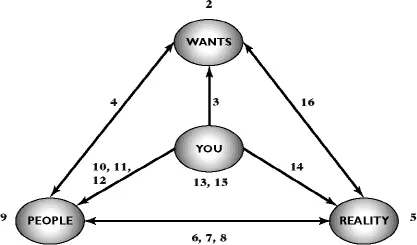
The Getting Things Done model is the framework for the book. The chapters cover the model in this way:
Each chapter focuses on a particular corner or connection of the model and has a central theme represented in the title of the chapter. The themes are sometimes questions (What is really important?} and sometimes direction (Face the politics). These are key questions and actions for you, the reader, to consider as you think about getting things done at work. Let’s elaborate a bit more on the chapters surrounding the four main elements or corners of the model.
10
WANTS: “Why Is That Important?” To learn more about the importance of people’s WANTS as related to leading and changing in your organization, begin with Chapter 2: Why Is That Important?; Chapter 3: Pursuing Your Aspirations; and Chapter 4: Discovering Dreams. WANTS draw us toward something better; WANTS cause movement. Without WANTS, nothing happens. Connect with their WANTS.
REALITY: “What Is Really Happening?” For more about assessing and understanding what is really going on right now, turn to Chapter 5: What Is Really Happening?; and Chapter 6: Build Common Understanding. We often miss out on the change we want because we are starting from different understandings of the current REALITY—what we have. If you want to succeed in getting things done with others, you’d better pay attention to their starting point.
PEOPLE: “Who Makes a Difference?” If you want to learn about identifying and working with those people particularly important to the issues now facing you and the organization, try Chapter 9: Who Makes A Difference?; and Chapter 10: Enlist Able Partners. All the change we undertake comes through working with key people; these chapters focus on building constructive relationships with them.
YOU: “How Might You Help?” If you want to learn more about yourself as a unique resource, begin with Chapter 13: How Might You Help?; Chapter 14: Find the Courage to Risk; and Chapter 15: Making Your Work Rewarding. All change starts here, whether we are aware of it or not. Our challenge is to become more aware and do our own work before we set out to do other people’s work.
The first chapter of the book, and the last two, offer ideas and actions important to the entire GTD model. You have already read Chapter 1: A Model For Getting Things Done. Chapter 16: Create Change, lays out some of the ground rules for making change work, whether in your whole organization, your work group, or your own life. Chapter 17: Actions That Get Things Done, offers twenty ways I have used many times to stimulate some movement in an organization.
11
CHAPTER TWO
Why Is That Important?
When attempting to move people from where they are right now toward something else, we often ask what is important to them? Good question, but I think not the core question. Ask them what and they will tell you the object, the person, the destination, the goal. That’s helpful, but it stands in front of what they want even more deeply, does not reach for the source of the motivation. We know what they want, but why? For example, teenagers often want cars. What they want is pretty clear: a car. But why? Recognition, independence, excitement, freedom, fulfillment, attractiveness, friends—these are the whys behind the goal of car; these are continuing sources of motivation for these kids, whether they have a car or not.
And, when you want to help people in your workplace move from their current reality, you need to appeal to the whys behind their goals. Sure, talk with them about what they want, but more important, find out why they aspire to that goal. “Why is that important?” calls forth the deeper reasons and feelings behind the goal. Responses to the what question elicit concrete, material, short-term goals; the why question yields the heartfelt convictions and values that support the more tang...
Table of contents
Cover Page
Title Page
Copyright Page
Dedication
Preface
Introduction: You are Not in Charge
Chapter 1: A Model for Getting Things Done
Chapter 2: “Why is That Important?”
Chapter 3: Pursuing Your Aspirations
Chapter 4: Discovering Dreams
Chapter 5: What is Really Happening?
Chapter 6: Build Common Understanding
Chapter 7: Face the Politics
Chapter 8: Seek the Priorities
Chapter 9: Who Makes a Difference?
Chapter 10: Enlist Able Partners
Chapter 11: Controlling Work Dynamics
Chapter 12: Dealing With Decision Makers
Chapter 13: How Might You Help?
Chapter 14: Find the Courage to Risk
Chapter 15: Making Your Work Rewarding
Chapter 16: Create Change
Chapter 17: Actions That Get Things Done
Conclusion: A Life Perspective on Leading Change
Resources
Index
About the Author
Trusted by 375,005 students
Access to over 1.5 million titles for a fair monthly price.
Study more efficiently using our study tools.
Frequently asked questions
Yes, you can cancel anytime from the Subscription tab in your account settings on the Perlego website. Your subscription will stay active until the end of your current billing period. Learn how to cancel your subscription
No, books cannot be downloaded as external files, such as PDFs, for use outside of Perlego. However, you can download books within the Perlego app for offline reading on mobile or tablet. Learn how to download books offline
Perlego offers two plans: Essential and Complete
Essential is ideal for learners and professionals who enjoy exploring a wide range of subjects. Access the Essential Library with 800,000+ trusted titles and best-sellers across business, personal growth, and the humanities. Includes unlimited reading time and Standard Read Aloud voice.
Complete: Perfect for advanced learners and researchers needing full, unrestricted access. Unlock 1.5M+ books across hundreds of subjects, including academic and specialized titles. The Complete Plan also includes advanced features like Premium Read Aloud and Research Assistant.
Both plans are available with monthly, semester, or annual billing cycles.
We are an online textbook subscription service, where you can get access to an entire online library for less than the price of a single book per month. With over 1.5 million books across 990+ topics, we’ve got you covered! Learn about our mission
Look out for the read-aloud symbol on your next book to see if you can listen to it. The read-aloud tool reads text aloud for you, highlighting the text as it is being read. You can pause it, speed it up and slow it down. Learn more about Read Aloud
Yes! You can use the Perlego app on both iOS and Android devices to read anytime, anywhere — even offline. Perfect for commutes or when you’re on the go. Please note we cannot support devices running on iOS 13 and Android 7 or earlier. Learn more about using the app
Yes, you can access Getting Things Done When You Are Not in Charge by Geoffrey M Bellman in PDF and/or ePUB format, as well as other popular books in Business & Leadership. We have over 1.5 million books available in our catalogue for you to explore.