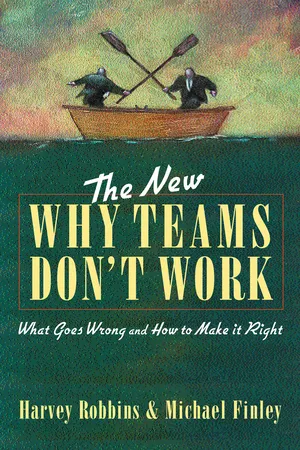
The move to teams has largely failed, say Harvey Robbins and Michael Finley, mainly because teams themselves are failing to think through the human implications of teaming. The New Why Teams Don't Work is a handbook for team members and team leaders to maintain the highest possible level of team intelligence-the skills, attitudes, and emotional flexibility to get the most out of a team's inherent differences.Describing what teams are really like, not how they ought to be, the book teaches people how to work together to make decisions, stay in budget, and achieve team goals. Robbins and Finley show, for instance, how to get hidden agendas on the table, clarify individual roles, learn what team members expect and want from each other, choose the right decision-making process, and much more.Updated throughout, the book includes completely new material on team intelligence, team technology, collaboration vs. teamwork, team balance, teams at the top, the team of one, plus all new and updated examples.
eBook - ePub
The New Why Teams Don't Work
What Goes Wrong and How to Make It Right
- 288 pages
- English
- ePUB (mobile friendly)
- Available on iOS & Android
eBook - ePub
About this book
Information
part one
The Dream of Teams

3 chapter one
chapter one
The Team Ideal
A generation ago people didn’t talk about teams. Oh, they existed, but they were conventional, function- bound things. There were accounting teams, finance teams, production teams, and advertising teams—all made of specialists in parallel functions or “silos.” Everyone on a team did pretty much the same thing.
Functional teams spent a lot of time together, and spoke the same functional language. Not having to deal with one another’s “differentness,” functional teams had something of a free ride.
Wow, has a lot changed since then. The conventional silo team is still out there. But it has been crowded out by scores of other kinds of teams.
There are work teams in which everyone has the same skills, but each person is assigned a specific task. There are project teams, where people with different expertise each tackle a different part of the task. There are functional teams, and there are cross-functional teams.
There are interorganizational teams and intraorganizational teams. Some teams, like Army platoons, live and breathe together. Others join together across time zones, language differences, and boundaries. There are teams that work together for twenty years and those that team up for only a minute or two, then fade away.
4 There are leader-led teams and leader-less teams. There are teams in which everyone takes turns leading. And teams on which everyone is leading all the time.
There are teams of a hundred, teams of a dozen, teams of two—even teams of one (we’ll explain that).
A Short History of Teams
Though teams may seem new, they aren’t. We hunted and gathered in teams a hundred thousand years ago. Someone led, everyone did what he or she was best at, and shared in the outcome. By the time of Hammurabi, teams were already old hat. What we do today is only a modest variation on that. The team is the natural unit for small-scale human activity.
The catch is that word “small-scale.” With the Industrial Revolution, which began in the 1700s and has taken the planet by storm, the common model for many businesses drastically changed. Mass assembly machinery and techniques developed in the early 1900s meant that a single man, woman, or even child in a factory could be ten times as productive as his or her cottage equivalent, working the old way.
The Industrial Age peaked with the development of scientific management. This theory, propounded by Frederick Taylor, an American, attempted to optimize the productivity of organizations by assigning specialized tasks to individuals. Bosses were bosses. Below them were ranks of managers. Below them were countless supervisors. And below them, at the bottom of the organizational pyramid, were the multitudes of rank-and-filers, each one assigned a single task, like tightening a screw or attaching a hose or stamping a document.
Scientific management yielded the phrase “a cog in the works.” It was, in many ways, the wonder of the world. Henry Ford’s River Rouge plant in Detroit was an impressive four-mile-long monument to scientific management. The United States government was also a form of scientific management. It broke a large organization down into a nearly infinite assortment of tasks or bureau drawers. The bureaucracy this created was very steep and very deep, from the clerk sorting applications in the U.S. Patent Office all the way up to the ultimate boss, the President of the United States.5
Technology ratcheted the machine age even tighter with the development of commercial mainframe computers in the 1950s. Large companies were suddenly able to perform accounting chores, such as billing, buying, cataloging, and payroll, that were unthinkable even in the big-company boom of the 1920s.
Bolstered by mainframe computers, big companies became megacompanies. The emphasis began a subtle shift away from uneducated manufacturing crews toward well-educated professional functional groups—people skilled in engineering, finance, distribution, and even technology itself.
By the 1960s the idea of teams made of flexible, multifunctional members, especially in big companies, had become nearly extinct. Functional teams such as accounting teams, design teams, and information services teams existed, but specialization and separation was the typical pattern.
Then the American postwar prosperity bubble popped. Corporations had become so immense that they were out of touch with their customers, and charging too much for value delivered. Workers were not asked to contribute their knowledge to the task of increasing an organization’s ability to compete or make a profit. A deep trench separated management from workers; management was the brains of an operation, and workers were the muscle, and that was all.
Labor relations became one of two things, each as bad as the other: adversarial to the point of intracompany war, or complacent to the point of indifference. The driving mission of adversarial industries like mining and oil seemed to be to keep workers down. The sloppy mission of complacent industries like autos and steel was to cut sweetheart deals with labor to mop up the gravy between them, and the hell with the customer. It was the age of bloat.
The rest of the world, ruined by World War II, was rapidly rebuilt. Fiercely competitive Japan, Germany, and other countries, seeking an edge against the U.S., were experimenting with new models for large organizations. Their successes at our expense were our wake-up call. The American engine of prosperity—huge factories, reductionist use of labor, vertical integration, and mainframe information control—began to stall.6
Japan came at America in large part because of its team ethic. In the wake of the war they had no enviable natural resources, no state-of-the-art infrastructure, no money, no computers. What they had was motivated people with a tremendous amount of social capital—the cultural disposition to work together—and the vision and patience to chart a strategy and see it through.
Working largely in teams, the Japanese proceeded to clean our clock. Through the 1970s word wafted across the Pacific Ocean of the new approach the Japanese were using. Instead of asking the least from workers—such as tightening a 9⁄16-inch bolt 23⁄4 turns clockwise, over and over and over—the Japanese were asking the most. Every worker, in every function, at every level, was made a part of the company team. And that team’s mission was continuous improvement of processes. No idea was too small, and no worker was too small. Everyone participated.
Wm. Edwards Deming, the American statistician who helped get industrial Japan back on its feet in the 1950s, contributed some of the key concepts to the Japanese idea of kaizen, or continuous improvement. Foremost among these was the prime directive of teams, the notion that all are human beings. (Years after he returned to the U.S., having received Japan’s highest honors, an acquaintance of ours asked him what the Japanese had taught him. Deming did not even look up from his dinner to reply. “People are important,” he said.)
By the 1990s the new team model overtook the old model of hierarchy, even in the U.S. By the millennium, organizations everywhere, of every size, saw teams as part of the answer to nagging issues of strategic focus, cost containment, restructuring, productivity, training, and connectivity, completing one of the great blood-less revolutions in history, and helping cause the longest period of economic expansion ever.7
In the 2000s, the idea of teaming has continued to evolve. Not rapidly, as technology evolves, but incrementally, as people discover new ways to put their heads together, and new reasons to do it. Technology is altering the way teams are expected to work, and occasionally making it easier and more fluid.
The renewed trend toward mergers means that teams will be operating across cultural grains, facing all the accompanying challenges. Already we are seeing virtual organizations that are wholly team-based—ad-hoc organizations thrown together for a single purpose, that do their work, make their money, and then disband.
Likewise, the new generation coming to power, the so-called “N” (for network) Generation, appears to have an intense teaming style all its own, as if they are determined to replace the ego-driven teams of their predecessors. It will be fascinating to see how that plays out.
So teams are here to stay, and even to dominate the way work is performed.
But as we shall see, they are also problematic.
Why Teams?
A team is easily defined: people doing something together. It could be a hockey team making a power play, or a research team unraveling an intellectual riddle, or a rescue team pulling a child from a burning building, or a family making a life for itself.
The something that a team does isn’t what makes it a team; the together part is.
Why did the world turn to teams? How could it not? On paper, at least, teams were a no-brainer:
- Teams save money. In come teams and out goes middle management. Organizations turning to teams solely to save bucks have not been disappointed.
- 8Teams increase productivity. Teams are closer to the action and closer to the customer than the old bureaucracy could be. Teams see opportunities for improving efficiencies bosses can’t hope to see.
- Teams improve communication. In a proper team, members are stakeholders in their own success. Teams intensify focus on the task at hand. The very heart of a team, its business if you will, is the sharing of information and the delegation of work.
- Teams do work that ordinary workgroups can’t do. When a task is multifunctional in nature, no single person or crew of functionaries can compete with a team of versatile specialists. There is just too much to know for one person or one discipline to know it all and do it well.
- Teams make better use of resources. Teams are a way for an organization to focus its most important resource, its brainpower, directly on problems. The team is the Just-In-Time idea applied to organizational structure—the principle that nothing may be wasted.
- Teams mean higher-quality decisions. Good leadership comes from good knowledge. The essence of the team idea is shared knowledge, and its immediate conversion to shared leadership.
- Teams mean better quality goods and services. The quality circle (long ago abandoned) was an early expression of the idea that quality improvement requires everyone’s best ideas and energies. Teams increase knowledge, and knowledge applied at the right moment is the key to continuous improvement in the quality of goods and services.
- Teams mean improved processes. Processes occur across functions. Teams, straddling all the functions contributing to a process, have better “process vision.” That’s why reengineering in the 1990s and the use of teams went hand in hand.
- 9Teams “differentiate while they integrate.” Most organizations are eager to cut costs and work more effectively, but they worry about the fragmentation that may occur after scaling back. Teams allow organizations to blend people with different kinds of knowledge together; the blend inoculates the organization against the shock of downsizing.
All these things sound really good, and they are all true enough in the aggregate. But teams can also result in a new wave of problems that are causing all kinds of organizations all kinds of grief. For over a decade, we have been discovering that while teams achieve some good outcomes, they often fail for one reason or another.
Yes, companies save dollars by eliminating or combining jobs deemed unnecessary—productivity by attrition. But communication, quality, and true productivity gains—all the promises teams make, and managers get so excited about—remain elusive.
So you can’t blame these companies if they are having second thoughts about the team idea. Are teams just another frantic business fashion? Is it time to hitch up the harnesses and rebuild the pyramid of bureaucracy?
No, and no. First, teams are not a fad. They have always been around, and they will always be around. Second, there can be no turning back. The old hierarchy was too expensive. Turning back means taking on the waste and excess costs in ...
Table of contents
- Cover Page
- Title Page
- Copyright Page
- Preface
- What’s New
- Acknowledgments
- part one The Dream of Teams
- part two Where Teams Go Wrong
- part three Team Myths
- part four Turning Teams Around
- Epilogue: Toward Team Intelligence
- Index
- About the Authors
Trusted by 375,005 students
Access to over 1.5 million titles for a fair monthly price.
Study more efficiently using our study tools.
Frequently asked questions
Yes, you can cancel anytime from the Subscription tab in your account settings on the Perlego website. Your subscription will stay active until the end of your current billing period. Learn how to cancel your subscription
No, books cannot be downloaded as external files, such as PDFs, for use outside of Perlego. However, you can download books within the Perlego app for offline reading on mobile or tablet. Learn how to download books offline
Perlego offers two plans: Essential and Complete
- Essential is ideal for learners and professionals who enjoy exploring a wide range of subjects. Access the Essential Library with 800,000+ trusted titles and best-sellers across business, personal growth, and the humanities. Includes unlimited reading time and Standard Read Aloud voice.
- Complete: Perfect for advanced learners and researchers needing full, unrestricted access. Unlock 1.5M+ books across hundreds of subjects, including academic and specialized titles. The Complete Plan also includes advanced features like Premium Read Aloud and Research Assistant.
We are an online textbook subscription service, where you can get access to an entire online library for less than the price of a single book per month. With over 1.5 million books across 990+ topics, we’ve got you covered! Learn about our mission
Look out for the read-aloud symbol on your next book to see if you can listen to it. The read-aloud tool reads text aloud for you, highlighting the text as it is being read. You can pause it, speed it up and slow it down. Learn more about Read Aloud
Yes! You can use the Perlego app on both iOS and Android devices to read anytime, anywhere — even offline. Perfect for commutes or when you’re on the go.
Please note we cannot support devices running on iOS 13 and Android 7 or earlier. Learn more about using the app
Please note we cannot support devices running on iOS 13 and Android 7 or earlier. Learn more about using the app
Yes, you can access The New Why Teams Don't Work by Harvey Robbins,Michael Finley in PDF and/or ePUB format, as well as other popular books in Business & Management. We have over 1.5 million books available in our catalogue for you to explore.