An Easy Approach to Using Surveys to Elicit Requirements!
Surveying is an excellent way to elicit requirements, but reliable resources that examine survey methods are hard to find — until now. Surveying Fundamentals for Business Analysts presents the basics of developing and executing efficient and effective surveys. It offers detailed descriptions of the different types of surveys and guidance on how to choose the right survey for your task as well as how to identify stakeholders and participants. Surveying Fundamentals also presents specific instructions on writing effective questions and gearing them toward a particular audience.
This practical guide provides the fundamentals you need to conduct and present the results of surveys — in one simple source. Follow the author's step-by-step approach to:
• Determine the scope of the survey
• Design questions that will capture specific data
• Analyze the data objectively and effectively
• Report the findings clearly
Add effective surveying to your list of business analysis skills!
- 172 pages
- English
- ePUB (mobile friendly)
- Available on iOS & Android
eBook - ePub
Surveying Fundamentals for Business Analysts
About this book
Information
CHAPTER 1
Defining the Objective
Before you can begin writing effective survey questions, you must understand what the survey is trying to accomplish. This can be done by identifying the objective or objectives of the survey. These objectives are broken down into possible variables and variations and further analyzed. This information is then used to write the survey questions. The objectives will be the guide to creating an effective survey and effective questions. You should be able to trace each question in the survey back to a single objective.
Setting Objectives
The objective of the survey may be taken directly from project documentation, such as the business case or problem definition. But if the survey is one of many elicitation activities, you may have to put more effort into determining the objectives for the survey in particular. When setting objectives for the survey, ask:

Start with one or more general objectives, and refine them as you go along. For example, if the general objective is to evaluate the new system that product specialists have recently begun using, related specific objectives might include:
Each concept or idea should be stated as a single objective. If the word “and” is used when stating an objective, it probably consists of two objectives. The more focused and clear the objectives are, the more likely the survey will gather the information needed.
Determining the Variables and Variations
Next, for each single objective, identify the specific information that must be collected. Determine the variables for each objective. Let’s say we are looking at satisfaction with the new system. For each variable identified, such as overall satisfaction, dig deeper. Can overall satisfaction be assessed, and then broken down into specific components, such as satisfaction with available data, system response time, and the usefulness of data? Ask what other variables might help explain why some users are satisfied and others are dissatisfied with the system.
The challenge is to think of all possible variables that may help collect the correct information. For example, user satisfaction may be affected by the training users received. Was it enough training? Was the training in the right format? What do the users think about their jobs? How does the system help them do their jobs? Does the new system make tasks easier than they used to be? Each variable and its components or variations will be used to develop questions.
Some variations may require further analysis and breaking down. For example, if the survey is looking at how users view their jobs now that the new system has been implemented, for the variation “view their jobs,” consider asking questions that address:
This analysis and breakdown can lead to more questions. For example, you might ask whether the new features being proposed for the new system would enhance or constrain interdepartmental interaction and relationships and professionalism.
Mind mapping tools (Figure 1-1) are a great way to quickly trace your objective to its variables and variations.
Once all variables and variations for each objective have been identified, determine which ones will be used to write questions. Depending on the length of the survey, all or only some variables and variations may be used. This process of breaking down objectives into smaller variables and variations on which all questions are based allows each question to be traced back to a single objective.
Once all objectives have been finalized, look at each objective and identify the target audience for questions about that objective. You may ask all the participants about all the objectives or present subsets of questions to different segments of participants.
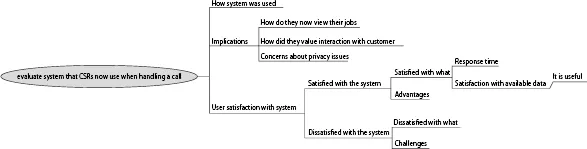
FIGURE 1-1: Example Mind Map
Depending on the type and size of the initiative, additional preparation may be warranted before proceeding with the survey. This additional work could include identifying participants, interviewing or having informal discussions with participants, analyzing relevant literature (in trade magazines, for example), or researching similar product features on the Internet.
CHAPTER 2
Identifying the Group
In any initiative a business analyst undertakes, it is important to know who the stakeholders are. Once they have been identified, some stakeholders are further categorized as potential participants. This chapter will help you identify stakeholders. It also offers methods to identify your potential participants and determine participant requirements.
Stakeholders
Identifying the right people to particip...
Table of contents
- Cover
- Title Page
- Copyright
- About the Author
- Contents
- Foreword
- Preface
- Introduction: Why Surveys?
- Chapter 1: Defining the Objective
- Chapter 2: Identifying the Group
- Chapter 3: Writing Questions
- Chapter 4: Ordering and Laying Out the Survey
- Chapter 5: Piloting the Survey
- Chapter 6: Sending Out the Survey and Following Up with Participants
- Chapter 7: Analyzing and Interpreting the Results
- Chapter 8: Reporting on the Results
- Appendix A: Checklist for Writing Good Questions
- Appendix B: Survey Process Template
- Appendix C: Question-Writing Template
- Appendix D: Case Study
- Glossary
- Bibliography
- Index
Trusted by 375,005 students
Access to over 1.5 million titles for a fair monthly price.
Study more efficiently using our study tools.
Frequently asked questions
Yes, you can cancel anytime from the Subscription tab in your account settings on the Perlego website. Your subscription will stay active until the end of your current billing period. Learn how to cancel your subscription
No, books cannot be downloaded as external files, such as PDFs, for use outside of Perlego. However, you can download books within the Perlego app for offline reading on mobile or tablet. Learn how to download books offline
Perlego offers two plans: Essential and Complete
- Essential is ideal for learners and professionals who enjoy exploring a wide range of subjects. Access the Essential Library with 800,000+ trusted titles and best-sellers across business, personal growth, and the humanities. Includes unlimited reading time and Standard Read Aloud voice.
- Complete: Perfect for advanced learners and researchers needing full, unrestricted access. Unlock 1.5M+ books across hundreds of subjects, including academic and specialized titles. The Complete Plan also includes advanced features like Premium Read Aloud and Research Assistant.
We are an online textbook subscription service, where you can get access to an entire online library for less than the price of a single book per month. With over 1.5 million books across 990+ topics, we’ve got you covered! Learn about our mission
Look out for the read-aloud symbol on your next book to see if you can listen to it. The read-aloud tool reads text aloud for you, highlighting the text as it is being read. You can pause it, speed it up and slow it down. Learn more about Read Aloud
Yes! You can use the Perlego app on both iOS and Android devices to read anytime, anywhere — even offline. Perfect for commutes or when you’re on the go.
Please note we cannot support devices running on iOS 13 and Android 7 or earlier. Learn more about using the app
Please note we cannot support devices running on iOS 13 and Android 7 or earlier. Learn more about using the app
Yes, you can access Surveying Fundamentals for Business Analysts by Carol Deutschlander CBAP in PDF and/or ePUB format, as well as other popular books in Business & Forecasting. We have over 1.5 million books available in our catalogue for you to explore.