Lead So Your People Speak Freely
Candid communication enhances innovation, ownership, engagement, and performance. The benefits of hearing questions and uncertainties, good and bad ideas, and honest feedback are game-changing. Yet research shows that most of the time, people never share their true thoughts with each other—and especially not with their leaders.
But what if they did? What if everyone could confidently communicate without fearing a negative response? In Permission to Speak Freely, highly acclaimed leader developers Doug Crandall and Matt Kincaid illustrate the benefits of candor, explain the inhibitors that cause it to feel unsafe, and provide tools for leaders to encourage their people and embed trust and openness into the foundation of their organizational culture.
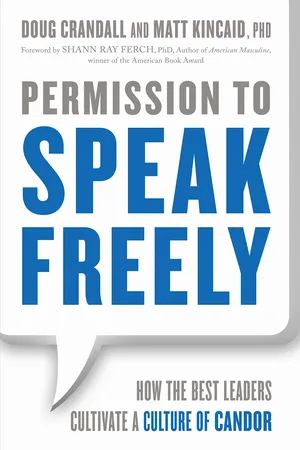
eBook - ePub
Permission to Speak Freely
How the Best Leaders Cultivate a Culture of Candor
- 164 pages
- English
- ePUB (mobile friendly)
- Available on iOS & Android
eBook - ePub
Permission to Speak Freely
How the Best Leaders Cultivate a Culture of Candor
About this book
Information
PART ONE
WHAT LEADERS NEED TO HEAR
1
QUESTIONS AND UNCERTAINTIES
There are naïve questions, tedious questions, ill-phrased questions. . . . But every question is a cry to understand the world. There is no such thing as a dumb question.
—CARL SAGAN, THE DEMON-HAUNTED WORLD
WE HAD A STUDENT, Paul, who was investigating a given career path and needed some help. One of us reached out to Micah—a friend in that field. Micah suggested that our student talk to a woman named Lisa, and we passed this info on to Paul via email. Shortly after, a text exchange followed:
PAUL: So email both of those two people?
US: Email Lisa and copy Micah.
PAUL: Like copy his email? Sorry I probably sound dumb.
US: When you send an email you can “copy” someone by putting them in the “cc” address. This means you’re sending it to Lisa but letting Micah know what’s going on.
PAUL: Oh, okay.
US: You don’t sound dumb.
When people expose themselves as unknowing, they immediately feel vulnerable. If they speak up and ask a question, they will search for the right way to ask—a way that doesn’t sound “dumb.” The leader’s response to their questions will have a significant impact on whether or not they ask again. And a culture of candor or a culture of silence will have been reinforced. It happens that quickly.
As leader developers, we’ve seen the boundless benefits of people speaking freely—and embracing a culture of candor. It happens when you release people from the burden of saying things the right way. As leaders, we should be cultivating questions, doubts, uncertainties, and other variations of not knowing. When people have permission to speak freely, they will put forth their perspectives, ask when they don’t understand, and seek guidance when they need help. So ask yourself:
Do I welcome a spirit of speaking freely?
Do I really welcome it?
Do I really welcome it?
Let those questions echo within you for a few seconds. Do you want to hear the questions and uncertainties that the people you lead wish they could say, want to say, aren’t sure they should say, feel vulnerable saying, and hold back from bringing up simply because they can’t find the right words? We believe all leaders need to hear the unfiltered thoughts and ideas from their people. What we’re proposing in this book is that you hear everything. Literally everything. You may be thinking, “I don’t want to hear everything. I don’t have time.” We hope this book will change your mind. The benefits of candid communication are immense and often life altering. Let’s look at a simple example of speaking up in confusion.
One Sunday afternoon, ten-year-old Timmy appeared to halfheartedly play through the first two quarters of a youth basketball game. He was jogging up and down the court, and his defense lacked intensity. Few things will accelerate the pulse of a basketball coach (or an overbearing father) more quickly than lackadaisical defense. In this case, the spectating father turned to his daughter midway through the first half and grumbled, “What’s the deal with your brother? Look at him. He has his back to the ball and he’s completely lost his man.” If you’re unfamiliar with basketball, one of the most important defensive principles is that every player should have his or her “head on a swivel” and be able to see both the person he or she is guarding and the basketball, at the same time, at all times. Timmy wasn’t doing this.
On the way home from the game, Timmy’s father broached the subject of proper defensive technique. His sermon lasted for about three minutes, during which he told Timmy, “Don’t turn your back to the ball,” six or seven times. “It’s about giving it 100 percent. You’re capable of playing great defense. Stuff like turning your back to the ball is all about effort,” huffed his father. The conversation stifled, and Timmy slowly grew more and more agitated. Finally his anger and frustration boiled over and he screamed out with tears in his eyes, “I don’t even know what you mean! I don’t know what you’re talking about when you say ‘Don’t turn your back on the ball’!”
There’s so much power in speaking freely, whether it’s a ten-year-old after a basketball game, a school janitor, a new manager, a rookie baseball player, a private first class in the military, or a commercial airline copilot. If Timmy doesn’t speak up in that moment, his dad assumes that he got the message. And because he had no idea what his father meant, his silence means that everything his dad said has been lost on him. Nobody benefits. The next time his father sees Timmy turn his back to the ball, he will assume that Timmy blew him off. And because he told Timmy six or seven times during the car ride, he concludes that his son lacks respect or just doesn’t care. The situation spirals downward at an accelerated rate. Three months later, he fires him. And while a dad can’t fire a son from the family, you get the point—this isn’t just a youth basketball story. It’s a story about leadership and communication. Leaders often mistake a lack of clarity for defiance. Timmy was confused, but his willingness to speak up saved the moment.
The reason that a permission to speak freely leadership orientation is so critical is because it’s so different. We all recognize organizational silence as a problem. It’s not a novel idea. But collectively, we’ve attempted to solve this problem in the wrong way. There are a handful of best-selling books aimed at teaching followers how to articulate their thoughts effectively, or how to speak courageously, or how to speak persuasively in an upward direction. Millions of dollars are spent on communication training each year. Timmy had neither read any of these books nor been trained in how to see things from his dad’s perspective. He just boiled over and spoke freely: “I don’t even know what you mean!” And truthfully, his dad was lucky that he spoke up at all. As leaders, we can’t rely on luck. It’s our job to initiate these conversations and build a culture where speaking freely is the norm and where people never ask for permission to speak freely—they simply know it’s been granted.
Dan Lovallo, from the University of Sydney, and Olivier Sibony, from McKinsey and Company—who’ve done extensive research on the role of inclusion and voice in decision-making—observe, “The culture of many organizations suppresses uncertainty and rewards behavior that ignores it . . . seldom do we see confidence as a warning sign—a hint that overconfidence, overoptimism, and other action-oriented biases may be at work.”1 Whether because of culture, incentive structures, insecurity, or inexperience, Jeff Gaines found himself in a situation where he needed help but forged on with “confidence.”
Gaines started out as an hourly associate at one of the world’s largest retailers. He earned a college degree on the side and then rapidly worked his way through the company’s merchandising ranks to become one of its youngest directors. Identified as “top talent,” Gaines earned a nomination to the company’s high-potential leadership program and a promotion to senior director. The original pilot of the leadership development course included an exercise designed to place front-line leaders and headquarters executives in the shoes of their own constituents: the Core Customer Challenge. Because of the emotional impact of the event, it has maintained its place in the curriculum through multiple years of revisions.
Per the challenge, Gaines and his cohort of eight colleagues set out one afternoon to purchase a week’s worth of groceries for a family of four living just above the poverty line. The budget was just under $70 (yes, for the entire week). Thirty minutes later, with milk, breakfast cereal, and a loaf of bread loaded in their shopping cart, Gaines and his group stood in front of the canned vegetables looking for the least expensive offering of green beans. Situated prominently on the middle shelf, the company’s private label was the best bargain at $0.68. A woman on Gaines’s team grabbed two cans and tossed them in the cart. Gaines, though, stopped the group before they could move on. “Just a second,” he murmured, “there are some cheaper ones down there.”
“Down there” was on the bottom right, out of the sight line of the average-sized human. Jeff spotted the Three Charms–brand beans—priced at $0.52 per can—because he had put them on the bottom shelf two years earlier while fighting his way up the merchandising ranks as a canned-vegetable buyer.* When Three Charms came to Jeff with their original pitch, he was hesitant to make the beans part of his assortment. Although doing so would be consistent with company strategy (offering the lowest price point of any retailer), the company’s mission (helping people save money), and Gaines’s own values, it conflicted with his incentive structure. His target for the year was a 4 percent revenue increase in his category. His performance review and bonus depended on it. At the point when he met Three Charms, he was trending just above 3 percent growth and working hard to improve. Placing Three Charms beans on the shelf—in a prominent position—would reduce sales of more expensive beans, slowing Gaines’s revenue growth. In the end, it wasn’t his conscience or his concern for the customer that put those beans on the shelf. From a strategy standpoint, he simply knew that he needed to introduce the lowest-priced option. So if he had to do it, he’d protect his revenues in the process. Hiding Three Charms in the bottom right solved the problem. Gaines never shared his concerns with his boss. When the two of them went through his display plan, he justified the placement of Three Charms beans through a number of logical arguments. None of them included what he was really thinking: I’m trying to hide them.
Most will empathize with the push and pull of Gaines’s competing interests: customers, strategy, and his own job performance. In his mid-twenties, trying to launch a long-term career with the company, he had three reasonable options:
1. reject Three Charms;
2. put the new brand of beans on the shelf; or
3. make Three Charms available, but in a place where customers probably wouldn’t see the beans.
In the world in which many of us reside—the one where people measure their words, hide their thoughts, and speak only when they know it’s safe—Gaines settled on the hide-and-seek-the-beans option. Speak Freely leadership creates a fourth possibility: Jeff Gaines shares his uncertainty with his leader and asks for help:
You know, boss, if I put the Three Charms beans right in the middle, it will cannibalize my other sales. My revenues will drop below target, and I won’t get my bonus. I’ll look like I’m failing. But I can’t not offer them. They are the lowest price on the market. I want to do what’s right for the customer and company, but I’m not going to make 4 percent if I do that. I don’t know what to do. I need your help.
We’ve queried thousands of leaders regarding scenarios similar to Three Charms beans. Literally no one has ever stood up in one of our classrooms and suggested that they wouldn’t want to hear Gaines’s vulnerable admission and request for guidance. The benefits of this type of candor are immediate and self-evident: instead of his placing the product below the normal customer’s sight line, he uncovers a different solution with his boss. The company benefits. The customer benefits. Gaines does the right thing. Trust ensues, and he opens up a little more confidently the next time he faces a dilemma. And to be clear, this story is not about retail strategy, Jeff Gaines, beans, or even values and mission. It’s simpler than that. It’s about open communication in an upward direction. If you’re Gaines’s leader, you should want to know what he’s actually thinking. You should want him to come to you for help if he needs it. You should want him to speak freely.
Permission to speak freely means, first and foremost, that the people you lead trust you enough to tell you they need help, to ask when they don’t understand, and to be bold with their lack of clarity. When these thoughts start to pour out, others will follow.
*We’ve omitted the company’s name and changed the brand to “Three Charms” on the advice of counsel (their counsel).
2
GREAT IDEAS AND TERRIBLE ONES
You can’t just give someone a creativity injection. You have to create an environment for curiosity and a way to encourage people and get the best out of them.
—SIR KEN ROBINSON, BLOOMBERG INTERVIEW, FEBRUARY 22, 2006
WHEN ORGANIZATIONS EMPOWER every person—at every level—to share ideas, innovation thrives, engagement scores go up, and feelings of ownership increase. This short chapter could almost qualify for the “tell me something I don’t know” category, so we’ll tell you something you probably don’t know.
It turns out we all have a blind spot when it comes to hearing others’ ideas—a big one worthy of discussion: people tend to harbor a hidden bias against creativity. Almost no one will say it out loud, but research suggests that it’s close to universally true. We prefer known solutions, especially in times of uncertainty. Ironically, it’s at times of uncertainty that creative solutions are often most needed. Leaders will opt for slightly new ideas, but don’t go shouting “Earth revolves around the sun” on us or you’re bound to get shot down. “American culture worships creativity,” stated an article in The Atlantic in October 2014, “but mostly in the abstract.” In order to gain idea acceptance, the writer recommended that people “frame new ideas as old ideas—to make your creativity seem, well, not so creative.”1 Not bad advice for those suffering under the thumb of tone-deaf leadership, but not the advice of this book. As leaders, we must stop holding our people prisoner to the idea that they must present all thoughts and ideas the right way—that is, the way that keeps us feeling comfortable.
Did you know that former Microsoft CEO Steve Ballmer predicted the iPhone would never gain traction? Decca Records, in a first-ever audition, famously told the Beatles that groups like theirs had gone out of style. In 1927, Harry Warner of Warner Bros. Pictures asked, “Who the hell wants to hear actors talk?” Executives at ABC shook their heads in amusement when Lloyd Braun first proposed the television series Lost. You might have heard that E. L. James self-published Fifty Shades of Grey after widespread rejection, but did you know that Mark Twain self-published The Adventures of Huckleberry Finn? And yes, every studio in Hollywood rejected Raiders of the Lost Ark. Point being: As leaders, we need as much help as we can get. If we don’t capitalize on those around us, our own abilities and ideas become the maximum capacity of the teams we ostensibly lead. We need creative ideas, slaps in the face, and warnings of impending doom. We need to listen, and we need to listen well, so that our people break through the aforementioned obstacles, believe in their ideas, and start speaking up.
In his book Drive, Daniel Pink teaches that mental parameters such as, in this instance, trying to find the right way to say something to your boss, significantly hinder creative thinking.2 Communication is hard enough when people say what they mean. So as long as the people you lead are focused on cracking your language code—or trying to say things the way they imagine you want to hear them—they’re no doubt giving you a lot of crappy suggestions. And this forces you to tighten the reins even more, right? Of course, you have to micromanage because your people can’t think for themselves—and it’s true, they can’t. Not under the scrutiny and fear of having to articulate their own ideas into your personal safe language for them to even be heard.
Instead of responding based on your own discomfort and uncertainty when you hear a new idea, force yourself to stop and at least listen. Just listen. Take a deep breath, bite your tongue, and hear what your people have to s...
Table of contents
- Cover
- Praise for Permission to Speak Freely
- Title page
- Copyright Page
- Contents
- Foreword by Shann Ray Ferch, PhD
- Introduction: How Speaking Freely Helped Bring a Championship to Seattle
- PART ONE: WHAT LEADERS NEED TO HEAR
- PART TWO: THE PROBLEM
- PART THREE: HOW TO CULTIVATE A CULTURE OF CANDOR
- Notes
- Index
- About the Authors
Trusted by 375,005 students
Access to over 1.5 million titles for a fair monthly price.
Study more efficiently using our study tools.
Frequently asked questions
Yes, you can cancel anytime from the Subscription tab in your account settings on the Perlego website. Your subscription will stay active until the end of your current billing period. Learn how to cancel your subscription
No, books cannot be downloaded as external files, such as PDFs, for use outside of Perlego. However, you can download books within the Perlego app for offline reading on mobile or tablet. Learn how to download books offline
Perlego offers two plans: Essential and Complete
- Essential is ideal for learners and professionals who enjoy exploring a wide range of subjects. Access the Essential Library with 800,000+ trusted titles and best-sellers across business, personal growth, and the humanities. Includes unlimited reading time and Standard Read Aloud voice.
- Complete: Perfect for advanced learners and researchers needing full, unrestricted access. Unlock 1.5M+ books across hundreds of subjects, including academic and specialized titles. The Complete Plan also includes advanced features like Premium Read Aloud and Research Assistant.
We are an online textbook subscription service, where you can get access to an entire online library for less than the price of a single book per month. With over 1.5 million books across 990+ topics, we’ve got you covered! Learn about our mission
Look out for the read-aloud symbol on your next book to see if you can listen to it. The read-aloud tool reads text aloud for you, highlighting the text as it is being read. You can pause it, speed it up and slow it down. Learn more about Read Aloud
Yes! You can use the Perlego app on both iOS and Android devices to read anytime, anywhere — even offline. Perfect for commutes or when you’re on the go.
Please note we cannot support devices running on iOS 13 and Android 7 or earlier. Learn more about using the app
Please note we cannot support devices running on iOS 13 and Android 7 or earlier. Learn more about using the app
Yes, you can access Permission to Speak Freely by Matt Kincaid,Doug Crandall in PDF and/or ePUB format, as well as other popular books in Business & Leadership. We have over 1.5 million books available in our catalogue for you to explore.