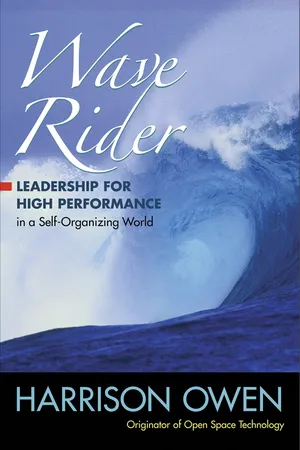
What began twenty years ago as a journey of exploration into the interplay between chaos, order, and the creative process culminates in this capstone work of Harrison Owen's pioneering career. From the creator of Open Space Technology (OST), Wave Rider shows how to apply the fundamental principles of self-organization – the driving power behind OST's immense success – not just to a single event but to the day-to-day management and leadership of organizations.Owen proposes that all systems – not only our organizations but indeed the entire cosmos – are fundamentally self-organizing. Control is ultimately an illusion, and attempts to assert it are a waste of time and can even be destructive. If we want to have truly high-performing organizations, at some point we need to set aside our preconceived goals and strategies, important as they are, and align ourselves and our work with the primal force of self-organization – learn how to ride that wave. To that end, Owen lays out eight concrete steps for becoming a successful Wave Rider, derived from the global experience of hundreds of thousands of Open Space events, wit ha clear focus on producing exceptional performance.The book includes a real-life tale from a genuine Wave Rider, Dee Hock of VISA International, as well as an imagined account of a day in the life of a wave-riding manager, to show how self-organizing principles can deal with specific functions like running a staff meeting, managing projects, motivating staff, and much more. Wave Rider is another exceptional contribution from one of organizational developments true innovators.
- 216 pages
- English
- ePUB (mobile friendly)
- Available on iOS & Android
eBook - ePub
About this book
Information
PART I
Preparation for Wave Riding
As with all roles and tasks, Wave Riding requires preparation. It is essential to identify what we are looking for (in this case High Performance), the environment we will be operating in, and some of the basic mechanisms and obstacles to be encountered along the way. In addition, the limitations and shortfalls of previous efforts in the quest for High Performance will be considered to the extent that this is helpful in understanding the unique position of Wave Riders, and the waves upon which they ride.
25 Chapter I
Chapter I
The Holy Grail: Superior Performance
In 1975, my friend and colleague Peter Vaill (at that point the Dean of the Business School at George Washington University) wrote a short paper which turned out to be long on influence. The paper bore the academic sounding title, “Towards a Behavioral Description of High Performing Systems,” However, as Peter was quick to admit, the academics were only skin deep, if only because he found himself “unable to say what a High Performing System is.” So much for academic precision, and it gets worse. It turns out that the thoughts expressed did not result from careful research but rather from “intuitive leaps” most of which occurred in “one four hour burst.” In fairness, Vaill carefully identified each of his Behavioral Characteristics as “hypotheses,” which indicates that they are subject to future validation, although he says nothing about how such research might be conducted, and expresses no interest in pursuing it. At whatever risk, I can only say——It worked for me.
It is true that many have written about high performance in human systems before and after Peter Vaill, but the appearance of his paper was a watershed in my estimation. Those of us who happened to receive a copy found our view of organizations, the way they were supposed to work, and how we might work with them changed in ways that, at least in my own case, would take years to fully appreciate. Some of the other recipients of the paper obviously came to a quicker (and positive) conclusion, most notably Peters and Waterman. Peter Vaill’s “intuitive leaps” became a cornerstone of a much larger effort which hit the streets bearing the title, In Search of Excellence.426
The fact that many of the organizations cited by Peters and Waterman as being “excellent” have now gone out of business does not detract from the powerful impact of this book. Indeed, it might be said that the history of organization and management thought during the succeeding years has been all about that search for what has turned out to be a most elusive quarry——Excellence. Or, were we to revert to the words of Peter Vaill, High Performing Systems. In short, we have been pursuing excellence and High Performance ever since, but somehow we never quite get there. Or perhaps more accurately, we never quite get there “according to the plan.” Excellence and high performance keep showing up——but rarely when we might expect them, even less when we planned on their arrival. But all of that is to get considerably ahead of our story, which properly begins with Peter Vaill’s “Behavioral Characteristics.”
The Behavioral Characteristics of High Performing Systems according to Peter Vaill
In the 1977 revision of his earlier paper, Vaill identifies some 52 characteristics. With frankness uncharacteristic of most academic papers he admits to certain favorites. In his own words, “Some hypotheses I am in love with and some I am not very interested in.” For the most part, Vaill’s favorites are those characteristics that would pertain to systems of all sorts, and the balance is more narrowly focused on businesses, and particularly manufacturing businesses (with machines). Following Vaill’s lead, I have focused on the favorites. The numbers at the end of each quote are Vaill’s original numbers.27
- Do Not Follow the Rule Book (“There may be a public, objective theory or ‘rule book’ about how to do the thing that the HPS is doing, but there will always be discrepancies between this public recipe and what the HPS is actually doing. This may be called the ‘Doug Sanders backswing’ hypothesis to remind golfer-readers that orthodoxy is not an absolute virtue.” #7)
- Members Can’t Explain It (“Communication about how and why the HPS operates as it does from members to outsiders will tend to be in platitudes and generalities, or by showing rather than telling at all. Members will feel and often say, ‘There’s no way I can explain it to you’.” #10)
- Members Experience “Peak Experiences” (“Members will report ‘peak experiences’ in connection with their participation in the HPS. They will ‘enthuse’, ‘bubble’, communicate ‘joy’ and ‘exultation’.” #12)
- Performance Breakthroughs Occur in Unplanned Ways (“Performance breakthroughs occur in unplanned ways. Hypothesis 12 will be especially obvious on these occasions. Members will account for the event in relatively non-operational idioms, such as ‘we finally got it all together’.” #13)
- External Controls Are Seen As Irrelevant—Never Look at the Clock (“External controls on the activity of the HPS are seen by members as at best irrelevant and at worst as positive impediments to performance. Circumvention of the rules tends to be overt and non-apologetic.” #17. Also #20: “Members seek relief from the pressures of participation in the HPS according to criteria which are internal to the system——its current phase of operations and the needs and expectations of other members. External schedules for relief and breaks are usually regarded by members as inappropriate.”28)
- The System Is Always “ON”—Even If You Can’t See It (“The system does not have a clear OFF/ON character. Members may regard it as ON when it seems OFF to observers, and OFF when it seems ON. The system’s movement from one state to the other is often difficult to detect from the outside.” #19)
- Neighboring Organizations Are Not Necessarily Pleased with HPS’s Output. (“The social value of the output of an HPS is problematic. Entities in the HPS’s environment will not automatically be ‘pleased’ with its output.” # 24)
- Members May Be Perceived as Thrill Seekers, Weirdos, or Mystics (“To the extent that members find participation in the HPS thrilling, they may become ‘thrill seekers.’ Activity in the HPS may provide a wide variety of sensual, affective, and cognitive experiences which, over time, members may become ‘motivated’ to attain and re-experience. For the most part, this kind of motivation may be relatively incomprehensible to observers. They may come to regard members so motivated as ‘weirdoes’ or ‘mystics.’ Negative judgments about members’ maturity and even morality may be made by untrained observers.” #34)29
- HPS’s Groove (“HPS’s exhibit a rhythm of operation which is both subjectively felt by members and objectively evident to observers. An argot will exist for describing this rhythm, for example, ‘tempo’ (chess); ‘footing’ (yacht racing); ‘wailing’ (improvisational jazz); also ‘getting it on’ and ‘grooving’——and note that ‘grooving’ has been extended in its application to many other activities; ‘taking it to… (the opposing team)’; ‘traction’ (term coined by W. Baldamus to account for the tendency of an assembly line job to pull the worker along); ‘hitting one’s stride’; ‘having a hot hand’ (basketball); ‘getting the boat set up’ (crew); and ‘mounting a charge’ (golf). The general phenomenon that these terms refer to is that the same or improved effects are produced with substantially less effort than before the particular rhythm was achieved.” #39)
In reviewing Vaill’s Behavioral Characteristics of HPS’s, it quickly becomes apparent that the organizations described are anything but “standard issue.” Consider, for example, the characteristic, Members May Be Perceived As Thrill Seekers, Weirdos, or Mystics. And the other characteristics are scarcely better. The fact that members Do Not Follow the Rule Book is sufficient to drive any well-trained manager to distraction.30
To the extent that Vaill’s Characteristics accurately reflect the general behaviors and conditions of High Performing Systems——doing what they do with Excellence, it is perhaps not surprising that the search for excellence has often come up empty-handed. And when it comes to our efforts to foster the development of such systems, our success just might have all of the popularity of a skunk at a garden party. It could turn out that although excellence and High Performance are valued in the abstract, the behavior of those who actually achieve these laudable states is socially unacceptable. Despite the odds, there can be little question that the search for both continues with intensity.
31 Chapter II
34
35
Chapter II
High Performance Systems Defined
Peter Vaill declined to define a High Performing System, which appears reasonable since we always seem to know one when we meet. It simply does better than the competition, and usually a lot better. Despite Vaill’s hesitance I feel compelled to make some effort at definition, which may be yet another example of fools rushing in where angels fear to tread. However, I am not insensitive to the risks involved, and therefore have chosen to back into the task by starting with a definition that I know does not work.
High Performance Defined as the Absence of Its Opposites
It is tempting to define an HPS in terms of the absence of the apparent opposites, such things as chaos, confusion, and conflict. If only we could rid our systems of this trio then perhaps order, clear thinking, and peace would reign. Under these circumstances, high performance would appear to be inevitable, or at least clearly within our grasp.
There is some problem with this approach, however, in that all three of these (chaos, confusion, and conflict) seem to be essential to living, and therefore their elimination would do substantial damage to life, to say nothing of high performing life. For those of us who cherish a pacific lifestyle, such an assertion verges on the outrageous, but consider the following.32
Chaos
The antidote for order, and most especially The Established Order——represents the dissolution of things as they were. It is always uncomfortable, not to say painful, but if we are ever going to experience novelty, space is required for the emergence of the new. Indeed scientists are now telling us that not only is chaos a part of life, a fact we know all too well, but that chaos is essential to life. Without chaos, there would be no life. Obviously this represents a distinct departure from that part of the conventional wisdom which perceives a meaningful life to be one of balance and equilibrium. However, as a biologist friend pointed out——when you reach equilibrium in biology, you are dead. The sad truth of the matter is that there is precisely one instant in our entire existence when we achieve equilibrium, and that is in the moment of our dying. Until then we are in some state of dis-equilibrium, and that is life.
Confusion
Confusion is the intellectual equivalent of chaos, and like chaos, it has gifts to give, albeit painful ones. Confusion serves the useful function of muddling made up minds so that new ideas may break through. It is always disconcerting when it happens, but as long as we are confirmed in our settled opinions, the likelihood of seeing our world in new, different, and better ways will elude us. The onset of confusion is typically marked by the perception of anomaly. Things just aren’t working the way they are supposed to, and we are confronted with a choice. Perhaps our vision is impaired? Or perhaps the spectacles through which we have been viewing our life need to be replaced? It is all very confusing, but when, and if, the day arrives in which the perceived anomaly is no longer the exception, we will have reached the cutting edge of new knowledge. It may just be that confusion is the beginning of wisdom.33
Conflict
Conflict is annoying at the least and lethal at the worst, but it does have its uses. In the world of ideas, conflict provides the necessary abrasive qualities to smooth rough ideas into real gems. And conflict can also consign bad ideas to the trash heap. For sure there is destruction, and in the case of dearly held ideas, no small amount of pain. But the net gain for us as individuals and organizations is unquestionably worth the pain——most especially if we are to achieve optimal levels of performance. The ideal of an organization free from conflict is, in my judgment, a dog that won’t hunt. In fact, if you will show me an organization without conflict, I will show you a dead one.
I submit that an understanding of a high performing system as being one in which chaos, confusion, and conflict have somehow been eliminated is a vain hope and a hollow shell, devoid of the very elements that make life and high performance possible. That the presence of the 3 C’s is painful and destructive cannot be denied. However, the act of destruction is essential to their function, and the associated pain is an unfortunate consequence. All of which brings us to a fourth element which is typically understood as being antithetical to performance at all levels, and certainly High Performance. That fourth element is Ending, and perhaps even Death.
34
Ending and Death
The simple truth of the matter is that as chaos, confusion, and conflict do their work, things come and go, they end. We could say they die. For fairly obvious reasons, we as human beings are not particularly happy with this arrangement. However, as things stand it is a fact——for every beginning there is an end. For every life there is a death.
Beyond the fact that no matter our feelings and hopes, Death and Ending hold an inescapable place in our world. It is also true that both make a positive contribution in our journey toward High Performance. And to the extent that we deny them their rightful place we inhibit our capacity to perform at high levels. Although this may appear massively counterintuitive, think about it for a moment. When we hang on tenaciously to the way things are, we preclude the possibility of serious improvement. Current thoughts, current practices, current modes of life may be familiar and dear, but their continued embrace bars the way to future evolution.
Toward an Understanding of High Performance
Chaos, confusion, conflict, in addition the ending and death cannot be seen as the enemies of high performance, for each contributes in substantive, albeit painful, ways to the elevation of the human enterprise. The fact that we might wish it differently does not change the reality that the 3 C’s and the Terminal Two come with the territory. Whatever understanding or definition of High Performance we may devise must not only include, but also transcend this troublesome quintet.
35
A Definition of High Performance
So how should we understand High Performance and define a High Performing System? I offer the following: High Performance is the productive interplay of diverse, complex forces, including chaos, confusion, and conflict, and characterized by wholeness, health, and harmony. It is harmonious, including all elements of harmony both consonance and dissonance, in that multiple forces work together to create a unitary flow. It is whole in the sense that there is a clear focus, direction, and purpose. It is healthy in that the toxins of its process (metabolic by-products in organisms) are eliminated effectively and without prejudice to itself or environment. High Performance can never be sustained at the cost of a fouled nest. A High Performing System is one that does all of the above with excellence, over time, and certainly better than comparable organizations.
Unpacking all of this will take some time, or more exactly the balance of this book. In the interim, and on the off chance that the relatively dry, academic definition may lack something when it comes to punch, permit me to offer an image. It is The River, the whole river in all of its seasons and places. And not just any river, but a mighty river coursing from its genesis to the sea, untrammeled by arbitrary barriers and boundaries, otherwise known as dams and levees.
Human beings seem to prefer domesticated rivers, but such rivers can never do their full work——and genuine high performance is not one of their characteristics. In addition to the placid interludes there are treacherous currents, wild rapids, occasional falls, and massive floods. There are warm days and cold days——days on which the humidity is so thick it must be cut with a knife, and other days when the chill winds of an arctic winter turn the massive flow into a solid state. The whole river, over its entire length, and through all of its days——doing its work reshaping and fertilizing the earth. That is my picture of High Performance.36
Some 2600 years ago, the Chinese general, Sun Tsu, seems to have had a similar understanding. Writing in The Art of War, he said, “Thus the army does not maintain any constant strategic configuration of power, water has no constant shape. One who is able to change and transform in accord with the enemy and wrest victory is termed spiritual.”5 Of course the general is writing about armies and war, which may make some uncomfortable, but he clearly understood the power of flow. In short, this is not exactly a new idea.
Between Peter Vaill’s Behavioral Characteristics, Sun Tzu’s flowing water, and my attempts at definition, perhaps we now know what we’re looking for. But the question remains——how do we get there from here?
37 Chapter III
Chapter III
Getting from Here to There
If Excellence and High Performance are the objectives we seek, how do we get there from here? The short answer could be: Define the problem and fix it.
This simple approach has much to commend it. If nothing else it seems like the logical thing to do, and from this logical basis a rational approach to the achievement of High Performance surely emerges. So for example, if a business is suffering from diminished sales one wo...
Table of contents
- Cover Page
- Title Page
- Copyright Page
- Preface
- Introduction Wave Rider
- PART I Preparation for Wave Riding
- PART II The Wave Rider’s Guide to the Future
- Conclusion
- Index
- About the Author
Trusted by 375,005 students
Access to over 1.5 million titles for a fair monthly price.
Study more efficiently using our study tools.
Frequently asked questions
Yes, you can cancel anytime from the Subscription tab in your account settings on the Perlego website. Your subscription will stay active until the end of your current billing period. Learn how to cancel your subscription
No, books cannot be downloaded as external files, such as PDFs, for use outside of Perlego. However, you can download books within the Perlego app for offline reading on mobile or tablet. Learn how to download books offline
Perlego offers two plans: Essential and Complete
- Essential is ideal for learners and professionals who enjoy exploring a wide range of subjects. Access the Essential Library with 800,000+ trusted titles and best-sellers across business, personal growth, and the humanities. Includes unlimited reading time and Standard Read Aloud voice.
- Complete: Perfect for advanced learners and researchers needing full, unrestricted access. Unlock 1.5M+ books across hundreds of subjects, including academic and specialized titles. The Complete Plan also includes advanced features like Premium Read Aloud and Research Assistant.
We are an online textbook subscription service, where you can get access to an entire online library for less than the price of a single book per month. With over 1.5 million books across 990+ topics, we’ve got you covered! Learn about our mission
Look out for the read-aloud symbol on your next book to see if you can listen to it. The read-aloud tool reads text aloud for you, highlighting the text as it is being read. You can pause it, speed it up and slow it down. Learn more about Read Aloud
Yes! You can use the Perlego app on both iOS and Android devices to read anytime, anywhere — even offline. Perfect for commutes or when you’re on the go.
Please note we cannot support devices running on iOS 13 and Android 7 or earlier. Learn more about using the app
Please note we cannot support devices running on iOS 13 and Android 7 or earlier. Learn more about using the app
Yes, you can access Wave Rider by Harrison H. Owen in PDF and/or ePUB format, as well as other popular books in Business & Management. We have over 1.5 million books available in our catalogue for you to explore.