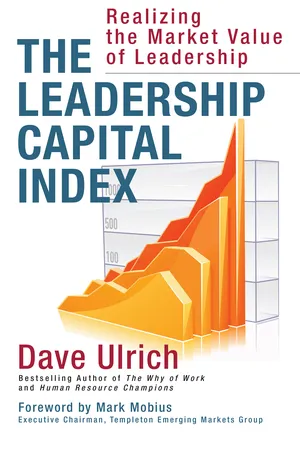
When it comes to evaluating a firm, leadership matters. We know that financial outcomes can predict about 50 percent of a firm's market value. Intangibles like strategy, brand, talent, R&D, innovation, risk, and so on account for the rest. But leadership underlies them all. And despite how important we know it is, we've been forced to rely on subjective and unreliable ways to measure its impact—until now.In this landmark book, leadership scholar, author, and consultant Dave Ulrich proposes a "leadership capital index"—a Moody's or Standard and Poor's rating for leadership. Drawing on research from investors and business leaders, and synthesizing the work of dozens of consulting firms and leadership experts, Ulrich analyzes two broad domains, each comprising five factors. The individual domain includes personal qualities, strategic prowess, execution proficiency, interpersonal skills, and fit between the leader's style and the organization's market promises. The organizational domain encompasses a leader's ability to create customer-focused cultures, manage talent, demand accountability, use information to gain competitive advantage, and set up work processes to deal with change. Ulrich details rigorous metrics and methods for evaluating leaders on each of these factors. The result is a groundbreaking book that will be of vital interest not only to equity and debt investors but also to boards of directors, executive teams, human resource and leadership development professionals, government and ratings agencies—and of course to leaders themselves.
- 312 pages
- English
- ePUB (mobile friendly)
- Available on iOS & Android
eBook - ePub
About this book
Information
PART ONE
Why and How Leadership Matters to Investors
Sometimes, new ideas completely disrupt traditional thinking. More often, new ideas emerge from synthesizing previous thinking, then evolving to fresh insights. This present work builds on outstanding work in the study of market value and leadership. Each of these separate disciplines has vast reservoirs of ideas, studies, and tools. In Chapter 1, I want to acknowledge this previous work but then show that by connecting market valuation and leadership, each discipline moves forward. Market valuation with leadership insights becomes more complete and accurate. Leadership through the lens of market valuation brings more discipline to the study of what effective leaders know and do. In Chapter 1, I also report on how the most prominent investor of our day (Warren Buffett) continually reflects on management as part of his decision making, and I report our research from investors about the importance of leadership in their decision making. Leadership matters to investors, but they can be comprehensive in their assessment.
In Chapter 2, I show that now is the time to propose a leadership capital index that offers investors a much more comprehensive way of assessing leadership as part of their firm valuation process. While investors recognize the importance of leadership, they often lack rigor in assessing it. The proposed leadership capital index identifies two domains of leadership (individual behavior and organization capabilities) and five elements in each domain that investors can access to move beyond superficial and casual leadership observations. This leadership capital index will also inform those interested in understanding governance, risk, social responsibility, and other organization processes. The domains and elements of this leadership capital index synthesize and extend multiple strands of excellent work into the next step of realizing the market value of leadership.
CHAPTER 1
When Leadership Matters to Investors, It Matters More
“How much is that doggie in the window?” asked Patti Page in a 1952 novelty song. Investment analysts and others have asked essentially that same question since companies have been publicly traded: “How much is this company?” (With a strong subtext of “How much is this company worth to me?”)
A dog’s value comes from its recognizable traits (breed, age, health, temperament), but also from its personal value to the owner (relationship, history, companionship). Similarly, a company’s value comes from its tangible assets like products, receivables, technology, and facilities—the assets that show up on the balance sheet and are as easy to see as the surface of a dog. Company value also includes intangibles such as strategy, brand, intellectual property, and reputation, which are more subjective and less likely to show up on the balance sheet but have been recognized as being just as essential to determining a company’s desirability as an investment.
Underlying the intangibles, each organization has a level of leadership capital—an established pattern of both individual leader characteristics and organization and human capital processes—that can and should be included in determining firm value. Investors often have a strong feeling about the importance of a particular leadership trait, but their opinions tend to be superficial because they don’t recognize or have ways to fully evaluate all the elements that underlie effective leadership. They make judgments with only one or two pieces of a leadership puzzle, not the entire puzzle.
The leadership capital index in this book will help investors and others improve their approach to firm valuation. When leadership capital becomes a factor in investor judgments, it will naturally receive more emphasis in day-to-day corporate life, to the benefit of many.
Audiences for Leadership Capital Insights
The insights from this book should prove useful for stakeholders committed to understanding leadership and value: investors, rating firms, proxy advisory firms, boards of directors, senior executives, and HR and leadership specialists.
INVESTORS
The primary audience for this book is investors looking to value the quality of a company’s leadership. Interested investors include equity and debt investors, long-term and short-term investors, and relational and transactional investors. Investors who value and assess the quality of leadership will make more informed decisions about the future value of a company. Most thoughtful investors recognize that leadership matters, but they are not clear on how to rigorously assess leadership.
A major private equity group held an annual conference for the CEOs of companies it had acquired, where it would share advice on what these independent CEOs should focus on in the next year. In 2009, soon after the market collapse, this conference focused for two days on leadership. The group executives had discovered that it often took five to seven years to turn around a distressed company—and that in 60% to 70% of the cases, the biggest challenge was the quality of leadership. Often the leaders who’d gotten the company into a position where it was purchased by the private equity group were not able to make the bold changes needed to turn around and transform their company to prepare it to be repositioned in the marketplace. The group leaders felt that if they could prepare acquired-firm leaders to be more capable, they could turn the companies faster. The group decided to hire a talent czar, someone who could assess leadership talent in companies likely to be acquired and then develop leadership in acquired companies to be better able to transform their company and prepare it to be resold. These private equity investors recognized that leadership mattered—and that they were not in a position to perform thoughtful or thorough assessments of leadership. So they retained a specialist to do so.
As this private equity group recognized, valuing leadership comes from and extends the work on intangibles. Two firms in the same industry with the same financial results may have dramatically different market valuation. This differentiated market valuation is often attributed to intangibles, which show up in business by boosting—or undercutting —investors’ confidence in a firm’s performance. Leaders architect intangible value. When investors accurately assess leadership, they are indirectly but accurately assessing the future intangible value of a firm. Thus investing in leadership capital may result in a leadership premium or discount, depending on the outcome of the assessment.
RATING FIRMS
Standard & Poor’s (S&P), Moody’s, and Fitch issue about 95% of the creditworthiness ratings based on their view of a company’s ability to pay back its debt. Credit rating has been a staple of measuring firm financial performance since the early 1900s, and a firm’s credit rating influences both its cost of capital and its ability to access capital. While critics sometimes challenge the details of risk assessments, these ratings continue to have great influence.
Just as credit ratings reflect the likelihood of continued financial effectiveness, a leadership capital rating could be created to reflect the likelihood of leaders’ making the right choices to drive firm performance. If universally accepted, a leadership capital index would have implications for numerous stakeholders. For example, in 2011, S&P very publicly downgraded U.S. securities from AAA to AA because of the budget deficit and rising debt burden. This downgrade influenced borrowing costs for the U.S. government, companies, and consumers. However, the underlying reason for this downgrade was not just the debt burden itself but the inability of leaders in Congress to collaborate well enough to face and solve the deficit problem. A leadership capital index that assesses the quality of leadership would complement a report on the symptom (debt burden and ability to repay), but go beyond it to assess the underlying problem (quality of leadership).
Likewise, in the 2008–2010 recession, many Western banks were “bailed out” by government support. The problem with this metaphor is that bailing water out of a boat only relieves the symptom. If the hole in the boat is not fixed, water will keep leaking in. The “hole in the boat” may be defined as poor leadership. Unless and until leaders behave differently, similar results will occur. Even after financial bailouts, leaders who spent excessively at executive retreats or on executive compensation continued to place their firms at risk. To avoid future bank risks, regulators formed bank stress tests that focused on risky assets, balance sheet quality, and the amount of capital on hold. Unfortunately, none of the bank stress tests in the United States (by the Federal Reserve Board), Asia (by the International Monetary Fund), or Europe (by the European Banking Authority) include an assessment of leadership. Perhaps this is why financial stress tests are somewhat discounted and do not receive the confidence they were intended to inspire.1
PROXY ADVISORY FIRMS
Proxy advisory firms, including Institutional Shareholder Services (ISS), Egan-Jones Proxy Services, Glass, Lewis & Co., and Institutional Investor Advisory Services (IIAS) in India offer shareholders advice on how to vote their shares. These firms issue reports on how a firm’s governance practices relate to firm performance based on public financial data. For example, ISS reports four pillars of governance practices: board structure, executive compensation, shareholder rights, and audit-related activities. While all are related to leadership, none of these four pillars rates leadership capital directly. They report the alignment of total shareholder return over one, three, and five years with CEO pay and compare this to an industry peer group to measure pay for performance, but they do not offer further insights on leadership. Including more refined indicators of leadership would enable these proxy firms to offer more thorough recommendations.
BOARDS OF DIRECTORS
As trustees of a firm’s assets and shareholder interests, boards of directors have fiduciary responsibility for its performance. To fulfill this responsibility, boards review strategic plans, financial performance, firm policies, and operating choices. A primary task of a board is to select a CE...
Table of contents
- Cover Page
- Title Page
- Copyright Page
- Dedication
- Contents
- Foreword
- Introduction: The Market Value of Leadership
- PART ONE: WHY AND HOW LEADERSHIP MATTERS TO INVESTORS
- PART TWO: THE INDIVIDUAL ELEMENTS OF THE LEADERSHIP CAPITAL INDEX
- PART THREE: THE ORGANIZATION ELEMENTS OF THE LEADERSHIP CAPITAL INDEX
- PART FOUR: APPLICATION AND ACTION
- Notes
- Index
- About the Author
Trusted by 375,005 students
Access to over 1.5 million titles for a fair monthly price.
Study more efficiently using our study tools.
Frequently asked questions
Yes, you can cancel anytime from the Subscription tab in your account settings on the Perlego website. Your subscription will stay active until the end of your current billing period. Learn how to cancel your subscription
No, books cannot be downloaded as external files, such as PDFs, for use outside of Perlego. However, you can download books within the Perlego app for offline reading on mobile or tablet. Learn how to download books offline
We are an online textbook subscription service, where you can get access to an entire online library for less than the price of a single book per month. With over 1.5 million books across 990+ topics, we’ve got you covered! Learn about our mission
Look out for the read-aloud symbol on your next book to see if you can listen to it. The read-aloud tool reads text aloud for you, highlighting the text as it is being read. You can pause it, speed it up and slow it down. Learn more about Read Aloud
Yes! You can use the Perlego app on both iOS and Android devices to read anytime, anywhere — even offline. Perfect for commutes or when you’re on the go.
Please note we cannot support devices running on iOS 13 and Android 7 or earlier. Learn more about using the app
Please note we cannot support devices running on iOS 13 and Android 7 or earlier. Learn more about using the app
Yes, you can access The Leadership Capital Index by Dave Ulrich in PDF and/or ePUB format, as well as other popular books in Business & Business Development. We have over 1.5 million books available in our catalogue for you to explore.