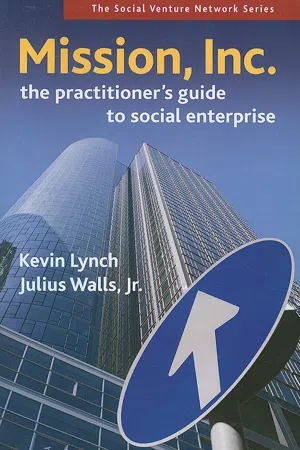
Business has the power to change the world, but some businesses embrace that opportunity more aggressively than others do. Social enterprises put their change mission first – what they sell or what service they provide is a means to accomplishing a larger goal, rather than an end in itself.Their front-and-center commitment to doing good makes social enterprises immensely attractive. But if you want to run one successfully, you have to manage a tricky balancing act. How can you be as efficient as any of your for-profit or nonprofit competitors while at the same time staying true to your social purpose?In this groundbreaking guide, social entrepreneurs Kevin Lynch and Julius Walls draw on their own extensive experiences and those of twenty other social enterprise leaders to focus on the fundamental blocking and tackling tactics that make the difference between success and failure. Exploring the many paradoxes that can hamstring social enterprises, the authors explain how starting and running a social enterprise requires leaders to adopt an entirely different mindset and often a wholly different perspective on the day-to-day choices they're forced to make. Likewise, Walls and Lynch help readers grapple with a different set of expectations from employees, investors, customers, and the community. For social enterprise practitioners, these expectations present an added layer of difficulty – but they can also offer unique advantages, which the authors explain how to leverage. Whether readers are looking for guidance on finding and hiring talent, marketing, finances, or scaling, this practical, accessible guide offers clear and compelling answers that light the way.
- 216 pages
- English
- ePUB (mobile friendly)
- Available on iOS & Android
eBook - ePub
About this book
Information
17 1
■ PRACTITIONER’S TIP
■ THE PRACTITIONER’S FORMULA
■ PRACTITIONER’S TIP
1
The ten paradoxes of social enterprise
Just like our colleagues, we love the enterprises we’re running. Hardly a day goes by that we don’t see a few glimmers of hope roll off the metaphorical production lines of our enterprises. At the end of the year, we proudly tabulate these incremental glimmers into a set of metrics and a report that documents the social change we’ve created.
But there’s a brutal truth we’re not as fond of discussing. It is simply this: we’re not doing enough.
By any measure, the problems we’re trying to address are getting bigger, not smaller. All the while, the aggregation of power continues within a market system that does not recognize the common good as its ultimate master.
We’ve approached this book as a practitioner’s guide because we want to improve the practice of social enterprise. We want to improve the business performance of social enterprises so that they grow, succeed, and most critically, go to scale. For only by attaining scale, by becoming large enough to change the current dynamics, can these enterprises serve their social purposes with the proper degree of impact.
18 Intellectual honesty can be hard to come by in this line of work. It’s easy to make yourself believe that your enterprise is changing the world because you are personally witnessing inspiring events, daily on the front lines. It’s easy to resonate with the story of the man on the beach who is throwing starfish back into the sea, knowing full well he can’t save all of them, most of them, or even a small fraction of them, but declaring, as he flings yet another, “I made a difference to that one.”
And we are making a difference. But for the most part, when compared to the need, we are doing so in a series of relatively small, usually local, completely fragmented, and mostly inefficient enterprises scattered across the land. Anyone who could ever find a means of doing a financial analysis of the sector as a whole would undoubtedly uncover a massive amount of duplication of the costs of simply being social enterprises— start-up expenses, fixed overhead, and social costs.
Our purpose is to change the world. Every economy of scale that is lost to lack of scale is a lost opportunity for social change. Every ounce of energy and resource that we spend on being a social enterprise is an ounce that we’re not spending on doing social enterprise. We can hardly be considered good stewards of our consumers’ trust, our employees’ sweat, or our backers’ funds if we fail to understand this.
Rubicon Programs, Inc., is among the largest and most successful social enterprises in the employment field. Its leader, Rick Aubry, offers a sobering perspective (with acknowledgment to his colleague Jim Schorr):
You need to be very cognizant of the cost and benefits of starting your business… Until there is a really big success in social enterprise, it’s going to remain a marginal force in having an effect on poverty in the United States… All 19of us have started out saying, “How are we going to make some jobs for the guys and gals walking in our doors?” and the businesses that evolved from that are small businesses that are not scalable… That really is going to require thinking about what is the value created by a social enterprise and what are the markets that could be turned to create a very large business.1
While Aubry is speaking from the perspective of a nonprofit social enterprise in the employment field, his point holds equally true for any social enterprise seeking to make a dent in the problems that threaten the common good.
■ PRACTITIONER’S TIP
You must get better to get bigger to do more.
We’ve all read the statistics about business failure rates. A fact of life for anyone starting any business, social enterprise or not, is that more businesses close their doors than survive, and even more stay small than make it big. If you just go by the odds, you’re not going to make it at all, much less on a scale that will make a difference.
More recently, as the field of social enterprise has grown, a spate of articles has been written about the failure rate of social enterprises, some concluding that social enterprises have not lived up to their promise. These articles have been met, in turn, by angry rebuttals from social enterprise practitioners, consultants, and associations.
To all of which we say, “Of course social enterprises fail— because businesses fail.” In most cases, the reasons are fairly obvious, among them:
20See Table
The more interesting discussion, in our view, is whether social enterprises fail with the same discipline or even with the dignity of traditional failed businesses. Indeed another whole set of unique factors can detract from social enterprises’ success:
More reasons social enterprises fail
Unwarranted optimism
Failure to cut losses
Belief that mission will prevail over reality
These factors operate so powerfully that they often become almost a part of the DNA of social enterprises. The passion of purpose can blind one to the hard calculated decisions that must be made to grow a business. But these factors, all representing some degree of hubris, can be overcome. They require nothing more than leaders who, at their core, understand that social enterprises demand the same levels of business discipline as any other successful enterprise.
Social enterprises can stumble in all the same ways traditional businesses can and a few more to boot. You can take 21comfort in knowing that every one of these traps is avoidable. You can take even more comfort in realizing that an equally powerful set of factors, not generally available to traditional businesses, can propel your success exponentially. For example, your mission can create a compelling marketing proposition. You have a greater-than-average chance of attracting great talent and harnessing their passion. You have a natural point of organizational focus that can streamline your processes and your decision making. And in general, lots of different potential stakeholders will start with the default position of liking you and wanting to see you do well.
The formula for building a sustainable social enterprise is actually quite simple to articulate, if not necessarily easy to execute:
■ THE PRACTITIONER’S FORMULA
Do all the right things a traditional business does,
avoid the social enterprise traps, and grab the
points of leverage that are available only to you.
After interviewing social enterprise leaders of every stripe, and through our own experience, we realized that every moving part of a social enterprise is a virtual double-edged sword of challenge and opportunity. In the chapters that follow, we apply this simple formula to these challenge-opportunity sets, one by one. If we can help you navigate around the challenges and capitalize on the opportunities, then perhaps you can improve the odds that your social enterprise will be among the businesses that succeed.
Better yet, then perhaps you can go to scale and really change the world.
22 What’s on Your Mind?
When we sat down to write this practitioner’s guide, we could have started just about anywhere. As practitioners ourselves, we get up every morning and face challenges and opportunities in every aspect of our enterprises. But how to translate this myriad of daily, interrelated experiences into a coherent practitioner’s guide?
We determined that we would write several chapters, each addressing a related set of challenges and opportunities. One problem, though: we had dozens of challenges and opportunities to choose from—and a lot more to say on any subject than we could reasonably fit into a chapter. Perhaps because we are practitioners ourselves, our bias is always to listen to the voices and collective wisdom of others who are doing the same wonderfully gratifying, wonderfully difficult work. We do believe that this collective wisdom can help us all do better and grow in our impact. So we decided to let practitioners help us define the chapter content. We conducted focus groups at the 2007 Social Enterprise Alliance and Social Venture Network conferences and asked practitioners just like you what was vexing them most at the time.
What we discovered was an amazing consensus about the inherent tensions faced by practitioners. We call these the Ten Paradoxes of Social Enterprise:
- The First Paradox: Doing Good Versus Doing Well—An overriding issue that lies at the core of everything a social enterprise attempts to do is the dynamic tension between the demands of the business and the imperative to serve the common good. The most successful ones become adept at balancing impact and profit.
- 23 The Second Paradox: Form Versus Function—A profound tension is played out in the social enterprise’s choice of a corporate structure. A confusing array of strategic options is available, making it all the more important to choose the right structure.
- The Third Paradox: Planning Versus Practice—Striking a balance between figuring out what to do and just doing it is a reality for social enterprisers at every stage. Working with discipline is key.
- The Fourth Paradox: Debits Versus Credits—Sooner or later, the presence or lack of money will determine the impact that any social enterprise can make on the common good. A thorough, multiperspective understanding of money and financing is necessary in order to create financial health.
- The Fifth Paradox: Do-Gooders Versus Good Doers— Nowhere is the idea that the right people are your most important asset more true than in a social enterprise seeking to harness people’s passion in a way traditional businesses can’t. It is imperative to hire the best people.
- The Sixth Paradox: Perception Versus Reality—Social enterprises are uniquely bestowed with the opportunity to gain strong competitive advantage by taking their marketing efforts to a new level that we refer to as marketing on higher ground.
- The Seventh Paradox: Value Versus Waste—A common malady of social enterprises is to become so caught up with the “sizzle” of their social missions that the daily operational blocking and tackling of their businesses suffers. Successful practitioners achieve operational success by eliminating waste and leaning the enterprise.
- The Eighth Paradox: Metrics Versus Instinct—Unlike traditional businesses, social enterprises measure their success 24in terms of social impact. The intricacies of metrics and measurement are important to learn.
- The Ninth Paradox: Growth Versus Focus—Many people are already in tune with the imperative to grow to scale to efficiently fulfill a social enterprise’s core purpose. They are equally aware of the challenges of doing so. Expanding sensibly is key.
- The Tenth Paradox: Sweat Equity Versus Blood Equity— Running a social enterprise is far from easy for the leader and can exact a personal toll. Long-term sustainability re quires a continual commitment to personal growth and caring for self.
Take Every Word of This with a Grain of Salt
Warning: Never give or take “expert advice” too seriously. You are running a social enterprise.“Enterprise” implies “entrepreneur,” and entrepreneurs know that doing the next right thing often defies anything you could plan for, be taught, or logically conclude you should do.
Kevin McDonald (recipient of a 2004 Social Enterprise Alliance award) tells a delightful tale of the sheer entrepreneurial opportunism that put his TROSA—now a sizable and relatively sophisticated enterprise—on the map in its early days.
Practical tips? Survival. You know what I mean? If somebody had front money, say $5 million, they’d waste a lot of it, I’m sure, because they wouldn’t think about survival. A hurricane came through and devastated our place, and we went over to help the neighbors because nobody had any electricity. Then I saw a guy who knew how to use a chain saw, from the mountains of North Carolina. So, I 25got a geographical phone book—it goes by streets—and I mapped where the hurricane went through. We started helping him and went into business, cutting up the trees and stuff like that. It was just on a spur of the moment. That was fourteen years ago, and now I have MBAs working for me.2
■ PRACTITIONER’S TIP
Survive long enough to get lucky.
Your job is to make sure that your enterprise lives to fight another day. Do this enough days in a row, with the power of your social purpose and your commitment to changing the world behind you, and your break will come.
If you take seriously the survive-to-get-lucky mantra, then you shouldn’t presume for a moment that the social enterprise you are starting or running today will resemble in any way the one that is going to be creating social change five or ten years from now. Remember, you’re dealing with two variables: the needs of the world you are seeking to change and the dynamics of the industry in which your enterprise is competing.
Rubicon is today a $16 million enterprise employing 250 people and serving over 4,000 others through its programs. This is what Rubicon became, but it’s not what Rubicon set out to become. It was initially a drop-in center for people in Richmond, California, a gathering point for very-low-income people with severe disabilities. It had no programs and its first social enterprises were very small programs that were seen more as extensions of training than anything el...
Table of contents
- Cover Page
- Title Page
- Copyright Page
- Letter from the Editor of the Social Venture Network Series
- Preface
- Acknowledgments
- Introduction: The Most Successful Business on Earth
- 1: The ten paradoxes of social enterprise
- 2: Doing good versus doing well: BALANCING IMPACT AND PROFIT
- 3: Form versus function: CHOOSING THE RIGHT STRUCTURE
- 4: Planning versus practice: WORKING WITH DISCIPLINE
- 5: Debits versus credits: CREATING FINANCIAL HEALTH
- 6: Do-gooders versus good doers: HIRING THE BEST PEOPLE
- 7: Perception versus reality: MARKETING ON HIGHER GROUND
- 8: Value versus waste: LEANING THE ENTERPRISE
- 9: Metrics versus instinct: MEASURING SUCCESS
- 10: Growth versus focus: EXPANDING SENSIBLY
- 11: Sweat equity versus blood equity: CARING FOR YOURSELF
- Epilogue
- Contacts
- Notes
- Index
- About Social Venture Network
- About the Authors
- Other Titles in the Social Venture Network Series
Trusted by 375,005 students
Access to over 1.5 million titles for a fair monthly price.
Study more efficiently using our study tools.
Frequently asked questions
Yes, you can cancel anytime from the Subscription tab in your account settings on the Perlego website. Your subscription will stay active until the end of your current billing period. Learn how to cancel your subscription
No, books cannot be downloaded as external files, such as PDFs, for use outside of Perlego. However, you can download books within the Perlego app for offline reading on mobile or tablet. Learn how to download books offline
Perlego offers two plans: Essential and Complete
- Essential is ideal for learners and professionals who enjoy exploring a wide range of subjects. Access the Essential Library with 800,000+ trusted titles and best-sellers across business, personal growth, and the humanities. Includes unlimited reading time and Standard Read Aloud voice.
- Complete: Perfect for advanced learners and researchers needing full, unrestricted access. Unlock 1.5M+ books across hundreds of subjects, including academic and specialized titles. The Complete Plan also includes advanced features like Premium Read Aloud and Research Assistant.
We are an online textbook subscription service, where you can get access to an entire online library for less than the price of a single book per month. With over 1.5 million books across 990+ topics, we’ve got you covered! Learn about our mission
Look out for the read-aloud symbol on your next book to see if you can listen to it. The read-aloud tool reads text aloud for you, highlighting the text as it is being read. You can pause it, speed it up and slow it down. Learn more about Read Aloud
Yes! You can use the Perlego app on both iOS and Android devices to read anytime, anywhere — even offline. Perfect for commutes or when you’re on the go.
Please note we cannot support devices running on iOS 13 and Android 7 or earlier. Learn more about using the app
Please note we cannot support devices running on iOS 13 and Android 7 or earlier. Learn more about using the app
Yes, you can access Mission, Inc. by Kevin Lynch,Julius Walls, Jr. in PDF and/or ePUB format, as well as other popular books in Business & Business General. We have over 1.5 million books available in our catalogue for you to explore.