Leadership That Matters examines transformational leadership-leadership that not only improves productivity and performance but also makes a positive difference in the lives of organization members. Traditional leaders achieve superior results because of their ability to transform people from dutiful followers into self-directed leaders who go beyond simply doing what is expected of them.Drawing on research that investigates leadership, culture, and performance in dozens of organizations, the Sashkins describe the specific behaviors and personal characteristics of transformational leaders. They show how you can construct an empowering organizational culture that nurtures self-reliance and long-term thinking. They offer practical advice on how you can become a transformational leader—and make leadership matter.
eBook - ePub
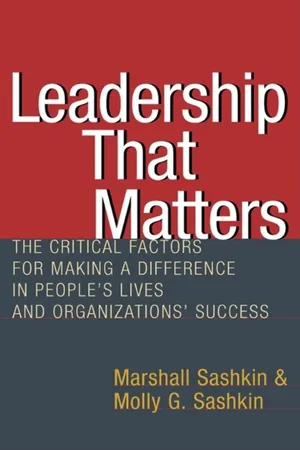
Leadership That Matters
The Critical Factors for Making a Difference in People's Lives and Organizations' Success
- 256 pages
- English
- ePUB (mobile friendly)
- Available on iOS & Android
eBook - ePub
Leadership That Matters
The Critical Factors for Making a Difference in People's Lives and Organizations' Success
About this book
Information
Chapter
ONE
What Is Leadership?
Good leadership consists of doing less and being more.
Lao Tzu1
To those who really understand leadership, Lao Tzu’s assertion is no surprise. The classic Tao Te Ching, from which we took the above and other quotations in this book, was written by Lao Tzu more than two thousand years ago. The Tao is the source of many common sayings, such as “A journey of a thousand miles begins with a single step.”
One reason the Tao was written was to help enlighten the warlords who then ruled various parts of China. One of Lao Tzu’s main aims was to show these rulers how to be better leaders. The essence of his eighty-one lessons can be found in Chapter 17 of the Tao. Our version goes like this:

We think that this is a wonderful illustration of how leadership matters. Leadership based on the leader’s engaging personality and style is not leadership that matters, in the long run. Cults fade and their leaders are forgotten, except to historians. And how often has a leader who was once loved and praised later turned to fear and threat of punishment to get results?
A person may achieve great things through his or her efforts, but not necessarily through effective leadership, leadership that matters. Nor does leadership matter just because the leader is powerful. Anyone who can use a gun can make people follow orders, but it’s not leadership that matters, it’s the gun.
This book is about leadership that matters, leadership that counts, that makes a difference in people’s lives. In a time of increased uncertainty, perhaps even apparent chaos, it is tempting to listen to those who believe that leaders are little more than creations of their times, reflections of larger social forces over which they and we have no real control. Even some leadership scholars have argued that our attribution of positive outcomes to the efforts of leaders may be little more than a romantic illusion.2 Such logic suggests that what we believe to be the effect of good leadership—or even the result of bad or evil leadership—may really be the outcome of social forces that we don’t understand.
For example, hardly anyone would deny that Mohandas (Mahatma) Gandhi had some influence on India’s struggle for independence from Great Britain. However, the above argument would emphasize the post-World War II economic issues that made it desirable for England to eliminate the costs of maintaining its far-flung colonial empire.
Looking to the darker side of leadership, some scholars argue that Adolph Hitler’s rise to power in post-World War I Germany was not due primarily to his charismatic leadership and appeal to the masses. Rather, Hitler’s rise was, in this view, mostly the result of desperate economic conditions. These included a worldwide depression on top of punitive economic conditions imposed on Germany after the war.
Our premise, that leadership matters, runs counter to the arguments illustrated above. We don’t deny that social circumstances have important effects. However, we strongly disagree that the effects of leadership are mostly romantic illusion or an explanation for societal dynamics that we can’t otherwise understand.
There is clear evidence today that leadership does matter. Leaders help reduce ambiguity and uncertainty in our lives. They do so by constructive acts that use complex social forces to achieve concrete, long-term aims and goals. But they do more: leaders make meaning. That is, they provide clear and positive reasons for their aims, actions, and accomplishments. One reason, then, that leadership matters is because leaders add clarity and direction to life and make life more meaningful.
Even more important, leaders help us learn to make our own meaning in our lives. That is, leaders teach us that we can control our own lives and that we are capable of creating meaning ourselves, through our own actions. This may sound a bit vague; that’s because it is complicated and difficult to explain, as well as to do. The central aim of this book is to show just how leaders do these things, how we can all learn to do them better, and in the process become more self-directed leaders ourselves.
Instead of beginning with a long and detailed explanation of leadership, we propose to start by asking you to examine your own experiences of leadership. Have you ever personally known or worked for or with someone you consider a truly exceptional leader? Think not of some famous person or politician but of a real individual you knew or know now, someone with whom you had significant interaction. This need not be someone you know or work with today; a leader from any time in your life will do, even if you knew this person twenty or more years ago.
Now go a step further. Think of a specific time and place, a real interaction that you had with this person you’ve identified as an exceptional leader. When you have that specific occasion clearly in mind, close your eyes and play it back in your mind’s eye, as though you were watching the leader and you on video. Take just a minute, right now, to do this.
After you have visualized and reviewed this memory, take a piece of paper and write down some things that come to your mind as descriptive of the leader. Or use the box provided below. You might just list words or brief phrases, or you might write a line or two.
We’ve conducted an exercise based on what we just asked you to do with a great many groups. Afterwards we ask participants to share some of what they’ve written down. Their responses always fall into three categories, which we describe below. Look back at your own responses and see where they fit.
The first category consists of terms like
• intelligent | • confident |
• creative | • persistent |
• honest | • patient |
• friendly | • forceful |
Some of your comments and descriptions may fit into this group. When we ask people why these items are grouped together, almost everyone says quickly, “They’re all traits, personality characteristics.”
The second category of terms usually includes
• listens well | • shares feelings |
• coaches | • supports us |
• acts consistently | • gives others credit |
• gives feedback | • delegates |
Again, it would be surprising if none of the descriptive terms you came up with fit in this category. What is the category? It’s not hard to see that all of these terms describe actions or behaviors. Most involve other people, too, but the central common feature is that they are leadership behaviors.
Finally, look at the third category, which often includes terms like
• involves the team | • has a vision |
• sees the “big picture” | • grabs my attention |
• is politically astute | • is committed to aims |
• looks for information | • understands our environment |
This third group of descriptions is more difficult to label. Sometimes there are very few terms that fit in this group. That’s because while the first two groups of terms are relatively simple to characterize, this one has more complicated content. Is “has a vision” a trait? Perhaps, but it is clearly more than a trait like “patience.” Is “involves the team” a behavior? Yes, but it goes beyond a simple behavior; it has to do with “the team.”
What links the terms in this last category? They all relate, in some way, to a broader context or situation in which leadership is expressed. We call this last category situational context.
You may think that we constructed this three-part categorization to try to sort out and identify a set of common traits, actions, and contexts. That’s not at all the case. Our point is that these same three categories emerged in each of the hundreds of groups with which we’ve worked using this exercise. The first two categories are always obvious, while the third is harder to see at first but, once recognized, is just as clear.
Why should the three categories be so important? These three categories—leadership traits, leadership behaviors, and the situational context of leadership—represent the three primary approaches that have historically been used to understand leadership.
Personality, Behavior, and Situational Context
The personality of leaders has been a subject of commentary for thousands of years. For example, the classical work of the Roman writer Plutarch, who lived in the first century A.D. and wrote a history of the lives of great men, is still read today. Leadership as personality and biography is surely the earliest approach to understanding leadership.
The study of great leaders’ personalities has continued to the present day. Who has not thought of Franklin Roosevelt or, more recently, John Kennedy, as leaders who stood out by virtue of their personality and character? Successful business leaders have also been the focus of special study. Books have been written, for example, about Bill Gates, founder of the incredibly successful and important Microsoft Corporation. Various biographers have speculated about the aspects of Gates’ personality that enabled his entrepreneurial success as leader of that organization.
Recent studies of leadership have also focused on leaders’ behaviors. Many have, for example, examined the actions of Gandhi, whose personal behavior led India to independence.3 The great humanitarian physician Albert Schweitzer said that with respect to leadership, “personal example is not the most important thing—it is the only thing.”
Nor has history ignored the context of leadership, such as the strategy used by Ulysses S. Grant that led the Union to victory in the Civil War. Especially interesting is the contrast between Grant as a great military leader and Grant as president. Many historians consider Grant to be one of the least effective of all U.S. presidents. In a military context Grant could not be defeated. As a political leader he was a disaster.
The three categories of personality, behavior, and context are also important because they replicate the results of almost a hundred years of formal leadership research. As we will see in Chapter Two, social scientists from the early part of the twentieth century to its recent end started with personality as the explanation for leadership. They moved on to look for explanatory behaviors when traits proved inconclusive. Finally, they searched the complexities of the situational context in an effort to understand leadership scientifically.
Leadership That Matters: A New Synthesis
No one of the three approaches to understanding leadership comes close to providing a comprehensive understanding of what leadership is and how it works. As Warren Benn...
Table of contents
- Cover Page
- Title Page
- Copyright Page
- Contents
- Acknowledgments
- Introduction
- Chapter One
- Chapter Two
- Chapter Three
- Chapter Four
- Chapter Five
- Chapter Six
- Chapter Seven
- Chapter Eight
- Chapter Nine
- Chapter Ten
- Chapter Eleven
- Chapter Twelve
- Chapter Thirteen
- Appendix One
- Appendix Two
- Notes
- Index
- About the Authors
Trusted by 375,005 students
Access to over 1.5 million titles for a fair monthly price.
Study more efficiently using our study tools.
Frequently asked questions
Yes, you can cancel anytime from the Subscription tab in your account settings on the Perlego website. Your subscription will stay active until the end of your current billing period. Learn how to cancel your subscription
No, books cannot be downloaded as external files, such as PDFs, for use outside of Perlego. However, you can download books within the Perlego app for offline reading on mobile or tablet. Learn how to download books offline
Perlego offers two plans: Essential and Complete
- Essential is ideal for learners and professionals who enjoy exploring a wide range of subjects. Access the Essential Library with 800,000+ trusted titles and best-sellers across business, personal growth, and the humanities. Includes unlimited reading time and Standard Read Aloud voice.
- Complete: Perfect for advanced learners and researchers needing full, unrestricted access. Unlock 1.5M+ books across hundreds of subjects, including academic and specialized titles. The Complete Plan also includes advanced features like Premium Read Aloud and Research Assistant.
We are an online textbook subscription service, where you can get access to an entire online library for less than the price of a single book per month. With over 1.5 million books across 990+ topics, we’ve got you covered! Learn about our mission
Look out for the read-aloud symbol on your next book to see if you can listen to it. The read-aloud tool reads text aloud for you, highlighting the text as it is being read. You can pause it, speed it up and slow it down. Learn more about Read Aloud
Yes! You can use the Perlego app on both iOS and Android devices to read anytime, anywhere — even offline. Perfect for commutes or when you’re on the go.
Please note we cannot support devices running on iOS 13 and Android 7 or earlier. Learn more about using the app
Please note we cannot support devices running on iOS 13 and Android 7 or earlier. Learn more about using the app
Yes, you can access Leadership That Matters by Marshall Sashkin,Molly G. Sashkin in PDF and/or ePUB format, as well as other popular books in Business & Leadership. We have over 1.5 million books available in our catalogue for you to explore.