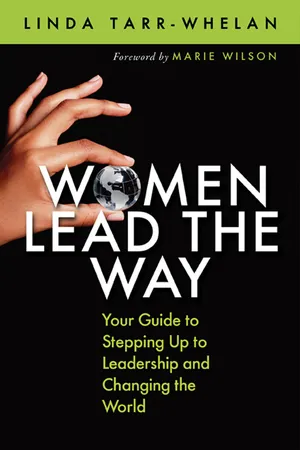
Offers practical steps for women to bring their passion, brains, and background to the power tables and make life better for themselves, their company or organization and global society. • Combines compelling research, international experience, and fascinating personal stories with solid advice • Tarr-Whelan has extensive background as a business woman, a government official, a non-profit leader, and a nurseA few "first women" are making key decisions in high places but a few is not enough to have a significant impact. Changing what gets decided takes changing who makes the decisions. But with just 17% of Congressional seats and 14% of Fortune 500 board seats held by women, the leaders defining priorities and solutions continue to look and act much the same as generations ago. Linda Tarr-Whelan marshals eye-opening facts and figures to decisively dispel the myths that still hold women back and shows women how to build their confidence and skills to pioneer a distinctive approach to leadership, one that emphasizes collaboration, communication and consensus. The proven tipping point, surprisingly, is just 30%--when women's representation at the top reaches 30%, real change starts to happen. Drawing on her extraordinarily diverse background as a consultant, organizer, and diplomat, Tarr-Whelan offers a women-led strategy for change and a complete set of practical road-tested tools readers can use to become powerful partners in creating a better future in a rapidly changing world. Closing the leadership gap is a win for everyone—it brings in new ideas, creates a more balanced and productive work environment, a revitalized social compact and demonstrable positive effects on the bottom line in business and government. Women Lead the Way artfully combines advocacy, research, and tactical guidance to help readers wedge the door open and bring more women through and up.
eBook - ePub
Women Lead the Way
Your Guide to Stepping Up to Leadership and Changing the World
- 240 pages
- English
- ePUB (mobile friendly)
- Available on iOS & Android
eBook - ePub
About this book
Information
WOMEN LEAD THE WAY
1 The 30% Solution
The 30% Solution is a proven and realistic way to bring more women up into leadership, alter cultural stereotypes, and influence agendas, resources, and outcomes. Perhaps you have been one of the “first women”—a great first step—but found out your ideas had less effect than you hoped. We now know the catalyst for a wave of change is having at least one-third women at the table. Learning more will empower you to move from aspiration to action, inform your personal leadership journey, and provide more opportunity for you and other women to be transformational leaders.
If you have not heard about the 30% Solution, you are not alone. The mainstream media have devoted almost no attention to the bigger picture of women’s progress. They have instead focused on sound bites, conflicts (real or imagined), and “firsts.”
Why do the media so often present factoids about women’s progress in quick TV interviews or short newspaper articles, without providing the broader context? One reason is that very few women commentators, editors, or producers play a key role in deciding what is newsworthy. Often, without even thinking about it, we are seeing the world through men’s eyes and don’t realize a woman’s perspective is missing.
In addition, controversy sells papers and programs. Therefore, economic and political coverage of women is heavily skewed toward conflict, not progress. You’ve surely read stories about younger women vs. older women, Democratic (or liberal) women vs. Republican (or conservative) women, working mothers vs. stay-at-home moms, and, of course, the ever-popular feminists vs. anti- or post-feminists.
“Firsts” are also considered newsworthy. Nancy Pelosi becomes the first woman Speaker of the U.S. House of Representatives. Katie Couric is the first woman in a network evening anchor’s chair, and Rachel Maddow takes a similar spot on cable news with her own show. Another woman like Indra Nooyi of PepsiCo or Meg Whitman of eBay becomes CEO of a Fortune 500 company. “Firsts” are certainly better than the alternative, and we’ve cheered our progress as old barriers have tumbled down.
The broader context of such stories, however, is harder to come by. That context would include, for example, the fact that women make up only 2.4% of the CEOs of Fortune 500 companies,1 a percentage that has been virtually static over about a decade. We seldom see information to make us wonder why this is so, or how the United States compares with other countries, or whether having more women at the helm might rejuvenate more businesses. Some groups, such as The White House Project and the Women’s Media Center, have pushed repeatedly to draw attention to the larger story, but the mainstream media seldom cover their work.
Without this kind of information, we may not realize how much further we have to go. Even if we do, without good data and a strategy like the 30% Solution, women often feel defensive in answering the question “Why single out women?” The work of the women’s movement eased much of the earlier overt discrimination, so most of us no longer see ourselves as victims. It can be difficult to articulate why more change is needed, and what kind, to reap benefits for society, not simply to help women or keep the count up.
Background on the 30% Solution
Achieving balanced leadership is actually an old idea. Half a century ago, Eleanor Roosevelt pointed out that better decisions would result if women and men talked through issues together and reached conclusions based on their differing views and concerns. Her words still ring true today: “Too often the great decisions are originated and given form in bodies made up wholly of men or so completely dominated by them that whatever of special value women have to offer is shunted aside without expression.”2
This view must have sounded radical then, and it is still not the norm. But it expresses the core reason why the 30% Solution is important: women do it differently. The British Prime Minister’s Office on Women puts it like this: “Equality. Same. Different.” Equality means the same opportunities, but the value added by different perspectives can generate different results. We need to get the best of what both men and women have to offer.
How do we get there? The answer is more women at the top—women who are agents of change and want to see more women join them. Critical mass tips the scales.
In many countries, leaders recognize this, and the power equation in government is beginning to change fairly quickly. Some societies, particularly newer democracies such as South Africa, have started with a basic belief in the importance of shared leadership in terms of race and gender as the very foundation of democracy. In drafting a constitution, South Africa focused on men and women, not men or women. It looked for enough representation to gain the valuable potential of all people. Other countries have also set benchmarks for women’s representation of 30% or more, recognizing that the 30% Solution offers a clear direction and tested strategy to reach greater leadership equilibrium.
The progress of this concept was speeded up by the deliberations of the Fourth UN Conference on the Status of Women, held in Beijing in 1995. Attending the amazing gathering of fifty thousand women and men and 189 governments as a delegate for the United States was a highlight of my life. We came together to create a platform that could guide the full empowerment and advancement of all women and girls around the world. The spotlight was not just on justice or human rights or equality for individual women and girls or even for women as a separate class. Instead, government officials (mostly men) and women’s advocates alike talked about bigger ideas such as the value of women’s advancement in achieving major societal goals of democratic participation and economic growth.
The energizing and informative discussions of equality were refreshingly different from any I had ever heard in the United States. They moved far beyond the important, but limiting, discussions of how to right past wrongs or protect women because they were victims of discrimination. The theme was the strength women added in modernizing old ways. A big question was, “What would it take for women to assume their rightful place as full actors in society so entire countries as well as families and communities could benefit from women’s leadership and innovative ideas?” Building on three years of regional meetings and expert seminars, the conference reached a breakthrough on altering the status quo.
Two intertwined approaches were adopted: mainstreaming women and their contributions in sufficient proportions in all realms of society, including the top levels of decision making, and creating special programs to combat discrimination and overcome historical inequities. Here at home, most of us in the women’s movement had worked very hard (and still do) on the second approach, an issue-by-issue effort to move women forward and equalize the scales. Although much more remains to be done on that front, it is adding the first approach, more women making decisions, that has the potential to be truly transformative.
Like the women I meet, you most likely want to make a greater contribution without having to face unproductive and unnecessary hurdles. You see yourself as having skills and ideas to contribute to a society that reflects the best of both genders. This is a future that will benefit men and women alike.
In Beijing, I saw a future like that beginning to take shape. Governments, experts, and advocates from the poorest and richest nations debated whether having more women in decision making could be a key to unlocking the development of more vibrant societies. The answer was yes. Advancing women’s participation in determining the shape of the future was a core means of enriching that future. Behind this conclusion was a commonsense proposition: you can’t expect anything different if you just keep doing what you have always done.
The conference concluded that for society to progress, something would have to change in the ages-old practice of men making the decisions and women pressing from outside the circles of power for a piece of the action. It was time for women to claim their space. As Insiders with enough strength to be heard, women decision makers could champion new answers to meet rapidly altering situations as well as solve lingering problems.
The delegates recognized that women’s roles, education, and economic and political involvement were already improving rapidly. These improvements, however, were not in themselves resetting the power tables. What else was needed?
The conference determined that the presence of 30% women in decision-making bodies is the tipping point to have women’s ideas, values, and approaches resonate. This critical mass of women has the clout to permanently change power dynamics. The 30% Solution was viewed as the essential catalyst to reach equilibrium in decision making.
The idea caught fire. A global agreement reaching across all cultures, religions, and political systems now declared the importance of having 30% women decision makers to spur economic and social development.3 On every continent, these ideas have been put into action.
The 30% Solution Gains Traction around the World (Except at Home)
It may seem counterintuitive for legislatures led by a solid majority of men to create mechanisms to bring more women into office. However, legislators around the world have been able to look beyond zero-sum thinking about men losing when women win office.
Immediately after the Beijing conference, the Inter-Parliamentary Union, an organization of national elected officials like our members of Congress, adopted the one-third marker as the goal for national legislatures. Twenty-three countries now meet or exceed the goal, while 101 have changed their constitutions, laws, and/or political party practices to aim for it.4 These are not only Western, European, or industrialized countries. The eleven countries with the greatest representation of women at the highest levels of government are Rwanda, Sweden, Cuba, Finland, Argentina, the Netherlands, Denmark, Angola, Costa Rica, Spain, and Norway. Since the turn of the 21st century, women have been elected president or prime minister in the Philippines, New Zealand, Senegal, Finland, Indonesia, Peru, Mozambique, Germany, Ukraine, Chile, Switzerland, Liberia, South Korea, Jamaica, Argentina, Iceland, Panama, and Latvia.
Different countries have different primary motivations for making these changes. Post-conflict societies like South Africa and Rwanda have written goals for women’s participation in parliament into their new constitutions to make a fresh start with new players. In these nations, male leaders were often much more involved than women in fighting wars. Women were often victims and then community builders. After the wars ended, the countries shared the basic belief that optimizing the contributions of women and men would make their societies work best. They also believed that setting hard targets for representation would help achieve this goal by bringing many more women into office.
The U.S. government under President George W. Bush also promoted change by adopting hard targets for women in office—but only outside U.S. borders.5 The government required the new constitutions of Afghanistan and Iraq to have quotas for women in their national parliaments. Progress for all citizens has been very slow, and long-standing cultural, tribal, and religious norms that diminish women’s participation still hold sway. The positive story is how women’s voices are now heard at the highest level of govern ment in these conservative societies to begin to counter the pervasive problems women face: Afghanistan is now twenty-eighth in the world in women’s legislative representation, Iraq thirty-fifth.
Other countries, such as India, have focused on different reasons for changing their laws. These nations believe greater representation of women will intensify the government focus on many crucial issues and will be of economic benefit. Traditionally, almost all local policy makers in these countries were male. They consistently ignored women’s critical priorities at the village level, such as safe water, education, and health care, and this attitude impeded economic progress. Having at least one-third women in these important local-level seats, called Panchayat, has had positive results in bringing about an alternative vision of community development with the introduction of streetlights, clinics, libraries, and public toilets.6 Negotiations are under way to extend the concept to the state and/or national level.7
In stark contrast, the United States has greeted the 30% Solution with silence and inaction. It is barely halfway home to reach the one-third mark for women in Congress. In 1996, the United States was forty-second in the world in women’s representation, and it has slid down further and further (see Chapter 3 for details). Other countries are passing the United States up while it complacently moves along at a snail’s pace.
In fact, Americans are still debating the role of women in governing the nation. In 2008, polls showed that almost one-third of voters were concerned about whether a woman could be an effective president. In contrast, the first woman prime minister was elected to head the Sri Lanka government almost fifty years ago.8 Strong and well-known women have also headed other governments, including those of India (Indira Gandhi), the United Kingdom (Margaret Thatcher), Israel (Golda Meir), Ireland (Mary Robinson), the Philippines (Corazon Aquino), and Norway (Gro Harlem Brundtland). The political atmosphere in Norway is exemplified by a story Gro Harlem Brundtland used to tell: her son asked, “Mother, can boys become prime ministers, too?”
Why the 30% Solution Results in Better Govern...
Table of contents
- Cover Page
- Title Page
- Copyright Page
- Contents
- Dedication
- Foreword
- Preface The Story behind the Book
- Introduction More Women Leaders, Better Leadership
- Part One Women Lead the Way
- Part Two Stepping Up to Leadership
- Conclusion Dreaming Bigger Dreams
- Notes
- Resources
- Acknowledgments
- Index
- About the Author
- Demos
Trusted by 375,005 students
Access to over 1.5 million titles for a fair monthly price.
Study more efficiently using our study tools.
Frequently asked questions
Yes, you can cancel anytime from the Subscription tab in your account settings on the Perlego website. Your subscription will stay active until the end of your current billing period. Learn how to cancel your subscription
No, books cannot be downloaded as external files, such as PDFs, for use outside of Perlego. However, you can download books within the Perlego app for offline reading on mobile or tablet. Learn how to download books offline
Perlego offers two plans: Essential and Complete
- Essential is ideal for learners and professionals who enjoy exploring a wide range of subjects. Access the Essential Library with 800,000+ trusted titles and best-sellers across business, personal growth, and the humanities. Includes unlimited reading time and Standard Read Aloud voice.
- Complete: Perfect for advanced learners and researchers needing full, unrestricted access. Unlock 1.5M+ books across hundreds of subjects, including academic and specialized titles. The Complete Plan also includes advanced features like Premium Read Aloud and Research Assistant.
We are an online textbook subscription service, where you can get access to an entire online library for less than the price of a single book per month. With over 1.5 million books across 990+ topics, we’ve got you covered! Learn about our mission
Look out for the read-aloud symbol on your next book to see if you can listen to it. The read-aloud tool reads text aloud for you, highlighting the text as it is being read. You can pause it, speed it up and slow it down. Learn more about Read Aloud
Yes! You can use the Perlego app on both iOS and Android devices to read anytime, anywhere — even offline. Perfect for commutes or when you’re on the go.
Please note we cannot support devices running on iOS 13 and Android 7 or earlier. Learn more about using the app
Please note we cannot support devices running on iOS 13 and Android 7 or earlier. Learn more about using the app
Yes, you can access Women Lead the Way by Linda Tarr-Whelan in PDF and/or ePUB format, as well as other popular books in Business & Leadership. We have over 1.5 million books available in our catalogue for you to explore.