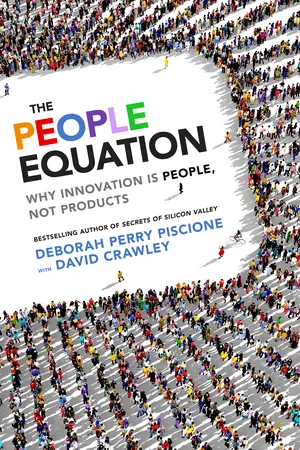
The People Equation Every business leader knows that the key to growth is innovation—if you do what you've always done, you'll get what you've always got. Deborah Perry Piscione and David Crawley argue that ultimately the key to innovation is people. After all, creativity is a uniquely human function, something that can't be automated. So how do you design an organization so that it provides the elements that will bear new thinking and bring forth bold ideas? Through The People Equation.Based on examples from their consulting work and research into successful business practices, Perry Piscione and Crawley's The People Equation enables leaders to create a culture where psychological safety is a given, risk taking is embraced, and collaboration between highly competent people is nurtured. When experiments and new initiatives look promising, Perry Piscione and Crawley's Improvisational Innovation process provides a road map to quickly develop ideas and bring them to market. All this requires upending the usual organizational pyramid and instilling a completely new mindset throughout the organization.Perry Piscione and Crawley show that in our rapidly changing world, the top is not where the really disruptive ideas are going to come from. And if people are afraid to take chances, even fail, you're never going to get those ideas—playing it safe means you'll be out of the game. The People Equation provides you with a formula for exponentially increasing out-of-the-box thinking in your organization and multiplying your chances for greater growth and success.
eBook - ePub
The People Equation
Why Innovation Is People, Not Products
- 192 pages
- English
- ePUB (mobile friendly)
- Available on iOS & Android
eBook - ePub
About this book
Information
CHAPTER 1
THE PSYCHOLOGY OF INNOVATION
The classic experiment on the concept of creative insight is the candle problem (figure 2a and 2b). Proposed by Gestalt psychologist Karl Duncker in his master’s thesis in 1926 and published posthumously twenty years later, the experiment involves a box of tacks, a candle, and a book of matches.1 The test subjects are told to attach the candle to a corkboard by using only the items presented to them. Typically, some subjects try to use the tacks to attach the candle to the corkboard, while others creatively melt some candle wax and attempt to attach the candle to the corkboard with it. Unfortunately, none of these methods work. What does work is to realize that the box that holds the tacks can also be used to hold the candle. In this way, a tack can be used to attach the box to the corkboard and the candle can rest in the box.
The candle problem is a great test of creative insight because to solve it, people have to overcome their preconceived notions of what the box is there for. This is why for ninety years it has been the benchmark for testing this type of psychological capacity and is still actively discussed.
The interesting thing is what it tells us about how the mind works under different stimuli. Classic reasoning from a typical modern-management or Taylorist-management approach is that to get the task done more quickly, one should incentivize the task. So what happens if you add a small financial incentive to come up with a solution to the candle problem faster?
This was tried by psychologist Sam Glucksberg in 1962. To create baseline times, a small financial reward was offered to one group for solving the candle problem more quickly, while another group was asked to just move as quickly as they could. Surprisingly, the group that was incentivized did the task more slowly than the group that wasn’t.
There is plenty of evidence to suggest that for straightforward tasks, incentives do work—at least in the short term.2 Incentives are widely deployed in management, initially for the types of tasks that matter in a mass-production factory or any other Taylorist workplace. Having said that, when creativity or lateral thinking is required, it’s not just that incentives don’t work; they actually reduce productivity, and this conclusion is supported by a body of scientific literature, starting with Glucksberg’s 1962 paper, and continues to be researched to this day.3 What incentives do is induce stress and create focus or even fear. These things are great when the task is known, but when the task isn’t, they are counterproductive. We very much support financial and equity rewards in our innovation process, but we want to emphasize that while stress may make you work faster, it can shut down higher-order thinking. Focus is great for excluding the nonessential, but it also kills lateral thinking. As we will describe in the next section—when we place these effects in an actual, observed corporate environment—stress and fear are often used by people high up in the hierarchy to create action; however, this may not be the type of action that is needed if creative lateral thinking is required to solve the problems that the corporation may face.
This teaches us that what seems intuitively correct, about setting up hierarchical, incentivized systems with vigorous rewards and punishment, is something that worked well for the industrial economy. But transplant those same notions to the fluid economy, where creativity is paramount, and you are setting yourself up for failure. If we want our organizations to be creative and to meet the challenges of the fluid economy, then a typical hierarchical organizing structure with short-term, carrot-and-stick incentives will not work.
The Boardroom Turret Gunner
A few years ago, we witnessed a senior executive meeting on the East Coast in a luxuriously appointed boardroom atop the headquarters of a publicly listed company. We’ll protect the company and the time we were there, but it was instantly clear who was in charge. Because the meeting was so contrary to what we encounter in Silicon Valley, we asked ourselves, was it the way the imposing executive sat or where? Was it the fact that everyone in the room oriented their chairs to him? Perhaps it was the way everyone else in the room was restrained while that singular individual barked orders—in addition to the fact that everyone in the room was slightly deferential to him and the amount of airtime he consumed. Perhaps it was the fact that when that individual paused, everyone else waited, or the way the individual swung around in the plush swivel chair in which he sat and fired questions to the prepared and unprepared alike. We referred to this executive as the turret gunner; he has all the trappings of a hierarchical leader.
As we sat and watched, somewhat in disbelief at the way the turret gunner was treating his subordinates, we learned that several people in the room spent hours a week working with the turret gunner and knew what was likely to evoke a negative response and what was not, but the person presenting that day was not one of them. The presentation was related to a review of a new initiative, and the turret gunner swung around and pointed his questions to the presenter. The fast-paced questions were laden with either implicit or explicit threats. The explicit threats could be as blunt as, “I’ll fire you if you don’t . . .” The implicit threats could be as subtle as, “What was the performance of . . .?” The presenter, who had lived and breathed the project for the last year, knew every detail of how the project functioned but somehow was not able to recall the answers. For the presenter, important details that needed to be brought to the forefront were memories that, in that environment, couldn’t be recalled.
The presenter continued talking but couldn’t recall information important to the decisions that were being made. The stream of verbiage seemed incoherent, and the senior people, especially the turret gunner, seemed to feel confirmed in their view that they were senior for a reason and the presenter junior for a reason. The presenter seemed to agree to do things that he certainly couldn’t execute. He agreed to do things that he wouldn’t otherwise do, and in more than one extreme case made commitments and agreed to targets that he should have known were unattainable. Ultimately, the people in the room made a set of decisions about the project, but those decisions were not the ones that could best spur the project forward because the best information was not discussed.
What happened? The harangued presenter wasn’t thinking at his best because he experienced an amygdala hijack. The amygdala is a small part of the brain that controls the fight or flight response. In situations in which the amygdala perceives a threat, this tiny part of the brain evokes an emotional response and can respond a few milliseconds faster than the thinking brain, or cerebrum, can. As such, the amygdala will override or hijack higher brain thinking and drive an immediate action-oriented response. This part of the brain is there for our survival in threatening situations, so this response can be powerful and automatic. However, the office environments where most of us spend our days are far removed from the wild environments in which the fight or flight response evolved. What this means is that while in primitive humans, immediate action was required to dispense with an existential threat, in the modern office, those actions might be unhelpful or even preposterous.
An amygdala-oriented response is dangerously seductive precisely because of the immediate, action-oriented response it causes. The tried-and-true management technique of anger and shouting is based on this truth.
In the Royal Military Academy Sandhurst (the British army’s officer training academy), which David attended, issuing certain types of commands clearly, loudly, and as an order is a skill that is actually taught. The “do it or you’re fired” message, delivered either explicitly or implicitly, is dangerously effective at creating movement. Leaders who make use of it may even feel a sense of satisfaction that they are able to motivate people to take action by using it. However, the question remains: what action? If the action is generated by bypassing the cerebrum, in which the required decision-making faculties are housed, then for the modern people-centric enterprise it can be a disaster. If the business that we are in is one where we require people to think about problems rather than move widgets, then we must strive to create an environment that remains effective even as we move as far away as we can from that type of seductive mode of operation.
Hierarchical organizations are intrinsically designed in this way. In a typical hierarchical organization, action occurs according to who is in the senior position, not who has the best idea. In a hierarchical organization, the senior people can typically fire or at least negatively influence the careers of their subordinates. While the massive negative consequence of a firing is under the control of a manager, promotion beyond a single hierarchical level is usually outside the control of a direct manager. As such, the traditional hierarchy is a fear-based system. The manager can fire, but he or she usually cannot move the person up more than part of a hierarchical level. This type of organization is designed to get an army of things done, by an army of people.
If you think back to the candle problem, when subjects are given an incentive, that is thought to create stress—an amygdala-based response. This shuts down the cerebrum, which is necessary to solve the problem most quickly. In essence, hierarchical organizations are designed to do this in order to create action, but they do so at the expense of creative thinking. So, the effectiveness of the hapless victim of the turret gunner suffers the same effects that cause subjects in the candle problem to slow down.
We must create a people-centric organization that promotes mindfulness and moves far away from the threat-oriented calls to action that are common in hierarchical organizations. The bottom line is that the people-centric organization needs to create an environment in which people feel safe enough to share ideas—but more than that, they need to feel safe enough to have ideas.
Psychological Safety and What It Means for Your Business
The notion of psychological safety is a well-studied phenomenon.4 The basic concept is centered on the extent to which people believe their actions will avoid personally negative repercussions. Those repercussions are—very often—subtle, such as a dismissive comment from a superior. It is important to understand that this is distinct from avoiding personal responsibility or accountability. It is simply that honest attempts to do the right thing for the team, even if they are mistaken, are not punished.
Through surveys, it is possible to measure the level of psychological safety, and high levels of psychological safety are correlated with the following:
• Higher rates of learning
• Higher rates of creativity
• Fewer mistakes
• Higher levels of team performance
These studies reveal sometimes surprising results. For example, team environments where mistakes are interpersonally penalized have lower levels of psychological safety and actually result in more mistakes. This occurs even in cases where those mistakes may be very serious. Why? If you are going to be penalized for speaking up, emotionally you will be less likely to do it, even if logically you should. Later in the chapter, we will talk about how nurses don’t report medication errors in an environment like this.
RISK-TAKING CULTURES
Silicon Valley is often described as having a risk-taking culture. In many ways, it’s probably more accurate to describe it as having a culture that accepts mistakes or a culture of high psychological safety. As the story goes in Silicon Valley, the reason all the office buildings are two stories high and surrounded by grass is that when you feel like throwing yourself out of the top floor, you wind up just spraining an ankle, only to go home and write another business plan. Typically, failing in a business a couple of times is viewed positively in Silicon Valley, and this is a manifestation of an environment of high psychological safety. Certainly, there are people here who are naturally bold risk takers, who have a risk-taking DNA, and they come here because this is an environment where they thrive.
A state of psychological safety is something that most humans are not predisposed to. In the natural environment, one might look into the distance to see an object, and that object may be unclear. It could be a bush laden with tasty berries or it could be a dangerous wild beast. You might be trying to decide whether to investigate the object further. An optimistic assessment of what it is might lead you to a nice snack, but it could also lead to your death. A pessimistic assessment at least ensures that you will survive to forage another day. As such, humans are predisposed to a state of psychological arousal for threats, and it doesn’t take much to raise this state of arousal. Human beings are predisposed not to move out of their comfort zone, not to go and do risky things, and to generally like routine.
Fortunately, however, things can be done to counter these tendencies and thus enable greater psychological safety, reduce threat-oriented thinking, and enable more cerebral thinking.
THE PEOPLE-CENTRIC ENVIRONMENT
A people-centric work environment is one that is designed to meet the needs of the people who work in it rather than the needs of the most senior person. The goal is to create an environment in which intrinsic motivations can come to the forefront. So, while financial motivations matter, as we learned earlier in this chapter and discuss further in chapter 5, financial rewards can, if misapplied, be counterproductive. If we are interested in creating a people-centric environment, we need to consider several elements: the physical environment, the mindset, and process.
Physical Environment
If you can, slow down for a moment and imagine a place, somewhere you feel happy, safe, and secure—a place where you are relaxed. It could be by the ocean or in the mountains; somewhere familiar or somewhere new. Look around that place and see all the things that you can see. Follow your eyes to absorb all the beauty around you and imagine hearing all the sounds you might hear in that place. As you read these words, imagine reaching out and touching something around you and running your hands through its physical material. It could be warm sand from a beach, grass in a field, water, or stone. It could be anything that is pleasing to you. As you imagine this place and think about it, does it seem like it’s a vacation place? Or does it seem like it’s a workplace?
When people go on vacation, they generally choose to go to a place of beauty to unwind, relax, or whatever the term is that causes you to be able to think well and more clearly. Many of us go to a place that is usually free from threats caused by other people, a place where there are few demands of us and where we are free to create demands for ourselves. For us and our colleagues who write, retreating to a place like this is often where we are most productive, where we have the greatest capacity for creative thought. It is as if the cerebrum can be most fully engaged.
But what if your workplace was like that? Most of us spend our days in an environment characterized by gray walls at right angles to each other, but not all work environments are like that. Here in Silicon Valley, there are workplaces that are eons apart from the towering cube-farms one finds in many of our larger cities. Some of these workplaces have a lot more in common with a resort vacation village. The Googles, Facebooks, and Pixars of the world do a phenomenal job replicating the resort lifestyle in the workplace.
The Mindset
The fundamental mindset of the people-centric organization is one of psychological safety. This does not mean a lack of accountability, but it does mean that honest attempts to do something different are rewarded rather than punished. There are several areas where people are typically vulnerable and are exposed. In particular, these are areas where a mindset of reward is important:
• Feedback seeking
• Help seeking
• Innovation
• Boundary spanning
• Speaking up about concerns / Providing feedback
Feedback seeking is the process through which people try to get information about their own individual performance in order to improve it. It is almost always a vulnerable place to be because you are explicitly asking for things that you might have done wrong and need to improve on. Feedback seeking can be difficult for the ego, but it is vital to be able to grow and develop into a more effective person. It is something that has to be encouraged in an organization that wants to see people who are more effective than they once were.
Help seeking, where one s...
Table of contents
- Cover
- Title Page
- Copyright Page
- Dedication
- Contents
- Introduction: Why People Matter
- 1. The Psychology of Innovation
- 2. The Process: Improvisational Innovation
- 3. The Inverted Organization
- 4. Risk-Taking Leadership
- 5. The Corporate Culture of How
- 6. It Only Takes One
- 7. Moving beyond the Comfort Zone
- 8. The Art of the Ask
- Epilogue: The Truth of Trust
- Notes
- Acknowledgments
- Index
- About the Authors
Trusted by 375,005 students
Access to over 1.5 million titles for a fair monthly price.
Study more efficiently using our study tools.
Frequently asked questions
Yes, you can cancel anytime from the Subscription tab in your account settings on the Perlego website. Your subscription will stay active until the end of your current billing period. Learn how to cancel your subscription
No, books cannot be downloaded as external files, such as PDFs, for use outside of Perlego. However, you can download books within the Perlego app for offline reading on mobile or tablet. Learn how to download books offline
Perlego offers two plans: Essential and Complete
- Essential is ideal for learners and professionals who enjoy exploring a wide range of subjects. Access the Essential Library with 800,000+ trusted titles and best-sellers across business, personal growth, and the humanities. Includes unlimited reading time and Standard Read Aloud voice.
- Complete: Perfect for advanced learners and researchers needing full, unrestricted access. Unlock 1.5M+ books across hundreds of subjects, including academic and specialized titles. The Complete Plan also includes advanced features like Premium Read Aloud and Research Assistant.
We are an online textbook subscription service, where you can get access to an entire online library for less than the price of a single book per month. With over 1.5 million books across 990+ topics, we’ve got you covered! Learn about our mission
Look out for the read-aloud symbol on your next book to see if you can listen to it. The read-aloud tool reads text aloud for you, highlighting the text as it is being read. You can pause it, speed it up and slow it down. Learn more about Read Aloud
Yes! You can use the Perlego app on both iOS and Android devices to read anytime, anywhere — even offline. Perfect for commutes or when you’re on the go.
Please note we cannot support devices running on iOS 13 and Android 7 or earlier. Learn more about using the app
Please note we cannot support devices running on iOS 13 and Android 7 or earlier. Learn more about using the app
Yes, you can access The People Equation by Deborah Perry Piscione,David Crawley PhD in PDF and/or ePUB format, as well as other popular books in Business & Management. We have over 1.5 million books available in our catalogue for you to explore.