A Treasury of How-to Guidance for Project Success!
People problems can really hurt your project, causing delays, eroding quality, increasing costs, and resulting in high levels of stress for everyone on the team. Yet if you're like most project managers, you've never been taught the soft skills necessary for managing tough people issues.
Essential People Skills for Project Managers brings the key concepts of people skills into sharp focus, offering specific, practical skills that you can grasp quickly, apply immediately, and use to resolve these often difficult people issues. Derived from the widely popular original book, People Skills for Project Managers, this new version provides condensed content and a practical focus.
• Apply project leadership techniques with confidence
• Resolve conflicts and motivate team members
• Help a team recover after a critical incident
• Determine your team members' personal styles so you can work more effectively with them
You'll also learn how to apply people skills for a more successful career and life!
• Discover how to manage stress – personal and professional
• Learn proven methods for managing your own career
• Find out how to thrive in an atmosphere of change
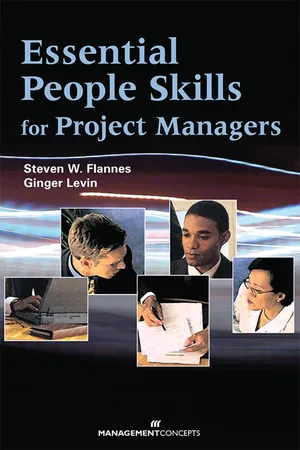
- 208 pages
- English
- ePUB (mobile friendly)
- Available on iOS & Android
eBook - ePub
Essential People Skills for Project Managers
About this book
Information
Topic
Negocios y empresaSubtopic
Historia del arte modernoCHAPTER 1
The Importance of People Skills in Project Management
People issues in projects can be messy and uncomfortable. Most importantly for the project manager, people issues can hinder project success, especially in terms of meeting the project’s schedule and budget. Achieving customer satisfaction within the project’s scope and quality requirements can also be jeopardized.
As a project manager, you can, however, develop and refine tangible skills that will enable you to address people issues successfully when they surface within the project team setting. Equipped with these skills, you will not only bring added value to your organization, but you will find more personal enjoyment and fulfillment in your work as you proactively manage your career.
PROJECTS: TECHNICAL PROBLEMS WITH HUMAN DIMENSIONS
Projects are technical problems with significant human dimensions. Cleland (1999) notes that many of the skills needed for project success revolve around people skills, such as the abilities to communicate, to work with others, to negotiate, and to listen. More recently, management consultant and author Peters (2004) said that “These days, it’s the people skills that matter and will increasingly determine an organization’s success.” From other professional perspectives comes the view that project management success is 80 percent art (the people skills) and 20 percent science- or technology-based. Unfortunately, many project management professionals have not had training in the people skills required for success and career advancement; instead, they are forced to develop these skills informally as they proceed through their careers.
WHY ARE PEOPLE SKILLS SO IMPORTANT?
Nine reasons and trends clearly establish a current need for the project professional to have strong, specialized people skills:
• The cyclical and stage nature of projects
• The trend in organizations to become more project-based
• An increase in project complexity
• The continual downsizing and outsourcing underway in many organizations
• An increasing movement toward a customer-driven world
• The challenges of leading in a matrix management structure
• The increase of virtual teams and a distributed workplace
• The role of project managers as organizational change agents
• The use of people skills as a risk management strategy.
Cyclical and Stage Nature of Projects
The creation and nurturing of a project team involves guiding the team through the people issues encountered in all project stages.
Groups of individuals become a team by progressing through a number of distinct and sequential stages; each stage requires that the project manager and team members have finely honed people skills to succeed at the highest levels. The four project stages are:
• Coming together
• Challenge and conflict
• Doing the work
• Project and team closure.
What follows is a look at the stages through which a group of individuals becomes an effective project team. We identify the basic people skills inhererently required in each stage, and use this discussion of the four stages as a means to introduce specific people skills, each of which is covered in detail in its own chapter later in the book. Over the course of any project, all the people skills discussed in this book are actually employed simultaneously during each of the stages. Some skills are just more prominent in one stage than in another.
Coming Together Stage
A team begins as a collection of individuals with different motivations and expectations. An individual team member brings to this first stage a social schema, which is a personal belief system comprising views about how people and social systems, such as teams, should operate. People also bring stereotypes to a new system or group, which reflect that person’s views and attributions toward members of various groups (e.g., “engineers,” “male project managers,” “older technicians about to retire”).
During this stage, it is important for the project manager to resist making any assumptions about the personalities, values, sources of motivation, interests, and agendas of each of the team members.
The people skill required to refrain from making blanket assumptions about the interests and qualities of each team member is:
• The ability to perceive individual differences (personal styles and interpersonal communication styles) among team members and stakeholders (which is the subject of Chapter 3).
Working in concert with the team members during this initial project stage, the project manager must be able to articulate a vision for the project; the vision explains “why” the project is getting done (its added value), as compared to just describing the “what” of the project (the technical specifications and the deliverables).
The two people skills required for crafting and communicating the project vision are:
• Effective interpersonal communication skills (such as listening actively and asking open-ended questions, which are presented in Chapter 3)
• The project manager’s ability to comfortably implement four distinct leadership roles, of which the “leadership” function is specifically used to communicate the project vision (presented in Chapter 2).
Challenge and Conflict Stage
Even in the best of teams, members often move into a second project stage that is marked by conflict and disagreement. During this stage of the project, conflict emerges because:
• Team members are attempting to clarify their roles by challenging peers for specific niches and identities
• Team members are anxious about the uncertainty involved in any new project
• Change or new experiences often contribute to the surfacing of self-doubt or old grievances.
When conflicts arise, the project manager’s assertive and facilitative style helps the team create not just solutions to individual conflicts but also processes the team can use to address conflicts that resurface.
Four distinct people skills are required of the project manager to resolve initial conflict and to model positive conflict resolution behaviors:
• The ability to identify the personal styles of team members (presented in Chapter 3)
• The ability to use four interpersonal communication techniques (presented in Chapter 3)
• The ability to apply five distinct conflict resolution strategies and to know when to apply each of them (discussed in Chapter 5)
• The ability to implement the “manager” role, which is one of the four basic leadership competencies, to help the team prepare a team charter that defines the methods the team will use to resolve conflict (presented in Chapter 2).
The team charter also begins to address the project manager people skill of knowing how to address crisis situations such as when a critical incident (e.g., serious illness, death of a team member, natural disaster) strikes a team member or the team itself.
The project manager people skill of knowing how to respond effectively to a critical incident involves the abilities (discussed in Chapter 7) to:
• Assess whether a critical incident debriefing (i.e., a facilitated team meeting designed to talk through the crisis) is warranted for the team
• Be empathic to the team members’ personal reactions to the event while still maintaining a business-oriented, task-completion focus
• Know when a project recovery plan is needed, plus the ability to identify the qualities of the ideal project recovery manager.
However, one of the potential negative aspects of creating standards and group norms via a team charter is that the team may begin to display conformity, obedience, or “group think” in decision making. Group think is defined as team behavior that displays extreme cooperation, compliance, and little willingness to appropriately confront the ideas of other team members. This risk arises when team members are conflict-averse, when the project manager is very directive, and when team size increases.
To mitigate the risk of group think and conformity, the project manager needs to achieve a balance of cohesion and dissent; this process is also known as “managing agreement” on the project team. The people skills required for managing agreement involve five conflict resolution skills (presented in Chapter 5). As the team begins to address this stage of conflict by using these skills, the team starts to evolve into the next stage, which involves getting the bulk of the work done.
Doing the Work Stage
When handled smoothly, the process of creating team standards for dealing with issues such as conflict resolution allows the group to do what it has been charged to do: complete the project within the guidelines of specifications, time, and cost.
To keep the team moving forward in a positive and productive manner, the project manager needs to create the conditions for:
• An adequately resourced team
• A proactively motivated team.
The two people skills required of the project manager to obtain the needed resources for the team and to create a motivated team atmosphere are:
• Comfort implementing the leadership role of “facilitator,” which involves an assertive pursuit of needed resources (discussed in Chapter 2)
• The ability to employ a variety of motivational approaches tailored to each individual on the team (covered in Chapter 4).
Should the project manager find that the team is not operating with the expected level of efficiency during this stage, certain people issues may be getting in the way. It is important at this point for the project manager to conduct a “people-issues audit” to determine if these issues are causing the project to veer off track.
Conducting a “people issues” audit involves:
• Determining if the team has an accurate grasp of the project vision, which encompasses a description of the added value the project brings to the customer (Chapter 2)
• Using people skills for managing conflict (Chapter 5) and motivating team members (Chapter 4)
• Fulfilling the project leadership role of “facilitator” (Chapter 2) by spending enough time developing needed support and resources for the project with important stakeholders both internal and external to the organization.
Project and Team Closure Stage
From the people-issue perspective of project management, the last stage is the one in which individuals on the team, and the team as a whole, assess the level of goal achievement and begin the process of “saying good-bye.”
This closure process affects team members differently, and their reactions are often directed toward the project manager. During this period, the manager is trying hard to conclude the remaining pieces of the project and may be surprised at the range of feelings team members display.
When facing project closure, the people-oriented project manager should remember that:
• Team members may display a wide range of unforeseen feelings, such as anger, apprehension, fear, and lack of confidence.
• These feelings may not be logical and can have very little to do with events or issues related to the project team.
This is also the stage in which the team members begin to think about what they will be doing after this project is completed. This future orientation is natural, given the self-protective need to manage one’s career in project work.
Two distinct people skills are required of the project manager to address these team member career concerns:
• The “mentor” role (discussed in Chapter 2), in which the project manager, in conjunction with the functional manager, gently guides the team member toward a frank discussion of the next assignment
• The application of six specific, active career management skills (which are examined in Chapter 8).
In this last phase of the project, stakeholders also may be experiencing personal stress (in the form of anxiety, lowered mood, and irritation) as well as physical fatigue. Under these conditions, the project manager must work to keep the team members committed to completing the tasks in a way that does not allow that stress to hamper performance.
To maximize performance at the close of the project, the project manager needs to use the people skills of:
• Crafting tailored motivation strategies that address the individual differences of team members (described in Chapter 4)
• Offering s...
Table of contents
- Cover
- Title Page
- Copyright Page
- About the Authors
- Dedication
- Table of Contents
- Forewords
- Preface
- Chapter 1: The Importance of People Skills in Project Management
- Chapter 2: Project Manager: Leader, Manager, Facilitator, Mentor
- Chapter 3: Interpersonal Communication Tools for the Project Manager
- Chapter 4: The Art of Motivation
- Chapter 5: Managing Project Conflict
- Chapter 6: Stress Management for the Project Manager
- Chapter 7: Critical Incidents: When Traumatic Events Strike the Project Team
- Chapter 8: Future Issues, Career Management, and Thoughts on People Issues
- References
- Index
Trusted by 375,005 students
Access to over 1.5 million titles for a fair monthly price.
Study more efficiently using our study tools.
Frequently asked questions
Yes, you can cancel anytime from the Subscription tab in your account settings on the Perlego website. Your subscription will stay active until the end of your current billing period. Learn how to cancel your subscription
No, books cannot be downloaded as external files, such as PDFs, for use outside of Perlego. However, you can download books within the Perlego app for offline reading on mobile or tablet. Learn how to download books offline
Perlego offers two plans: Essential and Complete
- Essential is ideal for learners and professionals who enjoy exploring a wide range of subjects. Access the Essential Library with 800,000+ trusted titles and best-sellers across business, personal growth, and the humanities. Includes unlimited reading time and Standard Read Aloud voice.
- Complete: Perfect for advanced learners and researchers needing full, unrestricted access. Unlock 1.5M+ books across hundreds of subjects, including academic and specialized titles. The Complete Plan also includes advanced features like Premium Read Aloud and Research Assistant.
We are an online textbook subscription service, where you can get access to an entire online library for less than the price of a single book per month. With over 1.5 million books across 990+ topics, we’ve got you covered! Learn about our mission
Look out for the read-aloud symbol on your next book to see if you can listen to it. The read-aloud tool reads text aloud for you, highlighting the text as it is being read. You can pause it, speed it up and slow it down. Learn more about Read Aloud
Yes! You can use the Perlego app on both iOS and Android devices to read anytime, anywhere — even offline. Perfect for commutes or when you’re on the go.
Please note we cannot support devices running on iOS 13 and Android 7 or earlier. Learn more about using the app
Please note we cannot support devices running on iOS 13 and Android 7 or earlier. Learn more about using the app
Yes, you can access Essential People Skills for Project Managers by Steven W. Flannes PhD,Ginger Levin PMP, DPA in PDF and/or ePUB format, as well as other popular books in Negocios y empresa & Historia del arte moderno. We have over 1.5 million books available in our catalogue for you to explore.