- 144 pages
- English
- ePUB (mobile friendly)
- Available on iOS & Android
eBook - ePub
About this book
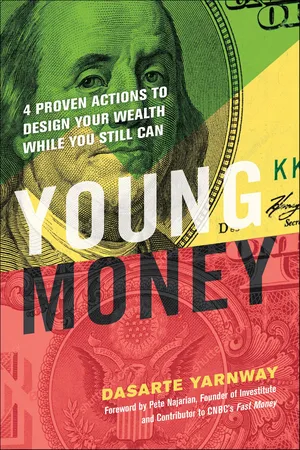
Turn Time into Money! If you're under 40, you may not have a lot of money, but you're loaded with a valuable resource: time. It probably doesn't seem like it when you're looking at your student loan debt or scraping up rent money each month, but being young is the ultimate advantage when it comes to building wealth. Starting now means you can experiment, learn from mistakes, bounce back from setbacks, and steadily build your legacy. Rising-star financial advisor Dasarte Yarnway offers a simple 4-step process you can use to become a Master Wealth Builder. It begins with having the right mindset—wealth begins in your mind and then is built every day through intentional actions. Yarnway examines: • The 4 most common financial pitfalls and how to avoid them • The 5 habits all Master Wealth Builders engage in • The 3 best ways to master your income • 7 simple practices for controlling costs A worksheet helps you assess exactly where you are financially, where you want to go, and how you're going to get there. So start now! As Warren Buffett said, "Someone is sitting in the shade today because someone planted a tree long ago." The sooner you plant, the more shade you'll have.
Information
Topic
Personal DevelopmentSubtopic
EntrepreneurshipSTEP 1
MASTER THE MINDSET
Set your mind on a definite goal and observe how quickly the world stands aside to let you pass.
— Napoleon Hill, Think and Grow Rich
1
When Cars Fly
As I walked into the investment firm in San Mateo, California, for my first official day of work after college, I was certain I would change the world. Instead, the experience working at that firm changed me.
It was a typical overcast morning in the Bay Area, and all the new recruits gathered in the firm’s lobby to take a tour of the premises. “Welcome to your new home!” said the assistant as we prepared to circle the research floor. There were glass windows that enclosed equity traders and research analysts as they processed buy-and-sell orders for clients and the firm’s various portfolio strategies. People were glued to their seats, attention split between four computer screens each that displayed graphs that looked as if they had no correlation or trend. I made it a point to look at all the other members of my cohort. Their faces couldn’t hide their excitement at the amazing opportunity to work at this firm. And I thought to myself, “I don’t know anything about this stuff.”
Yes, I knew nothing about finance and investing. I had played football in college and was on the trajectory to be an NFL draft pick when I tore my ACL. Realizing that I needed a new career path (and fast!), I looked around to see what else I could excel at. With nothing but ambition in my tank, I had interviewed at the investment firm and been hired as an investment associate.
As the week proceeded, I absorbed all that I could about the stock market and financial planning. Basic things like the definition of a stock, how markets work, and the average returns of specific investments were routinely typed in my search engine. But although I was accumulating fundamental knowledge of the industry, I still lacked the tools that would enable me to apply it. I could not pinpoint why investors chose to invest in certain companies over others.
And more importantly, I could not explain how these decisions could help a person build the wealth that I too yearned to build. From my naïve perspective, the stock market was a gamble that involved taking high risks on your principal to receive a reward that may or may not be realized at an undisclosed future date. Part of me was asking myself, “Why take the risk?” But the other, more ambitious part of me refused to let the opportunity to learn pass me by. Besides, I was a first-generation American born in an impoverished neighborhood—I did not have much to lose. And so I rolled the dice.
Every month after my arrival, a new cohort arrived and toured the premises just as I had. About four months in, with only a slightly better understanding of wealth-building, I was joined by a new employee with a knack for investing. Let’s call him John. I observed John closely as he started his computer and organized his desk. His face was as tired as if he had been working for thirty years. He dressed conservatively, even more so than the standard for the financial services industry. He read voraciously and had a laser focus when it came to completing tasks.
When the day came for our first Q&A session with the firm’s chief executive officer and billionaire investor, John proceeded to ask questions that many of us new hires could not even comprehend. The topic of the meeting centered on the correlation between investing and wealth-building, and my head was swimming with fundamental questions about how I, a kid from the inner city, could make my money work for me and build wealth. As the presentation progressed, many of the company’s strategies and ways of analysis were explained. And although most of my cohorts were wide-eyed and clueless, there was one person who wasn’t.
From the accumulation of wealth to the compound interest of dividends to the analysis of a company’s financial position before investing in it, it seemed as if there was nothing that John did not know. He even hurled back tough questions at our billionaire CEO until the leader asked to see him after the meeting. I was thoroughly impressed and felt the need to follow up with John. I machine-gunned a million questions at him about wealth-building, stocks, and analysis. But my simplest question is the one that yielded the most important answer. I asked, “How do you know what to invest in?”
He turned slowly, looked at me dead in the eye, and replied, “I’m investing for the day when cars fly.”
Wealth-Building Is a Marathon
There is an old adage that reminds us, “Life is a marathon and not a sprint.” In a sprint, the runner sets her sights on a destination that is close in distance with a foreseeable end. When the starting gun is shot, the sprinter is eager to reach her top speed as soon as possible so that she can win the race. She exerts all her energy early because of the short-term nature of the competition.
But if, like John, your eyes are set far into the future to the day when cars fly, the race is anything but short-term. It is most certainly a marathon. In a marathon, a number of factors contribute to the success of the runner. The runner must breathe properly and keep her composure. She must assess the distance between her current position and her goal, but also be aware of the other competitors and of other risks, all while being disciplined enough to know when to kick it up a notch and make a pass. The marathon runner’s mindset is one of consistency. It is the mindset that is routinely present in Master Wealth-Builders everywhere.
It is the mental shift from sprint to marathon that allows Master Wealth-Builders to stay committed to their goals. They know the road will be long and arduous, that many parts of the race must simply be endured, and that nothing worthwhile has ever come from comfort zones. They know that while their youth is an advantage, it also means that the journey will be that much longer, and that consistency over time is that much more important. They know how to master their mindsets to keep on going.
The bottom line is that wealth-building is a long-term goal and that young people like yourself have the longest term in which to do it right.
Thinking Counterintuitively
For many of us, our actions—in terms of wealth-building and otherwise—are emotionally driven and not based on rational conclusions. For example, a man plays the lottery and wins a few million dollars. Because his financial circumstances have changed overnight, all of the wealth-building work he had committed to prior to hitting the lotto are now, to him, unnecessary. “I’m rich!” he thinks to himself, which is the intuitive thing to feel. In truth, his winnings are a small deal in the grand scheme of Master Wealth-Building.
Let’s take that scenario and apply some counterintuitive thinking. Instead of splurging on goods, the winner reassesses his current financial circumstances, where he would like to go, and how long it will take him to get there. He deliberates thoughtfully on all his options to make sure that his next course of action is logical, precise, and aligned with his plan. This is a hard thing to do. Ignoring our reactive intuition is extremely difficult. Yet restraining yourself from acting on impulse often yields the best rewards. Take the most recent stock market crash.
On September 29, 2008, the Dow Jones Industrial Average fell 778 points—the largest single-day drop in its history at the time. During the previous period, the stock market had been yielding generous returns year over year. Without much research or professional help, families could throw a dart at any stock or mutual fund and that investment had a high likelihood of appreciating in value. This steady growth and wealth accumulation made Americans greedy and overly confident in their abilities to invest. They strayed from their financial plans (if they had any to begin with) and had astronomical expectations for their portfolios.
Unlike the crash during the Great Depression, which took several years for the market to reach its all-time lows, the financial crisis of 2008 took just eighteen months for the market’s value to drop by over 50 percent. Imagine investing $10,000 and waking up eighteen months later to just a little north of $5,000. Yikes! This was the same sentiment that most Americans had at the time. The thing that most Americans didn’t do was to think counterintuitively about the current situation, which led to hundreds of billions of unrecoverable dollars lost.
Think about it: Your account value is now at approximately $5,000. You’ve suffered the emotional heartache of watching the markets dive over a relatively short time period. At this point, you’ve sworn to yourself that you’ll never try this investing thing ever again. But, as Rothschild, an eighteenth-century banker, is said to have remarked, reaffirming the value of counterintuitive thinking, “The time to buy is when there is blood in the streets.”
With the S&P 500 Index sitting at roughly 676 points, indeed, blood was in the streets. And so you make an unnatural, probably uncomfortable, and definitely counterintuitive decision. Instead of pulling your money out of the market, you invest another $10,000, giving you a grand total of 15 shares in the S&P 500 Index. Nine years later, the S&P 500 stands at 2,351. Those 15 shares that you purchased at the bottom of the financial crisis—and against your own intuition—are now worth more than $25,000!
Wealth is not an accident, nor does it happen with luck. Even if you win the lottery, the likelihood of keeping that newfound wealth is statistically slim to none without your making the mental shift to adopt a mindset of wealth-building. And make no mistake about it: Mastering your mindset is by far the hardest part of building long-term wealth. Wealth starts in your mind, and then it manifests in your life. Wealth is built every day through sacrifice and extremely intentional actions. But without mastering your own thoughts, wealth-building is impossible. Your thoughts are the cogs in the engine that drive you down the path toward wealth.
If you can focus on the bigger picture, way into the future to when cars fly, thinking counterintuitively will eventually become second nature. Luckily, your youth gives you plenty of time to build the required muscle memory and to make the right decisions that will positively impact your near- and long-term financial circumstances.
2
4 A.M. Faith
As a young student-athlete at the University of California, Berkeley, I had the privilege of sitting next to some of the world’s best students and taking classes from some of the most brilliant professors. Students from all over the world convened in classrooms to share perspectives about life, race relations, business, and politics. The vast array of ideologies exposed me to different ways of thinking and disparities between communities and introduced me to concepts that I had never heard of before I enrolled.
The university’s character, charm, and freethinking spirit helped me harness the power of thought and focus, a priceless skill that has allowed many of my fellow students to become pioneers and innovators in their respective industries after college. But for me, the biggest gift I received from Berkeley was the gift of observation, specifically, the opportunity to observe a truly fine gentleman: Ron Gould, associate head coach and running backs coach.
If you read Coach Gould’s list of accomplishments, you’ll learn that he is the father of “Running Back U” and played a big role in launching the collegiate careers of some of the best college football running backs in the history of the game. His observant yet disciplinarian style was aligned with his mission to develop boys into men and into better citizens, and it was evident in every single one of his actions on and off the field. As a player, I felt that Coach Gould knew everything about me. He was everywhere, all the time, and would do anything for the players that he coached. The one thing that he did not know was that I studied him just as much as he may have been studying me. This is how he taught me the value of 4 a.m. faith.
It is said that faith is the unwavering belief in what is not seen. Well then, 4 a.m. faith is the ability to act on what is not seen. It means doing the things necessary to work toward tangible results, fueled by what you believe. It brings life to faith, moving you closer each day to your goals. It is what you need to do to be successful in sports, wealth creation, and life in general.
Professionally, a goal of Coach G’s was to be a head football coach for an organization so that he could continue to impact the lives of young men across the country. This was quite a lofty goal, considering the possibility of becoming head coach at Cal Berkeley was very slim. A personal goal of his was to remain in good physical shape so that he could be productive on and off the field and give his players and family the best of him.
Every morning at 4 a.m., Coach Gould took a walk before beginning his day. During this walk, he would meditate on the problems that he was facing, the things that he wanted to come to fruition, and the health and well-being of his family and players. He used the time to fuel his tank so that once his day began he could take action on all of the things that he wanted to manifest in his personal and professional life. After his walk, he would watch film to know what to coach on, and he could always be found in the weight room long before any of the other coaches and players were in the facility. He coached as if every day were an audition for his dream job.
In the spring of 2013, after the Cal football team went 5–7, the entire coaching staff was fired, including Coach Gould. But because of his 4 a.m. faith, I knew that Coach G’s coaching career was far from over. Sure enough, a few weeks after being released from the California football staff, he was hired in grand fashion to be the head coach of a college football program in Northern California.
This is what happens when you operate with 4 a.m. faith! In the darkest hours, when everyone was still asleep, Coach Gould was taking the time to think about his goals, assess his plan from all angles, and determine the right course of action that would bring him one day closer to success. He worked relentlessly for what he wanted, even when it didn’t seem possible that it could come to fruition. He coached every day with tenacity, passion, and belief, as if the job was right aroun...
Table of contents
- Cover
- Title Page
- Copyright Page
- Dedication
- Contents
- Foreword
- Introduction: The Ultimate Advantage
- Step 1: Master the Mindset
- Step 2: Master the Plan
- Step 3: Master Your Income
- Step 4: Master Money Drains
- Conclusion: Mastering Your Legacy
- Afterword
- Acknowledgments
- Index
- About the Author
Trusted by 375,005 students
Access to over 1.5 million titles for a fair monthly price.
Study more efficiently using our study tools.
Frequently asked questions
Yes, you can cancel anytime from the Subscription tab in your account settings on the Perlego website. Your subscription will stay active until the end of your current billing period. Learn how to cancel your subscription
No, books cannot be downloaded as external files, such as PDFs, for use outside of Perlego. However, you can download books within the Perlego app for offline reading on mobile or tablet. Learn how to download books offline
Perlego offers two plans: Essential and Complete
- Essential is ideal for learners and professionals who enjoy exploring a wide range of subjects. Access the Essential Library with 800,000+ trusted titles and best-sellers across business, personal growth, and the humanities. Includes unlimited reading time and Standard Read Aloud voice.
- Complete: Perfect for advanced learners and researchers needing full, unrestricted access. Unlock 1.5M+ books across hundreds of subjects, including academic and specialized titles. The Complete Plan also includes advanced features like Premium Read Aloud and Research Assistant.
We are an online textbook subscription service, where you can get access to an entire online library for less than the price of a single book per month. With over 1.5 million books across 990+ topics, we’ve got you covered! Learn about our mission
Look out for the read-aloud symbol on your next book to see if you can listen to it. The read-aloud tool reads text aloud for you, highlighting the text as it is being read. You can pause it, speed it up and slow it down. Learn more about Read Aloud
Yes! You can use the Perlego app on both iOS and Android devices to read anytime, anywhere — even offline. Perfect for commutes or when you’re on the go.
Please note we cannot support devices running on iOS 13 and Android 7 or earlier. Learn more about using the app
Please note we cannot support devices running on iOS 13 and Android 7 or earlier. Learn more about using the app
Yes, you can access Young Money by Dasarte Yarnway in PDF and/or ePUB format, as well as other popular books in Personal Development & Entrepreneurship. We have over 1.5 million books available in our catalogue for you to explore.