Hartmann is perhaps best known for his fierce commitment to Jeffersonian democracy and his steadfast opposition to the corporatization of America. But in these pages you'Äôll also discover his Older and Younger Cultures hypothesis, which identifies the root cause of so many of our social and environmental ills. You'Äôll hear from Hartmann on how to keep our schools from treating children like assembly line products, why attention deficit disorder is not an affliction, what cloudy Germany can teach us about solar energy, and much more.
Fascinating as these essays are, they'Äôre ultimately meant to inspire you to action. As Hartmann says at the end of every radio program, 'ÄúGet out there, get active! Tag, you'Äôre it!'Äù
- 360 pages
- English
- ePUB (mobile friendly)
- Available on iOS & Android
eBook - ePub
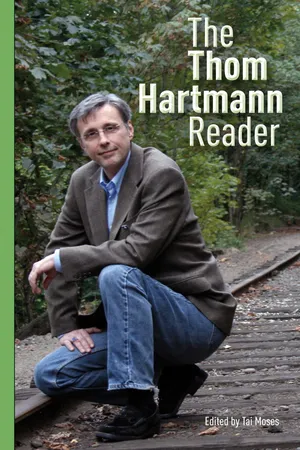
The Thom Hartmann Reader
About this book
Information
PART I
We the People
IT’S HARD TO PIGEONHOLE THOM HARTMANN. HE HAS A UNIQUE synthesis of qualities not often found in one person: a scholar’s love of history, a scientist’s zeal for facts, a visionary’s seeking after truth, an explorer’s appetite for adventure and novelty. While he advocates a return to simpler, egalitarian values of community, he is no dreamy idealist. He is a fierce critic of the powerful corporate interests that have taken over our culture and corrupted our politics. He is a merciless dissector of our government’s hypocrisies, no matter which party occupies the White House. His dreams for this country are the same ones that Thomas Jefferson had two and a quarter centuries ago, dreams that Hartmann describes here in “The Radical Middle.” In an eloquent, articulate voice, he writes in the hopes of guiding the reader toward increased responsibility and consciousness. He is interested in changing not just our behavior and actions but the thoughts and the attitudes that are at the root of widespread social problems. What he offers us is a radically different way of thinking.
While I was reading through the books, essays, and articles that make up Thom Hartmann’s published body of work, I began to distinguish several threads that run throughout the work, weaving in and out, and illuminating Hartmann’s unique vision. All of these threads are represented in the pieces that make up this collection, but the most vivid of them, the one that unites and defines all the others, is this: democracy is the natural state of nature and of mankind.
The study of democracy is one of the pillars of Hartmann’s life. He spent years immersed in the writings and the correspondence of Jefferson and the other Founders, researching the family tree of the American democratic experiment. He has studied ancient democracies all over the world, including the Iroquois Confederacy, which inspired Jefferson. Going back further he read the histories recorded by the first-century Roman senator Tacitus. He has spent time with indigenous and aboriginal peoples, the remnants of what he calls “older cultures,” and observed that they tend to live in egalitarian societies. He has examined how and why democracies fail; he understands the components of peace and the causes of war.
Investigating the biology of democracy, he has delved into animal studies showing that cooperation, not dominance, is the natural tendency of many species. In his book What Would Jefferson Do?, from which “Democracy Is Inevitable” is drawn, he exploded many of the most entrenched myths about American democracy, making short work of the neocons’ beloved notion that dominance is the natural way of the world, by showing that over time democratic systems will always push out despots and authoritarian governments.
He is a passionate advocate of the democratic way of life, of cooperation, person to person, on an individual level because democracy is, after all, personal. It supports and nurtures us, and we in turn support and nurture it. Democracy is our most cherished bond, and it is the most cherished of Thom Hartmann’s themes. Not for nothing does the highest law of our land, the US Constitution, begin with the words We the People. But We the People are in trouble today. Our economy no longer works for middle- and working-class Americans. As Hartmann describes in “The Story of Carl,” the “cons” have damaged our democracy and weakened our country’s once-vibrant middle class with the policies of Reaganomics: financial deregulation, tax cuts for the richest Americans, the destruction of our manufacturing sector, freezing the minimum wage, and undermining labor laws.
The media is also in trouble. In Hartmann’s trenchant analysis of the state of our media, “An Informed and Educated Electorate,” he analyzes how the corporate news media has abandoned its vital public-service mission and caters only to what people want, not what they need. After Ronald Reagan revoked the Fairness Doctrine, we saw the rise of right-wing shock jocks on conservative talk radio and the rapid erosion of the national conversation about politics into screaming matches, name-calling, and flat-out lying. Hartmann further chips away at the Reagan myth by showing how the great communicator was opposed to public education and subverted Jefferson’s intention that every American should have a decent education, free of cost.
In “Whatever Happened to Cannery Row?” Hartmann uses John Steinbeck’s classic novel as a vehicle to visit the recent past, America before Reagan, “a time of challenge and a time of opportunity.” While the piece is a paean to Hartmann’s parents and a lost era, it also drives home his deeper point: our country has gone off course, drifted off in a “dream-fog of consumerism”; and in 30 short years, America has become unrecognizable, our uniqueness replaced by a vast corporate footprint of chain stores and shopping malls. To find out who we are, we don’t need to completely reinvent ourselves—we just need to wake up and look to the past, salvage what was most precious, and bring it back home.
The Radical Middle
From ThomHartmann.com
THE FOUNDERS OF THIS NATION REPRESENTED THE FIRST RADIcal Middle. Back then they called it “being liberal.” As George Washington said, “As Mankind becomes more liberal, they will be more apt to allow that all those who conduct themselves as worthy members of the community are equally entitled to the protections of civil government. I hope ever to see America among the foremost nations of justice and liberality.”
They didn’t want King George or his military or corporate agents snooping in their houses, mails, or private matters; preventing them from organizing together and speaking out in public in protest of government actions; imprisoning them without access to attorneys, due process, or trials by juries of their peers; or reserving rights to himself that they felt should rest with the people or their elected representatives. (They ultimately wrote all of these in the Bill of Rights in our Constitution.)
They also didn’t want giant transnational corporations dominating their lives or their local economies. The Radical Middle has always believed in fairness and democracy and understood that completely unrestrained business activity and massive accumulations of wealth into a very few hands can endanger democratic institutions.
As James Madison said, “There is an evil which ought to be guarded against in the indefinite accumulation of property from the capacity of holding it in perpetuity by … corporations. The power of all corporations ought to be limited in this respect. The growing wealth acquired by them never fails to be a source of abuses.”
Similarly, John Adams wrote that when “economic power became concentrated in a few hands, then political power flowed to those possessors and away from the citizens, ultimately resulting in an oligarchy or tyranny.”
Thomas Paine, among others, wrote at length about the dangers to a free people of the massive accumulation of wealth, and following the excesses of the Gilded Age—which led to massive corruption of the American government by corporate and wealth-based interests—laws were put into place limiting the size and the behavior of corporations and taxing inheritance of the most massive of family estates so that a new hereditary aristocracy wouldn’t emerge in the nation that had thrown off the economic and political oppressions of the hereditary aristocracy of England.
The Radical Middle always believed in the idea of a commons—the things that we all own collectively and administer the way we want through our elected representatives. The commons includes our parks, roads, police, fire, schools, and our government itself; our ability to vote in fair and transparent elections; our military and defense; our systems for protecting our air, water, food, and pharmaceuticals; our ability to retire in safety if we’ve worked hard and played the game by the rules; and the security of knowing that an illness won’t financially wipe us out.
Regardless of electoral politics (since both of the major political parties often overlook these values, and both have become corrupted by wealth and corporate influence), poll after poll shows that the vast majority of Americans embrace the values of the Radical Middle.
In recent years America has been hijacked by the Radical Right. Corporations now write most of our legislation. Our elected representatives cater to the interests of wealth rather than what is best for the commons we collectively own or what will sustain that bulwark of democracy known as the middle class. They have, in large part, seized control of our media, wiped out our family farms, and wiped out small, middle-class-owned businesses from our towns and cities. They seek a “merger of corporate and state interests”—a definition Benito Mussolini used for what he called “fascism.”
The Radical Right has even gone so far as to use sophisticated psychological programming tools, like Newt Gingrich’s infamous “word list,” to paint the Radical Middle as some sort of insidious anti-Americanism.
We in the Radical Middle are calling for nothing less than a restoration of democracy, of government of, by, and for We the People, in a world that works for all.
From ThomHartmann.com, © 2007, published by Thom Hartmann.
The Story of Carl
From Screwed: The Undeclared War against the Middle Class
CARL LOVED BOOKS AND HE LOVED HISTORY. AFTER SPENDING two years in the army as part of the American occupation forces in Japan immediately after World War II, Carl was hoping to graduate from college and teach history—perhaps even at the university level—if he could hang on to the GI Bill and his day job long enough to get his PhD. But in 1950, when he’d been married just a few months, the surprise came that forced him to drop out of college: his wife was pregnant with their first child.
This was an era when husbands worked, wives tended the home, and being a good father and provider was one of the highest callings to which a man could aspire. Carl dropped out of school, kept his 9-to-5 job at a camera shop, and got a second job at a metal fabricating plant, working with molten metal from 7:00 p.m. to 4:00 a.m. For much of his wife’s pregnancy and his newborn son’s first year, he slept three hours a night and caught up on the weekends, but in the process he earned enough to get them an apartment and prepare for the costs of raising a family. Over the next 45 years, he continued to work in the steel and machine industry, in the later years as a bookkeeper/manager for a Michigan tool-and-die company as three more sons were born.
Carl knew he was doing the right thing when he took that job in the factory, and he did it enthusiastically. Because the auto industry was unionized, he found he was able to support his entire family—all four sons—on one paycheck. He had fully funded health insurance, an annual vacation, and a good pension waiting for him when he retired. Carl had become a member of the middle class. He may not have achieved his personal dream of teaching history, but he had achieved the American Dream. He was self-sufficient and free.
Working with molten metal could be dangerous, but the dangers were apparent, and Carl took every precaution to protect himself so that he could return home safe to his family. What he didn’t realize, however, was that the asbestos used at the casting operation was an insidious poison. He didn’t realize that the asbestos industry had known for decades that the stuff could kill but would continue to profitably market it for another 20 years while actively using its financial muscle to keep the general public in the dark and prevent the government from interfering.
A couple of years ago, Carl tripped on the stairs and ended up in the hospital with a compression fracture of his spine. He figured that fall also caused the terrible pain he’d been experiencing in his abdomen. The doctors, however, discovered that his lungs were filled with mesothelioma, a rare form of lung cancer that is almost always caused by exposure to asbestos. Mesothelioma is terminal, and its victims die by slow and painful suffocation.
Just because some corporation put profit before people, Carl got screwed.
I was Carl’s first child.
An Undeclared Way
My dad faced a painful death, but at least his job in a union shop left him with health care after retirement. Most Americans don’t even have that reassurance anymore. More than 45 million Americans don’t have health insurance to cover expenses for a serious illness, and 5 million lost their health insurance between 2001 and 2005. And it’s not just illness that worries most Americans today. Americans are working more and making less. It’s getting harder and harder to just get by.
There’s a reason for the pain Americans are suffering.
The America my dad grew up in put people before profits. The America he lives in now puts profits before people.
In my dad’s America, 35 percent of working people were union members who got a living wage, health insurance, and defined-benefits pensions. These union benefits lifted all boats because they set the floor for employment; for every union job, there was typically a nonunion job with similar pay and benefits (meaning roughly 70 percent of the American workforce back then could raise a family on a single paycheck). People who were disabled and couldn’t work could live on Social Security payments, and the elderly knew they would have a safe retirement, paid for by pensions, Social Security, and Medicare. The gap between the richest and the poorest shrunk rather than widened.
That America is disappearing fast. The minimum wage is not a living wage. Workers are now expected to pay for their own health insurance and their own retirement. Pension plans are disappearing—30,000 General Motors employees lost theirs in 2005—and there’s continued talk of privatizing Social Security. The safety net is ripping apart, and the results are that the middle class is shrinking. The rich are once again getting richer, and the poor are getting poorer:
■ The inflation-adjusted average annual pay of a CEO went up from $7,773,000 to $9,600,000 from 2002 to 2004. Meanwhile, from 2000 to 2004, the inflation-adjusted median annual household income went down from $46,058 to $44,389. In other words, ordinary people’s income went down by $1,669 while CEO pay went up by $1,827,000.1
■ From 2001 to 2005, America has lost 2,818,000 manufacturing jobs. If you don’t count jobs produced by the military-industrial complex, the number of private-sector jobs created since 2001 has decreased by 1,160,000.2
■ Although 67 percent of large employers (more than 500 employees) offer a traditional pension, that is down from 91 percent two decades ago, and it’s dropping fast as more companies freeze pensions and turn instead to 401(k)s.3 Only 6 percent of Americans working in the private sector can rely on a defined pension,4 and 76 percent of Baby Boomers say they don’t think they are very prepared to meet their retirement expenses.5
You don’t need the numbers because you probably already know someone who has been forced out of the middle class. Roger, for ins...
Table of contents
- Cover Page
- Title Page
- Copyright Page
- Dedication
- Contents
- Editor’s Note
- Introduction: The Stories of Our Times
- Part I We the People
- Part II Brainstorms
- Part III Visions and Visionaries
- Part IV Earth and Edges
- Part V Journeys
- Part VI America the Corporatocracy
- Acknowledgments
- Notes
- Index
- About the Author
- About the Editor
- Footnotes
Trusted by 375,005 students
Access to over 1.5 million titles for a fair monthly price.
Study more efficiently using our study tools.
Frequently asked questions
Yes, you can cancel anytime from the Subscription tab in your account settings on the Perlego website. Your subscription will stay active until the end of your current billing period. Learn how to cancel your subscription
No, books cannot be downloaded as external files, such as PDFs, for use outside of Perlego. However, you can download books within the Perlego app for offline reading on mobile or tablet. Learn how to download books offline
Perlego offers two plans: Essential and Complete
- Essential is ideal for learners and professionals who enjoy exploring a wide range of subjects. Access the Essential Library with 800,000+ trusted titles and best-sellers across business, personal growth, and the humanities. Includes unlimited reading time and Standard Read Aloud voice.
- Complete: Perfect for advanced learners and researchers needing full, unrestricted access. Unlock 1.5M+ books across hundreds of subjects, including academic and specialized titles. The Complete Plan also includes advanced features like Premium Read Aloud and Research Assistant.
We are an online textbook subscription service, where you can get access to an entire online library for less than the price of a single book per month. With over 1.5 million books across 990+ topics, we’ve got you covered! Learn about our mission
Look out for the read-aloud symbol on your next book to see if you can listen to it. The read-aloud tool reads text aloud for you, highlighting the text as it is being read. You can pause it, speed it up and slow it down. Learn more about Read Aloud
Yes! You can use the Perlego app on both iOS and Android devices to read anytime, anywhere — even offline. Perfect for commutes or when you’re on the go.
Please note we cannot support devices running on iOS 13 and Android 7 or earlier. Learn more about using the app
Please note we cannot support devices running on iOS 13 and Android 7 or earlier. Learn more about using the app
Yes, you can access The Thom Hartmann Reader by Thom Hartmann, Tai Moses in PDF and/or ePUB format, as well as other popular books in Politics & International Relations & Civics & Citizenship. We have over 1.5 million books available in our catalogue for you to explore.