We're losing patience with bad companies. We're fed up with the greed of Goldman Sachs, sickened by BP's pollution, tired of tainted food, tightfisted employers, and phony "corporate social responsibility." And Laurie Bassi and her co-authors have news: the "bad boy" days are over. We're at the dawn of the Worthiness Era, when doing the right thing is no longer optional--it's the key to success. And they've got the data to prove it. Good Company lays out the convergence of social, economic, and political forces-- ranging from the explosion of online information sharing to the emergence of the ethical consumer and the rapid expansion of the green market--that are ushering in this new era. Moreover, the authors prove the connection between good corporate behavior and the bottom line with their Good Company Index. Using publicly available information as well as original research, the Good Company Index evaluates each of the Fortune 100 companies as an employer, seller, and steward and then gives it a final grade. Among the surprising findings: only two Fortune 100 companies get an A, while a number of highly respected companies get a C or worse. Overall, companies in the same industry with higher rankings on the index consistently outperform their competitors. And this is not some academic exercise: the authors have used the principles of the index at their own investment firm to deliver market-beating results. Using a host of real-world examples Bassi and company carefully explain each aspect of corporate worthiness, offering companies a guide to what it now takes to win customer loyalty. Good Company moves the debate about corporate citizenship from the realm of faith to the realm of facts, showing it's no longer a question of ethics or virtue: it's a matter of survival.
Winner of the gold medal in the Business/Leadership category of the 2012 Nautilus Book Awards and Choice Magazine's Outstanding Academic Title Award.
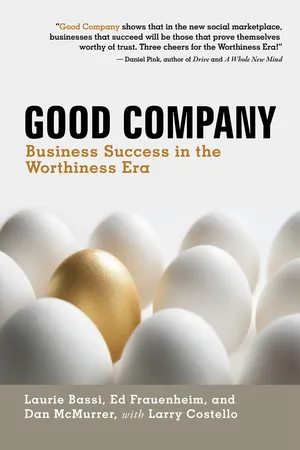
eBook - ePub
Good Company
Business Success in the Worthiness Era
- 296 pages
- English
- ePUB (mobile friendly)
- Available on iOS & Android
eBook - ePub
Good Company
Business Success in the Worthiness Era
About this book
Information
CHAPTER 1
The Worthiness Imperative
The Home Depot didn’t look bad on paper in early 2007. But online, I the home improvement giant didn’t look good. And the story of that disconnect gets at the heart of this book: we’re entering an age when goodness matters for companies like never before.
In January 2007, Home Depot ousted an unpopular, highly paid CEO, Robert Nardelli. And although Nardelli’s whopping $210 million severance package irked investors, the company signed a much more reasonable deal with his successor, Frank Blake.1 The Nardelli-Blake transition earned Home Depot positive press.2 And although Home Depot was suffering from the housing market decline, Blake announced a hopeful outlook in late February.
“The long-term fundamentals of our company are strong,” Blake said, “and we believe we can improve our performance and grow at, or faster than, the market beyond 2007.”3 He also outlined investments for better employee engagement, improved product innovation, and tidier stores.
But one month later, this corporate giant—which in 2006 had ranked 14th in the Fortune 100—was beset by the consumer equivalent of a mosquito swarm. The trouble started with an essay by personal finance columnist Scott Burns at Web site MSN Money. In the article, Burns lamented that Home Depot no longer held an intimate place in his life.
Sixteen years ago, I sent my wife a love note. It went like this:
“Carolyn: I’ve gone to Our Store. Be back soon. Love, Scott.”
We called Home Depot “our store” because we spent a lot of time there back in 1990. We’re house freaks…. But I have a confession to make. I still love my wife, but we don’t shop much at Home Depot anymore. Indeed, we generally try to avoid it and grieve for the loss.4
The reason Home Depot fell from his good graces, Burns wrote, is that the company shifted from serving customers well to abusing their time through skimpy staffing. “The result is that a once-iconic, wonderfully American store has become an aggravation rather than a blessing,” he wrote.
MSN Money invited readers to share their own experiences with the “Big Orange Box.” They did. By the thousands. Within the first week alone, some 4,700 comments were posted at the site.5 The bulk of them told withering tales of unhelpful employees and unpleasant visits.
One longtime customer echoed the loss Burns felt because of Home Depot’s decaying service. “I have been shopping at HD for 18 yrs. I used to go in and walk the aisles in the evening to relax and see new products,” the reader commented. “I now dread a trip to HD for any reason. The place is filthy and in disarray. If you need help too bad.”6
Amid all the lamenting and lambasting, Home Depot stepped into the fray—and in an unconventional way. Rather than have the firm publish a traditional press release, Frank Blake himself posted a comment directly on MSN’s discussion board. Blake said the company was taking steps to improve its service and shopping experience and apologized for the disappointment.
“There’s no way I can express how sorry I am for all of the stories you shared,” Blake wrote. “I recognize that many of you were loyal and dedicated shoppers of The Home Depot…. And we let you down.”7
The torrent of unflattering testimonials about Home Depot by everyday people and the fact that its CEO felt compelled to make a personal, direct appeal to customers speaks to a profound change under way in the business world today.
More and more, companies must be good to succeed. That is, they have to be good to their customers—as Home Depot wasn’t a few years back—as well as good stewards of communities they touch and of the broader environment. And they must be good employers. Not just generous and caring, but smart about managing people effectively and able to inspire them—something that Home Depot apparently wasn’t doing well at the outset of 2007.
In effect, people are choosing the companies in their lives in the same way they choose the guests they invite into their homes. Consumers, employees, and investors are demanding that companies be “good company.” When Home Depot went from being a trusted companion to a “consistent abuser of its customers’ time,” for example, Scott Burns kicked it out of his life. He no longer considered Home Depot to be worthy of his business.
And he let the world know about it, prompting thousands of other people to give their two cents. That they all did so through an online give-and-take gets at the reasons goodness—or worthiness—is fast becoming an imperative.
Chief among the factors pushing companies to behave better are the rise of interactive Web 2.0 technologies and a corresponding culture of participation and disclosure, whereby millions of people are publishing their experiences and opinions online. Also forcing companies in the direction of worthiness is a growing global consciousness. Heightened appreciation of human interdependency—fueled by factors like international trade, travel, and concern about global climate change—is making people care more about how companies treat workers, customers, communities, and the environment.
Now more than ever, people are interested in and able to evaluate which companies are worthy of their business as customers, their best efforts as employees, and their capital as investors. In short, people have newfound power to reward and punish corporations for their actions, and they are doing so in a rising wave of “ethical” economic behavior.
Perhaps surprisingly, the Great Recession did not diminish people’s desire to keep company with good companies. Buying sustainable products from high-road companies often costs more. But people, many of them making do on reduced income, have become more scrupulous about companies’ morals in recent years. A 2009 study of 6,000 consumers globally found that 61 percent bought a brand that supports a good cause even if it wasn’t the cheapest brand. What’s more, 64 percent said they would recommend a brand that supports a good cause, up from 52 percent only a year earlier.8
It is as if the financial crisis slapped Americans and others in the face, opening their eyes to the materialism and me-firstism that have largely guided our culture and economy over the past three decades. People are holding themselves and the companies with which they do business to a higher standard. Greed is giving way to goodness.
As a result of heightened consumer ethics and of forces with roots deeper than the recent recession, we are entering a new economic age. We call it the Worthiness Era. In it, companies face mounting pressures to prove themselves worthy of their employees, customers, and investors. In order to do so, they must combine competitive savvy with a genuine desire to do more than maximize short-term profits or enrich a narrow circle of stakeholders. And then they must back up those good intentions with actions. It’s an era based fundamentally on reciprocity. Put simply, companies must demonstrate they care about people and the planet if they are going to prosper.
In fact, the oft-heard aphorism that companies “can do well by doing good” requires an update. Companies will not be able to do well unless they do good. What has been a nice-to-have over the past decade or so is becoming a necessity.
“Companies that become catalysts for social change and respond to rising consumer expectations that they and their brands help make the world a better place will not only survive, but also thrive, in ways their competitors will not,” says Mitch Markson, president of consumer marketing at public-relations firm Edelman.9
The idea that good behavior is becoming a requirement may seem farfetched at the moment. After all, among the companies profiting during the recent downturn were financial services firms like Goldman Sachs, which bet against its own clients and whose trading practices arguably worsened the economic crisis.10 And American workers have never been more “disposable,” as a Bloomberg Businessweek cover story in early 2010 put it.11 Many workers have had little choice but to settle for precarious or part-time jobs amid high unemployment, greater use of temporary labor, and continued offshoring.
Forces like these can slow the drive to better behavior. But even in a more free-agent economy, with work defined by contingent, impermanent arrangements, the world is changing in ways that ensure that worthy companies eventually will prevail. Whether they use employees or contractors to accomplish their mission, firms increasingly will have to respect, care for, and inspire workers. Failure to do so will translate into poor productivity, poor products, and a poor reputation in the eyes of workers, consumers, and investors.
Exactly how a company puts worthiness into effect will depend on its particular industry, workforce, and abilities. But it won’t be enough to have piecemeal corporate social responsibility programs. Nor will greenwashing—the all-too-common practice of cloaking less-than-good environmental stewardship with eco-marketing—fool a public ever-more savvy about what true sustainability looks like. Increasingly, organizations will be judged on how thoroughly worthy they are.
Not many corporations receive a top grade on that test right now. We developed a measurement of worthiness based on multiple criteria associated with customer care, people management, and stewardship, which we call the Good Company Index. Our research shows that just two Fortune 100 firms—shipping titan FedEx and entertainment giant Disney—earned an A, thereby meeting our definition of a Good Company. Plenty of the largest companies are laggards, with grades of D or F.
If we are right about the dawning of a new era, such less-than-fully commendable companies may still be able to survive in the years ahead. But unless they shift to a course of real reciprocity with their stakeholders, they will not flourish. As Home Depot discovered in 2007, the business world is changing. Changing for good.
The Telltale Signs
Among the telltale signs that worthiness is becoming an imperative:
• In early 2011, the “trust barometer” study by public-relations firm Edelman found that only 46 percent of U.S. respondents trust business to do what is right.12
• Despite the recession, sales of “ethical” consumer products have been growing rapidly. The U.S. market for items marketed as green, natural, organic, humane, or the result of fair trade has grown annually in the high single- to low double-digits over a recent five-year period, to a projected $38 billion in 2009.13
• In 2010, nearly three out of four Americans said they are more likely to give their business to a company that has fair prices and supports a good cause than to a company that provides deep discounts but does not contribute to good causes.14
• A 2010 study found that 64 percent of global consumers believe it is no longer enough for corporations to give money; they must integrate good causes into their everyday business. The report also found that 72 percent expect corporations to take actions to preserve and sustain the environment.15
• Consumers in emerging markets—projected to be increasingly important customers for many of the worlds’ biggest companies—are more willing than their developed-world counterparts to pay a premium for technology products marked as environmentally friendly. On average, 84 percent of consumers in China, India, Malaysia, and Singapore say they would accept a higher price for a green product, compared with 50 percent in the United States, Japan, France, and Germany.16
• Globally, 56 percent of people want a job that allows them to give back to society versus 44 percent who value personal achievement more.17
• As we emerge from the Great Recession, Americans’ job satisfaction has fallen to a record low. Just 45 percent of Americans were satisfied with their jobs in 2009.18 Dissatisfaction with employers extends to the executive suites. A 2010 study of senior executives worldwide found 41 percent to be dissatisfied in their current positions, and 70 percent to be looking for new career opportunities.19
• Investors are starting to vote with their dollars for sustainable companies. The value of assets linked to the Dow Jones Sustainability Indexes—which list the most sustainable large public companies in the world—has grown from ...
Table of contents
- Cover Page
- Title Page
- Copyright Page
- Dedication Page
- Contents
- Preface
- Part I • The Worthiness Era
- Part II • Evidence and Rankings
- Part III Good Employer, Good Seller, Good Steward
- Part IV • The Future
- Appendix. Good Company Index: Scoring and Sources
- Selected Works for Further Reading
- Acknowledgments
- Notes
- Index
- About the Authors
Trusted by 375,005 students
Access to over 1.5 million titles for a fair monthly price.
Study more efficiently using our study tools.
Frequently asked questions
Yes, you can cancel anytime from the Subscription tab in your account settings on the Perlego website. Your subscription will stay active until the end of your current billing period. Learn how to cancel your subscription
No, books cannot be downloaded as external files, such as PDFs, for use outside of Perlego. However, you can download books within the Perlego app for offline reading on mobile or tablet. Learn how to download books offline
Perlego offers two plans: Essential and Complete
- Essential is ideal for learners and professionals who enjoy exploring a wide range of subjects. Access the Essential Library with 800,000+ trusted titles and best-sellers across business, personal growth, and the humanities. Includes unlimited reading time and Standard Read Aloud voice.
- Complete: Perfect for advanced learners and researchers needing full, unrestricted access. Unlock 1.5M+ books across hundreds of subjects, including academic and specialized titles. The Complete Plan also includes advanced features like Premium Read Aloud and Research Assistant.
We are an online textbook subscription service, where you can get access to an entire online library for less than the price of a single book per month. With over 1.5 million books across 990+ topics, we’ve got you covered! Learn about our mission
Look out for the read-aloud symbol on your next book to see if you can listen to it. The read-aloud tool reads text aloud for you, highlighting the text as it is being read. You can pause it, speed it up and slow it down. Learn more about Read Aloud
Yes! You can use the Perlego app on both iOS and Android devices to read anytime, anywhere — even offline. Perfect for commutes or when you’re on the go.
Please note we cannot support devices running on iOS 13 and Android 7 or earlier. Learn more about using the app
Please note we cannot support devices running on iOS 13 and Android 7 or earlier. Learn more about using the app
Yes, you can access Good Company by Laurie Bassi,Ed Frauenheim,Dan McMurrer,Larry Costello in PDF and/or ePUB format, as well as other popular books in Economics & Business General. We have over 1.5 million books available in our catalogue for you to explore.