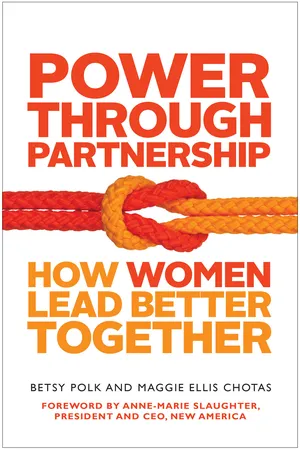
WINNER OF THE 2015 SILVER MEDAL IPPY AWARD IN BUSINESS/CAREER/SALES. Betsy Polk and Maggie Chotas have learned something powerful: when women work together they discover a level of support, flexibility, confidence, accountability, and freedom to be themselves that they rarely find in other work relationships. Drawing on their own twelve-year partnership and from interviews with 125 women business partners, Polk and Chotas demolish the myths that keep women from collaborating and offer advice for handling a host of potential challenges. This groundbreaking book shows that when women team up—combining complementary skills, channeling their egos into the partnership, and encouraging each other—they can work as full equals to achieve something that's exponentially greater than each woman alone.
- 168 pages
- English
- ePUB (mobile friendly)
- Available on iOS & Android
eBook - ePub
About this book
Information
Chapter 1
Why Partnership Works for Women
The story behind our trust in the power of partnership begins with two frizzy-haired high school sophomores who met in English class and united over a class project, a Saturday Night Live take on Ray Bradbury’s The Martian Chronicles, set to the music of the B-52s. We received an A. The external validation was nice, but best of all, we had a lot of fun bouncing ideas off each other, writing and rewriting, and spending hours thinking creatively together. After high school, we promised ourselves that someday we’d work together for real.
We held on to the idea of partnering even while our professional lives took different paths—Betsy as a consultant working with a range of institutions to bolster communication and collaboration, and Maggie as a teacher and school administrator. In 2002, when we found ourselves living in the same North Carolina area code, experiencing similar career transitions and with three young children between us, we started getting serious. What would it look like for us to lead together? How could we combine Betsy’s background in organization development consulting with Maggie’s experience in education? Marathon phone calls and long talks while pushing kids in strollers resulted in The Mulberry Partners, our education-focused practice for organization development, coaching, and consulting.
We were not surprised to realize, early on, that this entrepreneurial partnership suited us. Having a business, an actual entity, made us accountable to each other in ways we would have found difficult to justify otherwise. Back then, as the mothers of young children, we found it difficult to carve out time for ourselves without feeling guilty. But scheduling time together for a professional endeavour elevated this time from me-time to sanctioned time focused on reaching goals. Through this sense of shared responsibility grew a credibility that fueled our confidence, which enhanced our business, attracting clients and leading to growth.
A few years after we founded Mulberry, in the middle of our weekly meeting, huddled over laptops at one of our favorite coffee shops, it suddenly struck us that we were happy with our work, our leadership, and our lives. We were doing what by then was second nature—building on ideas, communicating in our partnership shorthand, respecting each other’s expertise, and trusting that the outcomes of our meeting would reflect a united front.
We surveyed the crowd of mostly women surrounding us in the café, comparing our lot with theirs. A lively group of moms seemed as busy as we were, but their focus was distracted as they tried to converse while keeping small children entertained. Lined up at the coffee bar were some business-suited women handling calls while ordering espresso for their morning commutes.
Were these women as satisfied as we were? We hoped so. But as coaches who work with a wide range of people, we were beginning to see that ours was a rare reality. So many of the women we knew—whether they were solo entrepreneurs, corporate employees, or stay-at-home moms—were struggling to opt out, opt back in, or just stay afloat. They were often plagued by doubt and insecurity as they strived for something more.
And there we were, marching to our own beat, with someone by our side who had as much skin in the game. We had expanded a twenty-year friendship into a business that helped schools, nonprofit organizations, and corporations to develop collaborative cultures. We were bringing forth the best of ourselves without second-guessing the value of our contribution. We were engaged in work we enjoyed, reaching goals based on our own values that we were equally and fully vested in. We trusted ourselves and each other to fulfill a shared vision. Our work was successful. Our lives—filled with spouses, children, and activity—were sane. We were leading the way we wanted to, on our own clocks, in cafés, at client sites, in our home offices, and even on trails, where we held long “strategy talks” as we walked. Thanks to our work together, we were two women who understood where the other was coming from, and we were happy.
Overload: A Female Conundrum
Consider the women you know. How many are struggling to squeeze even more into already packed lives? How many are saying yes too often and no all too rarely? How many are trying to convince themselves that perfection is just beyond the horizon, that all they have to do is work harder, sleep less, push more, smile wider, be tougher, and maybe they will get there, somehow, someday. These women—we’ve certainly been among them—are striving to be superwomen, summoning all their energy to reach a mirage of perfection, trying to scale mountains of exalted expectations (their own and those of others) as they struggle to lean in deeper and deeper.
When we suggest partnership as a practical solution to these women, their eyes light up as they imagine this professional relationship with someone who is just as focused on achieving similar goals and is equally committed to sharing responsibilities. But then a shadow of doubt crosses their faces as they remind themselves of all the reasons partnership just can’t work. Their explanations run the gamut: the fear of trusting someone else; anxiety about conflict; and worry about not having enough time, smarts, skills, money, and/or talent to contribute to a fifty-fifty collaboration. Perhaps they can see the ultimate value of partnership, but the time and energy the investment requires and the penalty if it doesn’t work out seem to make the risks too huge to take the chance.
But what if these undecided women could see many high-visibility female role models demonstrating that through collaboration they are leading more capably without running themselves ragged? Perhaps then they could see that those advantages of partnering that seemed too good to be true are indeed real and well within reach.
What if women saw the possibility of partnership as a logical, radical way of working? It is logical because collaboration makes sense, builds on strengths, and provides a way for women to operate in a world that continues to be gender inequitable. And it is radical because as much sense as partnership makes for women, especially now, as women struggle to succeed in this inequitable world, the path to partnership has been obscured by myths, misconceptions, and negative messages, turning what should be a logical decision to team up with an ally into an off-the-beaten-path alternative.
Until now, anyway. Instead of partnership remaining a glimmer in the eye of an overworked superwoman that is too easily wiped away as an impossible dream, we want it to be an accessible, equitable choice for women as they make decisions about their work lives.
The Benefits of Partnership
We want to change the world, transforming the ways in which women work by spreading the message about the tremendous benefits that can be realized in healthy female partnerships, such as flexibility, confidence, freedom, support, mutual accountability—and happiness.
Flexibility
Flexibility is a major partnership asset that provides the space and trust for one partner to step forward as the other leans back. Then, with barely a flutter, there’s room for the roles to shift. Whether it’s balancing a job share, adjusting dynamics in a client meeting, or filling in for each other when a sick child is at home, women in partnership know how to step up or step back depending on what is needed in the moment.
Kirsten “Kiwi” Smith, half of the screenwriting duo behind such blockbuster movies as Legally Blonde, shared a story that demonstrates this partnership balancing act. Kiwi and partner Karen McCullah Lutz were pitching their script for a movie for the sixth time to Hollywood executives, and things were not going well. As Kiwi tells it, “I kept pushing Karen to do these meetings and she didn’t want to anymore, so this time it was up to me. I pitched my heart out, and the producer said it was the worst thing he’d ever heard. While I was lying on the floor practically crying, Karen picked up the pitch and kept it going. It’s a good thing she did. They said yes.” The result of Kiwi and Karen’s flexible persistence was the movie The Ugly Truth.
But imagine that it was just Kiwi in the story. She might still have been on the floor crying while the executives stepped over her to go for lunch. If it was just Karen, she would have given up the pitch after the third try. Later in our interview, Kiwi remarked, “The male screenwriters I’ve worked with tend to just focus on getting the job done. For women, the relationship lines tend to zigzag between personal and professional, and back again.” It’s those zigzagging lines that make women’s collaborations more than just business arrangements, giving them texture, complexity, and meaning.
Unfortunately, the lines of the traditional work world often don’t allow the same sort of zigzagging. Most workplaces are set up around the idea of the ideal worker: someone who is available to give his heart, soul, and life to the company. As Brigid Schulte describes in her bestseller Overwhelmed: Love, Work, and Play When No One Has the Time:
The ideal worker doesn’t take parental leave when a child is born. He doesn’t need a place or time to pump breast milk. He has no need of family-friendly policies like flexible scheduling, part-time work, or telecommuting. The ideal worker doesn’t have to find babysitters, deal with school closures on snow days, or otherwise worry about child-care responsibilities.… The ideal worker never has to think about researching good assisted-care facilities for Mom or Dad as they get older, whether they’re getting the best treatment in ICU, or how to get his sister to her next chemotherapy appointment. It’s simply not his job.7
Schulte concludes that the ideal worker is “so tied to his job that he works endless hours, even if it costs him his health and his family.” Though this is a bit exaggerated, there are plenty of work environments where this stranglehold is the reality. A mere mention of the idea of flexibility in one of these places could cause you to be treated as if you were yelling out a bomb threat, and you could be whisked away into a secure location. Sounds far-fetched, right? Sadly, it’s not. While in graduate school, Maggie interviewed for a job. She was in the middle of an office tour when the woman who was interviewing her began describing the benefits of the position. “What about the four-day-a-week option we discussed earlier?” Maggie asked. The interviewer glanced furtively at the cubicles surrounding them and whispered, “This isn’t something to be talked about out here.” Maggie was quickly escorted into a private office to discuss what turned out to be a hush-hush topic.
Often flexibility is brought up in relationship to child-rearing, but interviews with partners show that isn’t just parents who want or need it. When the father of Summer Bricknell of LocoPops Gourmet Popsicles, a chain of Mexican-style popsicles, was bedridden, Summer was able to be with him and support her mother, thanks to her partnership with Connie Semans. As Summer told us, “Without a partner, it would be much harder for me to take time away from the business. Loco-Pops would go by the wayside and I would be on to the next big thing.” Instead, she was able to take time away, knowing the business would be in good hands with Connie at the helm.
While flexibility is a benefit of any type of partnership, regardless of gender, the reality is that women still do the majority of the caregiving in families, from child to elder care. According to the National Alliance for Caregiving and AARP, an estimated 66 percent of informal caregivers are female.8 Without flexible work options, women typically end up spending twelve more years out of the workforce compared with men.9 The truth is that women need the kind of flexibility partnership can provide in order to stay engaged in the workforce for the long haul. This doesn’t necessarily mean they will work less, but it often means that they will adapt and do what’s needed to get it all done, achieving results on multiple fronts.
Cali Ressler and Jody Thompson share a passion for promoting the kinds of results-oriented workplaces that engage today’s leaders—both women and men. What started at Best Buy as an innovative human resources project became ROWE, Results-Only Work Environment, the independent company Cali and Jody founded to focus on helping work-places such as the White House become focused on results. Who better than two women partners to make the case for how the way flexibility can transform the world of work?
Confidence
We can say from our perspective as coaches that no matter how smart, how together, how polished a woman might seem, chances are that some seeds of self-doubt lurk right below the surface. This theory was reinforced when we started working with a coaching client who struck us as the epitome of competence in her role as head of a successful independent school. When she called for our help, we were delighted by the opportunity to work with such an esteemed, beloved leader. Yet when we met with her, the strong exterior was quickly cast aside, revealing a muddle of misgivings about decisions she had made and communications she had delivered.
Most people, women as well as men, face moments when they question and critique the person in the mirror, but what surprised us in this case and in so many others is how little it takes for a woman, compared with a man, to doubt her abilities. Of course, men suffer from their fair share of moments of doubt. But for women, who are operating on inequitable playing fields and often under immense expectations for perfection in all aspects of complex lives, normal human feelings of insecurity can turn into suffocating self-doubts. This way of thinking is so prevalent for women that in 1978, Pauline Clance and Suzanne Imes identified the “imposter syndrome”10 to describe the sense of phoniness successful women can feel when they achieve.
Although the imposter syndrome was first studied in the 1970s, the nagging effect of lack of confidence in high-achieving women continues to be a hot topic today. In The Confidence Code: The Science and Art of Self-Assurance: What Women Should Know, Katty Kay and Claire Shipman explain, “For years, women have kept our heads down and played by the rules. We have made undeniable progress. Yet we still haven’t reached the heights we know we are capable of scaling.”11 This lack of confidence has a profound effect on many women’s sense of self and feelings of efficacy. Without the confidence to ask for what they want and sureness in their ideas, according to Shipman and Kay, it’s rare for women to get into the upper echelons of leadership. And the few women who do reach that level often doubt that they deserve to be there.
The partnership dynamic plays a powerful role in developing confidence. The process starts with deciding to partner. When you say yes to combining your skills with those of a respected peer, you need to first acknowledge that you’re bringing valuable skills and perspectives to the partnership: after all, your partner is choosing you for good reasons. And, while you may sometimes experience the imposter syndrome yourself, chances are you have faith in the credibility of your partner: a woman may cut herself down, but rarely will she transfer that insecurity to her close colleague. Through the very act of partnering, women learn to assume confidence in themselves because their professional identity is closely tied to that of their partner’s.
As we were writing this book, we considered the influence of our own partnership and realized we had both experienced a boost in self-esteem from sharing each other’s confidence. Whenever we’ve faced a task that seemed challenging, all we had to do was remind ourselves that together we were sure to figure it out. Knowing that we could count on drawing from a deeper well of confidence turned what could have been anxiety into we-can-do-it enthusiasm and success.
Freedom
We live in a world where “brusque” is code for another B-word used to describe a woman in leadership whose power intimidates others, whereas for men such assertive behavior is a perk of leadership and is often expected. Similarly, although showing emotion is often considered a feminine weakness, it can be perceived as a male strength. Jon Stewart deftly handled this gender double standard in a segment of The Daily Show entitled “The Broads Must Be Crazy.” Stewart juxtaposed a picture of a misty-eyed Hillary Clinton with photos of male politicians breaking down in tears. Whereas the media’s response to Clinton included comments deriding her for “letting her emotions fall out of her” and “having mood swings,” the teary-eyed males received praise from reporters for being “passionate” and “honest.” The comparisons led Stewart to proclaim, with his typical acerbic wit, “It’s OK to be a pussy, as long as you have a dick.”12
In sharp contrast to the entrenched double standards that plague our society, women in partnership have access to the freedom that comes from working with someone who gets it because she has been operating on the same playing field, under the same unspoken rules and societal expectations. This shared understanding can make it easier for a woman to bring her entire self to work, knowing that in the company of a female peer there’s no need to modify, adjust, or apologize for who she really is. Partnership is one of the few professional spheres (perhaps the only one) in which women can comfortably be themselves—brusque, emotional, or otherwise—in contrast to more structured, mixed-gender environments, where women might not feel so at ease.
Kendall Allen, who, with Elizabeth Bleser, led a business unit for Incognito Digital, an online marketing firm, described her appreciation of this freedom, “It’s really, really nice to have a female partner to discuss male-female dynamics that are sometimes power, som...
Table of contents
- Cover Page
- Title Page
- Copyright Page
- Dedication
- Contents
- Foreword
- Introduction Out from Under the Radar
- Chapter 1 Why Partnership Works for Women
- Chapter 2 What Does Being a Woman Have to Do with It?
- Chapter 3 Debunking the Myths
- Chapter 4 Searching for Partners
- Chapter 5 Preparing for Risks
- Chapter 6 Leveraging Conflict
- Chapter 7 The Rubber Band Theory Moving Forward
- Notes
- Acknowledgments
- Contributing Partners
- About the Authors
- About The Mulberry Partners
- Index
Trusted by 375,005 students
Access to over 1.5 million titles for a fair monthly price.
Study more efficiently using our study tools.
Frequently asked questions
Yes, you can cancel anytime from the Subscription tab in your account settings on the Perlego website. Your subscription will stay active until the end of your current billing period. Learn how to cancel your subscription
No, books cannot be downloaded as external files, such as PDFs, for use outside of Perlego. However, you can download books within the Perlego app for offline reading on mobile or tablet. Learn how to download books offline
Perlego offers two plans: Essential and Complete
- Essential is ideal for learners and professionals who enjoy exploring a wide range of subjects. Access the Essential Library with 800,000+ trusted titles and best-sellers across business, personal growth, and the humanities. Includes unlimited reading time and Standard Read Aloud voice.
- Complete: Perfect for advanced learners and researchers needing full, unrestricted access. Unlock 1.5M+ books across hundreds of subjects, including academic and specialized titles. The Complete Plan also includes advanced features like Premium Read Aloud and Research Assistant.
We are an online textbook subscription service, where you can get access to an entire online library for less than the price of a single book per month. With over 1.5 million books across 990+ topics, we’ve got you covered! Learn about our mission
Look out for the read-aloud symbol on your next book to see if you can listen to it. The read-aloud tool reads text aloud for you, highlighting the text as it is being read. You can pause it, speed it up and slow it down. Learn more about Read Aloud
Yes! You can use the Perlego app on both iOS and Android devices to read anytime, anywhere — even offline. Perfect for commutes or when you’re on the go.
Please note we cannot support devices running on iOS 13 and Android 7 or earlier. Learn more about using the app
Please note we cannot support devices running on iOS 13 and Android 7 or earlier. Learn more about using the app
Yes, you can access Power Through Partnership by Betsy Polk,Maggie Ellis Chotas in PDF and/or ePUB format, as well as other popular books in Betriebswirtschaft & Unternehmertum. We have over 1.5 million books available in our catalogue for you to explore.