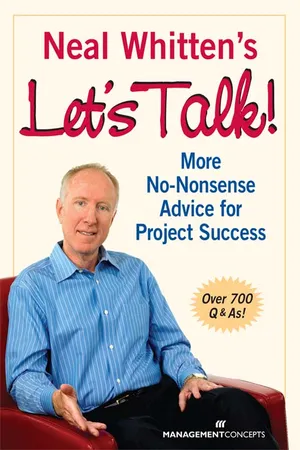
Neal Whitten's Let's Talk! More No-Nonsense Advice for Project Success focuses on best project behaviors, by answering more than 700 insightful, personal, and sometimes sensitive questions on a broad range of topics from leadership, communication, and culture, to accountability, ethics, and conflict resolution. Following on the heels of Neal Whitten's No-Nonsense Advice for Successful Projects, this book offers more of the no-nonsense advice that has helped countless leaders and projects. This book is for those who aspire to become consistently effective leaders, project members, or employees and therefore become more valuable to their projects and organizations.
- 376 pages
- English
- ePUB (mobile friendly)
- Available on iOS & Android
eBook - ePub
Neal Whitten's Let's Talk! More No-Nonsense Advice for Project Success
About this book
Information
PART ONE
Project Stakeholders
Part One has eight chapters—one chapter for each of eight key groups of project stakeholders. These groups were chosen because of their universality across most projects and because I routinely field many questions about them. A sampling of the issues addressed in each chapter is listed below.
CHAPTER 1: THE PROJECT MANAGER
Taking on too many “monkeys”; understanding scope of accountability; behaving as an “absolute” dictator; working with insufficiently skilled project members; dealing with competing projects; developing project members; being both a project manager and a resource manager; dealing with difficult resource managers; taking on an excessive workload; and taking on a troubled project.
CHAPTER 2: THE BOSS/RESOURCE MANAGER
Focusing on employee strengths versus weaknesses; dumping employees on project managers; assigning jobs to employees; making commitments for employees; accountability for commitments made by employees; managing commitments based on priority; determining the closeness of your relationship with employees; dealing with poorly performing employees; frequency of performance evaluations; coaching, counseling, and tracking employees; your role in downsizing employees; employees tooting their own horns; and employees seeking help from their bosses.
CHAPTER 3: THE PROJECT SPONSOR
Finding a project sponsor; defining the relationship between the project manager and the project sponsor; disagreeing with the project sponsor; involvement of the project sponsor with the project; and what to do if a client/project sponsor relationship is disruptive to the project manager.
CHAPTER 4: THE BUSINESS ANALYST
Ensuring an effective requirements document; understanding the client’s business-related processes; meeting minimum requirements; producing results that conform to requirements; the power of the business analyst; creating a healthy contentious environment; disagreeing with the project manager; fostering a good relationship with the project manager; and being the client’s advocate.
CHAPTER 5: THE PROJECT ANALYST
Enabling the project manager to be more effective; providing primary interface to project management tools; assisting in the preparation of project plans; constructing an overall project plan; role in project tracking meetings; expanding the project manager’s reach; and backing up the project manager.
CHAPTER 6: THE CLIENT
Client not providing enough dedicated people; working with internal versus external clients; confiding in client about company-sensitive information; saying “no” to a client; honoring a client’s request that undermines a project’s outcome; what to do if the client is displeased with the project manager’s performance; and whether the client must always come first.
CHAPTER 7: CONTRACTORS
Hiring contractors in lead positions; contractor as the project manager or resource manager; treatment of contractors; begrudging contractors; uncooperative contractors; and cost-effectiveness of contractors.
CHAPTER 8: VENDORS
The project manager’s accountability over the vendor’s performance; low vendor quality; resolving disagreements with a vendor; what to do if a vendor removes project-critical personnel; overseeing vendor performance; and the criticality of the project manager’s leadership.
CHAPTER 1
The Project Manager
“Shallow men believe in luck.
Strong men believe in cause and effect.”
Strong men believe in cause and effect.”
—Ralph Waldo Emerson, American author, poet, and philosopher
| Q1.1 | Can you briefly describe the project manager’s job? |
| A1.1 | The project manager (PM) directs the planning and execution of a project and is held personally accountable for the success of the project. The PM is a nurturer of projects. |
| Q1.2 | What are the primary duties of a project manager? |
| A1.2 | The project manager:
This list of the project manager’s most significant duties is taken from Neal Whitten’s No-Nonsense Advice for Successful Projects, Chapter 14, “Duties of the Effective Project Manager.” |
| Q1.3 | As a project manager, I feel that I probably take on too many tasks that members of my team should be assigned. Any advice on how to deal with this? |
| A1.3 | As a general rule, the project member who has the dependency should be assigned the action item. However, if the problem affects more than one project member, then the project manager should strive to find someone to own and lead the effort and effectively work it to closure. There may be times (albeit infrequently) when it is okay for the PM to take on such a “monkey”—for example, if the problem is urgent, the project member is clearly overloaded, or the PM is the right person to deal with the issue because of his skills, position of influence and power, or availability. |
| Q1.4 | Why do you say “albeit infrequently” when referring to moments in which a project manager should take on a “monkey”? Wouldn’t you agree that it is noble for the project manager to take on some of the work of project members so that they are free to perform other work? |
| A1.4 | No, not in most cases. By doing project members’ work for them, you may inadvertently deny them a chance to learn and practice commitment, accountability, and leadership skills. But the biggest downside is that you, as the PM, can become the major critical path on the project. A project plan shows one critical path, the one that is typically referred to, but there can be another critical path that can do greater harm to the execution of a project plan. That critical path is the availability of the PM to help discover potential problems and fix them. A PM who is busy doing others’ work cannot perform his or her own duties, which include tracking progress, seeking out potential problems, and being available to help remove or mitigate obstacles for others. The most effective project managers remain relatively available to help other stakeholders be successful within their own domains of responsibility. |
| Q1.5 | Can you give an example of a project manager taking on too much work, becoming a project’s critical path, and, therefore, not being available to perform many of his duties? |
| A1.5 | I was asked to mentor a project manager I’ll call Vihar for a day. I observed his behavior in meetings and working with others one on one. His project had about a dozen core members. I began the day by watching Vihar run his weekly project tracking meeting. After the meeting, I told him that I counted 50 open action items, 40 of which were assigned to him. I said that it is unusual for a PM to own so many action items; doing so puts the PM at risk of becoming the critical path on the project. I asked why he owned so many action items. By the end of the day, I understood why. Vihar was easily intimidated, and many project members resisted taking on new action items, even though those action items were in their domains of responsibility. When project members refused to take ownership of action items, he took them on himself. Vihar’s behavior limited his availability to manage across the project, which severely handicapped his effectiveness. As stated earlier, the PM should avoid becoming the project’s critical path, but instead should be available to “grease the skids” and help other project member... |
Table of contents
- Cover Page
- Title Page
- Copyright
- About the Author
- Dedication
- Table of Contents
- Preface
- Acknowledgments
- Introduction
- Part One: Project Stakeholders
- Part Two: The People Side
- Part Three: The Project Side
- Part Four: Introducing These Topics and Discussions in Your Organization
- Part Five: Closing Thoughts
- Index
Trusted by 375,005 students
Access to over 1.5 million titles for a fair monthly price.
Study more efficiently using our study tools.
Frequently asked questions
Yes, you can cancel anytime from the Subscription tab in your account settings on the Perlego website. Your subscription will stay active until the end of your current billing period. Learn how to cancel your subscription
No, books cannot be downloaded as external files, such as PDFs, for use outside of Perlego. However, you can download books within the Perlego app for offline reading on mobile or tablet. Learn how to download books offline
Perlego offers two plans: Essential and Complete
- Essential is ideal for learners and professionals who enjoy exploring a wide range of subjects. Access the Essential Library with 800,000+ trusted titles and best-sellers across business, personal growth, and the humanities. Includes unlimited reading time and Standard Read Aloud voice.
- Complete: Perfect for advanced learners and researchers needing full, unrestricted access. Unlock 1.5M+ books across hundreds of subjects, including academic and specialized titles. The Complete Plan also includes advanced features like Premium Read Aloud and Research Assistant.
We are an online textbook subscription service, where you can get access to an entire online library for less than the price of a single book per month. With over 1.5 million books across 990+ topics, we’ve got you covered! Learn about our mission
Look out for the read-aloud symbol on your next book to see if you can listen to it. The read-aloud tool reads text aloud for you, highlighting the text as it is being read. You can pause it, speed it up and slow it down. Learn more about Read Aloud
Yes! You can use the Perlego app on both iOS and Android devices to read anytime, anywhere — even offline. Perfect for commutes or when you’re on the go.
Please note we cannot support devices running on iOS 13 and Android 7 or earlier. Learn more about using the app
Please note we cannot support devices running on iOS 13 and Android 7 or earlier. Learn more about using the app
Yes, you can access Neal Whitten's Let's Talk! More No-Nonsense Advice for Project Success by Neal Whitten PMP in PDF and/or ePUB format, as well as other popular books in Business & History of Renaissance Art. We have over 1.5 million books available in our catalogue for you to explore.