All politics are climate politics in the twenty-first century - and this bold book argues for a Green New Deal that confronts both climate change and inequality
The age of climate gradualism is over, as unprecedented disasters are exacerbated by inequalities of race and class. We need profound, radical change. A Green New Deal can tackle the climate emergency and rampant inequality at the same time. Cutting carbon emissions while winning immediate gains for the many is the only way to build a movement strong enough to defeat big oil, big business, and the super-rich - starting right now.
A Planet to Win explores the political potential and concrete first steps of a Green New Deal. It calls for dismantling the fossil fuel industry and building beautiful landscapes of renewable energy, guaranteeing climate-friendly work and no-carbon housing and free public transit. And it shows how a Green New Deal in the United States can strengthen climate justice movements worldwide. We don't make politics under conditions of our own choosing, and no one would choose this crisis. But crises also present opportunities. We stand on the brink of disaster - but also at the cusp of wondrous, transformative change.
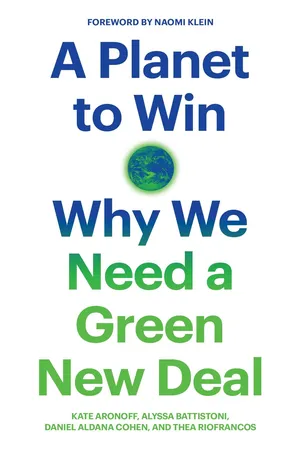
eBook - ePub
A Planet to Win
Why We Need a Green New Deal
- 208 pages
- English
- ePUB (mobile friendly)
- Available on iOS & Android
eBook - ePub
A Planet to Win
Why We Need a Green New Deal
About this book
Information
1
BURY THE FOSSILS
Aluminum has a melting point of 1,220° Fahrenheit. If you aren’t a welder or a chemist, there’s no practical reason to know this. From beer kegs to the foil we wrap our leftovers in, aluminum is ubiquitous. But it’s one of the less charismatic elements on the periodic table, not a show-off like neon or cobalt or a celebrity like carbon.
More carbon in the atmosphere has helped make ten of the last fifteen years the hottest on record. Fourteen of the largest twenty wildfires in California history have occurred over the same period: less rain and higher temperatures create petri dishes for wildfires to spark. Climate change increases the variability in rain and temperature, and a wet winter one year can sprout vegetation that becomes kindling during a dry season the next. The Camp Fire, which leveled the town of Paradise, killed eighty-six people after sparks from a poorly maintained transmission line owned by mammoth California power provider PG&E met the surrounding brush.
Those trying to escape flames were surprised as their cars’ aluminum rims turned molten, splaying out onto the overheated pavement. Drivers who managed to flee on foot found that their shoes melted to the road as they ran. Rubber melts at 356° Fahrenheit. Many didn’t make it out. Flames burned so hot, one local official in Alameda County told the New York Times, that there was no DNA left on human remains; emergency response officials and cadaver dogs sorting through the ruins often found only unidentifiable bone fragments. “People have been cremated, for lack of a better term,” he said.1
Breaking the Chain
It’s rare to be able to name who caused climate impacts with confidence. We can’t blame any given weather event on a coal or oil company any more than we can pin a particular lung cancer death on a particular cigarette company, however often the deceased lit up Marlboro Reds. Yet just ninety greenhouse-gas-producing companies—almost all privately held or state-owned fossil fuel producers—have been responsible for two-thirds of planet-warming emissions since the dawn of the industrial age; half of those were released in the last thirty years.2 As state investigators in California found, a private utility squeezing out extra profits by neglecting maintenance of its power lines is responsible for the sparks igniting them. From extraction to delivery to lobbying, the fossil fuel industry and private utilities work hand-in-hand as the masters of an energy system dominated by shareholders and driven by all the wrong priorities.
To keep warming below 2° Celsius, about four-fifths of known fossil fuel reserves must not be dug up and burned. And yet companies’ valuation is premised on the expectation that everything they own will be sold and combusted. The fossil fuel industry’s business model, and hence their executives’ prerogative, is to grow their reserves and burn every last drop. The industry’s ongoing existence is thus incompatible with the future of anything we might recognize as human civilization. The Green New Deal should dismantle our profit-driven energy system just as aggressively as it constructs a clean energy alternative. It’s the only way to stop the carbon pollution that’s driving the climate emergency and to crush the companies erecting the greatest political obstacles to decarbonizing.
It’s easy to forget how simple this problem is when we navigate our own little energy landscapes. We can flick a switch without much thought for the long-dead creatures compacted into coal, oil, and gas, their unrecognizable carcasses exhumed by fossil fuel companies and shipped around the world to be incinerated, unleashing heat-trapping greenhouse gasses into the atmosphere and threatening millions now living. Left unchecked, the death toll of climate change could easily creep up into the hundreds of millions—or billions in the worst case scenarios—unleashing chaos and suffering on an unprecedented scale, all to pad a few corporate bottom lines.3
Yet for as long as it’s been in the public consciousness, climate change has masqueraded, like other environmental problems, as a fight without enemies—as the old Pogo cartoon mourns, with the titular character staring out at a field of litter, “We have met the enemy and he is us.”
Demand shapes supply, so we’re all a tiny bit complicit in fossil fuels’ toxic excavation. These companies and their products are ubiquitous. That we all use them has been a powerful defense for the companies profiting from them: energy executives spare no expense painting shareholder and public interest as one in the same. “Very few aspects of modern life aren’t touched in some way by natural gas and oil,” a shiny ad campaign from the American Petroleum Institute argues. “Thousands of products made from natural gas and oil make life healthier, safer, more comfortable and more enjoyable … They support creativity, help us manage our environment and think beyond ourselves.”4
The strategy has worked, shifting focus away from the obvious: the first step to preventing catastrophic climate breakdown is to keep the fossil fuels that cause it in the ground, as Indigenous-led fights against projects like the Dakota Access and Keystone XL pipelines have argued.
Potentially trillions of dollars’ worth of fossil fuel profits—stranded coal, oil, and gas assets—will have to go unrealized. The industry’s legendary profitability is far more fragile than it looks. The moment world powers make credible commitments to slash carbon emissions, the stock value of oil will crash, likely precipitating a global economic crisis if we don’t plan for it. We have met the enemy and he is a few hundred fabulously wealthy executives.
The inflated value of these companies is premised on a promise to kill. Prioritizing the lives of billions means seizing public control of the energy economy and assuring a just transition that improves people’s lives, with a special focus on assisting fossil industry workers and the frontline communities that have been hardest hit by extraction. For ethical and practical reasons, a just transition also requires naming and shaming our enemies, focusing the climate movement’s rage where it belongs: on fossil fuel CEOs and private utility executives.
The debate over California’s wildfires represents a break with usually diffuse chains of responsibility. PG&E, the utility that skimped on maintenance to fatten shareholder dividends, didn’t cause every single one of the recent fires, but state investigators have found that they caused a lot of them. “There’s a clear-cut pattern here: that PG&E is starting these fires,” US District Judge William Alsup told company lawyers at a hearing early in 2019, drawing on the state’s inverse condemnation laws. “Does the judge just turn a blind eye and say, ‘PG&E, continue business as usual, continue to kill people’?”5
PG&E doesn’t extract fossil fuels itself. But what made it responsible for so many wildfires is what makes companies like ExxonMobil responsible for the climate crisis: neglecting the public good with reckless energy operations for the sake of profit. During the Camp Fire, the utility declined to shut off power lines despite encroaching flames. In the years prior, it diverted $100 million from its safety and operations budget into executive bonuses and investor payouts, and spent $5 billion on shareholder dividends while delaying infrastructure upgrades that it knew were desperately needed. The same logic applies to fossil fuel producers. When shareholders’ interests are the priority, then investing in new drilling and stock buybacks that offer the quickest buck isn’t just more profitable for them than doubling down on renewables—it’s a mission handed down from on high. Left unchallenged, it will result in catastrophe.
Dismal Science
By 2050, projected new oil and gas development in the United States—barring new regulations or a drastic change in oil prices—could unlock enough carbon to release the equivalent of the lifetime emissions of 1,000 coal-fired power plants. (In 2017, the United States had 359 coal plants.) And no country is planning to grow fossil extraction faster than the United States. Most new extraction is slated to happen in the Permian Basin in Texas and New Mexico and the Appalachian Basin in Ohio, Pennsylvania, and West Virginia. They won’t stop there, either. Fossil fuel companies are constantly hunting for new reserves and new ways to extract from them. After the United States lifted an export ban in 2015, it’s now increasingly exporting oil—and carbon pollution—to other countries.
The Intergovernmental Panel on Climate Change outlines a different to-do list. To cap warming at 1.5° Celsius, global coal, oil, and natural gas usage will have to decline, respectively, by 97, 87, and 74 percent, by 2050.6 Decline should happen fastest in rich countries like the United States, which can afford a rapid transition off incumbent fuels. As we’ll discuss in later chapters, that involves dramatically scaling up renewable energy, electrifying most energy use, and decarbonizing carbon-intensive sectors like agriculture and transportation.
The problem is, even as solar and wind have gotten cheaper and more widespread, the proportion of energy they generate nationwide has increased only slightly.7 Good energy isn’t displacing enough of the bad—it’s just adding more. We need to stop the bad directly. This is especially true globally, where overall renewables are just adding clean power on top of dirty. Because carbon knows no borders, “net-zero” emissions at home won’t mean much if exports continue. How could a radical Green New Deal leverage US policymaking to kneecap the fossil fuel industry beyond our borders?
In economic parlance, emissions reductions measures generally fall into two buckets: supply-side policies, which deal with energy production, and demand-side policies dealing with its consumption. In the climate context, supply refers quite literally to the supply of fossil fuels, and restrictive supply-side policies limit emissions at their source in wells and mines through measures like fracking bans. Such policies would also phase out subsidies that encourage coal, oil, and gas development. Demand-side policies include successful measures like pro-renewable energy regulations (“renewable portfolio standards”) and government procurement. Most controversially, demand-side policy involves tweaking energy consumption. The most hotly contested issue here is a carbon tax.
Pricing carbon would help. In the United States, it would encourage cleaner energy use where it’s affordable and available, and help shape firms’ long-term investments, like making sure any new company cars bought are electric. Border carbon adjustments would help prevent firms from moving their carbon-fueled production outside the United States, only to send carbon-rich products back into the country through trade.
But subtle market signals can only do so much. A carbon price low enough to be politically viable won’t be high enough to transform global energy markets. According to the radicals at the Organization for Economic Co-operation and Development, most of the carbon fees that have been put into place are far too low to make a dent in emissions.8 Meanwhile, as France’s Yellow Vest protests show, forcing citizens to shoulder the cost of decarbonization is understandably unpopular when the context is austerity, shrinking taxes on the rich—whose consumption causes disproportionate pollution—and a lack of available and affordable no-carbon alternatives.
The Green New Deal isn’t averse to market signals—but it will take public involvement in markets further than neoliberals dream. The kinds of public finance, procurement policies, pro-innovation research funds, and other measures that we have in mind are far stronger than centrists’ proposed nudges. For neither a carbon price, nor a fuller suite of policies addressing the demand and supply of clean energy, is a substitute for direct, public regulations to simply keep the carbon buried.
In the United States, restrictive supply-side action has been a taboo for almost everyone except climate and environmental justice groups, who have long called for just that.
Economists Fergus Green and Richard Denniss write that policymakers have overemphasized efforts to limit demand for greenhouse gases with carbon taxes and cap-and-trade regimes, and that they have stayed “remarkably silent” on supply-side instruments.9 Policymakers’ reluctance to adopt restrictive supply side policies deprives us of critical tools for fighting climate disruption. Focusing exclusively on demand avoids attacking fossil fuel companies’ core product, and more importantly fossil political power, head-on. That’s a mistake a radical Green New Deal won’t make.
California Oil Über Alles
With fires transforming its verdant hills into ashy graveyards, smokestacks still belching carbon in poor neighborhoods, and solar panels proliferating, California’s contradictions offer a glimpse into the possible future of American climate politics. For all of California’s success with renewables, it also reveals the limits of lopsided demand-only policies.
In 2016, California met its target of getting emissions below 1990 levels four years early.10 It’s battled the White House in the courts to hold onto its ambitious fuel standards, which have made California home to half of the country’s zero-carbon vehicles.11 The state has had a cap-and-trade program to reduce emissions in place since 2012. While it hasn’t significantly reduced emissions and has left much of the polluting industry in poor and racialized communities untouched, revenue from that program has directed funds into a panoply of green jobs programs and resiliency improvements to frontline communities. Just before leaving office, former Governor Jerry Brown signed a bill mandating that the state’s electricity sector run 60 percent on renewables by 2030 and 100 percent on zero-carbon energy by 2045.12 These changes haven’t come out of the kindness of politicians’ hearts—Brown and others are responding to the state’s muscular climate and environmental justice movements.
These movements are rooted in the low-income communities of color that have refineries and fracking wells in their backyards. As organizers there are well aware, the state remains a major oil and gas producer. While anointing himself America’s Trump-era ambassador to the world on US climate policy, Brown approved over 21,000 new permits for oil and gas drilling. California continues to subsidize this fossil extraction. It hands over land through lease approvals and other forms of state aid. And its enhanced oil recovery tax credit allows oil producers to write off drilling costs, in addition to federal tax breaks; in 2018, Chevron paid a negative 4 percent federal tax rate, receiving $181 million in rebates. That solar panels are popping up on Golden State rooftops isn’t much solace when the Chevron plant in your backyard is still giving your kids asthma.
If California were to cut off its fossil fuel supply, at least some of it would be replaced by fuel from elsewhere. That’s the argument of oil and gas lobbyists in the region. “Every barrel of oil not produced in California will be replaced by a barrel produced and shipped in from a region that doesn’t have our state’s stringent environmental laws,” said Catherine Reheis-Boyd, president of the Western States Petroleum Association.13
But supply and dema...
Table of contents
- Cover Page
- Halftitle Page
- Title Page
- Copyright Page
- Contents
- Foreword
- Introduction: Bad Weather, Good Politics
- 1. Bury the Fossils
- 2. Strike for Sunshine
- 3. Rebuilding the World
- 4. Recharging Internationalism
- Conclusion: Freedom to Live
- Acknowledgments
Trusted by 375,005 students
Access to over 1.5 million titles for a fair monthly price.
Study more efficiently using our study tools.
Frequently asked questions
Yes, you can cancel anytime from the Subscription tab in your account settings on the Perlego website. Your subscription will stay active until the end of your current billing period. Learn how to cancel your subscription
No, books cannot be downloaded as external files, such as PDFs, for use outside of Perlego. However, you can download books within the Perlego app for offline reading on mobile or tablet. Learn how to download books offline
Perlego offers two plans: Essential and Complete
- Essential is ideal for learners and professionals who enjoy exploring a wide range of subjects. Access the Essential Library with 800,000+ trusted titles and best-sellers across business, personal growth, and the humanities. Includes unlimited reading time and Standard Read Aloud voice.
- Complete: Perfect for advanced learners and researchers needing full, unrestricted access. Unlock 1.5M+ books across hundreds of subjects, including academic and specialized titles. The Complete Plan also includes advanced features like Premium Read Aloud and Research Assistant.
We are an online textbook subscription service, where you can get access to an entire online library for less than the price of a single book per month. With over 1.5 million books across 990+ topics, we’ve got you covered! Learn about our mission
Look out for the read-aloud symbol on your next book to see if you can listen to it. The read-aloud tool reads text aloud for you, highlighting the text as it is being read. You can pause it, speed it up and slow it down. Learn more about Read Aloud
Yes! You can use the Perlego app on both iOS and Android devices to read anytime, anywhere — even offline. Perfect for commutes or when you’re on the go.
Please note we cannot support devices running on iOS 13 and Android 7 or earlier. Learn more about using the app
Please note we cannot support devices running on iOS 13 and Android 7 or earlier. Learn more about using the app
Yes, you can access A Planet to Win by Thea Riofrancos,Kate Aronoff,Alyssa Battistoni,Daniel Aldana Cohen in PDF and/or ePUB format, as well as other popular books in Politics & International Relations & Political Economy. We have over 1.5 million books available in our catalogue for you to explore.