Tales of neoliberalism's death are serially overstated. Following the financial crisis of 2008, neoliberalism was proclaimed a "zombie," a disgraced ideology that staggered on like an undead monster. After the political ruptures of 2016, commentators were quick to announce "the end" of neoliberalism yet again, pointing to both the global rise of far-right forces and the reinvigoration of democratic socialist politics. But do new political forces sound neoliberalism's death knell or will they instead catalyze new mutations in its dynamic development?
Mutant Neoliberalism brings together leading scholars of neoliberalism—political theorists, historians, philosophers, anthropologists and sociologists—to rethink transformations in market rule and their relation to ongoing political ruptures. The chapters show how years of neoliberal governance, policy, and depoliticization created the conditions for thriving reactionary forces, while also reflecting on whether recent trends will challenge, reconfigure, or extend neoliberalism's reach. The contributors reconsider neoliberalism's relationship with its assumed adversaries and map mutations in financialized capitalism and governance across time and space—from Europe and the United States to China and India. Taken together, the volume recasts the stakes of contemporary debate and reorients critique and resistance within a rapidly changing landscape.
Contributors: Étienne Balibar, Sören Brandes, Wendy Brown, Melinda Cooper, Julia Elyachar, Michel Feher, Megan Moodie, Christopher Newfield, Dieter Plehwe, Lisa Rofel, Leslie Salzinger, Quinn Slobodian
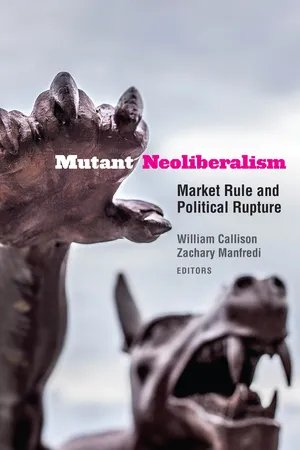
eBook - ePub
Mutant Neoliberalism
Market Rule and Political Rupture
- 320 pages
- English
- ePUB (mobile friendly)
- Available on iOS & Android
eBook - ePub
Mutant Neoliberalism
Market Rule and Political Rupture
About this book
Information
Publisher
Fordham University PressYear
2019Print ISBN
9780823285709
9780823285716
Edition
1eBook ISBN
9780823285723
ONE
Neoliberalism’s Scorpion Tail
Wendy Brown
Taking even themselves by surprise, hard-right forces have shot into power in liberal democracies across the globe. Every election brings a new shock: neo-Nazis in the German and Austrian parliaments, neo-fascists in the Italian one, Brexit ushered in by tabloid-fueled xenophobia, the rise of white nationalism in Sweden and other parts of Scandinavia, authoritarian regimes taking shape in Turkey and Eastern Europe, and, of course, Trumpism. Racist, anti-Islamic, misogynist, and anti-Semitic bellicosity has taken to the streets, the Internet and the voting booths, and newly coalesced far-right groups have burst boldly into public after years of lurking mostly in the shadows. Politicians and political victories embolden far-right movements, which in turn acquire sophistication and legitimacy as political handlers and social media experts craft the message. As recruits grow, centrists, mainstream neoliberals, liberals, and leftists are spinning. We even have trouble with the naming—is this authoritarianism, fascism, populism, illiberal democracy, undemocratic liberalism, rightwing plutocracy? Or something else?
Failure to predict, understand, or effectively contest these developments is due partly to blinding assumptions about perduring Western values and institutions, especially progress, Enlightenment, and liberal democracy, and partly to the unfamiliar agglomeration of elements in the rising right. These new forces conjoin familiar planks of neoliberalism (licensing capital, leashing labor, demonizing the social state, attacking equality, promulgating freedom) with their seeming opposites (nationalism, enforcement of traditional morality, populist anti-elitism, and demands for state solutions to economic and social problems). They combine moral righteousness with nearly celebratory amoral and uncivil conduct. They endorse authority while featuring unprecedented public social disinhibition and aggression. They rage against relativism but also against science and reason, spurning evidence-based claims, rational argumentation, credibility, and accountability. They disdain politicians and politics while evincing a ferocious will to power and political ambition. They condemn elites and worship wealth. Where are we?
A composite Left account, with a focus on the United States, goes roughly like this: In the global North, neoliberal economic policy devastated rural and suburban regions, emptying them of decent jobs, pensions, schools, services, and infrastructure as social spending dried up and capital chased the cheap labor and tax havens of the global South.1 Meanwhile, a consequential cultural and religious chasm deepened as hip, educated, slender, secular, multicultural, globetrotting urbanites built a different moral-cultural universe from the mid-landers, whose economic woes were salted with estrangement from those who ignored, ridiculed, or disdained them. More than hard up and frustrated, they were alienated and humiliated, left out and left behind—“strangers in their own land,” in Arlie Hochschild’s phrase. Then there was enduring racism, fueled as new immigrants transformed suburban neighborhoods and as policies of “equity and inclusion” appeared to the uneducated white male to favor everyone over him. Thus, liberal political agendas, neoliberal economic ones, and cosmopolitan cultural ones generated a growing sense of abandonment, betrayal, and rage on the part of the new dispossessed, the white working- and middle-class populations of the first and second world. If their dark-skinned counterparts were harder hit by neoliberal decimations of union-protected jobs and public goods, they did not suffer lost pride of place in America or the West.
As this phenomenon first took shape, the story goes, plutocrats manipulated it brilliantly: the dispossessed were thrown under the economic bus at every turn while being played a political symphony of Christian family values along with paeans to their whiteness and their young sacrificed in senseless, endless wars.2 Patriotism-as-militarism, Christianity, family, racist dog whistles, and unbridled capitalism made up the successful recipe of conservative neoliberals until the 2008 finance capital crisis devastated incomes, retirements, and home ownership for its working- and middle-class white base.3 With even the economists muttering that they had been wrong about unchecked debt financing and globalization, serious discursive displacement was now required. This meant screaming about ISIS, undocumented immigrants, and affirmative action myths and, above all, demonizing government and the social state for the economic catastrophe—slyly shifting the blame from Wall Street to Washington because it rescued the banks while hanging the little people out to dry. Thus was a second wave of reaction to neoliberalism born, this one more unruly, populist, and ugly. Already galled by an elegant black family in the White House, disgruntled American whites were also fed a steady diet of right-wing commentary on radio, TV, and social media, inflected from the fringes as a potpourri of previously isolated movements—white nationalist, libertarian, anti-government, and fascist—connected with each other via the Internet.4 Family values and militaristic patriotism were no longer enough. Rather, the new hard-right populism was bled directly from the wound of dethroned privilege that whiteness, Christianity, and maleness granted to those who were otherwise nothing and no one.
The dethronement was easy enough to blame on job-stealing immigrants and minorities, along with other imagined undeserving beneficiaries of liberal inclusion (most outrageously those of terrorist religions and races) courted by elites and globalists.5 Thus were casualties of neoliberal deracination mobilized by the figure of their own losses mirrored in a nation lost: this figure drew on a mythical past when families were happy, whole, and heterosexual, when women and racial minorities knew their place, when neighborhoods were orderly, secure, and homogeneous, when terrorism was outside the homeland, heroin was a black problem, and a hegemonic Christianity and whiteness constituted the manifest identity, power, and pride of the nation and the West.6 Against invasions by other peoples, ideas, laws, cultures, and religions, this was the fairytale world right-wing populist leaders promised to protect and restore. The campaign slogans tell it all: “Make America Great Again” (Trump), “France for the French” (Le Pen), “Take Back Control” (Brexit),” “Our Culture, Our Home, Our Germany” (Alternative for Germany), “White Europe/Pure Poland” (Law and Justice Party).
The accent marks in this story vary. Sometimes they are on neoliberal policy, sometimes on left liberal absorption with multiculturalism and identity politics, sometimes on the growing political importance of evangelicals and Christian nationalists, sometimes on the vulnerability of the uneducated to lies and conspiracies and increasingly siloed media, sometimes on the existential need for horizons and inherent unattractiveness of a globalist worldview for all but elites, and sometimes on the enduring racism of an old white working class or the new racism cleaved to by younger uneducated whites. Some stress powerful right-wing think tanks and political money. Most agree that neoliberal intensification of inequality within the global North was a tinderbox and that mass migration from South to North was a match to the fire.
With its various inflections, this has become the Left common sense since the political earthquake of November 2016. The narrative is not wrong but incomplete. It does not register the forces shaping the profoundly antidemocratic form of the rebellion and thus tends to align it with fascisms of old. It does not consider the demonized status of the social and the political in neoliberal governmentality or the valorization of traditional morality and markets in their place. It does not reflect how the neoliberal mobilization of traditional values and brutal attack on social equality could turn up the heat on and legitimate long-simmering racisms and misogyny. It does not register the intensifying nihilism that challenges truth and transforms traditional morality into weapons of political battle. The account does not identify how assaults on constitutional democracy, equality, public education, and a civil, nonviolent public sphere have been carried out in the name of freedom and traditional morality. It does not grasp how neoliberal rationality generated the hard right and disoriented the left with an ordinary discourse in which social justice is at once trivialized and monsterized as tyrannical “political correctness” or what right-wing media star Jonah Goldberg termed the left’s Gramscian Kulturkampf aimed at overthrowing liberty and morality.7
If these are some of the legacies of neoliberalism fomenting the present, theorizing them requires thinking beyond Undoing the Demos, where I characterized neoliberalism’s world-making powers as economizing all features of existence.8 It requires revising formulations of neoliberal and neoconservative rationalities as distinct, as I also did in previous work and many others have done as well. Both moves miss crucial features of the Reagan-Thatcher neoliberal revolution, features that took their bearings not only from America’s more familiar Chicago boys, but from the Austrian philosopher Friedrich Hayek and the Freiburg School of ordoliberalism. This revolution aimed at releasing markets and traditional morality to govern and discipline individuals while maximizing freedom and de-democratizing the state.
That markets have this role in neoliberalism is a commonplace; not so with traditional morality. Its concrete place in the neoliberal revolutions of the 1980s and ’90s is the subject of Melinda Cooper’s invaluable 2017 book Family Values. However, only a careful rereading of Hayek reveals the architecture of reason that binds traditional morality to neoliberal economics and casts all political challenges to gender, racial, and sexual hierarchies and to class extremes as assaults on freedom and moral order. For Hayek, markets and morals together are the foundation of freedom, order, and the development of civilization. Markets can only do their work if states secure and support them but do not encroach on or intervene in them. Traditional morals can only do theirs when states are likewise restrained from usurping them with justice precepts and when expanding their reach beyond what Hayek calls “the personal protected sphere” gives them more legitimacy in public and commercial life than secular social democracies ordinarily permit. Thus, more than a project of “economizing everything,” as I argued in Undoing the Demos, Hayekian neoliberalism is a moral-political project aimed at protecting traditional hierarchies by negating the social as a domain of justice and radically restricting democratic claims on states.9
Put another way, the attack on society and social justice in the name of market freedom and moral traditionalism is an emanation of neoliberal rationality, hardly the invention of political conservatives. Of course, hard-right parties have made a steady drumbeat of appeals to traditional morality paired with homilies to the free market, together wrapped in nativism, Christianity, and patriotism. And it is easy enough to see how white and male superordination and nativist exclusions are tucked into the markets-and-morals project. On the one hand, deregulated markets tend to reproduce rather than ameliorate historically generated social powers and stratification. On the other hand, traditional morality repels challenges to inequalities and links patriotism not just with love of country but love of the way things were, tarring objections to those ways as unpatriotic. Yet, as I shall suggest in the essay’s final turn, this nostalgia also blends with unique forms of nihilism, fatalism, and ressentiment animated in turn by a panoply of forces including economization, rapture Christianity, climate change, and above all what we might call the end of the Cretaceous period for white male supremacists. These dinosaurs, of course, may burn down the planet rather than adapt. We will get to that problem later. First, we need to consider in more depth the anti-democratic markets-and-morals project of neoliberalism, forwarded largely through attacks on the social and the political.
Attack on the Social
Democracy, especially in large capitalist nation-states, requires explicit effort to bring into being a citizenry capable of self-rule. Neither markets themselves nor winners within them can be permitted to dominate democratic life; both must be contained to generate political equality, democracy’s fundament. Democracy also requires a robust cultivation of society as the place where we experience a linked fate, where we are more than private individuals or families, more than economic producers, consumers, or investors, more than mere members of a nation, and more than our differences. Situated conceptually and practically between state and personal life, society is where we are brought together and thought together, politically enfranchised and gathered (not merely cared for) through public goods and care for the public interest. It is also where historically produced inequalities are manifest as differentiated political access, voice, and treatment and where they can be redressed. Social justice, then, more than an intrinsic good, is the antidote to otherwise depoliticized stratifications, exclusions, abjections, and inequalities shrouded by liberal privatism and undermining political equality.10
Tellingly, society—its intelligibility, harboring of stratifying powers, and standing as a site of justice and the commonweal—is precisely what neoliberalism set out to destroy conceptually, normatively, and practically. Social regulation and redistribution were discursively delinked from democracy’s dependence on political equality and inverted into tyranny, democracy’s opposite. Hayek deemed the very notion of the social false and dangerous, meaningless and hollow, destructive and dishonest, a “semantic fraud.” Concern with the social was the signature of all ...
Table of contents
- Cover
- Title Page
- Copyright
- Contents
- Introduction: Theorizing Mutant Neoliberalism
- 1. Neoliberalism’s Scorpion Tail
- 2. The Market’s People: Milton Friedman and the Making of Neoliberal Populism
- 3. Neoliberals against Europe
- 4. Anti-Austerity on the Far Right
- 5. Disposing of the Discredited: A European Project
- 6. Neoliberalism, Rationality, and the Savage Slot
- 7. Sexing Homo Œconomicus: Finding Masculinity at Work
- 8. Feminist Theory Redux: Neoliberalism’s Public-Private Divide
- 9. “Innovation” Discourse and the Neoliberal University: Top Ten Reasons to Abolish Disruptive Innovation
- 10. Absolute Capitalism
- List of Contributors
- Index
Trusted by 375,005 students
Access to over 1.5 million titles for a fair monthly price.
Study more efficiently using our study tools.
Frequently asked questions
Yes, you can cancel anytime from the Subscription tab in your account settings on the Perlego website. Your subscription will stay active until the end of your current billing period. Learn how to cancel your subscription
No, books cannot be downloaded as external files, such as PDFs, for use outside of Perlego. However, you can download books within the Perlego app for offline reading on mobile or tablet. Learn how to download books offline
Perlego offers two plans: Essential and Complete
- Essential is ideal for learners and professionals who enjoy exploring a wide range of subjects. Access the Essential Library with 800,000+ trusted titles and best-sellers across business, personal growth, and the humanities. Includes unlimited reading time and Standard Read Aloud voice.
- Complete: Perfect for advanced learners and researchers needing full, unrestricted access. Unlock 1.5M+ books across hundreds of subjects, including academic and specialized titles. The Complete Plan also includes advanced features like Premium Read Aloud and Research Assistant.
We are an online textbook subscription service, where you can get access to an entire online library for less than the price of a single book per month. With over 1.5 million books across 990+ topics, we’ve got you covered! Learn about our mission
Look out for the read-aloud symbol on your next book to see if you can listen to it. The read-aloud tool reads text aloud for you, highlighting the text as it is being read. You can pause it, speed it up and slow it down. Learn more about Read Aloud
Yes! You can use the Perlego app on both iOS and Android devices to read anytime, anywhere — even offline. Perfect for commutes or when you’re on the go.
Please note we cannot support devices running on iOS 13 and Android 7 or earlier. Learn more about using the app
Please note we cannot support devices running on iOS 13 and Android 7 or earlier. Learn more about using the app
Yes, you can access Mutant Neoliberalism by William Callison, Zachary Manfredi, William Callison,Zachary Manfredi in PDF and/or ePUB format, as well as other popular books in Economics & Literary Criticism Theory. We have over 1.5 million books available in our catalogue for you to explore.