Democracy is in crisis. In every major company it has been stole by elites or in the hands of strong men. In democracy's name we see a raft of policies that spread inequality and xenophobia worldwide. It is clear that democracy - the principle of government by and for the people - is not living up to its promise.
In fact, real democracy- inclusive and egalitarian - has in fact never existed. In this urgent and engaging book, Astra Taylor invites us to re-examine the term. Is democracy a means or an end? A process or a set of desired outcomes? What if the those outcomes, whatever they may be - peace, prosperity, equality, liberty, an engaged citizenry - can be achieved by non-democratic means? Or if an election leads to a terrible outcome? If democracy means rule by the people, what does it mean to rule and who counts as the people? The inherent paradoxes are too often unnamed and unrecognized. But to ignore them is no longer possible.
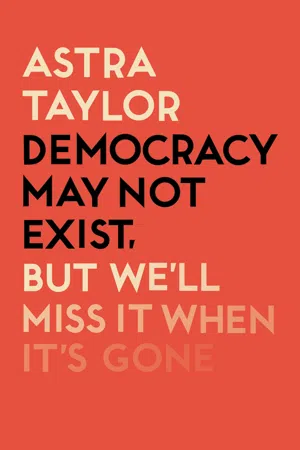
Democracy May Not Exist, but We'll Miss It When It's Gone offers a better understanding of what is possible, what we want, and why democracy is so hard to realize.
- 368 pages
- English
- ePUB (mobile friendly)
- Available on iOS & Android
eBook - ePub
Democracy May Not Exist But We'll Miss it When It's Gone
About this book
Information
CHAPTER 1
FREE TO BE WINNERS AND LOSERS
(FREEDOM/EQUALITY)
IN 1989, WHEN the Berlin Wall fell, people everywhere cheered the dawn of a new democratic age. The free world had triumphed over the unfree and was now in ascendance. The liberal doctrine of individual rights, periodic elections, and consumer abundance appeared both irresistible and unstoppable. Socialism, painted as a bleak and blinkered condition where individualism and opportunity were suppressed in favor of state-sponsored sameness, was condemned as a condition of equality run amok, while capitalism, an inherently unequal economic system, was increasingly taken to be synonymous with democracy or freedom.
Some historians say the Cold War began in 1947 with a speech by President Harry Truman in which he used the word free or freedom an astonishing twenty-four times in a mere eighteen minutes; the word equality was not uttered once.1 By 1989, freedom and equality, two terms central to the theory and practice of democracy, occupied opposite ends of a bipolar political spectrum after decades of a slow rupture. Ideals that throughout democratic history had been intertwined in complex, fruitful ways were severed; concepts long allied had become enemies. This was an unprecedented inflection point in the history of democratic governance. Moreover, the eclipsing of Marxist alternatives in 1989 also, counter-intuitively, precipitated aspects of democracy’s decline: deregulated markets and transnational policy making began to ramp up income inequality and undermine attributes of national sovereignty on which a liberal-democratic, welfare-state system depends. Thus this dawn of a new democratic age in fact inaugurated the degradation of democracy in key ways.
The consequences of severing freedom and equality have been profound. Although distinct and occasionally discordant, freedom and equality were regularly envisaged as virtues that could positively reinforce each other when held in proper balance. Over time they have been reconfigured as wholly incompatible, with one term jeopardizing the other. While equality was recast as a threat to liberty, freedom became reduced to the right to be left alone—what some philosophers, following Isaiah Berlin, call negative liberty, or “freedom as non-interference.” Capitalism’s resounding 1989 victory concluded this shift, with the locus of freedom moving firmly to the marketplace. Contemporary freedom is, above all, the freedom to compete in the economy without intervention from meddling government, and to get ahead or fall behind trying. It means, in other words, being free to be unequal. “Freedom breeds inequality,” the celebrity conservative talk show host William F. Buckley pronounced to a television audience of millions in 1968, articulating a perspective that would soon become commonplace. “Unless you have freedom to be unequal, there is no such thing as freedom.”
Flashback another couple of hundred years, and we can see how novel, and strange, this formulation is. This blunt dualism, the pitting of freedom and equality in a zero-sum game, stands in stark contrast to earlier modes of understanding. The slogan of the French Revolution, in 1789, married freedom and equality to a third term: liberté, égalité, fraternité. The two ideals, bonded by brotherhood—not sisterhood, as visionary feminists, including Olympe de Gouges, noted at the time, an insight for which she paid with her life—reinforced each other, a trinity of virtues that required the end of aristocracy and a class leveling to stand a chance of being enacted.
In the revolutionary formulation, influenced by the writings of the philosopher Jean-Jacques Rousseau, individuals become both free and equal through the exercise of common citizenship (what could be called collective freedom or, following Berlin again, positive liberty). It was a remarkable shift in perspective. Since the dramatic demise of ancient Athens over two thousand years prior, democracy had been associated with freedom spun out of control, with anarchy and mob rule; to present democracy as a desirable alternative to stifling aristocracy and a guarantor of basic liberties was unorthodox, to say the least. Thus, the French Revolution, like the end of the Cold War, was a democratic watershed, this one marking the moment when the idea of political equality entered the popular imagination and when the word democracy was rescued from the disrepute that had long stalked it.2
Today, one corner of the liberté, égalité, fraternité triad reigns undeniably supreme. Freedom, and freedom alone, is the paramount value, the concept on the tip of everyone’s tongue, while equality languishes as the less celebrated counterpart, and brotherhood can barely be discerned. While making my documentary I asked dozens of people what democracy meant to them. “Freedom” was the standard and often instantaneous reply, as though that clarified matters and the concept’s meaning was self-evident.
The people I met usually defined freedom as the chance to exercise choice and get ahead. For some—typically people from marginalized backgrounds—freedom was defined as the absence of fear. (In this, they echo the musician Nina Simone, who told an interviewer, “I’ll tell you what freedom is to me. No fear.”) For twenty-one-year-old Salam Magames, a Syrian refugee I met in Greece from war-torn Aleppo, freedom contains both elements: “Freedom means that a human being gets all their rights.” And, she added, “We just want to put our head on the pillow without having nightmares that someone will come and kidnap and assault us.”
No one, not a single soul in the United States or elsewhere, told me that democracy meant “equality.”
If I had prodded, perhaps the people I spoke to would have professed a commitment to the principle that human beings are intrinsically equal. Maybe they simply took this equality as a given—an innate quality every individual automatically possesses simply by virtue of being born human. And yet I don’t believe that equality went unmentioned merely because it was taken for granted. For most of history, hierarchies were assumed to be not just legitimate but natural (how else could monarchs, aristocrats, racists, and misogynists hold on to power?). Equality emerged as an intellectual concept much later than the idea of freedom, which means its roots are not as deep or as robust as we might think. And equality is rarely used for propaganda purposes, which means it is less quick on the lips: we visit the Statue of Liberty, not the Statue of Equality; and in the early oughts, we built a Freedom Tower and were served freedom fries, not equality ones; we fight for our civil liberties, not civil equalities. Equality—which has been called “the most controversial of the great social ideals”—just isn’t as hyped.3
Freedom and equality have never been self-evident, impartial terms, but are constantly evolving, invoked and refashioned to serve the desires of conflicting groups and interests, their dominant meanings challenged by those with dissenting perspectives. Thanks to these struggles, more people than ever believe that human beings are roughly equivalent on some metaphysical level. That may be the case, but we are hardly the same. Democracy has to cope with incredible human variation, a process that can require treating people unequally in order to ensure the possibility of something approaching just outcomes. Someone like Salam, who has been made homeless and traumatized by war, may need extra degrees of assistance and support in order to be equally free. In these seemingly special cases, we can see a truth of the human condition that in fact applies to every single person on earth. Freedom is not a state of independence but a state of interdependence, one in which our unique needs are met by the society in which we live, in order that we might all have a fair chance of flourishing. In a democracy, what that means in practice will always fluctuate. The tension between freedom and equality, though often exaggerated, is real: an excess of one can endanger the other, but at the same time neither value can be expressed in isolation.
If we want to understand our present confusion over the relationship between equality and freedom, we have to look all the way back to ancient Athens, that mythic birthplace of democracy that was built on the economic bedrock of bondage. Athenians were not ashamed of the existence of slavery, which was typical for city-states and empires of that era. Rather, what they were proud of, what set them apart, was their system of directly democratic self-rule, a unique situation in which the demos, people, held kratos, power.
There are reasons to question Athens’s formative place in the democratic pantheon. One can highlight the existence of other proto-democratic traditions, for example in regions that correspond to modern-day Turkey, Egypt, Syria, Iraq, and, as we’ll see, the Americas. Nevertheless, and despite Athenian society’s many shortcomings—slavery, misogyny, xenophobia, and imperialism (terrible characteristics modern societies have yet to be fully cured of)—there’s no denying that the city-state was remarkable in many respects.4 The Athenian system of direct democracy consisted of a wide range of institutions, laws, customs, and concepts aimed at enabling all citizens to enjoy isonomia, or equality before the law—an equality founded on isegoria, or “equal freedom of speech,” the right to both speak and be heard in the Assembly and to rule and be ruled in turn.
The innovations of the Athenian system were legion, from a complex and virtually incorruptible jury system to the practice of ostracism that cast out would-be strongmen; from rotation by lottery as opposed to election for key public offices (on the grounds that elections were not democratic enough, as the well born and well spoken tended to win) to payments for civic service to cover lost wages for those who could not otherwise attend. Athenian craftsmen used marble and bronze to empower citizens and curb corruption in ways modern engineers with silicon chips and wireless networks would do well to learn from.
Ancient Athens’s signal breakthrough, however, was that it gave real political power to poor people—so much power that one esteemed scholar has likened it to a “dictatorship of the proletariat.”5 The Assembly of Athens was open—in practice, not just in theory—to tens of thousands, hardscrabble farmers and wealthy landowners alike. In that all-powerful body, and also in the courts that determined the fate of the community and its members, the lower classes occupied the space of free and equal citizens, not passive subjects. “Neither is poverty an obstacle, but a man may benefit his country whatever the obscurity of his condition,” Pericles maintained.
The obstacle of poverty was first circumvented at a point widely regarded as one of the birth moments of Western democracy. In 594 BC, in response to a crisis that had farmers selling themselves into foreign slavery because they could no longer pay their debts, an aristocratic poet turned social reformer named Solon instigated the first significant step toward the inclusion of the working poor in political life. “All the common people were weighed down with the debts they owed to a few rich men,” Plutarch’s account of this period reports. Though Solon declined to redistribute land and impose strict equality in living standards as some of his supporters hoped, his “shaking off of obligations” involved canceling payments and returning the enslaved Athenians to freedom while outlawing the practice of debt bondage. He also tackled criminal justice, repealing the laws established by the former tyrant Dracos, whose “draconian” code made almost every crime—even stealing a single fruit or vegetable—punishable by death. Disappointing those who urged him to seize control and become a tyrant himself, Solon instead created a new social order, laying the foundation for a system in which impoverished citizens could fully participate in the governing institutions of the city.6
Given the history of debt bondage and the constant threat of invasion from neighboring city-states such as Sparta, the Athenians evolved to become supremely wary of domination, whether perpetuated by fellow citizens or external enemies (although male citizens dominated other social groups within, through slavery, and without, through imperial conquest). Freedom from external domination meant cultivating military might, but avoiding internal threats involved cultivating equality of political power among citizens so that no individual or group, no matter how charismatic, rich, or highborn, could reign supreme. Such were the convictions of the people who invented not just the word democracy but also demagogue and oligarchy.
During the two centuries of democracy that followed Solon’s reforms, Athenians remained committed to the insight that the polity would disintegrate into civil war and chaos if economic inequality undermined the standing of poorer citizens. The classicist Danielle Allen distilled the logic for me as follows: “Freedom requires political equality; political equality requires social equality and economic egalitarianism. You line the concepts up that way, and freedom and equality fit together like hand in glove.” It doesn’t take the brilliant mind of a Pericles to see that differentials of wealth invariably translate into imbalances in political power. The dichotomy between freedom and equality that is so common today would have been nonsensical to the ancient Greeks. After all, the interdependence of the two ideals had been affirmed at the very inception of their social order through the reforms of Solon.
In some ways, ancient Athens was very much like the early United States. Both ostensible cradles of government by the people were founded on institutionalized unfreedom and the fervently held belief that some human beings did not qualify as political equals and could be ruthlessly exploited. Indeed, it was the visible presence of slavery that led people in both societies, Athenian and American, to deeply, and perhaps pathologically, value and romanticize the ideal of liberty as the antithesis of bondage.
American legal scholar Aziz Rana calls this core contradiction the “two faces of American freedom.” “All men are created equal,” the American Declaration of Independence famously declares, those equal men endowed with the inalienable right to pursue liberty alongside life and happiness. But the upper-class owners of human chattel who penned and signed that document counted each enslaved African as three-fifths of a person, denied men without property and women the right to vote, and committed genocide against native people while illegally speculating on stolen land.
For early American settlers, democratic ideals “gained strength and meaning through frameworks of exclusion,” Rana explains, the emancipatory and oppressive features of American life tightly bound.7 Liberty and economic independence—for a limited elite class—required free land and forced labor, perpetuating the dispossession of indigenous people and the institution of slavery (freedom meant the freedom to settle and to enslave). On this corrupt foundation, the colonists who counted as full political citizens, as members of the democratic demos, constructed a conception of “republican freedom” that “provided a truly expansive vision of collective life—in which self-rule entailed actively asserting one’s authority over economic, political, and religious institutions.” For that fortunate subset of men, freedom and equality were complimentary. The republican conception of liberty upheld civic participation as essential to freedom. Self-rule, in turn, required a degree of economic equality among the citizenry lest political equality be undermined. That meant settler citizens should be propertied men, with land of their own, not itinerant menial laborers who were subservient and therefore incapable of self-government. (In his Commentaries on the Laws of England, from the 1760s, Sir William Blackstone propounded this view, insisting that men without property, lacking independence, would threaten the “general liberty.”)
Rana’s conception of the Janus-faced nature of American freedom adds a new dimension to the standard narrative of American independence we all learn in school. Children are taught about the thirteen colonies that rose up against an oppressive monarchy under the famous rallying cry “No taxation without representation,” but the reality was, of course, more complex. Though they had a variety of grievances, settlers were motivated to revolt against British control at a moment when their privileged position within the empire was shifting. As imperial administrators sought to manage far-flung subjects—whose ranks now included French and Spanish colonists, indigenous people, Caribs, and Bengalis—white-skinned Protestant colonists regarded any sign of increased tolerance and diversity (that is, increasing equality) as a threat to their special status and the freedom that that special status conferred. When the Crown issued the Royal Proclamation of 1763, gesturing toward protecting the territorial rights of tribes with whom it had treaties from further encroachment, American settlers were aghast, for their model of freedom and equality depended on an expanding frontier. This indignation was the glue that united small-time farmers and wealthy land speculators such as George Washington, who were affronted that taxes were being levied to pay for British troops to halt settler appropriation of Native American land. According to sociologist Michael Mann, independence from imperial prerogatives typically correlated with increased settler violence against natives: “the stronger the democracy among the perpetrators, the greater the genocide.”8
Meanwhile, successful legal challenges to slavery mounted on British soil, such as the celebrated 1772 Somerset decision declaring slavery odious and incompatible with English common law, only added to the settlers’ sense of imperial persecution. American revolutionaries protested that they were, in fact, the true slaves, to an absolute and arbitrary power across the Atlantic, with such cries of oppression emanating the loudest from slaveholding colonies.9 Seen from this perspective, the American Revolution was arguably conservative, aimed as much at maintaining the status quo than ushering in a radically different, more democratic epoch in which the racially excluded might have a chance to reap the benefits of freedom and equality’s coexistence.
The settlers succeeded on their terms. The continuation of slavery and the post-revolution grab of indigenous territory ensured a degree of economic egalitarianism unknown in the mother country. Schemes such as the Georgia Land Lotteries, in which the U.S. government forced Native American communities from their homelands and distributed parcels to European settlers, made the fabled yeoman farmer possible. Even as they unabashedly protected the property rights of the prosperous, the founding fathers supported redistributive policies that would be anathema to most officeholders today, recognizing that massive imbalances in wealth could undermine the fragile republic. Thomas Jefferson, for example, successfully brought an end to Virginia laws of entail (which limited inheritance to a family line) and primogeniture (the passage of property to the eldest son) in order to break up large estates and ensure a more middling distribution of land and wealth so as to prevent the emergence of a “future aristocracy.” The tremendously popular pamphleteer and “father of the American Revolution...
Table of contents
- Cover Page
- Halftitle Page
- Title Page
- Copyright Page
- Dedication
- Contents
- Introduction: Living in the Tension
- Chapter 1: Free to Be Winners and Losers: (Freedom/Equality)
- Chapter 2: Shouting as One: (Conflict/Consensus)
- Chapter 3: Reinventing the People: (Inclusion/Exclusion)
- Chapter 4: Choose This, or Else!: (Coercion/Choice)
- Chapter 5: Is This What Democracy Looks Like?: (Spontaneity/Structure)
- Chapter 6: A Socratic Mob: (Expertise/Mass Opinion)
- Chapter 7: New World Order: (Local/Global)
- Chapter 8: A Ruin or a Habitation: (Present/Future)
- Conclusion: From Founding Fathers to Perennial Midwives
- Notes
- Acknowledgments
- Index
- About the Author
Trusted by 375,005 students
Access to over 1.5 million titles for a fair monthly price.
Study more efficiently using our study tools.
Frequently asked questions
Yes, you can cancel anytime from the Subscription tab in your account settings on the Perlego website. Your subscription will stay active until the end of your current billing period. Learn how to cancel your subscription
No, books cannot be downloaded as external files, such as PDFs, for use outside of Perlego. However, you can download books within the Perlego app for offline reading on mobile or tablet. Learn how to download books offline
We are an online textbook subscription service, where you can get access to an entire online library for less than the price of a single book per month. With over 1.5 million books across 990+ topics, we’ve got you covered! Learn about our mission
Look out for the read-aloud symbol on your next book to see if you can listen to it. The read-aloud tool reads text aloud for you, highlighting the text as it is being read. You can pause it, speed it up and slow it down. Learn more about Read Aloud
Yes! You can use the Perlego app on both iOS and Android devices to read anytime, anywhere — even offline. Perfect for commutes or when you’re on the go.
Please note we cannot support devices running on iOS 13 and Android 7 or earlier. Learn more about using the app
Please note we cannot support devices running on iOS 13 and Android 7 or earlier. Learn more about using the app
Yes, you can access Democracy May Not Exist But We'll Miss it When It's Gone by Astra Taylor in PDF and/or ePUB format, as well as other popular books in Politics & International Relations & Democracy. We have over 1.5 million books available in our catalogue for you to explore.