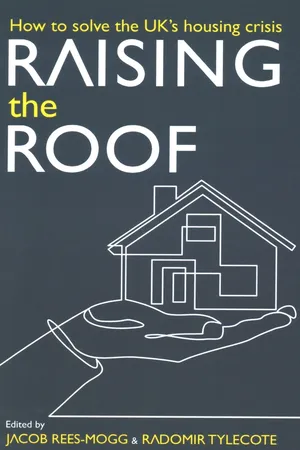
Raising the Roof addresses one of the key issues of our era – the UK's housing crisis. Housing costs in the United Kingdom are among the highest on the planet, with London virtually the most expensive major city in the world for renting or buying a home. At the core of this is one of the most centralised planning systems in the democratic world – a system that plainly doesn't work. A system that has resulted in too few houses, which are too small, which people do not like and which are in the wrong places, a system that stifles movement and breeds Nimbyism. The IEA's 2018 Richard Koch Breakthrough Prize, with a first prize of £50, 000, sought free-market solutions to this complex and divisive problem. Here, Breakthrough Prize judge Jacob Rees-Mogg and IEA Senior Research Analyst Radomir Tylecote critique a complex system of planning and taxation that has signally failed to provide homes, preserve an attractive environment and enhance our cities. They then draw from the winning entries to the Breakthrough Prize, and previous IEA research, to put forward a series of radical and innovative measures – from releasing vast swathes of government-owned land to relaxing the suffocating grip of the green belt. Together with cutting and devolving tax, and reforms to allow cities to both densify and beautify, this would create many more homes and help restore property-owning democracy in the UK.
eBook - ePub
Raising the Roof
How to Solve the United Kingdom's Housing Crisis
- 160 pages
- English
- ePUB (mobile friendly)
- Available on iOS & Android
eBook - ePub
Raising the Roof
How to Solve the United Kingdom's Housing Crisis
About this book
Information
Edition
1Subtopic
Human RightsPART ONE
Raising the Roof
Introduction
It is no coincidence that the United Kingdom has both the most centralised planning system of any large country in the democratic world, and one of the worst housing crises in the democratic world. Quite simply, the central planning of housebuilding does not work.
Our country’s attempt to place housebuilding considerably under central state control since World War II, however well-intentioned, is, paradoxically, why the centre demands housebuilding and does not get it; it is why, when housing is built, it is so often disliked, leading to the Nimbyism that so befuddles Whitehall; and it is why, despite the business of housebuilding being so profitable, houses still go unbuilt. We build too few houses, which are too small, which people do not like, and which are in the wrong places.
This paper will describe a radical programme to cut the Gordian Knot that is our centralised planning system. When this is put into action, some of which can be done incrementally, the United Kingdom will be able to undo its almost uniquely severe housing crisis.
At first glance, our central proposition may seem counter-intuitive. Surely the central state is exactly the organisation that can ‘push through’ new housebuilding. In fact, since the end of World War II, by centralising almost all taxation and much decision-making from our local governments and localities – to a degree seen elsewhere only in socialist countries – it has thwarted the free market which could otherwise build the houses people actually want. Here, a socialist system has meant the usual socialist outcome: failure. Central government is responsible for most of the United Kingdom’s housing crisis.
We will discuss below how this came about after 1945, and how it can be solved. Before that, it is important to understand how serious our problem now is.
Our failure to build is often called our most serious economic problem. The evidence tells us that it is, in fact, a catastrophe. For over a generation, we have built houses at a lower rate than any other country with comparable data. Estimates suggest a shortfall below the desirable level of new-build housing of 2.5 million since 1992 (Cheshire 2018); since 1970, the average price of a house has risen four-and-a-half-fold after inflation, where the UK is again an outlier, with no other OECD country experiencing a price increase of this magnitude over the period (Niemietz 2016). In the 1970s, the average buyer needed under three gross annual salaries for a house. Now, before interest payments, this is over seven, also making the UK unique.
The housing costs Britons face are now among the highest in world, and this holds for house prices or rents, in absolute terms or relative to income. There is a shortage of housing for first-time buyers, in the social housing sector, and in private accommodation (ibid.). We lack houses of every type.
1 This essay was originally published as a separate paper in July 2019. The authors are particularly grateful for the advice of John Myers of London Yimby, Nicholas Boys Smith at Create Streets, Robert Wickham and Keith Boyfield, as well as ...
Table of contents
- The Richard Koch Breakthrough Prize
- About the authors
- PART ONE
- Raising the Roof
- 1 Raising the roof
- PART TWO
- 2 The Land Purchase Act
- 3 Presumed permission: a self-build framework for local development rights
- 4 Simplified Planning Zones and the realignment of fiscal incentives
- 5 Planning to the people: how a system of transferable development rights could replace the green belt
- 6 Taking on established interests: a new approach to land to solve the housing shortage
- 7 The Localism 2.0 reform
- 8 A supply-side answer tothe housing crisis: false impressions and true solutions
- A note on the longlist
- About the IEA
Trusted by 375,005 students
Access to over 1.5 million titles for a fair monthly price.
Study more efficiently using our study tools.
Frequently asked questions
Yes, you can cancel anytime from the Subscription tab in your account settings on the Perlego website. Your subscription will stay active until the end of your current billing period. Learn how to cancel your subscription
No, books cannot be downloaded as external files, such as PDFs, for use outside of Perlego. However, you can download books within the Perlego app for offline reading on mobile or tablet. Learn how to download books offline
Perlego offers two plans: Essential and Complete
- Essential is ideal for learners and professionals who enjoy exploring a wide range of subjects. Access the Essential Library with 800,000+ trusted titles and best-sellers across business, personal growth, and the humanities. Includes unlimited reading time and Standard Read Aloud voice.
- Complete: Perfect for advanced learners and researchers needing full, unrestricted access. Unlock 1.5M+ books across hundreds of subjects, including academic and specialized titles. The Complete Plan also includes advanced features like Premium Read Aloud and Research Assistant.
We are an online textbook subscription service, where you can get access to an entire online library for less than the price of a single book per month. With over 1.5 million books across 990+ topics, we’ve got you covered! Learn about our mission
Look out for the read-aloud symbol on your next book to see if you can listen to it. The read-aloud tool reads text aloud for you, highlighting the text as it is being read. You can pause it, speed it up and slow it down. Learn more about Read Aloud
Yes! You can use the Perlego app on both iOS and Android devices to read anytime, anywhere — even offline. Perfect for commutes or when you’re on the go.
Please note we cannot support devices running on iOS 13 and Android 7 or earlier. Learn more about using the app
Please note we cannot support devices running on iOS 13 and Android 7 or earlier. Learn more about using the app
Yes, you can access Raising the Roof by Jacob Rees-Mogg,Radomir Tylecote,Stephen Ashmead,Calvin Chan,Ben Clements,Luke McWatters,Daniel Pycock,Thomas Schaffner,Charles Shaw,Gintas Vilkelis,William Watts in PDF and/or ePUB format. We have over 1.5 million books available in our catalogue for you to explore.