eBook - ePub
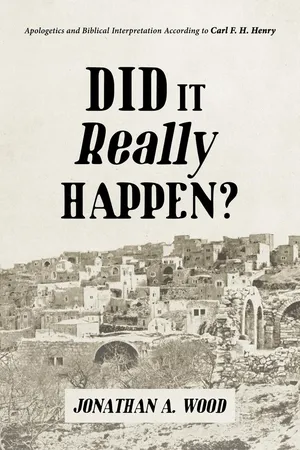
Did it Really Happen?
Apologetics and Biblical Interpretation According to Carl F. H. Henry
- 196 pages
- English
- ePUB (mobile friendly)
- Available on iOS & Android
eBook - ePub
Did it Really Happen?
Apologetics and Biblical Interpretation According to Carl F. H. Henry
About this book
The Bible makes remarkable claims about people and events in world history. Creation, Adam and Eve, Israel's escape from Egypt, the rise and fall of Israel's kingdom, the birth of the Messiah, Jesus Christ's life, death, and resurrection, the growth of the church--all points of interest by scholars for the historical veracity of the Scriptures. Yet, the Bible does not appear to present the acts of God in history for the purpose of vindicating historical accuracy of the text. The Bible is a story that reveals the living God through inspired writings that communicate the meaning of historical events. In light of the Bible as the revelation of God, and the high stakes of historical veracity for the claims of the Bible, how should Christians approach the interpretation of the Scriptures in a faithful way?
Carl F. H. Henry offers guidance as a foremost theologian regarding God, revelation, and the Scriptures. In Did it Really Happen? Jonathan Wood engages the thought of Carl Henry in dialogue with the major alternatives to revelation, history, and the biblical text. The value of Carl Henry's approach is shown to provide a path forward for affirming the historicity of the Bible while interpreting the text well.
Information
1
Revelation, History, and the Biblical Text
The Evangelical scholars who gathered at the International Council on Biblical Inerrancy for Summit II (ICBI Summit II) came together under the idea that the necessity of inerrancy had been established in the first summit.1 The first summit produced what has become the foundational document for an evangelical description of inerrancy—The Chicago Statement on Biblical Inerrancy. With the gains concerning the doctrine of revelation, the second council sought to complete the task of the first by carrying through the doctrine of revelation to its impact on hermeneutics as noted through the comment of James Packer, “[b]iblical authority is an empty notion unless we know how to determine what the Bible means.”2 With this comment, the “hermeneutical problem” for evangelical theology was summarized and the trajectory was set for the ICBI Summit II. The notion that the Bible bears authority because it is communication from an authoritative God carries the implicit consequence that it is then authoritative for those to whom it communicates. Yet, as Packer acknowledges, the authority of Scripture as a function in an interpreter’s life is dependent upon the apprehension of God’s communication through the process of hermeneutics.
The relationship among revelation, history, and the biblical text is a significant factor for the proper apprehension of biblical meaning. This triad is relevant in constructing hermeneutical approaches and thus bears impact on the breadth of theological method. Craig Bartholomew notes the existence of four broad turns in the history of modern hermeneutics. These turns are the historical, literary, postmodern, and theological turns.3 The narrative provided by Bartholomew’s account of these hermeneutical phases leads one from the initiation of hermeneutics that are historically focused to the questions that evangelicals must now face concerning the relation of history to text.4 As has been documented by chroniclers of interpretive history, beginning in the eighteenth century, a shift took place toward a preoccupation with historical method.5 The resulting dominance of the historical-critical method in biblical and theological studies had a serious effect as noted by Edgar Krentz who writes:
It is difficult to overestimate the significance the nineteenth century has for biblical interpretation. It made historical criticism the approved method of interpretation. The result was a revolution of viewpoint in evaluating the Bible. The Scriptures were, so to speak, secularized. The biblical books became historical documents to be studied and questioned like any other ancient sources. The Bible was no longer the criterion for the writing of history; rather history had become the criterion for understanding the Bible. The variety in the Bible was highlighted; its unity had to be discovered and could no longer be presumed. The history it reported was no longer assumed to be everywhere correct. The Bible stood before criticism as defendant before judge. The criticism was largely positivist in orientation, imminentist in its explanations, and incapable of appreciating the category of revelation.6
The net effect was that historical justifiability must be present for taking the biblical text seriously. This development still holds influence, and its mark is evident on the most common hermeneutic of modern evangelicalism, the historical-grammatical method.7 While many historical-grammatical interpreters may take exception to being identified with the positivist, imminentist trappings of the historical-critical method, evangelical interpretation has maintained a basic historical orientation.8 The historical shape of evangelical hermeneutics is typified in Gordon Fee’s statement:
From the perspective of the biblical scholar, the first step toward valid interpretation of Scripture is a historical investigation known as exegesis, which means the determination of the originally intended meaning of a text. “History as context for interpretation” does not refer to our own history, but to the original setting(s) of the biblical texts themselves.9
In the early twentieth century, following the historical turn, literary criticism developed out of concern that historically focused reading neglected the literary shape of the text itself. Alter and Kermode note, “[historical] criticism was of great cultural and doctrinal importance; but, as we have said, it diverted attention from biblical narrative, poetry, and prophecy as literature, treating them instead as more or less distorted historical records.”10 The literary turn is marked by an emphasis on the literary analysis of the Bible that does not always have an accompanying concern with historical issues.11
Bartholomew points to a development out of literary emphasis into the so-called postmodern turn in the 1980s. The hallmark feature of the postmodern turn is that it served as a challenge to both the historical and literary mindset, by asserting notions of pluralism and the indeterminacy of texts. Bartholomew’s assertion is that “[postmodernity] questions the very foundations of [literary and historical approaches] and alerts us to the inevitability of a plurality of views in biblical interpretation.”12 Subsequent to the challenge presented by the postmodern turn, the door opened for what Bartholomew identifies as a theological turn. This turn is identified by two marks. First, Scripture is to be read according to its plain sense with a limited role for historical criticism. Second, hermeneutical emphasis is placed on reading under the influence of theology for the church and Christian doctrine.13
This cursory summary of approaches to text and history serves to indicate the longstanding tensions between historical interests and theological interests when interpreting Scripture. As Bartholomew argues, as a “theological turn” appears to be afoot, the importance of doctrinal presuppositions concerning Scripture is, in turn, influencing how one reads the Bible.14 These developments in biblical hermeneutics relate specifically to the issues of revelation, history, and biblical hermeneutics in contemporary evangelicalism. Within the concern of this book on Carl F. H. Henry as a significant theologian of the doctrine of revelation, my hope is that one will find beneficial resources in his writings on these issues.
As Henry’s theology is articulated in the context of those with whom he was conversing, the particular approaches that merit analysis as significant influences on contemporary approaches to revelation, history, and the biblical text are that of Wolfhart Pannenberg and Hans Frei. The summary of biblical interpretation provided above finds a parallel in corresponding theological approaches to the doctrine of revelation with the historical turn represented by the revelation-as-history approach of Wolfhart Pannenberg and the literary turn manifested in the post-liberal approach typified by Hans Frei. As a chief representative of the neo-evangelical movement, the writings of Carl F. H. Henry provide fertile ground for considering these issues from the perspective of the doctrine of revelation.
The Path Ahead
The purpose of this book is to argue that, in contrast to the revelation-as-history and post-liberal approaches to revelation, Henry’s doctrine of revelation generates a text-oriented, yet apologetically engaged, scheme of the relationship between revelation, history, and biblical text.
The connection between one’s doctrine of revelation and h...
Table of contents
- Title Page
- Introduction
- Chapter 1: Revelation, History, and the Biblical Text
- Chapter 2: Revelation as the Foundation for Carl F. H. Henry
- Chapter 3: Revelation as History for Pannenberg
- Chapter 4: Revelation as Narrative for Frei
- Chapter 5: Carl Henry’s Insights and Today’s Evangelical
- Bibliography
Trusted by 375,005 students
Access to over 1.5 million titles for a fair monthly price.
Study more efficiently using our study tools.
Frequently asked questions
Yes, you can cancel anytime from the Subscription tab in your account settings on the Perlego website. Your subscription will stay active until the end of your current billing period. Learn how to cancel your subscription
No, books cannot be downloaded as external files, such as PDFs, for use outside of Perlego. However, you can download books within the Perlego app for offline reading on mobile or tablet. Learn how to download books offline
Perlego offers two plans: Essential and Complete
- Essential is ideal for learners and professionals who enjoy exploring a wide range of subjects. Access the Essential Library with 800,000+ trusted titles and best-sellers across business, personal growth, and the humanities. Includes unlimited reading time and Standard Read Aloud voice.
- Complete: Perfect for advanced learners and researchers needing full, unrestricted access. Unlock 1.5M+ books across hundreds of subjects, including academic and specialized titles. The Complete Plan also includes advanced features like Premium Read Aloud and Research Assistant.
We are an online textbook subscription service, where you can get access to an entire online library for less than the price of a single book per month. With over 1.5 million books across 990+ topics, we’ve got you covered! Learn about our mission
Look out for the read-aloud symbol on your next book to see if you can listen to it. The read-aloud tool reads text aloud for you, highlighting the text as it is being read. You can pause it, speed it up and slow it down. Learn more about Read Aloud
Yes! You can use the Perlego app on both iOS and Android devices to read anytime, anywhere — even offline. Perfect for commutes or when you’re on the go.
Please note we cannot support devices running on iOS 13 and Android 7 or earlier. Learn more about using the app
Please note we cannot support devices running on iOS 13 and Android 7 or earlier. Learn more about using the app
Yes, you can access Did it Really Happen? by Jonathan A. Wood in PDF and/or ePUB format, as well as other popular books in Theology & Religion & Biblical Criticism & Interpretation. We have over 1.5 million books available in our catalogue for you to explore.