eBook - ePub
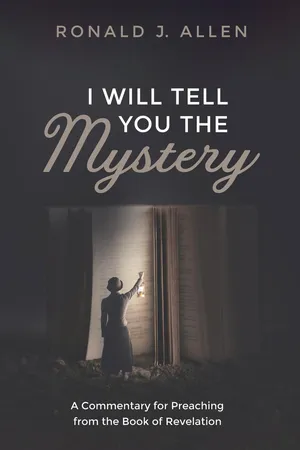
I Will Tell You the Mystery
A Commentary for Preaching from the Book of Revelation
- 268 pages
- English
- ePUB (mobile friendly)
- Available on iOS & Android
eBook - ePub
About this book
The book is a commentary on preaching from the book of Revelation. Working through the book of Revelation verse by verse, the commentary seeks to help the preacher recognize what the book (with its apocalyptic theology) invited people in antiquity to believe and do. . . . The book of Revelation communicates through a series of word-pictures. Allen explains each word-picture in light of its ancient setting. The commentary brings the viewpoint of the book of Revelation into conversation (through mutual critical correlation) with contemporary theology, especially process thought. The work aims to help the preacher to help the congregation identify what they can genuinely believe and confidently do. Believing that the best preaching arises from the local context, the volume does not include full sermons, but, rather, seeks to raise issues and questions that might be thought-provoking.
Information
Topic
Theology & ReligionSubtopic
Biblical CommentaryRevelation 1
Revealing the Ruler of Rulers
The beginning of the book of Revelation orients listeners to the nature of the communication that is to follow: it is an apocalypse. When the congregations hear that John is speaking about an apocalypse, they know what to expect. This opening section also establishes the authority of the book as coming from God, and this prologue-like material reveals key theological ideas that are developed further in the book.
Revelation 1:1–8: Prologue: John Reveals the Nature and Purpose of the Book
1:1. John signals listeners immediately that they are to hear a revelation. In John’s setting, the word apocalypse (apokalypsis) had the specific meaning of a vision that revealed theological perspective on the present and the future that people would not otherwise know. John’s apocalypse (revelation) casts a vision in dramatic images intended to help the listening community recognize the idolatry, injustice, exploitation, scarcity, and violence of the present broken age, and to point the congregation to the hope that God will transform the broken world into a new creation in which all circumstances mediate love, justice, peace, mutuality, and abundance. An apocalypse encouraged the congregations to be faithful through the struggles and destruction of the old age so they could become a part of the renewed world that biblical writers and contemporary preachers sometimes call the realm of God, sometimes called the new heaven and the new earth, or the new Jerusalem.1
John indicates that the book of Revelation is a letter (see Rev 1:4–5a). In antiquity, letters to communities were typically read aloud to the assembled group. The experience of the community was more of hearing with the ear than of seeing with the eye. As noted in the introduction, John assumes that someone reads the letter aloud with vocal emphasis to the assembled congregation. This practice suggests that the person who reads aloud from the book of Revelation in today’s service of worship should read with expression and not with the flat speech often typical of lectors. Even better, readers could memorize the passage and present it with movement.
1:2. God gave the revelation to Jesus Christ, who gave it to an angel, who gave it to John. This statement establishes the authority of the apocalypse: it came from God. For the apocalyptic theologians, angels were intermediary figures between heaven and the world. Angels carried messages, and exercised power in God’s behalf. Angels appear prominently in both roles in this book.2
The book of Revelation soon fills out the identity of Jesus Christ: He is the Ruler of rulers, a figure of awesome cosmic power, God’s apocalyptic agent who conquered the powers of the old age and brought about the transition to the new (1:12–16). However, Jesus did not always appear to be the Ruler of rulers. John’s readers know that the Romans crucified Jesus, an ignominious death from a Jewish point of view. How shall they understand the relationship between Jesus crucified and Jesus risen? What does it say about the power of God that Jesus was crucified? Later, John explains this relationship by turning to the image of the ruling Lion of Judah who was simultaneously the murdered Lamb (5:1–8).
According to John, events described in the vision “must soon take place.”3 Indeed, as the book unfolds, we discover that some things—particularly the judgment of the Roman Empire—are already underway. John did not attach a specific timeline to the end of the earth and the emergence of the new one. However, “soon” (taxos) means shortly, quickly, without much delay. While the time is not fully defined, John expected the final historical cataclysm to occur in the near future.
Believers have often been vexed by the fact that the new Jerusalem is yet to come. A preacher could help a congregation wrestle with this issue by reviewing alternatives, and helping the congregation identify a viewpoint that makes sense. A few Bible students, preterists, think that the events described in the Revelation actually took place in John’s time and that the realm of God today is his rule in the heart. Premillenialists construct timelines (often very specific) with events and dates that indicate how close we are to the end-time events. Many Christians, perhaps a plurality, have a general conviction that God will end this age and begin a new one, but they do not attach this transition to a specific time line. Some who partake of this general point of view take God’s sense of time to be quite different from ours—e.g., “One day is like a thousand years, and a thousand years are like one day.” Still others (including me) doubt that God will end this present age and replace it with another one. Indeed, some (including me) do not think God has the raw power to intervene in history in the dramatic way assumed by the book of Revelation, but see God attempting to lure the world towards greater love, peace, justice, mutuality, and abundance.4 From this last perspective, possibilities for a renewed world are always at hand—they are always “soon”—in that God is ever present in offering them. We do not have to sit and wait for an indeterminate future. Our job is to respond appropriately to God’s initiatives in the present.
Revelation 1:3: A Beatitude
1:3. In apocalyptic writings, to be blessed usually means to be included in the community that is moving from the present broken world to the new heaven and earth. Revelation 1:3 is an end-time beatitude declaring that the person who reads the book aloud in worship is blessed in this way, as are those who hear the book and then take the path of faithfulness that John commends. An implication is that those who do not follow the guidance of the Revelation are cursed. The ultimate curse is the lake of fire, where the cursed are tormented “day and night forever and ever” (20:10; cf. 14:11; 20:11–14).
According to recent scholarship, many members of the congregations to whom John wrote were becoming too acculturated to the Roman Empire. This beatitude says to them, “If you want to be blessed—if you want to be on the road to the realm of God—then you need to follow the prescriptions of this vision. Otherwise, you will be cursed, along with the rest of the empire.”
Revelation 1:4–5a: A Letter to Circulate among the Congregations
1:4a. John now adapts the customary opening of a letter in the Hellenistic age. By casting the book as a letter, John indicates that the Revelation is to be read aloud in the congregations, probably during services of worship. This oral presentation functioned much like a sermon in today’s congregation.
This insight suggests that the preacher might frame the sermon itself as a letter to today’s listeners. Instead of talking about the book of Revelation, and explaining it in didactic fashion, the sermon could speak as if it is a direct word to the congregation. Such a letter-sermon might summarize the leading themes of the book of Revelation as a whole and address them to the context of the congregation, or it might focus on one passage from the book. This approach is especially amenable to the letters to the seven churches in Revelation 2:1—3:22.
The format at the beginning of the letter indicates (a) the sender (John, 1:4a), (b) the recipients (the seven churches, 1:4a), and (c) a greeting, “Grace and peace” (1:4b–5). The introduction to this book expands on the identity of John: an early Christian prophet (a figure in the early church who receiving messages from God), imprisoned on the island of Patmos because the Roman government perceived him as a threat to peace (1:9). The seven congregations may be a circuit that John traversed, prophesying in congregation after congregation, much like circuit-riding preachers in an earlier day in M...
Table of contents
- Title Page
- Preface
- Abbreviations
- Introduction for Preachers
- Revelation 1 / Revealing the Ruler of Rulers
- Revelation 2-3 / Revealing Ambiguities in the Witness of the Church
- Revelation 4-5 / Revealing the Power of God
- Revelation 6-7 / Revealing How Judgment Is Already Beginning Now
- Revelation 8-11 / Revealing the Consequences of Not Repenting
- Revelation 12-14 / Revealing Why and How the World Is So Broken
- Revelation 15-16 / Revealing the Digits on the Clock: Ticking towards Midnight
- Revelation 17:1-19:10 / Revealing the Fall of the Empire
- Revelation 19:11-20:15 / Revealing the Final Judgment
- Revelation 21-22 / Revealing the New Heaven and the New Earth
- Bibliography
Trusted by 375,005 students
Access to over 1.5 million titles for a fair monthly price.
Study more efficiently using our study tools.
Frequently asked questions
Yes, you can cancel anytime from the Subscription tab in your account settings on the Perlego website. Your subscription will stay active until the end of your current billing period. Learn how to cancel your subscription
No, books cannot be downloaded as external files, such as PDFs, for use outside of Perlego. However, you can download books within the Perlego app for offline reading on mobile or tablet. Learn how to download books offline
Perlego offers two plans: Essential and Complete
- Essential is ideal for learners and professionals who enjoy exploring a wide range of subjects. Access the Essential Library with 800,000+ trusted titles and best-sellers across business, personal growth, and the humanities. Includes unlimited reading time and Standard Read Aloud voice.
- Complete: Perfect for advanced learners and researchers needing full, unrestricted access. Unlock 1.5M+ books across hundreds of subjects, including academic and specialized titles. The Complete Plan also includes advanced features like Premium Read Aloud and Research Assistant.
We are an online textbook subscription service, where you can get access to an entire online library for less than the price of a single book per month. With over 1.5 million books across 990+ topics, we’ve got you covered! Learn about our mission
Look out for the read-aloud symbol on your next book to see if you can listen to it. The read-aloud tool reads text aloud for you, highlighting the text as it is being read. You can pause it, speed it up and slow it down. Learn more about Read Aloud
Yes! You can use the Perlego app on both iOS and Android devices to read anytime, anywhere — even offline. Perfect for commutes or when you’re on the go.
Please note we cannot support devices running on iOS 13 and Android 7 or earlier. Learn more about using the app
Please note we cannot support devices running on iOS 13 and Android 7 or earlier. Learn more about using the app
Yes, you can access I Will Tell You the Mystery by Ronald J. Allen in PDF and/or ePUB format, as well as other popular books in Theology & Religion & Biblical Commentary. We have over 1.5 million books available in our catalogue for you to explore.