- 308 pages
- English
- ePUB (mobile friendly)
- Available on iOS & Android
eBook - ePub
About this book
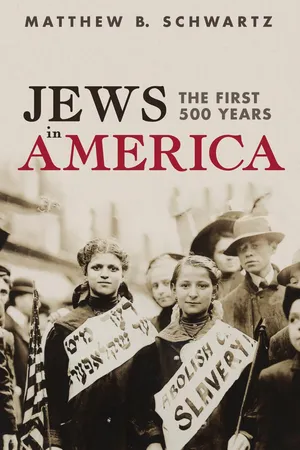
Using a readable question-and-answer format, Jews in America: The First 500 Years presents the activities of Jews in America since the beginnings of European settlement. It tells something of the story of how Jews came to the "golden land" and what they have done here--men and women, scientists and athletes, soldiers and merchants, settlers and scholars. It is indeed a remarkable story.
Information
Topic
HistoireSubtopic
Histoire du peuple juif1945–1980
Cross-Currents
A new era began with the end of World War II. Jewish life in the U.S. in those years can perhaps be best understood in terms of a pattern of cross currents, as people moved from one form of Judaism to another, or into or out of Judaism altogether. Jews were in the forefront of all the great social movements—civil rights, feminism, and the protest against the Vietnam War.
Large numbers of GI’s returning from the Second World War prompted a growth of new housing, and Jews moved en masse to the suburbs. Many major cities were empty of Jews by the 1970’s. Jews who remained in mixed urban neighborhoods, especially in New York, were occasionally victims of the eruptions of urban tensions involving both individual violence and mob incidents in which synagogues and Jewish buildings were attacked.
Jewish families were caught up with everyone else in the great change in family structure. Family units typically were small, except among the yeshiva oriented. By the 1970’s growing numbers of young Jews were not marrying at all, or were marrying out of the faith, and divorce rates grew.
American Jews paid close attention to developments in Israel, visiting and contributing huge sums of money. They watched anxiously as Israel defended itself in a series of wars against intransigent Arab neighbors. For some Jews, Zionism became almost a substitute for religion.
On the religious front, Conservative Judaism reached a peak in the 1950’s and 60’s, building large synagogues in the growing suburbs. Congregations became increasingly liberal, adopting innovations like bat mitzvah celebration, the triennial Torah reading cycle, and women rabbis. A generation of new young rabbis had fewer links with Orthodox Eastern European antecedents. The old guard at the Jewish Theological Seminary, men like Louis Ginzberg, Louis Finkelstein, Abraham Joshua Heschel and Saul Lieberman were aging and passing from the scene.
Reform congregations grew both in size and in scope of activity. Reform embraced Zionism by 1948 and began to reintroduce bar mitzvah and to introduce bat mitzvah celebrations to the temples. The rabbi and cantor were more likely to wear a talit, prayer services used more Hebrew, and more congregants prayed with their heads covered. Old German families were still prominent, but the Eastern European families also joined the leadership. The new Reform prayer book, adopted in 1976, reflected both the diversity within Reform and the growing interest in tradition.
Orthodox refugees, who had survived Nazi Europe, brought a new dose of yeshiva educated Jews to the U.S. after World War II, and helped spark the resurgence of day schools and advanced yeshivot. By the 1960’s, a new self-confident Orthodoxy began to show itself. Large Hasidic enclaves developed, notably the Lubavitch community in Crown Heights and Satmar in Williamsburg, New York. In the 1950’s many traditional synagogues were turning Conservative, but this trend slowed greatly as Orthodoxy reasserted itself.
Jews continued to make important contributions, far out of proportion to their numbers, in many fields. They served in government and, at one point in the 1980’s, seven Jews sat in the U.S. Senate.
Q. How did the U.S. government deal with immigration after World War II ?
A. After World War II, Europe was filled with people whose lives were totally uprooted. Congress passed a Displaced Persons Act in 1948, as a temporary measure, to allow almost 500,000 refugees to enter the U.S. over the next several years. Sixteen percent of the refugees were Jews. In 1952, the McCarran-Walter Act passed through Congress over President Truman’s...
Table of contents
- Title Page
- Acknowledgements
- Preface
- Abbreviations
- Introduction
- 1492-1802: Colonial Days
- 1802-1850: German Jewish Immigration
- 1850-1881: Civil War and Expansion
- 1881-1924: Eastern European Immigration
- 1924-1945: Americanizing
- 1945-1980: Cross-Currents
Trusted by 375,005 students
Access to over 1.5 million titles for a fair monthly price.
Study more efficiently using our study tools.
Frequently asked questions
Yes, you can cancel anytime from the Subscription tab in your account settings on the Perlego website. Your subscription will stay active until the end of your current billing period. Learn how to cancel your subscription
No, books cannot be downloaded as external files, such as PDFs, for use outside of Perlego. However, you can download books within the Perlego app for offline reading on mobile or tablet. Learn how to download books offline
Perlego offers two plans: Essential and Complete
- Essential is ideal for learners and professionals who enjoy exploring a wide range of subjects. Access the Essential Library with 800,000+ trusted titles and best-sellers across business, personal growth, and the humanities. Includes unlimited reading time and Standard Read Aloud voice.
- Complete: Perfect for advanced learners and researchers needing full, unrestricted access. Unlock 1.5M+ books across hundreds of subjects, including academic and specialized titles. The Complete Plan also includes advanced features like Premium Read Aloud and Research Assistant.
We are an online textbook subscription service, where you can get access to an entire online library for less than the price of a single book per month. With over 1.5 million books across 990+ topics, we’ve got you covered! Learn about our mission
Look out for the read-aloud symbol on your next book to see if you can listen to it. The read-aloud tool reads text aloud for you, highlighting the text as it is being read. You can pause it, speed it up and slow it down. Learn more about Read Aloud
Yes! You can use the Perlego app on both iOS and Android devices to read anytime, anywhere — even offline. Perfect for commutes or when you’re on the go.
Please note we cannot support devices running on iOS 13 and Android 7 or earlier. Learn more about using the app
Please note we cannot support devices running on iOS 13 and Android 7 or earlier. Learn more about using the app
Yes, you can access Jews in America by Matthew B. Schwartz in PDF and/or ePUB format, as well as other popular books in Histoire & Histoire du peuple juif. We have over 1.5 million books available in our catalogue for you to explore.