eBook - ePub
Youth Ministry and Theological Shorthand
Living Amongst the Fragments of a Coherent Theology
- 258 pages
- English
- ePUB (mobile friendly)
- Available on iOS & Android
eBook - ePub
Youth Ministry and Theological Shorthand
Living Amongst the Fragments of a Coherent Theology
About this book
In Youth Ministry and Theology Shorthand, David Bailey explores the dialogue between practice and theological education through the lens of youth ministry. This qualitative study illuminates how youth ministers talk about their work amongst young people. Through the slowing down of the youth ministry process it is discovered that youth ministers speak in theological shorthand. Theological shorthand is a paradox: it is both meaningful--it fuels long-term sacrificial service amongst young people--and it is problematic, as it risks untethering youth ministry from the wider narrative of the Christian story.
The book will appeal to youth ministers, clergy, academics, graduate and post-graduate students, but also informed volunteers involved in youth ministry. Through the discipline of practical theology, it correlates the voices of the youth ministers, a set of materials used to deepen faith, and contemporary expressions of sung worship. These are then brought into conversation and explored via different aspects of Trinitarian theology to deepen the theological grammar within contemporary youth ministry and to help develop theological literacy.
Information
Topic
Theology & ReligionSubtopic
Christian MinistryPart One
Scene Setting:
Youth Ministry, Practical Theology, and the Evangelical Tradition
Chapter 1
Living Amongst the Fragments of a Coherent Theology
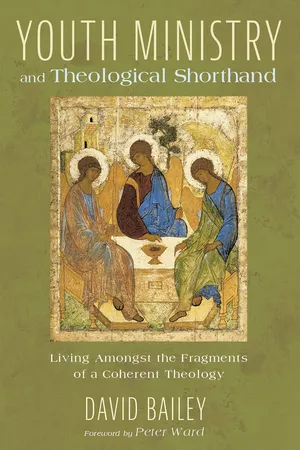
Rublev’s icon depicts the mysterious story where Abraham receives three visitors as he camps by the oak of Mamre and a meal is served. Through the meal, the friendship and conversation continues, Abraham seems to be talking straight to God. It is a picture of Middle Eastern hospitality, both generous and spontaneous. On further inspection, at the outset of the story, the visitors are described as “three men” and as the conversation about Sarah begins it is no longer three men who speak, but “the LORD.” The three have become singular, perhaps foreshadowing the Trinity.36 In Rublev’s imagination of the scene, set around a white table are seated three gold–winged figures. On this table lies a chalice–like bowl, shimmering gold and containing a roasted lamb. A house can be seen at the top left and a tree in the center, creating the backdrop. Less obvious is a rocky hill in the upper right corner. The composition is a great circle, echoing the conversation, the table becomes central with the focus on the chalice–bowl. Persson37 continues that Rublev was the first iconographer to use a circle in his design, the symbol of perfection, unity and eternity having no beginning and no ending. The movement goes around and around, drawing us in, there is no place for our eyes to stop, we have the opportunity to take part in this picture, to reflect and discuss its meaning.
The picture operates at a number of different levels, the three angels seated under Abraham’s tree, yet it can be interpreted38 as a visual expression of what the Trinity means, what is the nature of God, who is God and how do we approach God? What does it mean to be part of this story and conversation? Reading the picture from left to right, we see the Father, the Son, and the Holy Spirit, but there is space for us to be seated—to come in, to participate, to join in with the discussion, to access the meal, to be in communion. Persson sees that Rublev must have spent a long time in prayer and thought before painting the icon, because as he painted the icon he took some very bold steps. He made the conscious decision to eliminate the figures of Sarah and Abraham, leaving only the three figures to convey the idea of Trinity. Strictly speaking, icons are written, not painted, because iconography is not simply an art form. Rather, to construct and write an icon is to make the word of God present and Persson39 sees that it is important that worshipers should learn to “read” them.
Early in 2017, I went to an evening at St Martins in the Fields in central London. The theme of the evening was: How does Academic theology serve the church? Leaving aside the fact that the title separates theology from the performed and lived, it was a fascinating and interesting evening of discussion by prominent theologians and practitioners. In some sense, the evening carried aspects of Rublev’s icon, it was participative, discursive, and good natured and carried out in a tone reflective of the communion of Christians present. Nevertheless, the discussion was carried out in theological shorthand. Words and terms were used and tossed around freely. The term incarnation was one of these, and there was an assumption that we understood the language in the same way. Now, in many ways, a discussion of this sort cannot be had in any other manner, but quite quickly phrases or terms operate like fragments, like torn up pieces of paper blown about by the wind of conversation. These phrases are fragments of theology, fragments of the Christian tradition and story. These fragments or theological shorthand exist in our conversations, in our language about God.
Language and Epistemology
Vanhoozer40 is critical about how language may limit reality. This is particularly shown in his critique of Derrida who sees that we have no non–linguistic access to the way things really are. For Derrida, we speak and think about things on the basis of certain language and the words and language used is largely a matter of arbitrary social convention. This is a system of difference, a pattern of distinctions and connections. Our words acquire meaning not by referring to actual things, but by differing from other words, what we know about things is culturally, which is to say linguistically constructed. Therefore, whatever we think is always/already shaped by the language system we employ. The tension here, is that within the notion of postmodernity the prism of language deconstructs everything and we are left with fragments, nothing is a given and everything is reduced to signs in an arbitrary system of signifiers. God can be seen only to exist within the realms of language and culturally bound expression—there is nothing outside the text. It is this that is problematic, and if this is the case, language becomes a labyrinth from which there is no exit to the real world, no exit to objective created realities. For if there is nothing in what we say—e.g. reality is just socially constructed through language, then ultimately what we say doesn’t matter and we move towards the uncommitted life an...
Table of contents
- Title Page
- Foreword
- Acknowledgments
- Introduction
- Part One: Scene Setting: Youth Ministry, Practical Theology, and the Evangelical Tradition
- Part Two: Echoes of a Coherent Theology: Theological Shorthand and Current Practice
- Part Three: Towards a Coherent Theology
- Bibliography
Trusted by 375,005 students
Access to over 1.5 million titles for a fair monthly price.
Study more efficiently using our study tools.
Frequently asked questions
Yes, you can cancel anytime from the Subscription tab in your account settings on the Perlego website. Your subscription will stay active until the end of your current billing period. Learn how to cancel your subscription
No, books cannot be downloaded as external files, such as PDFs, for use outside of Perlego. However, you can download books within the Perlego app for offline reading on mobile or tablet. Learn how to download books offline
Perlego offers two plans: Essential and Complete
- Essential is ideal for learners and professionals who enjoy exploring a wide range of subjects. Access the Essential Library with 800,000+ trusted titles and best-sellers across business, personal growth, and the humanities. Includes unlimited reading time and Standard Read Aloud voice.
- Complete: Perfect for advanced learners and researchers needing full, unrestricted access. Unlock 1.5M+ books across hundreds of subjects, including academic and specialized titles. The Complete Plan also includes advanced features like Premium Read Aloud and Research Assistant.
We are an online textbook subscription service, where you can get access to an entire online library for less than the price of a single book per month. With over 1.5 million books across 990+ topics, we’ve got you covered! Learn about our mission
Look out for the read-aloud symbol on your next book to see if you can listen to it. The read-aloud tool reads text aloud for you, highlighting the text as it is being read. You can pause it, speed it up and slow it down. Learn more about Read Aloud
Yes! You can use the Perlego app on both iOS and Android devices to read anytime, anywhere — even offline. Perfect for commutes or when you’re on the go.
Please note we cannot support devices running on iOS 13 and Android 7 or earlier. Learn more about using the app
Please note we cannot support devices running on iOS 13 and Android 7 or earlier. Learn more about using the app
Yes, you can access Youth Ministry and Theological Shorthand by David Bailey in PDF and/or ePUB format, as well as other popular books in Theology & Religion & Christian Ministry. We have over 1.5 million books available in our catalogue for you to explore.